
扩内需政策

Search documents
内需政策密集落地 丽尚国潮再获控股股东增持 彰显长期发展信心
Zheng Quan Shi Bao Wang· 2025-12-18 02:20
Core Viewpoint - The recent shareholding increase by the controlling shareholder of Lishang Guochao aligns with the Chinese government's focus on stimulating domestic demand and consumption, reflecting confidence in the company's strategic transformation [1][2][3] Group 1: Shareholding Increase - The controlling shareholder, Zhejiang Yuanming Holdings, plans to increase its stake by acquiring between 7,613,353 to 15,226,704 shares over the next 12 months, representing 1% to 2% of the total share capital, without a fixed price range [1] - This increase follows a previous buyback completed just three weeks prior, where the shareholder invested 75.92 million yuan to acquire 15,130,202 shares, raising their total voting rights to 33.46% [1] Group 2: Business Performance and Financials - Lishang Guochao's core business, particularly the commercial retail sector centered around the Asia-Europe Shopping Mall, has shown a stable performance with a gross margin of 49.60% [2] - The company reported a revenue of 477 million yuan and a net profit of 116 million yuan for the first three quarters of 2025, marking a year-on-year growth of 7.85%, with a non-recurring net profit growth rate of 9.05% [2] Group 3: Strategic Alignment and Market Confidence - The shareholder's continuous buyback is seen as a positive response to national policies aimed at expanding domestic demand, reinforcing confidence in the company's strategic direction [3] - The absence of a fixed price range in the buyback plan indicates a long-term investment strategy rather than short-term market speculation, allowing for flexible operations in response to stock price fluctuations [3] - The company has established a business structure characterized by "professional markets as the ballast, commercial retail as the growth engine, and commercial management as the new driving force," supported by a special loan of up to 100 million yuan from ICBC Zhejiang Branch [3]

中银国际:供应端扩产高峰已过 “反内卷”助力化工业景气度回升
智通财经网· 2025-12-16 09:11
Core Viewpoint - The chemical industry is currently at the bottom of the cycle, with the "anti-involution" trend expected to accelerate the optimization of the competitive landscape, leading to an increase in both profitability and valuation for leading companies [1] Group 1: Industry Performance - Chemical product prices are at historical lows, with the chemical industrial PPI showing negative year-on-year growth for 37 consecutive months as of October 2025 [1] - Among 119 tracked chemical products, 26.89% are in the bottom 10% price percentile, and 60.50% are in the bottom 30% [1] - The basic chemical industry is expected to see a stabilization in net profit after three consecutive years of decline from 2022 to 2024 [1] Group 2: Supply Side Dynamics - Fixed asset investment in the chemical raw materials and products manufacturing industry has turned negative year-on-year for the first time in nearly five years as of June 2025 [2] - As of Q3 2025, the value of fixed assets in the basic chemical industry reached 1,462.858 billion yuan, a year-on-year increase of 15.56% [2] - The ongoing construction projects have seen a decline, with a year-on-year decrease of 15.11% as of Q3 2025 [2] Group 3: Demand Side Insights - The demand for chemical products is expected to grow due to stimulus policies and the continuous increase in exports [3] - The real estate sector is under pressure, while demand from the automotive and chemical fiber sectors remains strong [3] - As of September 2025, the export quantity index for chemical raw materials and products manufacturing was 122.40, indicating robust export performance [3] Group 4: Global Competitive Landscape - In 2023, China's chemical sales reached 22,381 billion euros, accounting for 43.1% of the global market, marking a 111.55% increase since 2013 [4] - China's chemical exports are projected to reach 254.96 billion USD in 2024, positioning it as the second-largest exporter globally [4] - The competitiveness of Chinese chemical companies has been enhanced due to the exit of overseas production capacities [4] Group 5: Future Outlook - The "14th Five-Year Plan" emphasizes the need to enhance the quality and competitiveness of key industries, including chemicals [5] - The industry is moving towards a model of "anti-involution" through self-discipline and policy collaboration, which is expected to facilitate a transition from scale expansion to high-quality growth [5] - Initiatives such as joint production cuts and policy support are anticipated to help restore product prices and profits in various sub-industries [5]
11月份核心CPI同比上涨1.2%!创2024年3月以来新高
Zheng Quan Shi Bao Wang· 2025-12-15 05:16
Group 1 - In November, the Consumer Price Index (CPI) increased by 0.7% year-on-year, with the growth rate expanding by 0.5 percentage points compared to the previous month, marking the highest increase since March 2024 [2] - The core CPI, excluding food and energy prices, rose by 1.2% year-on-year, maintaining a growth rate above 1% for three consecutive months [3] - The Producer Price Index (PPI) decreased by 2.2% year-on-year, with the decline rate widening by 0.1 percentage points compared to the previous month, influenced by a high comparison base from the previous year [4] Group 2 - Food prices contributed to the CPI increase, with fresh vegetable prices rising by 14.5% year-on-year after a nine-month decline, significantly impacting the CPI [2] - The prices of coal mining and washing, photovoltaic equipment manufacturing, and lithium-ion battery manufacturing have shown a narrowing decline in year-on-year prices, indicating the effectiveness of measures against "involution" competition [4][5] - Emerging industries are driving price increases in related sectors, with prices for external storage devices and components rising by 13.9% year-on-year, and integrated circuit manufacturing prices increasing by 1.7% [4][5]
东吴证券芦哲:2026年市场重点是更深层次的制度建设
Zhong Guo Zheng Quan Bao· 2025-12-12 02:47
Core Viewpoint - The focus of the Central Economic Work Conference has shifted from "stabilizing the stock market" to "stabilizing employment, enterprises, markets, and expectations," indicating a change in policy priorities towards maintaining normal market operations and building confidence [1] Group 1: Economic Policy Changes - The emphasis for 2024 has moved from "insufficient demand" to "prominent contradictions between strong supply and weak demand," highlighting a greater focus on supply-demand balance [1] - The conference acknowledged that the issues faced are largely developmental and transitional, suggesting that they can be resolved with effort, and the long-term positive conditions for China's economy remain unchanged [1] Group 2: Domestic Demand Expansion - Consumption is prioritized in the expansion of domestic demand policies, but the description of the "two new" policies (equipment updates and trade-ins) has shifted from "increasing efforts and expanding scope" to "optimizing," indicating a transition from merely increasing funding to improving efficiency [2]

锐财经|物价水平保持企稳态势
Ren Min Ri Bao Hai Wai Ban· 2025-12-12 01:52
Group 1 - The Consumer Price Index (CPI) increased by 0.7% year-on-year in November, the highest since March 2024, driven primarily by a reversal in food prices from a decline to an increase [2][4] - Core CPI, excluding food and energy, rose by 1.2% year-on-year, maintaining above 1% for three consecutive months [2][4] - The Producer Price Index (PPI) saw a month-on-month increase of 0.1% but a year-on-year decline of 2.2%, indicating a mixed price environment influenced by seasonal demand and macroeconomic policies [4][5] Group 2 - Food prices shifted from a 2.9% decline to a 0.2% increase, with fresh vegetable prices rising by 14.5% after nine months of decline, significantly impacting the CPI [2][3] - Service prices and industrial consumer goods prices increased by 0.7% and 2.1% respectively, contributing positively to the CPI [2][4] - The demand for coal and gas increased seasonally, leading to price rises in related industries, with coal mining prices up by 4.1% [4][5] Group 3 - Emerging industries such as new materials and intelligent technology are driving price increases in related sectors, with prices for external storage devices rising by 13.9% year-on-year [5][6] - Consumer demand is being revitalized through targeted actions, with prices in sectors like arts and crafts rising by 20.6% [5][6] - The government plans to enhance domestic demand and consumption through various initiatives, especially as the year-end approaches, which is traditionally a peak consumption period [7]
物价水平保持企稳态势(锐财经)
Ren Min Ri Bao Hai Wai Ban· 2025-12-11 22:56
Group 1 - The Consumer Price Index (CPI) increased by 0.7% year-on-year in November, the highest since March 2024, driven primarily by a reversal in food prices from a decline to an increase [2] - Core CPI, excluding food and energy, rose by 1.2% year-on-year, maintaining above 1% for three consecutive months [2] - The increase in CPI was influenced by seasonal price rises in services and industrial consumer goods, with household appliances and clothing prices rising by 4.9% and 2.0% respectively [2][4] Group 2 - The Producer Price Index (PPI) saw a month-on-month increase of 0.1% but a year-on-year decrease of 2.2%, with the decline attributed to high comparison bases from the previous year [4][6] - Seasonal demand increases in certain domestic industries, such as coal and gas, contributed to the month-on-month price rise in PPI [4] - New industries, including new materials and intelligent technology, are driving price increases in related sectors, with prices for external storage devices rising by 13.9% year-on-year [6] Group 3 - To stabilize price levels and promote reasonable price recovery, there is a need to continue expanding domestic demand and optimizing market competition [7] - The upcoming year-end and early-year period is seen as a crucial time for consumer spending, with plans for various promotional activities to enhance consumption [7] - Looking ahead to 2026, policies aimed at expanding domestic demand are expected to support a moderate recovery in prices, particularly in service sectors such as dining, accommodation, and health services [7]

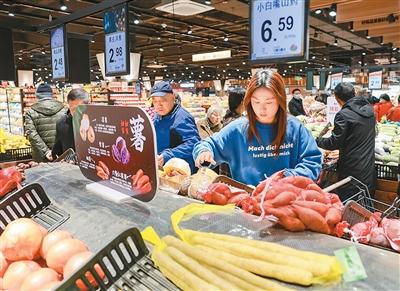
扩内需政策措施继续显效
Jing Ji Wang· 2025-12-11 06:56
Group 1: Consumer Price Index (CPI) Insights - In November, the CPI increased by 0.7% year-on-year, marking the highest growth since March 2024, with a month-on-month decrease of 0.1% [2][3] - The rise in CPI was primarily driven by a shift in food prices from decline to increase, with fresh vegetable prices rising by 14.5% after nine consecutive months of decline [2][3] - Core CPI, excluding food and energy, rose by 1.2% year-on-year, maintaining above 1% for three consecutive months, indicating stable inflationary pressures [2][3] Group 2: Producer Price Index (PPI) Insights - The PPI increased by 0.1% month-on-month in November, marking the second consecutive month of growth, influenced by seasonal demand increases in certain industries [4] - Year-on-year, the PPI decreased by 2.2%, with the decline slightly widening compared to the previous month, primarily due to high comparison bases from the previous year [4] - The increase in PPI was supported by rising prices in coal and gas sectors, while international oil price fluctuations led to a decrease in domestic oil and gas extraction prices [4] Group 3: Market Trends and Future Outlook - The ongoing "anti-involution" measures are showing results, with price declines in key industries narrowing, indicating improved market competition [5] - Emerging industries are rapidly developing, contributing to price increases in related sectors, such as a 13.9% rise in external storage devices and components [6] - Future inflation is expected to remain low, with a gradual recovery in prices anticipated due to stable domestic demand and effective competition governance [7][8]
光控资本:中长期支撑本轮A股上涨的基础并未发生转变
Sou Hu Cai Jing· 2025-12-11 05:18
Group 1: Federal Reserve Actions - The Federal Reserve is expected to lower interest rates by 25 basis points in December, with an increasing number of officials advocating for a pause in further rate cuts, indicating a higher threshold for additional reductions [1] - Powell's statements were not particularly hawkish, and the Fed announced plans to purchase short-term Treasury bills to alleviate market concerns [1] - Given ongoing economic and employment pressures, the Fed may continue to lower rates into 2026, but the pace of cuts is expected to slow due to persistent inflation [1] Group 2: Consumer Price Index (CPI) Insights - CPI has been rising since September, primarily due to increased vegetable prices, rising consumer goods and service prices under domestic demand expansion policies, and higher gold prices affecting jewelry costs [3] - Future CPI increases will depend on the easing of supply constraints as local vegetables come to market and the need for further expansion of national subsidies to support consumer goods and service prices [3] - The "14th Five-Year Plan" emphasizes expanding the supply of quality consumer goods and services as a key support for domestic demand strategy, leading to a cautiously optimistic outlook for future CPI increases [3] Group 3: A-Share Market Performance - The A-share market experienced fluctuations, with the Shanghai Composite Index finding support near 3876 points and showing a slight upward trend in the afternoon [4] - The average price-to-earnings ratios for the Shanghai Composite and ChiNext indices are 16.04 and 49.54, respectively, indicating a suitable environment for medium to long-term investments [4] - The market's upward potential is increasing due to supportive policies and improved liquidity, with expectations for the Shanghai Index to consolidate around the 4000-point mark [4]

美联储明年1月可能按兵不动,下一次降息或在明年3月份
Mei Ri Jing Ji Xin Wen· 2025-12-11 00:46
|2025年12月11日星期四| NO.1中金:美联储明年1月可能按兵不动,下一次降息或在明年3月份 12月11日,中金公司(601995)研报指出,美联储如预期在12月会议上降息25个基点,但反对降息的官 员增至两人,显示进一步降息的门槛正在抬高。与此同时,鲍威尔的表态并不强硬,加之美联储宣布将 启动短期国库券(T-bills)购买操作,帮助缓和了市场的担忧。此前被充分计入的"鹰派降息"预期出现反 转,加剧了市场波动。展望未来,鉴于经济与就业仍面临下行压力,我们预计美联储或将在2026年继续 降息;但考虑到通胀粘性犹存,降息节奏趋于放缓。明年1月份可能按兵不动,下一次降息或在明年3月 份。 NO.2中金:2026年储能行业需求景气度仍然较高 中金认为2026年储能行业需求景气度仍然较高,主要原因为:1)储能需求增长逻辑不变,一方面是全球 能源转型趋势持续,风光装机占比提升需要依赖电网、储能建设,另一方面是AI数据中心缺电逻辑仍 在,预期明年或将涌现更多AI配储项目;2)国内、美国、欧洲三大主要市场大储招标、计划项目量较 大;中东、印度、澳洲、智利市场大储需求涌现;3)户储和工商储需求仍然强劲,新兴市场缺电逻 ...

银河证券:通胀还能持续回升吗?
Sou Hu Cai Jing· 2025-12-11 00:37
展望后市,CPI回升需关注以下两个方面:一是随着南方本地菜逐步上市、北方设施蔬菜供应增加,市 场供需紧张局面有望局部缓解,因此后续的蔬菜价格涨幅可能不及11月,考虑到猪肉对CPI的拖累仍在 延续,鲜果价格增长较为平稳,食品CPI的拖累可能略有放大。二是扩内需政策下部分消费品需求前置 导致价格呈现走弱的态势,或需进一步扩大国补使用范围,并强化服务消费相关政策,才能更持续地带 动消费品和服务价格回升。考虑到"十五五"规划将"扩大优质消费品和服务供给"列为扩大内需战略的关 键支撑,因此我们对后续CPI的回升持谨慎乐观的预期。 11月份CPI环比微跌0.1%(前值0.2%),同比上涨0.7%(前值0.2%),其中翘尾因素较上月改善约0.6 个百分点。整体来看翘尾因素叠加食品拖累减弱是CPI回升主因。食品价格环比上涨0.3%(前值 0.7%),过去五年环比均值为-0.4%;同比下降2.9%(前值-4.4%),影响CPI同比下降约0.54个百分点。非 食品价格环比上涨0.2%(前值-0.1%),过去五年环比均值为0.1%。核心CPI环比微跌0.1%,同比上涨 1.2%。 鲜菜价格上涨仍是食品CPI的主要贡献,猪肉仍是拖累 ...