
AI资本开支

Search documents
美国 12 月 FOMC 会议点评:中性降息落地,技术性扩表重启
Guoxin Securities· 2025-12-15 06:29
Interest Rate Changes - The Federal Reserve announced a 25 basis point rate cut, lowering the federal funds rate target range from 4.00%-4.25% to 3.75%-3.50%[2] - The decision reflects a shift to a neutral monetary policy stance, with the committee indicating that the banking system's reserve levels are now adequate[4] Economic Outlook - The Fed raised its GDP growth forecast for 2025 to 1.7% and for 2026 to 2.3%, suggesting a baseline scenario of a soft landing for the U.S. economy[14] - Unemployment is projected to gradually decrease from the current rate of 4.5% to 4.2% by 2028, indicating a stable labor market despite recent cooling[17] Inflation and Employment - Inflation has risen since early this year but remains somewhat elevated, with the core PCE inflation forecast adjusted down to 2.5% for 2026[17] - Employment growth has slowed, with the unemployment rate slightly increasing, reflecting concerns about job market stability[4] Internal Disagreements - There is significant internal division within the FOMC, with three dissenting votes during the recent meeting, the highest level of disagreement since 2019[5] - The distribution of rate expectations in the dot plot has become more dispersed, indicating increasing uncertainty among committee members regarding future policy directions[5] Balance Sheet Management - The Fed will restart short-term Treasury purchases at an initial pace of approximately $40 billion per month to maintain adequate liquidity in the banking system[6] - This action is characterized as a technical operation, distinct from broader monetary policy adjustments[6] Future Rate Cuts - The Fed is expected to implement two additional rate cuts in 2026, likely in March and July, influenced by upcoming changes in FOMC leadership and potential political motivations[9] - The anticipated new chair, Hassett, may align with political pressures for earlier rate cuts, although significant caution is expected in the approach[10]
热点思考 | 两个美国:“K型经济”的成因与出路(申万宏观·赵伟团队)
Sou Hu Cai Jing· 2025-12-14 17:41
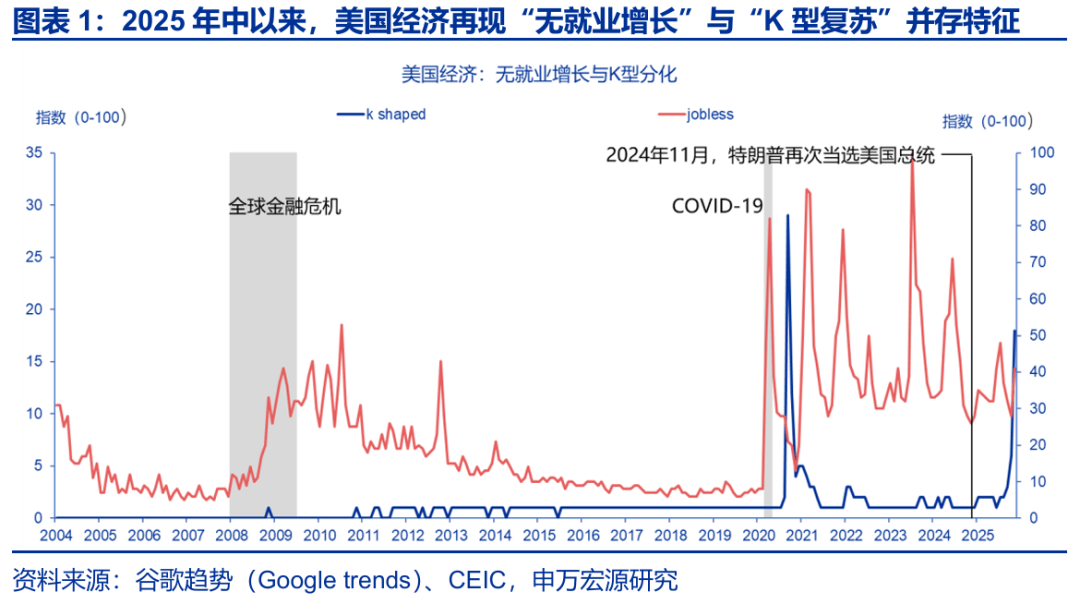
Group 1 - The core viewpoint of the article discusses the emergence of "jobless growth" and "K-shaped recovery" in the U.S. economy since mid-2025, questioning whether the economy can escape these characteristics in 2026 [1][4][77] - The U.S. economy has shown structural imbalances characterized by "jobless growth" and "K-shaped economy," with non-farm payrolls declining significantly since early 2025, averaging only 18,000 new jobs per month from June to August, far below historical non-recession averages [1][5][77] - The "K-shaped economy" reflects a divergence in consumption, employment, wages, and wealth, where high-income households experience significantly higher consumption growth compared to low-income households [20][30][67] Group 2 - The causes of the "K-shaped economy" are identified as a combination of economic slowdown, monetary easing, the impact of Trump's policies, and a structural bull market in U.S. stocks, with "jobless growth" being a primary factor [2][43][64] - The labor market has become increasingly relaxed, with low-wage groups feeling the economic downturn first and recovering last, indicating a structural issue in income and wealth distribution [2][53][67] - The article highlights that the "K-shaped gap" is difficult to bridge, raising the question of whether growth will be inclusive or if recession will eliminate wealth [3][77][94] Group 3 - The article posits that the U.S. economy is in a late cycle, with a shift from labor-driven growth to capital and technology-driven growth, leading to a decline in job opportunities and stagnant income growth [40][53][77] - The impact of tariffs and immigration policies has contributed to the decline in job creation, with a significant portion of the slowdown attributed to government layoffs and the effects of tariffs on employment [56][59][64] - The long-term trend of income and wealth inequality in the U.S. has been exacerbated since the 1980s, with the top 1% of income earners capturing a larger share of wealth, indicating a systemic issue in wealth distribution [67][94]

两个美国:“K型经济”的成因与出路
Shenwan Hongyuan Securities· 2025-12-14 09:29
Economic Overview - Since mid-2025, the U.S. economy has exhibited characteristics of "jobless growth" and a "K-shaped economy," with non-farm employment numbers declining to an average of 18,000 per month from June to August, significantly below the historical average of 109,000 during non-recession periods[1][15] - The GDP growth rate remains robust, supported by AI capital expenditures, despite the lack of job growth[1][21] K-shaped Economy Characteristics - The K-shaped economy is marked by a divergence in consumption, employment, wages, and wealth, where high-income households experience significantly higher consumption growth compared to low-income households[1][26] - For instance, the spending growth difference in air travel and furniture between high and low-income families reached 10.5 and 10.2 percentage points, respectively, as of November 1[1][27] Causes of K-shaped Economy - The "jobless growth" phenomenon is attributed to structural imbalances in the economy, including the late-cycle economic phase, monetary easing, and the impacts of Trump's policies on immigration and tariffs[2][45] - Since the 1980s, the growth of real labor income has lagged behind productivity growth, indicating a long-term trend of increasing income and wealth inequality[2][66] Labor Market Dynamics - The labor market has transitioned from a tight supply to a surplus, with the Labor Market Conditions Index (LMCI) dropping from a peak of 1.46 in January 2022 to 0.25 by August 2025, indicating a loosening labor market[2][51] - The unemployment rate for marginalized groups, such as low-education and minority populations, has risen significantly, while the unemployment rate for white individuals remains low[2][46] Future Economic Outlook - In 2026, the U.S. economy is expected to shift from "jobless growth" to "low employment growth," but the K-shaped characteristics may persist due to a weak labor market balance[3][81] - The equilibrium employment number has decreased to 30,000-80,000 jobs per month, suggesting that maintaining a low unemployment rate will not necessarily lead to a return to high employment growth[3][83]
机构称港股从“估值修复”转向“估值重估”,恒生ETF(159920)午盘攀升涨近2%
Mei Ri Jing Ji Xin Wen· 2025-12-12 06:20
Core Viewpoint - The Hong Kong stock market is experiencing a positive trend, with the Hang Seng Index and Hang Seng Tech Index both showing gains, indicating a shift in investment logic towards new productivity and high-quality development [1] Market Performance - On December 12, the Hang Seng Index rose by 1.36% and the Hang Seng Tech Index increased by 1.45% [1] - Technology stocks saw widespread gains, while the metals sector led the increases [1] - The Hang Seng ETF (159920) rose nearly 2%, with notable performers including China Life, ZTO Express, China Hongqiao, and CK Infrastructure [1] - Conversely, companies like Hansoh Pharmaceutical, WuXi Biologics, and Zhongsheng Group experienced declines [1] Future Outlook - Jianyin International suggests that the investment logic for Hong Kong stocks has shifted from traditional valuation recovery to a revaluation based on new productivity and high-quality development [1] - There is potential for moderate expansion or improvement in valuations and earnings by 2026 [1] - Key catalysts and event windows include the reassessment of China's economic growth momentum at the start of the 14th Five-Year Plan, the Central Economic Work Conference in mid-December, and developments in US-China relations surrounding Trump's visit and the midterm elections [1] - Progress in AI capital expenditure and profitability is also highlighted as a significant factor [1] Notable Investment Targets - Core broad-based Hong Kong stock: Hang Seng ETF (159920) [1] - AI and platform economy focus: Hang Seng Tech Index ETF (513180) [1] - Focus on the development of Chinese enterprises in Hong Kong: Hang Seng China Enterprises ETF (159850) [1]
道指、标普创新高,甲骨文暴跌拖累纳指,金银齐涨
Di Yi Cai Jing Zi Xun· 2025-12-11 23:39
Market Overview - The U.S. stock market showed mixed performance, with the Dow Jones Industrial Average and S&P 500 reaching new highs driven by cyclical stocks, while the tech sector faced pressure due to Oracle's significant drop [2] - The Dow closed up 646.26 points, or 1.34%, at 48,704.01, marking a record high [2] - The S&P 500 rose 0.21% to 6,901.00, also setting a new closing record, while the Nasdaq Composite fell 0.26% to 23,593.86, with tech stocks underperforming [2] Sector Performance - Small-cap stocks performed particularly well, with the Russell 2000 index rising 1.21% to 2,590.61, also reaching a historical high [2] - Oracle's stock plummeted 10.83% after reporting cloud revenue below expectations and announcing an additional $15 billion investment in data centers, raising concerns about "AI capital expenditure overheating" [2] Federal Reserve Actions - The Federal Reserve lowered the policy interest rate to a range of 3.5% to 3.75%, indicating a more moderate easing phase, with future rate cuts expected to be slower than in the current year [3] - Fed Chair Jerome Powell suggested that the current economic conditions remain resilient, and future inflation may stabilize due to the one-time upward pressure from tariffs implemented during the Trump administration [3] Economic Data - Initial jobless claims rose to 236,000, significantly above the expected 220,000, marking the largest weekly increase since 2020, indicating a cooling labor market [4] - The U.S. trade deficit narrowed to $52.8 billion in September, the lowest level in five years, supported by a 3% increase in exports [4] Market Predictions - Analysts predict that the S&P 500 may have a chance to reach 7,000 points in the short term, as investors digest potential uncertainties in the AI sector [4] - However, there are warnings of higher risks in the coming year, with expectations that the S&P 500 could decline to 6,500 points by the end of 2026 due to pressures from AI capital expenditures and potential policy uncertainties with a new Fed chair [4] Bond Market - The yield on the 10-year U.S. Treasury note fell by 2.3 basis points to 4.141%, while the two-year yield decreased by 3.9 basis points to 3.526% [4] Commodity Market - Following the interest rate cut, the U.S. dollar weakened, leading to a strong performance in precious metals, with gold prices rising by 2.1% to $4,313 per ounce, a one-month high [5] - Crude oil prices fell, with light crude futures for January 2026 dropping by $0.86 to $57.60 per barrel, a decline of 1.47% [5]

美股三大股指涨跌不一,摩根大通成本预警施压大盘,中概股多数下跌
Feng Huang Wang· 2025-12-09 22:29
Market Overview - The U.S. stock market closed mixed, with investors anticipating a potential 25 basis point rate cut by the Federal Reserve, despite warnings from JPMorgan about increased spending in 2026 affecting bank stocks [1] - The Dow Jones Industrial Average fell by 179.03 points (0.38%) to 47,560.29, while the Nasdaq rose by 30.58 points (0.13%) to 23,576.49, and the S&P 500 decreased by 6.00 points (0.09%) to 6,840.51 [3] Sector Performance - Sector ETFs showed varied performance, with the energy sector ETF rising by 0.62%, while the financial sector ETF fell by 0.37% and the biotechnology index ETF dropped by 1.68% [3] - In the S&P 500, the healthcare sector declined by 1%, while the technology sector saw a slight increase of 0.1% [3] Notable Stock Movements - Major tech stocks had mixed results, with Tesla up by 1.27% and Google A up by 1.07%, while Meta fell by 1.48% [4] - JPMorgan's stock dropped by 4.66%, marking its largest single-day decline since April, following the announcement of expected spending of $105 billion in 2026 [4] Upcoming Earnings Reports - Oracle and Broadcom are set to release their earnings reports later this week, with market focus shifting towards corporate AI capital expenditures [2] Company News - SpaceX is advancing its IPO plans, aiming to raise over $30 billion with a target valuation of approximately $1.5 trillion, with a potential listing in mid to late 2026 [6] - The AI Agent Foundation has been established by leading companies including Google, Microsoft, and Amazon to develop open-source technology standards for AI agents [7] - Meta's new model, codenamed "Avocado," has been delayed until Q1 2026, shifting from an open-source to a proprietary model due to competitive pressures [8] - Anglo American's shareholders approved a $50 billion merger with Teck Resources, creating a new global metals giant focused on copper mining in Chile and Peru [9]
中证A500ETF(159338)连续3日净流入超7.5亿元,市场关注四大配置方向
Mei Ri Jing Ji Xin Wen· 2025-12-05 03:19
Core Insights - Huachuang Securities highlights four major investment directions for the CSI A500 index: technology innovation, cyclical industries, overseas expansion, and the real estate chain [1] Group 1: Investment Directions - Technology innovation focuses on robust growth at the endpoint and the commercialization of ToB, with an emphasis on the need to digest valuations in the tech sector [1] - Cyclical industries are expected to benefit from price elasticity due to supply clearing, particularly in sectors like non-ferrous metals, chemicals, steel, coal, construction materials, and machinery [1] - Overseas expansion aims to enhance global competitiveness, with a focus on electric new energy, machinery, communication equipment, and energy metals [1] - The real estate chain is anticipated to recover from mid-term bottoming out, with high potential in construction, building materials, home furnishings, appliances, and property management [1] Group 2: Market Opportunities - The technology manufacturing sector is seeing a steady increase in return on equity (ROE) amid the transition of old and new growth drivers [1] - Investors are encouraged to consider the CSI A500 ETF (159338), which is leading in the number of accounts among similar products, being more than three times that of the second-ranked fund [1]
渤海证券研究所晨会纪要(2025.12.05)-20251205
BOHAI SECURITIES· 2025-12-05 00:25
Market Review - In the past five trading days (November 28 to December 4), major indices mostly rose, with the Shanghai Composite Index slightly up by 0.01% and the ChiNext Index up by 1.19% [2] - The trading volume decreased, with a total of 8.27 trillion yuan traded, averaging 1.65 trillion yuan per day, a decrease of 145.3 billion yuan compared to the previous five trading days [2] - Among the sectors, non-ferrous metals, telecommunications, and defense industries saw the highest gains, while media, beauty care, and computer sectors experienced the largest declines [2] Policy Insights - On December 3, the Deputy Director of the Central Financial Office emphasized the necessity of accelerating the construction of a financial powerhouse to promote high-quality development [3] - Key directions for capital market development include enhancing inclusivity and adaptability, and improving the coordination between investment and financing functions [3] - The focus will be on building a stable long-term investment ecosystem and increasing financing support for key industries and technologies during the 14th Five-Year Plan period [3] Strategy Insights - The A-share market is entering a phase of oscillation and waiting, with an emphasis on policy and technology as key themes for future investment [4] - Investment opportunities are identified in the TMT sector and robotics due to ongoing capital expansion by domestic and international cloud vendors and the acceleration of domestic computing power substitution [4] - The power equipment and non-ferrous metals industries are highlighted as having investment potential due to high global energy storage demand and the ongoing industrialization of solid-state batteries [4] - There are also opportunities in social services and resource sectors driven by policy adjustments focusing on structural changes and "anti-involution" [4] - The banking sector is noted for its investment potential due to a low interest rate environment and a shift in public fund holdings towards performance benchmarks [4]
286.49亿港元,加仓阿里巴巴
Zhong Guo Ji Jin Bao· 2025-12-03 14:20
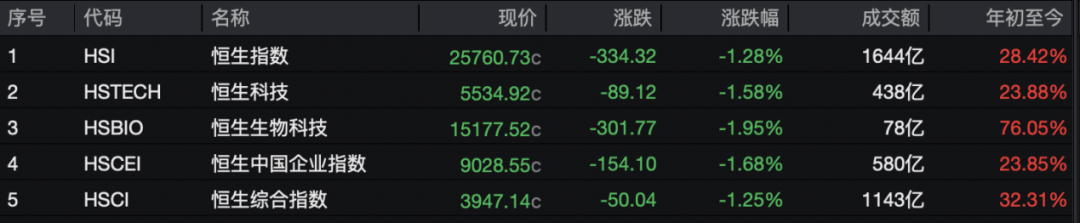
Market Overview - The Hong Kong stock market experienced a decline on December 3, with the Hang Seng Index closing at 25,760.73 points, down 1.28% [2] - The total market turnover for the day was 1,644 million HKD, with southbound funds net buying 22.79 million HKD [2] Southbound Capital Activity - Southbound funds have net bought Alibaba for 15 consecutive days, accumulating a total of 286.49 million HKD [6] - On December 3, net purchases included Xiaomi Group at 8.7 million HKD, Alibaba at 4.27 million HKD, and Meituan at 2.97 million HKD, while Tencent Holdings saw a net sell-off of 7.32 million HKD [6] Semiconductor Sector - Semiconductor stocks showed resilience, with notable gains including Huahong Semiconductor up 1.58% and Hard Egg Innovation up 1.02% [3] AI and GPU Market Insights - HSBC's investment management head for China and core Asia, Shen Yu, indicated that China's AI capital expenditure story is just beginning, with significant growth expected in domestic GPU and AI computing power over the next 12 to 18 months [5] - The domestic GPU replacement rate is projected to rise rapidly to over 50% in the coming years, potentially reaching 79%, which will drive the development of AI applications in China [5] Stock Index Changes - FTSE Russell announced the inclusion of companies such as CATL and China Hongqiao into the FTSE China 50 Index, effective December 22 [11] - The changes will also see the removal of companies like CITIC Securities and Great Wall Motors from the index [11] Regulatory Actions - The Hong Kong Securities and Futures Commission has instructed the Hong Kong Stock Exchange to suspend trading of Daxian Education shares starting December 3, 2025, amid ongoing investigations [12][15]

中外资机构热议“AI泡沫”
Zhong Guo Ji Jin Bao· 2025-12-03 03:21
Core Viewpoint - The debate around the existence of an "AI bubble" is intensifying, with discussions focusing on AI's economic contributions and its impact on technology stocks [1]. Group 1: Existence of AI Bubble - The emergence of "AI bubble theory" is attributed to four main reasons: high concentration of holdings, concerns over investment returns, market perception, and doubts about technological pathways [3][4]. - High concentration of AI holdings and profit-taking amid market uncertainties, such as tariffs and Federal Reserve interest rate expectations, are leading to profit realization [3]. - Concerns regarding the sustainability of AI capital expenditures have arisen due to the shift from self-financing to debt financing, impacting cash flow expectations for companies like Oracle and Meta [3]. - Historical context suggests that the current high valuations and growth rates of tech companies are causing unease among investors unfamiliar with the underlying logic [3]. - The divergence between GPU and TPU technologies is influencing performance expectations for companies like NVIDIA, with future growth dependent on which technology path prevails [4]. - Current AI valuations differ significantly from the 1999-2000 internet bubble, with free cash flow yields approximately three times higher and forward P/E ratios about 35% lower than during that period [4]. Group 2: Contribution of AI to Economic Growth - AI-related spending is becoming a key driver of global economic growth, with significant contributions expected in the coming years [5]. - In the U.S., AI spending is projected to contribute approximately 0.4 percentage points to GDP growth by 2026-2027, accounting for about 20% of total growth [5]. - The expected productivity growth from AI in the U.S. is estimated to be between 25 to 35 basis points by 2027 [5]. - In contrast, AI's contribution to GDP growth in China is anticipated to be minimal in 2026, with a contribution of about 10 to 15 basis points by 2027 [5]. - The focus on AI's impact on cost reduction in industries, particularly in the service sector, is expected to become more pronounced by 2026 [6]. Group 3: Impact on Technology Stocks - The fundamental factors surrounding AI are expected to influence stock price performance, with a broader distribution of market leadership anticipated in the U.S. stock market by 2026 [7]. - AI applications are seen as a driving force for U.S. stock strategies, with expectations of positive operational leverage effects [7]. - The health of the upstream computing power industry is expected to remain strong, providing opportunities for AI-related tech stocks in the first half of 2026 [8]. - Increased electricity demand from AI may become a focal point for U.S. stocks, with semiconductor and cloud service providers likely to benefit from AI spending [8]. - The Chinese stock market is expected to see significant performance from technology stocks due to advancements in AI, supported by a large domestic market and favorable policies [8].