
财政政策

Search documents
宏观金融数据日报-20251212
Guo Mao Qi Huo· 2025-12-12 03:17
Group 1: Market Interest Rate and Bond Information - DRO01 closed at 1.28 with a -1.14bp change, DR007 at 1.45 with a -0.05bp change, GC001 at 1.26 with a -15.50bp change, GC007 at 1.51 with a 0.00bp change, SHBOR 3M at 1.58 with a 0.20bp change, and LPR 5 - year at 3.50 with a 0.00bp change [3] - 1 - year treasury bond closed at 1.34 with a 0.70bp change, 5 - year at 1.62 with a -0.10bp change, 10 - year at 1.83 with a -1.40bp change, and 10 - year US treasury bond at 4.13 with a -1.30bp change [3] - The central bank conducted 118.6 billion yuan of 7 - day reverse repurchase operations yesterday, with 180.8 billion yuan of reverse repurchases maturing, resulting in a net withdrawal of 62.2 billion yuan [3] Group 2: Central Bank Policy and Economic Outlook - This week, there are 663.8 billion yuan of reverse repurchases maturing in the central bank's open market, with 107.6 billion, 156.3 billion, 79.3 billion, 180.8 billion, and 139.8 billion maturing from Monday to Friday respectively [4] - The Political Bureau Meeting of the CPC Central Committee pointed out that next year's economic work should adhere to making progress while maintaining stability and improving quality and efficiency, continue to implement a more proactive fiscal policy and a moderately loose monetary policy, and increase counter - cyclical and cross - cyclical adjustment [4] Group 3: Stock Index and Futures Market - The CSI 300 closed at 4552, down 0.86%; the SSE 50 at 2977, down 0.39%; the CSI 500 at 7083, down 1.02%; and the CSI 1000 at 7312, down 1.30%. The trading volume of the Shanghai and Shenzhen stock markets was 1.8571 trillion yuan, an increase of 78.6 billion yuan from the previous day [5] - IF当月 closed at 4540, down 0.8%; IH当月 at 2970, down 0.4%; IC当月 at 7074, down 0.7%; and IM当月 at 7305, down 0.9% [5] - IF trading volume was 106,663, down 13.1%; IF open interest was 269,076, down 2.7%; IH trading volume was 46,276, down 9.6%; IH open interest was 93,141, down 3.7%; IC trading volume was 112,902, down 3.1%; IC open interest was 248,093, down 1.6%; IM trading volume was 191,043, up 7.7%; IM open interest was 368,357, down 0.2% [5] Group 4: Market Analysis and Investment Suggestions - The Fed cut interest rates by 25bp as expected overnight, but there was a large divergence within the Fed on the future rate - cut rhythm, with contradictions between inflation recovery and employment pressure [6] - The stock index weakened in a volatile manner throughout the day yesterday. The Politburo Meeting released limited incremental information recently, and the Central Economic Work Conference is expected to make more specific arrangements for next year's economic work [6] - In the short term, be vigilant against the "buy - the - rumor, sell - the - news" adjustment after the meeting policies are implemented. In the long run, the market adjustment since mid - November has opened up space for the upward movement of the stock index next year, providing a layout window. Investors can consider gradually establishing long positions during the adjustment phase and use the discount structure of stock index futures to optimize long - term investment costs and win - rates [6] Group 5: Futures Contract Premium and Discount Information - IF premium/discount rates for the current - month, next - month, current - quarter, and next - quarter contracts were 12.61%, 6.54%, 4.50%, and 4.15% respectively [7] - IH premium/discount rates for the current - month, next - month, current - quarter, and next - quarter contracts were 11.08%, 4.92%, 1.89%, and 1.87% respectively [7] - IC premium/discount rates for the current - month, next - month, current - quarter, and next - quarter contracts were 5.47%, 9.60%, 9.83%, and 10.63% respectively [7] - IM premium/discount rates for the current - month, next - month, current - quarter, and next - quarter contracts were 4.61%, 12.37%, 12.55%, and 12.91% respectively [7]
明年经济工作重点有什么新提法、新信号?一起了解“宏观定力+微观温度”
Yang Shi Wang· 2025-12-12 02:35
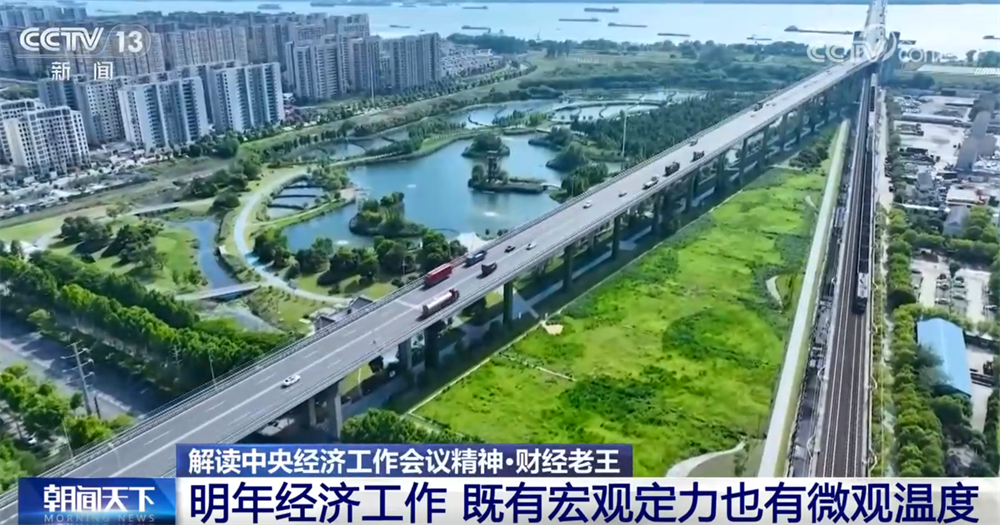
会议特别强调"一体推进教育科技人才发展方案",还点名打造京津冀、长三角、粤港澳三大国际科创中心。更值得关注的是,"人工智能 +"要"深化拓展"并"完善治理"——既要跑得快,也要跑得稳。 央视网消息:中央经济工作会议明确了明年经济工作的重点,更透露出不少新提法、新信号。来看总台央视记者王雷——财经老王带来的 解读。 先说财政政策。大家熟悉的育儿补贴、家电以旧换新、养老服务支持,背后都有财政"真金白银"的支撑。明年,我国将继续实施"更加积 极的财政政策"。跟去年的"提高赤字率、增加发行超长期特别国债"相比,今年变成了"保持必要的财政赤字、债务总规模和支出总量"。听着 是不是有点低调?其实不然。老王问了专家:2026年,国家要把每一分钱都用在刀刃上——该给养老的给养老,该补科技的补科技,该稳企业 的稳企业。说白了,财政要"提质增效"。 再看货币政策。会议强调要"加大逆周期和跨周期调节力度"。逆周期调节是通过降息、扩大财政支出等措施稳定经济;而跨周期调节则是 强调政策的连续性和可持续性。"逆周期+跨周期"意味着政策将从应急救火转向长期筑基,既要稳住当下,更要布局未来,提前五年甚至十年 布局,解决人口老龄化、产业升级等 ...

中央部署明年八大重点任务
第一财经· 2025-12-12 02:07
2025.12. 12 本文字数:3533,阅读时长大约6分钟 此前多位接受第一财经采访的专家表示,明年财政赤字率预计将不会低于2025年的4%,并继续适度 增加发行超长期特别国债、地方政府专项债券等,使得明年新增政府债务规模超过2025年的约12万 亿元,比如可能在13万亿元至16万亿元。此举将扩大财政支出,比如明年全国一般公共预算支出有 望超过30万亿元,增速在4%~5%左右,发挥财政政策稳增长、扩内需、惠民生的重要作用。 作者 | 第一财经 祝嫣然 陈益刊 杜川 一年一度的中央经济工作会议12月10日至11日在北京举行。会议指出,明年经济工作在政策取向 上,要坚持稳中求进、提质增效,发挥存量政策和增量政策集成效应,加大逆周期和跨周期调节力 度,提升宏观经济治理效能。 会议部署了八大重点任务,包括坚持内需主导,建设强大国内市场;坚持创新驱动,加紧培育壮大新 动能;坚持改革攻坚,增强高质量发展动力活力;坚持对外开放,推动多领域合作共赢;坚持协调发 展,促进城乡融合和区域联动;坚持"双碳"引领,推动全面绿色转型;坚持民生为大,努力为人民群 众多办实事;坚持守牢底线,积极稳妥化解重点领域风险。 "坚持内需主导, ...

铜冠金源期货商品日报-20251212
Tong Guan Jin Yuan Qi Huo· 2025-12-12 02:04
Report Industry Investment Rating No relevant content provided. Core Views of the Report - After the Fed's interest rate cut, the US dollar index fell, and commodities generally strengthened, with gold, silver, and copper rising significantly, while oil prices continued to adjust under the expectation of loose supply and demand. In China, the central economic work conference emphasized "seeking progress while maintaining stability and improving quality and efficiency," and the policy in 2026 will still focus on "stability" [2][3]. - The continued strengthening of the interest rate cut expectation supported the rise of precious metals, and the silver price reached a new high. The central economic work conference released positive signals, and the copper price is expected to continue to run strongly at a high level in the short term. The aluminum price is expected to fluctuate strongly due to inventory reduction, while the alumina price continues to be weak due to oversupply [4][6][8]. - The zinc price is expected to fluctuate strongly due to the tightening of zinc ore supply and the decline of social inventory. The lead price is expected to fluctuate and consolidate due to low inventory and differentiated consumption. The tin price is expected to fluctuate strongly due to favorable fundamentals [12][13][14]. - The industrial silicon price is expected to decline weakly due to the weakening of demand. The steel price is expected to fluctuate due to general industrial data. The iron ore price is expected to be under pressure due to strong supply and weak demand. The double - coke price is expected to fluctuate weakly due to the weakening of demand in the off - season [16][17][18]. - The soybean meal futures are expected to stop falling and stabilize and enter a shock operation due to good soybean auction results. The palm oil price is expected to fluctuate within a range due to the rise of rapeseed oil and the expected increase in palm oil inventory [21][24]. Summary by Related Catalogs Macroeconomics - Overseas: The number of initial jobless claims in the US last week increased by 44,000 to 236,000, the largest single - week increase in four and a half years. The stock market showed a differentiated trend, and the US dollar index fell to 98.1 after the Fed's interest rate cut [2]. - Domestic: The central economic work conference emphasized "seeking progress while maintaining stability and improving quality and efficiency," and the policy in 2026 will still focus on "stability." The A - share market fell on Thursday, and the bond market continued to rebound and repair [3]. Precious Metals - On Thursday, international precious metal futures continued to rise. COMEX gold futures rose 2.00% to $4309.30 per ounce, and COMEX silver futures rose 4.83% to $63.98 per ounce. The market's bet on the continued interest rate cut in January was strengthened, and the silver price reached a new high, driving the synchronous rise of gold, platinum, and palladium [4]. Copper - On Thursday, the main contract of Shanghai copper continued to rise, and LME copper broke through the $11,800 line. The macro environment at home and abroad improved, and the supply of concentrates continued to tighten. It is expected that the copper price will continue to run strongly at a high level in the short term [6][7]. Aluminum - On Thursday, the main contract of Shanghai aluminum closed at 21,970 yuan per ton, up 0.23%. The aluminum ingot inventory continued to decline, mainly due to transportation problems in the northwest. The low inventory supported the aluminum price to fluctuate strongly [8]. Alumina - On Thursday, the main contract of alumina futures closed at 2,469 yuan per ton, down 1.4%. The alumina market is in an oversupply pattern, and the market short - selling atmosphere is strong, so the price continues to be weak [10]. Cast Aluminum - On Thursday, the main contract of cast aluminum alloy futures closed at 20,965 yuan per ton, up 0.36%. The raw material supply is tight, the consumption is weak, and the demand side is waiting and seeing. It is expected that the cast aluminum price will fluctuate at a high level [11]. Zinc - On Thursday, the main contract of Shanghai zinc first rose and then fell during the day and rebounded sharply at night. The supply of zinc ore continued to tighten, the processing fees at home and abroad were under pressure, and the social inventory decreased. It is expected that the zinc price will fluctuate strongly in the short term [12]. Lead - On Thursday, the main contract of Shanghai lead fluctuated narrowly during the day and sideways at night. The production of primary and secondary lead smelters decreased, and the social inventory was at a low level, but the consumption was differentiated. It is expected that the lead price will fluctuate and consolidate [13]. Tin - On Thursday, the main contract of Shanghai tin fluctuated narrowly during the day and closed up at night. The supply of tin ore was affected by the conflict in Congo - Kinshasa, and the demand for AI semiconductors was optimistic. It is expected that the tin price will fluctuate strongly [14]. Industrial Silicon - On Thursday, industrial silicon fluctuated narrowly. The supply is converging, and the demand is weakening. The establishment of a polysilicon platform company may drag down the short - term demand. It is expected that the industrial silicon price will decline weakly [15][16]. Steel (Spiral and Coil) - On Thursday, steel futures fluctuated and fell. The industrial data was average, and the supply and demand were both weak. It is expected that the steel price will fluctuate [17]. Iron Ore - On Thursday, iron ore futures fluctuated and fell. The demand was weak, the supply was strong, and the inventory increased. It is expected that the iron ore price will be under pressure [18]. Double - Coke (Coking Coal and Coke) - On Thursday, double - coke futures fluctuated weakly. The demand in the off - season was weak, the supply was strong, and the inventory increased. It is expected that the double - coke price will fluctuate weakly [19]. Bean and Rapeseed Meal - On Thursday, the 05 contract of soybean meal closed flat, and the 05 contract of rapeseed meal rose 0.35%. The soybean auction results were good, and there was news that the customs clearance time of imported soybeans might be extended. It is expected that the soybean meal futures will stop falling and stabilize and enter a shock operation [20][21]. Palm Oil - On Thursday, the 01 contract of palm oil rose 0.44%. The production of Malaysian palm oil in early December increased, and the inventory was expected to rise. The rapeseed oil price rose due to quarantine problems. It is expected that the palm oil price will fluctuate within a range [23][24].
早盘速递-20251212
Guan Tong Qi Huo· 2025-12-12 02:04
Report Summary 1. Hot News - The Central Economic Work Conference emphasized continuing proactive fiscal policies, maintaining necessary fiscal deficits, debt scales, and expenditure volumes, optimizing fiscal expenditure structures, and using policy tools such as reserve requirement ratio and interest rate cuts. It also focused on stabilizing the real - estate market [2]. - The Henan Bureau of the National Mine Safety Administration ordered Mianchi Liangjiawa Coal Industry Co., Ltd. to suspend production for 2 days due to major accident hazards [2]. - Mongolia plans to export 90 million tons of coal in 2026 and aims for 100 million tons in 2027 with the operation of border railways [2]. - Citigroup predicts that oil prices may fall to an average of $60 per barrel by Q1 2026, with Brent crude expected to drop to $60 per barrel by the end of 2025 and have an annual average of $62 per barrel in 2026, ranging from $55 - $65 per barrel [2]. - As of December 11, 2025, domestic soda ash manufacturers' total inventory was 1.4943 million tons, down 0.82 million tons (0.55% decline) from Monday, and production was 735,400 tons, up 31,500 tons (4.48% increase) week - on - week [2]. 2. Sector Performance - Key sectors to watch: silver, lithium carbonate, pulp, Shanghai copper, and Shanghai gold [3]. - Night - session performance: non - metallic building materials rose 2.79%, precious metals 30.91%, oilseeds and oils 8.87%, soft commodities 3.13%, non - ferrous metals 24.63%, coal, coke, steel, and minerals 11.38%, energy 2.58%, chemicals 10.72%, grains 1.40%, and agricultural and sideline products 3.59% [3]. 3. Sector Positions - The chart shows the five - day changes in commodity futures sector positions from December 5 to December 11, 2025 [4]. 4. Performance of Major Asset Classes - In the equity market, the Shanghai Composite Index had a daily decline of 0.70%, a monthly decline of 0.39%, and an annual increase of 15.56%. Other indices also had different performance [5]. - In the fixed - income market, 10 - year, 5 - year, and 2 - year treasury bond futures had different daily, monthly, and annual performance [5]. - In the commodity market, the CRB commodity index, WTI crude, London spot gold, LME copper, and Wind commodity index had various performance [5]. - Other assets like the US dollar index and CBOE volatility index also showed different trends [5]. 5. Stock Market Risk Preference and Commodity Trends - The report presents the trends of major commodities such as the Baltic Dry Index, CRB spot index, WTI crude, London spot gold and silver, LME copper, CBOT soybeans, and CBOT corn, as well as the risk premium of the stock market [6].
预计2026年初债市的胜率和赔率将有阶段性上修,基准国债ETF(511100)冲击4连涨
Sou Hu Cai Jing· 2025-12-12 02:03
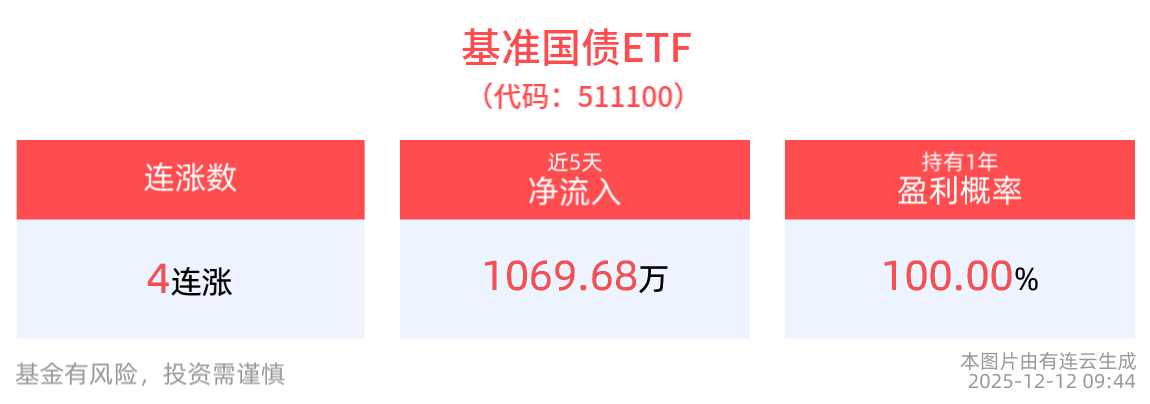
Group 1 - The benchmark government bond ETF (511100) has seen a 0.08% increase, marking its fourth consecutive rise, with an average daily trading volume of 11.14 billion yuan over the past week [1] - The ETF has attracted a total of 10.697 million yuan in inflows over the last five trading days, bringing its latest scale to 11.131 billion yuan [1] - Since its inception, the ETF has recorded a highest monthly return of 2.67%, with the longest streak of monthly gains being 9 months and a maximum gain of 6.94% [1] Group 2 - Citic Securities indicates that the 2025 Central Economic Work Conference emphasizes "practicing internal skills," with expectations for continued fiscal policy support in 2026, focusing on domestic demand, innovation, and reform [3] - The bond market is anticipated to see an upward adjustment in winning rates and odds at the beginning of 2026, reflecting positive market expectations regarding policy [3] - The benchmark government bond ETF tracks the Shanghai Benchmark Market Government Bond Index, selecting all government bonds within the exchange's benchmark market variety, with an overall duration of 9.37, indicating a medium-term bond index [3]
明年我国将实施更加积极有为的宏观政策
Xin Hua She· 2025-12-12 02:00
杨志勇表示,明年我国将继续实施更加积极的财政政策,这和今年的财政政策取向一以贯之,财政在国 家治理中的基础和重要支柱作用将得到进一步发挥。"加强财政科学管理"等安排,将更充分地释放和提 升财政政策效能,更好护航经济运行、推动经济增长目标的实现。 新华社北京12月11日电 宏观政策是护航经济稳定运行的重要手段。12月10日至11日举行的中央经济工 作会议提出,实施更加积极有为的宏观政策,并明确要继续实施更加积极的财政政策,要继续实施适度 宽松的货币政策。 做好明年经济工作,政策取向备受关注。会议指出,明年经济工作在政策取向上,要坚持稳中求进、提 质增效,发挥存量政策和增量政策集成效应,加大逆周期和跨周期调节力度,提升宏观经济治理效能。 "明年的政策取向释放出'更加积极有为'的鲜明信号。"中国财政科学研究院院长杨志勇表示,宏观政策 加大调控力度,增强政策前瞻性针对性协同性,将更好引导发展预期,推动经济实现质的有效提升和量 的合理增长,为实现"十五五"良好开局打牢基础。 "保持必要的财政赤字、债务总规模和支出总量""加强财政科学管理"……会议明确了财政政策发力方 向。 在货币政策方面,会议也作出明确安排:"把促进经 ...
2026经济形势如何?政策如何发力?对话三位首席经济学家
3 6 Ke· 2025-12-12 00:27
Core Viewpoint - The Central Economic Work Conference emphasizes the need for a balanced approach to economic work in 2026, focusing on both policy support and reform innovation, while aiming for quality improvement and reasonable growth in the economy [1][2]. Economic Policy Direction - The conference advocates for a "more proactive fiscal policy" and "moderately loose monetary policy" to enhance economic stability and growth [1][4]. - There is an expectation for fiscal policy to strengthen, particularly in areas of "investment in people" and consumer support [2][4]. - Monetary policy is anticipated to allow for interest rate cuts of 10 to 20 basis points, with a focus on efficiency and proactivity [2][4][7]. Domestic Demand and Consumption - The conference identifies "domestic demand as the leading force" and emphasizes the importance of boosting consumption through specific actions, including a plan to increase urban and rural residents' income [2][8]. - Service consumption is highlighted as a key area for policy focus in 2026, with measures to enhance consumer spending and support for social security [2][10]. Risk Mitigation in Real Estate - The conference stresses the need to "actively and prudently resolve risks in key areas," particularly in stabilizing the real estate market [3][11]. - Measures include encouraging the acquisition of existing housing for affordable housing projects and reforming the housing provident fund system [11][12]. - The focus on real estate is seen as crucial for preventing risks from spreading to local government debt and the financial system [3][12][13]. Fiscal and Monetary Coordination - There is an emphasis on the coordination between fiscal and monetary policies, with fiscal measures expected to be more direct and monetary policies remaining moderately loose [4][5]. - The fiscal deficit is projected to maintain around 4%, with an increase in the scale of fiscal deficits to approximately 6 trillion yuan [6][7]. Long-term Economic Planning - The conference indicates that policy formulation will focus on long-term economic development rather than short-term stimulus effects, aligning with the "15th Five-Year Plan" [5][6]. - The approach will include a comprehensive evaluation of various economic policies to ensure consistency and effectiveness in macroeconomic policy direction [5][6].
中央经济工作会议勾勒金融重点:支持重点领域、灵活高效降准降息
2 1 Shi Ji Jing Ji Bao Dao· 2025-12-12 00:09
中央经济工作会议于10日至11日在北京召开,会议总结2025年经济工作,分析当前经济形势,部署2026 年经济工作。 值得注意的是,会议五次提到"金融"。会议明确要"引导金融机构加力支持扩大内需、科技创新、中小 微企业等重点领域",同时还要"继续发挥新型政策性金融工具作用""创新科技金融服务"并"深入推进中 小金融机构减量提质",为2026年金融工作指明了方向。 财政货币政策继续协同发力 会议明确,要继续实施更加积极的财政政策。保持必要的财政赤字、债务总规模和支出总量,加强财政 科学管理,优化财政支出结构,规范税收优惠、财政补贴政策。重视解决地方财政困难,兜牢基层"三 保"底线。严肃财经纪律,坚持党政机关过紧日子。 中国民生银行首席经济学家温彬认为,会议明确"保持必要的财政赤字、债务总规模和支出总量",与明 年经济工作要"提质增效"的整体基调相互呼应。温彬预计,在"更加积极"的财政政策取向下,2026年新 增政府债务规模或进一步提升至12.5万亿元左右,以支撑广义财政支出强度、兜牢基层"三保"底线;赤 字率维持在4.0%左右水平,对应赤字规模约为5.9万亿元,较上年增加约2000亿元,增加部分主要由中 央承担 ...
华西证券:明年债市或比预期好一点 行情节奏可能靠后
Di Yi Cai Jing· 2025-12-12 00:09
Group 1 - The core viewpoint is that the bond market may continue to experience a weak oscillating pattern in 2026, similar to 2025, due to concerns over rising inflation and ongoing strict regulations [1] - There is a consensus expectation that the bond market will struggle to form a clear direction, influenced by the transition from expansive fiscal policies to stable fiscal policies if economic growth targets decline [1] - The key to the bond market's performance in 2026 will be the substantial changes in monetary policy, which may require the emergence of bottom-up risk events to stimulate active monetary policy [1] Group 2 - The potential shift in fiscal policy could alleviate supply pressure on government bonds if the fiscal deficit rate decreases alongside lower economic growth targets [1] - The bond market may see a "slow at first, fast later" rhythm, with a period of dormancy in the first quarter, followed by active engagement in the second and third quarters, potentially leading to an annual low point [1]
