
AI泡沫

Search documents
驳斥AI泡沫论!瑞银:数据中心毫无降温迹象,上调明年市场增速预期至20-25%
Hua Er Jie Jian Wen· 2025-12-08 09:03
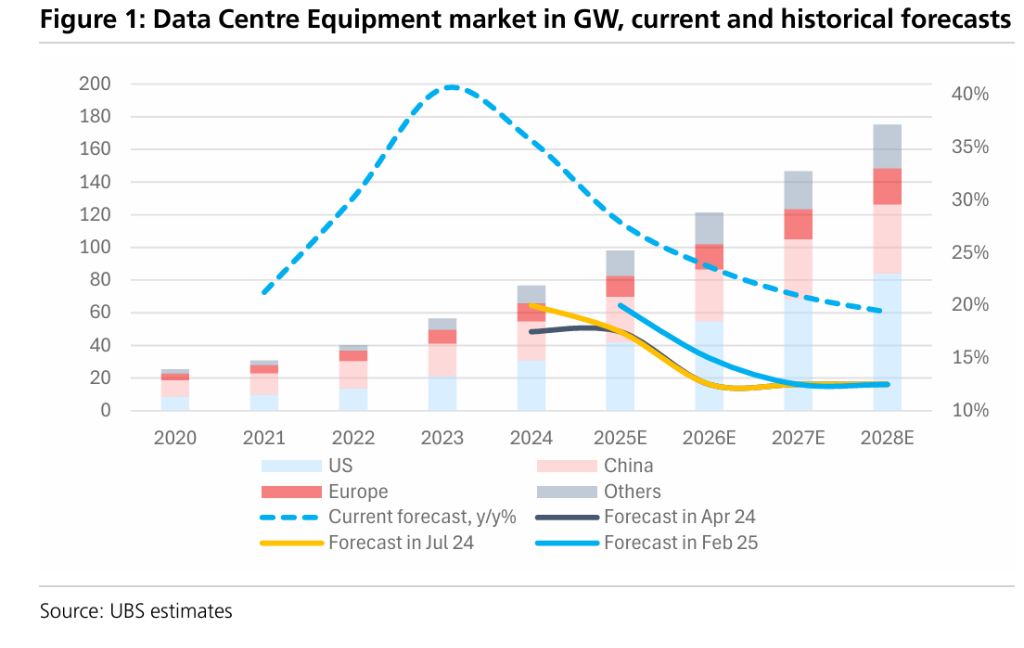
Core Insights - UBS reports that the global data center equipment market shows no signs of cooling, with current construction capacity reaching 25GW and operational capacity at approximately 105GW [1] - The industry is expected to grow by 25-30% by 2025, with strong momentum continuing into 2026 [1][4] - UBS raises mid-term growth expectations, forecasting a market growth rate of 20-25% in 2026, supported by low vacancy rates and strong construction data [1][4] Market Growth Projections - Following a projected 25-30% growth in 2025, the growth rate for 2026 is expected to remain high at 20-25%, with 15-20% growth anticipated in 2027 and 10-15% from 2028 to 2030 [4] - Vacancy rates in North America, Europe, and Asia-Pacific are at historical lows of 1.8%, 3.6%, and 5.8% respectively, indicating a supply-demand imbalance [4] Cooling Technology and Capital Expenditure - The cooling market is expected to perform exceptionally well, with a projected 20% compound annual growth rate (CAGR) by 2030, and liquid cooling technology leading with a 45% growth rate [7] - AI data centers are experiencing a structural change in construction costs, with costs per megawatt increasing by approximately 20% compared to traditional data centers, primarily due to upgrades in cooling and power infrastructure [8] AI Revenue and Market Dynamics - Annual recurring revenue (ARR) from major AI-native applications has reached $17 billion, accounting for 6-7% of the current SaaS market [10] - The adoption rate of generative AI (GenAI) is unprecedented, with companies reporting an average revenue growth of 3.6% and cost reductions of 5% over the past year [10] Technological Shifts - The transition to 800V direct current (DC) architecture is expected to reshape the competitive landscape, with widespread deployment anticipated by late 2028 to early 2029 [16] - Demand for medium voltage (MV) equipment is expected to remain stable, while low voltage (LV) AC equipment may face risks from higher voltage DC distribution [16]

每周投资策略-20251208
citic securities· 2025-12-08 06:46
Group 1: US Market Focus - The Federal Reserve is expected to lower interest rates again this week, with a 25 basis point cut anticipated in December [11][19] - Concerns about the "AI bubble" are emerging, with discussions on the sustainability of AI capital expenditures and the pace of AI application deployment [20][21] - Alphabet's Gemini 3 series has gained attention for its significant improvements in reasoning capabilities, potentially impacting its market position against competitors like OpenAI [22] Group 2: Australian Market Focus - Australia's GDP growth for Q3 was below expectations at 2.1% year-on-year, while inflation remains high, leading to a diminished likelihood of interest rate cuts [31][27] - The Reserve Bank of Australia is expected to maintain a hawkish stance, with a potential for only one more rate cut in the future [31][32] - The report recommends focusing on the materials and dividend sectors, highlighting companies like Northern Star and Woodside as key investment opportunities [27][34] Group 3: Indonesian Market Focus - Inflation relief in Indonesia provides a basis for cautious optimism regarding interest rate cuts in 2026, with a focus on banking and telecommunications sectors [3][11] - The VanEck Indonesia Index ETF is suggested as a potential investment vehicle for exposure to the Indonesian market [3] Group 4: Global Market Performance - The MSCI China index showed a 1.1% increase, driven by technology and aerospace stocks, indicating a positive trend in the Chinese market [5] - The Hang Seng Index and other major indices have shown resilience, with the Hang Seng Index up 0.9% and the MSCI China index reflecting a strong year-on-year performance [5][6] Group 5: Commodity and Currency Performance - The US dollar has declined under interest rate cut expectations, while copper prices have surged to historical highs [8] - The report notes significant movements in commodity prices, with WTI crude oil futures up 2.6% and LME copper prices increasing by 3.8% [8]


AMD CEO苏姿丰再谈AI泡沫:让我夜不能寐的不是友商,而是创新
Sou Hu Cai Jing· 2025-12-08 02:10
Core Viewpoint - AMD CEO Lisa Su believes that the AI industry is not in a "bubble" and that concerns about such a bubble are exaggerated, emphasizing the need for massive chips from companies like AMD to support future AI developments [3]. Group 1: Company Performance - Since Lisa Su became CEO in 2014, AMD's market value has increased from $2 billion to $300 billion [3]. - AMD has successfully launched the Zen architecture processors, replacing the less favorable Bulldozer architecture [3]. Group 2: Strategic Partnerships - AMD entered a significant partnership with OpenAI earlier this year, where OpenAI will deploy 6 GW of AMD Instinct GPUs [3]. - As part of the agreement, AMD allowed OpenAI to purchase 160 million shares of AMD stock at $0.01 per share, equating to approximately 10% of the company's shares [3]. Group 3: Competitive Landscape - Lisa Su does not express concern over competition from NVIDIA or tech giants like Google and Amazon, who are developing their own chips [3]. - The primary focus for AMD is on accelerating innovation rather than worrying about competitors [3]. Group 4: Future Outlook - Lisa Su describes the current state of AI as being in its "infancy," indicating that AMD must prepare for the future by developing more chips [3].


黄仁勋和马斯克,谁才是「时代的司机」?
Xin Lang Ke Ji· 2025-12-08 00:50
Group 1 - The core issue highlighted is that despite Nvidia's impressive quarterly performance, the stock price has declined, indicating that market expectations may be too high [2][7] - Jensen Huang expressed frustration that the market does not fully recognize Nvidia's strong quarterly results, leading to a "no-win" situation where any performance shortfall could be interpreted as evidence of an AI bubble [2][7] - Nvidia's stock fell by 9% in November and over 13% in the past month, despite a 62% year-over-year revenue growth and a 65% increase in net profit, surpassing Wall Street expectations [7][11] Group 2 - Huang's concerns echo the historical experiences of Intel and Microsoft, who faced similar market pressures despite strong performance, leading to stock price declines due to concerns over future sustainability [10][11] - The article draws parallels between Nvidia's current situation and past experiences of tech giants like Microsoft and Intel, emphasizing the challenges of being a market leader under high expectations [10][11] - The narrative also touches on the competitive landscape in the AI sector, with companies like Google and Meta vying for leadership, indicating a fierce battle for dominance in the AI era [20][21] Group 3 - Nvidia is currently positioned as a dominant player in the AI chip market, akin to the "Wintel" alliance of the PC era, but faces increasing competition from companies developing their own AI chips [19][20] - Google's advancements with its TPU technology pose a significant threat to Nvidia, as TPU servers reportedly have a lower total cost of ownership compared to Nvidia's offerings [22][21] - The article concludes with a warning that Nvidia must remain vigilant against emerging competitors, as the landscape of AI technology continues to evolve rapidly [28]


OpenAI疯狂囤货,山姆・奥特曼的DRAM灰色交易
阿尔法工场研究院· 2025-12-08 00:06
Core Insights - The article discusses a significant surge in DRAM memory prices, particularly a 156% increase in the price of a 32GB DDR5 memory kit within a month, attributed to a combination of market panic, AI-related demand, and supply chain issues [2][3]. Group 1: Market Dynamics - OpenAI signed unprecedented agreements with Samsung and SK Hynix on October 1, securing 40% of global DRAM supply, which caught the industry off guard [5][6]. - The secrecy surrounding these agreements led to widespread panic among competitors and suppliers, as they were unaware of the scale and timing of OpenAI's actions [7][9]. - The lack of safety stock in the market was exacerbated by tariff confusion, declining prices, and halted second-hand DRAM manufacturing, leaving the market vulnerable [11][12]. Group 2: Impact on Products - The immediate impact of the memory shortage is categorized into different levels of urgency for various products: - S Level: Memory itself is in critical shortage, with prices skyrocketing [15]. - A Level: Solid State Drives (SSDs) are at risk due to their price lagging behind DRAM changes [16]. - B Level: NVIDIA graphics cards have some buffer but are still at risk, especially high-capacity models [19]. - C Level: Laptops and smartphones are currently safe but may face issues once inventory runs out [20]. - D Level: PlayStation is well-prepared due to prior procurement [21]. - E Level: Products without memory, like CPUs, may see price drops due to decreased demand [22]. Group 3: Future Considerations - The article emphasizes that even if the memory shortage is alleviated, the market will remain chaotic for at least the next 6 to 9 months due to long delivery cycles for DDR5 [15]. - There is a call for deeper investigation into OpenAI's financial practices and their impact on the memory market, highlighting concerns over their aggressive accumulation of resources [22].

兴业证券2026年度市场策略:万物竞发 全面牛市启航
智通财经网· 2025-12-07 14:03
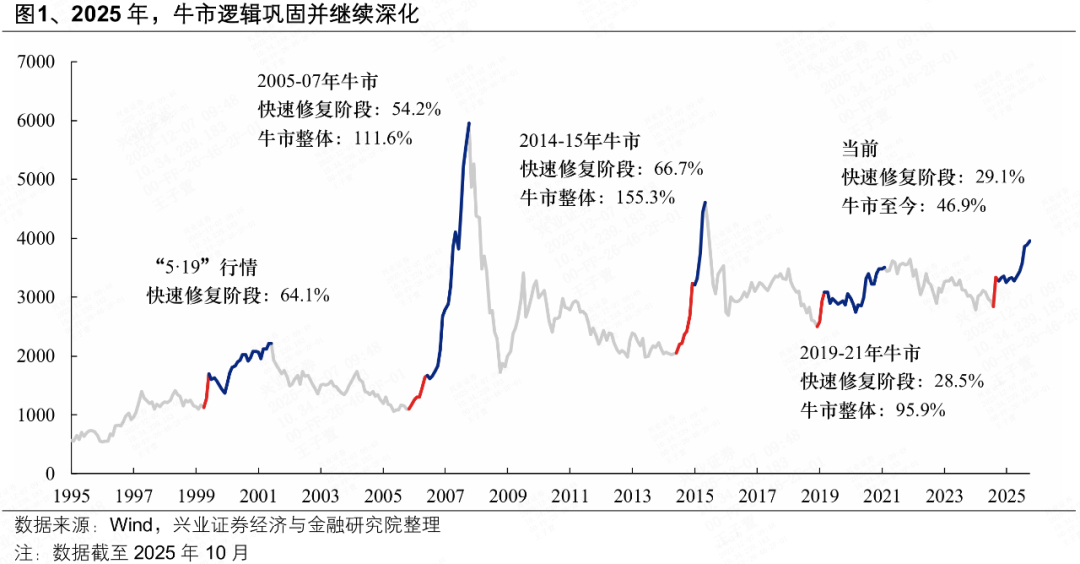
兴业证券此前强调,"本轮资本市场反转肩负重任,未来经济转型发展过程中,资本市场将成为引导资源配置的核心平台",并提出提振股市的新逻辑:助 力新质生产力发展、承载居民财富配置渠道、盘活优质资产。今年以来,三大逻辑持续巩固,资本市场与实体经济良性循环,夯实了本轮牛市的底层逻 辑。 与此同时,今年以DeepSeek、半导体、机器人、6代机、创新药等为代表的各领域"多点开花"突破引发的产业价值重估、大国博弈中的战略自信、"十五 五"对于未来转型思路进一步明确,带来的市场中长期宏观"叙事"和认知的转变,进一步强化本轮牛市的逻辑并拔高行情天花板。 行至当前,在2025年市场大幅上涨、上证综指一度突破4000点后,2026年市场将如何演绎? 报告全文如下: 一、海外展望:流动性宽松和弱美元有望提振 今年以来中美股市关联度提升。一方面,宽松的流动性环境中,外溢的美元流动性催化全球风险资产迎来普涨,新兴市场尤为受益。另一方面,A股今年 表现靠前的海外算力链业绩预期和美股龙头高度挂钩、受美股映射较强。 因此,我们看到中美两国股市的相关性显著提升,标普500和万得全A滚动60日相关系数2025年的均值为0.4,远高于2021-20 ...

2026年A股逻辑,首席经济学家们划重点了|财经早察
2 1 Shi Ji Jing Ji Bao Dao· 2025-12-07 13:10
Core Insights - The consensus among chief economists is that the core driver of China's economy in 2026 will shift towards domestic demand, particularly in the service sector, leading to a more balanced economic development compared to the current year [2] - The logic of A-share value re-evaluation is expected to continue, with the capital market becoming a core platform for wealth allocation and technological innovation [2] Economic Outlook - In October, China's Producer Price Index (PPI) saw its first month-on-month increase of the year, indicating a positive signal for economic recovery [2] - If PPI continues to narrow its decline or even turn positive year-on-year, it could lead to a mild re-inflation, benefiting corporate profits [2] A-share Market Trends - The improvement in corporate earnings alongside the potential recovery of PPI is anticipated to resonate with valuation expansion, driving a more robust upward trend in A-shares [2] - The A-share market is increasingly recognized as a key stage for both wealth allocation and corporate technological innovation [2] Global Market Considerations - There is acknowledgment of the existence of a bubble in the U.S. AI sector, but the timing and impact of a potential burst are considered manageable [3] - The upcoming U.S. midterm elections are highlighted as a critical period to watch, particularly if the Federal Reserve struggles to lower interest rates or if AI commercial applications do not perform well [3] Technology and Investment Focus - The integration of technology with industry is seen as a core investment focus, with China's vast AI application scenarios providing a more grounded basis for technological innovation compared to U.S. tech giants [3] - The commercial viability of technology in the industrial sector is a key area for future observation [3] Uncertainties Ahead - Economists noted several uncertainties for 2026, including changes in international relations and geopolitics, cross-regional impacts of overseas market fluctuations, and potential domestic political "black swan" events [3]
SOFR利差失控引全球资产暴跌,美财政成导火索,华尔街风暴将重演
Sou Hu Cai Jing· 2025-12-07 08:52
Group 1 - The core issue highlighted is the significant widening of the SOFR spread, reaching 32 basis points, indicating a tightening liquidity situation in the market [1][3] - SOFR, which represents the borrowing rate between financial institutions, has seen a divergence from the Federal Reserve's interest rates, signaling that banks are reluctant to lend, leading to a liquidity crunch [3][5] - The liquidity crisis has forced leveraged players, such as hedge funds and brokers, to sell off assets rapidly to raise cash, resulting in a sharp decline in various financial assets, including stocks and cryptocurrencies [5][12] Group 2 - The liquidity issues were exacerbated by the U.S. government shutdown, which caused funds that should have flowed into the market to be locked in the Treasury's accounts, further tightening liquidity [8][12] - SOFR has replaced LIBOR as the primary interest rate benchmark, being based on actual transactions, making it a more reliable indicator of market conditions [10] - Following the resolution of the government budget crisis, there was a temporary recovery in the stock market as funds began to flow back into the market, but concerns remain about potential future liquidity crises [12][14]
陷入“决策僵局”中的美联储
Western Securities· 2025-12-07 06:34
宏观点评报告 陷入"决策僵局"中的美联储 证券研究报告 2025 年 12 月 07 日 核心结论 从降息预期的节奏来看,市场除了定价了 2025 年 12 月降息之外,2026 年 仍需降息 2 次左右。数据显示,2025 年 12 月降息 25 个 bp 的概率高达 87%, 2026 年 4 月和 7 月各降息 25 个 bp 的概率分别为 41%和 32.4%。 从近期来看,非农和通胀数据的缺失,使得基本面处于难以准确估量。首先, 就业的不同数据打架,劳动力市场真实情况被掩盖。根据 ADP 公布的数据, 11 月私营部门就业人数减少 3.2 万,低于经济学家预估中值的增加 1 万,证 明裁员力度加大。但是截至 11 月 28 日当周,初请失业金人数减少 2.7 万, 至 19.1 万人。另外,11 月 21 日当周持续领取失业金人数也有所降低至 193.9 万人。首申数据的回落表明,在经历政府停摆与政策不确定性后,企业更倾 向于通过"冻结招聘"而非直接裁员来控制成本。与此同时,续请人数持续 盘踞高位,印证了市场吸纳能力的疲软,失业者再就业周期被拉长。其次, 从价格来看,出口商、进口商与消费者围绕关税成 ...

AI周报:摩尔线程上市首日股价涨4倍 DeepSeek推出两款新模型
Di Yi Cai Jing· 2025-12-07 01:39
Group 1: Market Developments - Moole Technology, the first domestic GPU stock, saw its share price surge by 425.46% on its debut, closing at 600.5 CNY per share, with a market capitalization of 282.3 billion CNY, significantly exceeding its issue price of 114.28 CNY per share [1] - DeepSeek launched two new models, DeepSeek-V3.2 and DeepSeek-V3.2-Speciale, claiming global leadership in inference capabilities, with Speciale surpassing Google's Gemini3 Pro in several benchmarks [2] - ByteDance and ZTE announced the release of the "Doubao AI Phone," which features advanced AI capabilities, although initial user feedback indicated some operational issues [3] Group 2: Strategic Moves - OpenAI's CEO Sam Altman declared a "red alert" to prioritize the rapid improvement of ChatGPT, delaying other projects in response to competitive pressures from Google [4] - Baidu's Kunlun chip division is reportedly preparing for an IPO in Hong Kong, aiming to submit its application by Q1 2026 [5][6] - Lenovo introduced its "AI Factory" solution and upgraded its AI server offerings, emphasizing the need for enhanced computational power in AI applications [7] Group 3: Industry Trends - Nvidia's CFO indicated that major model manufacturers are seeking direct partnerships with Nvidia, moving away from reliance on cloud service providers [8] - UBS analysts noted that the likelihood of an AI bubble in China is low, attributing this to limited domestic financing and a cautious approach to capital expenditure [9] - Micron Technology announced its exit from the consumer storage business to focus on providing storage solutions for AI applications [13] Group 4: Technological Innovations - Amazon launched its custom AI chip, Trainium3, which reportedly offers four times the computational speed of its predecessor and can reduce AI model training costs by up to 50% compared to equivalent GPU systems [14] - Nvidia expanded its strategic partnership with Synopsys, investing approximately 2 billion USD to enhance virtual design and testing capabilities in various industries [10]