
美元走弱

Search documents
老债王发出警告:10年期美债收益率难破4.25%底部,AI驱动美股“小牛市“延续
智通财经网· 2025-06-25 02:59
Group 1 - Bill Gross warns that due to rising fiscal deficits and a weakening dollar, the 10-year U.S. Treasury yield is unlikely to fall below 4.25% [1] - Gross suggests a "small bull market" strategy for stocks and a "small bear market" stance for bonds, emphasizing that the stock market, driven by AI, indicates 1-2% economic growth [1] - The current 10-year yield hovers around 4.3%, typically exceeding consumer price inflation by about 1.75 percentage points [1] Group 2 - The S&P 500 index has risen over 3% year-to-date, while the Nasdaq 100 index has increased more than 5%, with expectations of institutional investors increasing stock exposure [2] - Gross previously advised caution during market volatility in early April, suggesting investors avoid trying to "catch a falling knife" amid tariff concerns [2] - Gross believes that there will not be dramatic changes in the current market conditions [3]
周期论剑|冲突与波动,再议周期
2025-06-23 02:09
Summary of Key Points from Conference Call Records Industry or Company Involved - The discussion primarily revolves around the commodities market, particularly focusing on cobalt, lithium, oil transportation, and the Chinese stock market dynamics. Core Points and Arguments 1. **US Dollar Weakness and Commodity Performance** The US dollar is expected to continue its trend of weakening, benefiting commodities and non-US equity assets, particularly Hong Kong stocks due to the liquidity advantages from the Hong Kong dollar's peg to the US dollar [1][4] 2. **Chinese Economic Demand** There is a marginal weakening in Chinese economic demand for the second half of the year, but overall risks are considered manageable. The capital market policies are expected to support defensive and stable dividend sectors, as well as sectors with strong mid-year performance [1][5] 3. **Cobalt Price Dynamics** The Democratic Republic of Congo has extended its ban on cobalt intermediate exports until September 20, leading to a 40% rebound in cobalt prices. China's cobalt inventory is low, indicating a high certainty of price increases, potentially reaching 300,000 yuan [1][9][10] 4. **Lithium Price Outlook** Lithium carbonate prices are expected to face long-term downward pressure, potentially stabilizing around 50,000 yuan due to supply growth outpacing demand. Industry inventory levels are high, and stock prices have begun to recover [1][11] 5. **Oil Transportation Sector Performance** The oil transportation sector has shown strong performance recently, with prices doubling from over 20,000 to 64,000 due to geopolitical tensions. The supply-demand situation for the oil transportation industry is expected to remain favorable over the next two years, despite low market expectations [1][14][15] 6. **Impact of Geopolitical Tensions on Oil Prices** Current oil prices are heavily influenced by geopolitical tensions, particularly between Iran and the US. Short-term price fluctuations are expected, with potential spikes if tensions escalate further [1][6][8] 7. **Steel Industry Profitability** The steel sector is showing signs of recovery, with first-quarter profits exceeding expectations despite price declines. The overall profitability is expected to improve as demand stabilizes and costs decrease [1][36][37] 8. **Coal Market Dynamics** The coal market is experiencing a recovery in prices, with a slight increase noted. Demand is expected to rise due to seasonal factors, while supply constraints are also influencing price stability [1][40][42] 9. **Airline Sector Outlook** The airline sector is optimistic, with strong demand for summer travel expected to drive ticket prices higher. However, supply growth is limited due to safety concerns and operational constraints [1][12][13] 10. **Real Estate and Infrastructure Investment Trends** Recent policies in the real estate sector are aimed at stabilizing the market, with a focus on urban renewal projects. The overall investment environment is expected to improve, particularly in high-demand areas [1][17][35] Other Important but Possibly Overlooked Content - The potential for significant price increases in cobalt and the direct benefits to companies like Huayou Cobalt due to their substantial cobalt mining operations in Indonesia [1][10] - The importance of monitoring geopolitical developments, particularly in the Middle East, as they could have immediate impacts on oil prices and transportation costs [1][6][8] - The structural changes in the steel industry, indicating a shift towards a more favorable supply-demand balance, which could enhance profitability for leading companies [1][39]
重新讨论变局下的资产配置方法论系列(一):美元还能跌多久?
Minsheng Securities· 2025-06-18 12:42
Group 1: Macro Economic Insights - The narrative of a weakening dollar has become a common preference among risk-averse investors since Trump's administration, as significant depreciation of the dollar often leads to revaluation of non-dollar assets[1] - The macroeconomic narrative is a key driver of market direction, with the potential loss of reserve currency status being a significant concern, particularly due to the large debt burden of the U.S.[2] - Historical transitions of reserve currencies have presented substantial asset revaluation opportunities, with past examples showing significant depreciation of the current reserve currency relative to successors and precious metals[2] Group 2: U.S. Debt Analysis - The U.S. government debt burden has increased by 14.6% from 2019 to 2023, while household leverage has decreased by 3.1% and non-financial corporate leverage has decreased by 8.6%[3] - The U.S. government debt level was over 100% before the global pandemic, but concerns were minimal; post-pandemic, the debt has risen significantly, reflecting a societal "leverage transfer"[3] - The pressure from maturing U.S. government bonds is expected to peak in Q1 2027, with an estimated maturity amount of $9 to $10 trillion, compounded by a potential fiscal deficit stabilizing above 5%[5] Group 3: Future Projections - The next two years are critical for the U.S. debt cycle transition, influencing fiscal, monetary policies, and the dollar index[6] - Historical patterns indicate that the current dollar depreciation cycle may last until the end of 2027, with a potential initial rapid depreciation followed by a prolonged period of volatility[7] - Risks include extreme U.S. trade policies leading to faster and larger-than-expected dollar depreciation, which could exacerbate global economic slowdowns[7]
博时宏观观点:A股震荡期间,关注科技成长
Xin Lang Ji Jin· 2025-06-17 01:37
Group 1 - The escalation of geopolitical conflicts in the Middle East, particularly Israel's attacks on Iran, has led to a significant increase in oil prices and a rise in the global energy sector, along with a boost in gold prices [1] - In the U.S., May inflation was lower than expected, resulting in the dollar hitting a three-year low, while U.S. Treasury yields continued to fluctuate [1] - Domestic social financing in May showed a year-on-year growth of 8.7%, remaining stable compared to the previous month, primarily supported by government bonds, although credit remains weak, particularly in medium to long-term corporate loans, potentially impacted by U.S. tariff escalations [1] Group 2 - The bond market experienced fluctuations but leaned towards strength, with the central bank's active liquidity provision alleviating concerns over tight funding due to upcoming maturities [1] - The market's focus has shifted towards fundamentals as U.S.-China tariff negotiations reached a temporary resolution, with short-term geopolitical tensions in the Middle East affecting market risk appetite but expected to have a diminishing mid-term impact [1] - The continued weakness of the dollar is likely to attract funds into emerging markets, benefiting equity markets [1] Group 3 - In the Hong Kong stock market, multiple domestic and international factors have collectively strengthened risk appetite, with a potential continuation of this trend in the short term [2] - The escalation of geopolitical conflicts in the Middle East has temporarily boosted oil sentiment, although global oil demand may still be affected by tariffs in the medium term [2] - Economic policy uncertainties stemming from tariffs and doubts about the dollar's credibility are expected to maintain a long-term bullish trend for gold prices, despite short-term price volatility [2]
国泰海通|策略:褪色的霸权:美元走弱下的资产配置启示
国泰海通证券研究· 2025-06-16 14:53
Core Viewpoint - The potential for a depreciation of the US dollar is increasing due to misalignment in monetary policy and obstacles in the dollar's external circulation, suggesting a focus on foreign exchange markets, commodities, and non-US equity investment opportunities [1]. Group 1: Historical Context of Dollar Depreciation - Since 1970, there have been seven significant periods of dollar depreciation, each impacting asset performance differently, with commodities generally benefiting the most [2]. - Key periods include: 1. 1971-1973: Breakdown of the Bretton Woods system led to a dollar credit crisis, benefiting commodities and Asian equities [2]. 2. 1976-1980: Missteps by the Federal Reserve resulted in high inflation, with commodities performing best amid concerns of stagflation [2]. 3. 1985-1987: The Plaza Accord initiated a deliberate dollar depreciation, with industrial metals outperforming precious metals and Japanese equities leading globally [2]. 4. 1989-1992: US economic recession and German reunification led to a weaker dollar, with subdued performance in commodities and equities [2]. 5. 1994-1995: Unexpected rate hikes by the Federal Reserve suppressed economic expectations, benefiting commodities as non-US economies rebounded [2]. 6. 2002-2008: The US faced "twin deficits," leading to a commodities bull market and strong performance in non-US equities [2]. 7. 2017-2018: Recovery in the Eurozone and emerging markets resulted in positive returns for both commodities and equities [2]. Group 2: Drivers of Dollar Weakness - Factors contributing to dollar weakness include relative economic advantages, misaligned monetary policies, and credit risks associated with the dollar [3]. - Economic advantages typically arise during global economic recoveries, prompting capital to flow from the US to faster-growing regions [3]. - Misalignment in monetary policy has historically led to dollar weakness, though such periods are rare [3]. - Credit risks emerge when global investors grow concerned about the dollar's stability, leading to a sell-off and subsequent depreciation [3]. Group 3: Asset Performance During Dollar Weakness - Commodities consistently outperform during periods of dollar weakness, driven by demand for physical assets and reduced investment costs for developed countries [4]. - Non-US equity markets tend to benefit more than US equities, with emerging markets showing greater elasticity in capital inflows [4]. - Historical performance rankings during dollar depreciation periods show that the Hang Seng Index outperformed, followed by the Nikkei 225 and European markets [4]. Group 4: Investment Opportunities - The likelihood of a trend towards dollar depreciation is increasing, with a focus on foreign exchange markets, commodities, and non-US equity investments [5]. - Key investment areas include: 1. Foreign exchange: The Eurozone, Japan, and Canada are expected to see their currencies strengthen due to high net positions in US assets [5]. 2. Commodities: Continued value in gold and potential for other physical assets to gain traction [5]. 3. Equities: Focus on economies with leverage capacity, such as Germany and India, with Hong Kong stocks expected to outperform A-shares due to improved liquidity [5].


星展升南航目标价至3.8港元 上调盈测
news flash· 2025-06-16 04:13
Core Viewpoint - DBS has raised the target price for China Southern Airlines (01055.HK) to HKD 3.8, increasing earnings forecasts due to lower fuel prices and a weaker USD, despite ongoing pressure on passenger yield and cargo operations [1] Summary by Relevant Categories Financial Performance - The company is expected to benefit from a decline in operating expenses due to falling aircraft fuel prices and a weaker US dollar [1] - Earnings forecasts for the next two years have been increased by 40% and 65% respectively [1] Market Conditions - Passenger yield continues to be under pressure due to consumer price sensitivity and macroeconomic uncertainty [1] - There are adverse factors affecting the cargo segment as well [1] Analyst Rating - DBS maintains a "Hold" rating for China Southern Airlines while adjusting the H-share target price from HKD 3.2 to HKD 3.8 [1]
欧洲养老金狂抛美元,期权市场却押注抛售潮将暂告一段落
Jin Shi Shu Ju· 2025-06-13 02:35
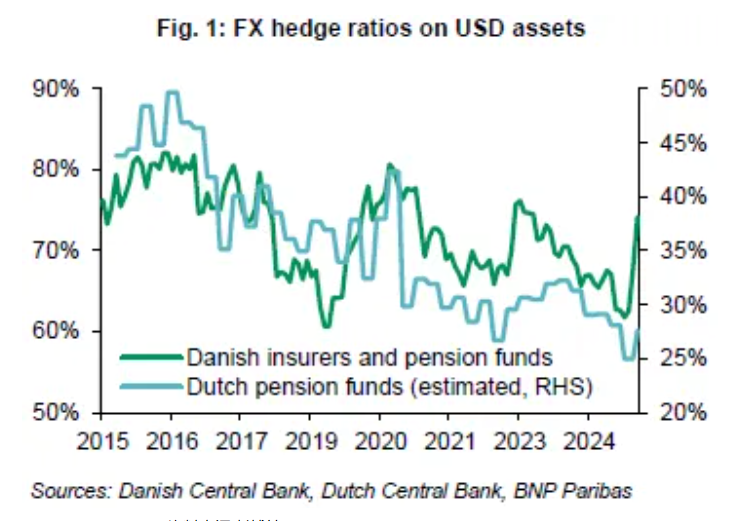
Group 1 - European pension funds are increasing their foreign exchange hedging, leading to significant dollar sell-offs, particularly in the Netherlands and Denmark, where unhedged dollar exposure has decreased from 23% to 20% of total assets [1] - Danish pension funds have reduced their dollar exposure by $37 billion since the beginning of the year, with a record hedging ratio of 74.2% in April [2] - The trend of hedging against dollar assets is gaining global attention, with many companies in Switzerland, Japan, and Australia still at historically low levels of currency protection [2] Group 2 - The dollar has weakened for five consecutive months, with a pessimistic indicator reaching extreme levels, suggesting a potential calm period for the dollar ahead of the Federal Reserve's next interest rate decision [3][6] - Despite the dollar's decline, traders are reducing their bearish bets on the dollar, indicating a shift in sentiment as recent economic data shows resilience in the U.S. economy [7][8] - The consensus on Wall Street remains that the dollar will continue to weaken, driven by tariff anxieties and softening economic data, with predictions pointing to further declines through 2025 [11]
美元走弱可能帮助比特币再次上涨
news flash· 2025-06-12 11:40
美元走弱可能帮助比特币再次上涨 金十数据6月12日讯,LMAX Group策略师Joel Kruger在一份报告中说,美元走弱,加上投资者冒险意愿 的增强,可能有助于再次提振比特币。由于贸易不确定性和对中东紧张局势的担忧,比特币下跌 1.7%。美元指数跌至97.789的三年低点。"美元的疲软通常有利于加密货币,随着投资者重新转向风险 更高的资产,比特币和以太坊的潜在反弹将得到支持。" ...
台币扬升创三年收盘高点 受美国降息预期助推
news flash· 2025-06-12 10:17
Core Viewpoint - Weak inflation data in the U.S. has fueled expectations for interest rate cuts by the Federal Reserve, leading to a further decline in the U.S. dollar and a significant appreciation of the New Taiwan Dollar (TWD) [1] Group 1 - The TWD experienced a rapid rise similar to the surge seen in early May, closing at its strongest level in three years [1] - The TWD appreciated nearly 1% against the U.S. dollar, reaching a peak of 29.625, the highest intraday level since May 5 [1] - The closing appreciation was reduced to 0.88%, with the final rate reported at 29.660 [1]
美元指数再探阶段性新低,上海金ETF(159830)盘中翻红,机构:贵金属中长期上行逻辑依然稳固
2 1 Shi Ji Jing Ji Bao Dao· 2025-06-06 06:20
Group 1 - International gold prices increased, with COMEX gold rising by 0.51% to $3392.6 per ounce as of the report [1] - Shanghai Gold ETF (159830) saw a slight increase of 0.09% in the afternoon, with a trading volume exceeding 17 million yuan, and it closely tracks Shanghai Gold (SHAU.SGE) [2] - The management fee for Shanghai Gold ETF is 0.25%, and the custody fee is 0.05%, both lower than the average for similar products, and it supports T+0 trading [2] Group 2 - The US dollar index fell by 0.07% to 98.74, reaching a near 32-day low, with a cumulative decline of nearly 9% this year [2] - East China Futures noted that the weakening dollar and weak US data supported a slight increase in precious metals, with expectations of short-term strength due to ongoing geopolitical risks and US economic weakness [2] - Debon Securities maintains a positive outlook on gold, citing ongoing uncertainties in global trade and the weakening global position of the US dollar as factors that could provide lasting support for gold prices [3]