避险需求

Search documents
白银td走势大幅上扬 避险需求升温支撑银价
Jin Tou Wang· 2026-01-06 03:04
Group 1 - Silver TD is currently trading above 18942, with an opening price of 18180 CNY/kg and a current price of 19154 CNY/kg, reflecting an increase of 5.25% [1] - The highest price reached today is 19208 CNY/kg, while the lowest was 18105 CNY/kg, indicating a bullish short-term trend for Silver TD [1] - The daily chart shows that Silver TD has recovered part of last week's decline, with strong bullish momentum indicated by the upward MACD histogram and the RSI entering the overbought zone [3] Group 2 - The short-term outlook for Silver TD remains bullish, with key support levels identified between 17500-18000 and resistance levels between 19000-19500 [3]
日度策略参考-20260106
Guo Mao Qi Huo· 2026-01-06 02:51
Report Industry Investment Rating No relevant information provided. Report Core Viewpoints - Short - term, the stock index may continue a relatively strong trend, but attention should be paid to the impact of overseas geopolitical events on market risk appetite. In the long - term, the stock index is expected to rise in 2026 based on 2025 [1]. - Asset shortage and weak economy are beneficial to bond futures, but the central bank has recently warned of interest - rate risks, and attention should be paid to the Bank of Japan's interest - rate decision [1]. - Different commodities have various trends, including price increases, oscillations, and potential reversals, with corresponding investment strategies recommended [1]. Summary by Related Catalogs Macro Finance - Short - term, the stock index may continue to be strong, and in the long - term (2026), it is expected to rise on the basis of 2025 due to factors like continuous policy efforts, inflation recovery, capital market reform, and the support of Central Huijin [1]. - Asset shortage and weak economy benefit bond futures, but the central bank warns of interest - rate risks, and the Bank of Japan's interest - rate decision should be watched [1]. Metals Non - ferrous Metals - Copper: The price has further increased due to weak industry fundamentals but positive macro sentiment and continuous premium. However, short - term adjustment risks should be guarded against, and the upward trend is expected to continue [1]. - Aluminum: Domestic electrolytic aluminum has accumulated inventory, but positive macro sentiment and the early fermentation of supply - tightness expectations are likely to keep the price strong [1]. - Alumina: The supply side has a large release space, and the weak industry fundamentals put pressure on the price. However, the current price is near the cost line, so it is expected to oscillate [1]. - Zinc: The fundamentals have improved, the cost center has moved up, recent negative factors have been mostly realized, and market sentiment is volatile, leading to price oscillations [1]. - Nickel: Positive macro sentiment, concerns about supply due to Indonesian events, slow inventory accumulation, and unconfirmed Indonesian policies are likely to keep the short - term price strong. It is recommended to go long at low prices and control risks [1]. - Stainless Steel: Positive macro sentiment, concerns about raw - material supply, a rebound in nickel - iron prices, a slight reduction in social inventory, and an increase in January production plans are likely to keep the short - term futures price strong. It is recommended to go long at low prices, and enterprises should wait for opportunities to sell and hedge [1]. - Tin: The industry association's initiative has put pressure on the price, but considering the tense situation in Congo - Kinshasa, the supply may still be affected. After a short - term decline, the downward space is limited, and low - long opportunities near the support level are recommended [1]. - Precious Metals: Geopolitical risks and international - order uncertainties have boosted the demand for hedging, making the price strong in the short - term. However, the high VIX of silver indicates potential risks. Platinum and palladium are expected to fluctuate widely in the short - term, and platinum can be bought at low prices or a [long - platinum short - palladium] arbitrage strategy can be adopted in the long - term [1]. Black Metals - Iron Ore: There is a combination of weak reality (weak direct demand, high supply, and inventory accumulation) and strong expectation (potential supply disturbances from energy - consumption control and anti - involution). The near - month contract is restricted by production cuts, while the far - month contract has upward potential [1]. - Steel (including Rebar): The valuation of the price is not high, and it is not recommended to short. Positions in cash - and - carry arbitrage can take rolling profits [1]. - Glass: Supply and demand are acceptable, and the valuation is low, so the downward space is limited, and it may be under pressure to oscillate [1]. - Soda Ash: It follows the trend of glass, with acceptable supply and demand, low valuation, and limited downward space, and may oscillate under pressure [1]. - Coking Coal: The fourth - round spot price cut has started. After the futures price dropped to the corresponding position and rebounded, attention should be paid to whether it can reach a new low during the implementation of the price cut. There is a high possibility of wide - range oscillations [1]. - Coke: The logic is the same as that of coking coal [1]. Energy and Chemicals - Crude Oil: OPEC + has suspended production increases until the end of 2026, the uncertainty of the Russia - Ukraine peace agreement, and US sanctions on Venezuelan oil exports have an impact on the price [1]. - Fuel Oil: The short - term supply - demand contradiction is not prominent, and it follows the trend of crude oil. The probability of the 14th Five - Year Plan's rush - work demand is falsified, the supply of Marey crude oil is sufficient, and the asphalt profit is high [1]. - Asphalt: The cost is strongly supported, the spot - futures price difference is low, and the mid - stream inventory may tend to accumulate [1]. - Rubber: For natural rubber, the mid - stream inventory may tend to accumulate, and the price oscillates. For BR rubber, the futures position has declined, the price increase has slowed down, the processing profit is gradually repaired, it maintains high - level operation in terms of production and inventory, and the spot trading is weak [1]. - PTA: The PX market has experienced a sharp increase, and the domestic PTA maintains high - level operation, benefiting from stable domestic demand and the recovery of exports to India since the end of November [1]. - MEG: Two sets of MEG devices in Taiwan, China, are planned to stop production due to efficiency reasons. The price has rebounded rapidly due to supply - side news, and the downstream polyester operating rate is over 90%, with better - than - expected demand [1]. - Short - fiber: The price continues to fluctuate closely following the cost [1]. - Styrene: The Asian styrene market is generally stable. Suppliers are reluctant to reduce prices due to continuous losses, while buyers keep pressing prices due to weak downstream demand and profit compression. The market is in a weak - balance state, and the short - term upward momentum depends on overseas market drive [1]. - Steam: The upward space is limited due to insufficient domestic demand, but there is support from anti - involution and the cost side [1]. - Propylene: The supply pressure is large, the downstream improvement is less than expected, the cost is strongly supported by high - level propylene monomers and rising crude - oil prices, and there is a risk of rising crude - oil prices due to intensified geopolitical conflicts [1]. - PVC: The global production in 2026 is expected to be low, but currently, new capacity is being released, the supply pressure is increasing, and the demand is weak [1]. - Chlorine: The inventory pressure in Shandong is large, the supply pressure is high due to high - level operation and few overhauls, the non - aluminum demand is in the off - season, and the cost support is weakened by the rising price of liquid chlorine [1]. - LPG: The January CP has risen unexpectedly, providing strong cost - end support. Geopolitical conflicts in the US, Venezuela, and the Middle East have increased the short - term risk premium. The EIA weekly C3 inventory is in an accumulation trend, with a temporary slowdown in overseas demand. The domestic PDH maintains high - level operation but is deeply in deficit, and the overseas olefin blending - oil demand is acceptable [1]. New Energy and Silicon Industry - Polysilicon: There is production increase in the northwest and decrease in the southwest. The December production plan has decreased. A capacity storage platform company has been established, with a long - term expectation of capacity reduction. The terminal installation in the fourth quarter has increased marginally. Large enterprises are willing to support the price but not to deliver. The short - term speculative sentiment is high [1]. - Lithium Carbonate: It is the traditional peak season for new - energy vehicles, the energy - storage demand is strong, the supply - side production resumption has increased, and the price has risen rapidly in the short - term [1]. Agricultural Products - Palm Oil: The MPOB December data is expected to be negative, but it may reverse under themes such as seasonal production reduction, the B50 policy, and US biodiesel. If the price gaps up due to geopolitical events, short - selling can be considered [1]. - Soybean Oil: It follows the trend of other oils in the short - term, and waiting for the January USDA report is recommended [1]. - Rapeseed Oil: News of blocked trader purchases and Australian seed imports has led to a large rebound in the single - side price and the 1 - 5 spread, but it is difficult to change the subsequent loosening of the fundamental situation. A decline in sentiment is expected, and short - selling on rebounds can be considered [1]. - Cotton: The domestic new - crop harvest is expected to be good, but the purchase price of seed cotton supports the cost of lint. The downstream operation rate remains low, but the yarn - mill inventory is not high, with rigid restocking demand. The cotton market is currently in a situation of "having support but no driver", and attention should be paid to factors such as the central government's No. 1 Document in the first quarter of next year, planting - area intentions, weather during the planting period, and peak - season demand [1]. - Sugar: There is a global surplus and a large supply of domestic new - crop sugar, with a strong consensus on short - selling. If the futures price continues to fall, the cost support is strong, but the short - term fundamentals lack continuous driving forces, and attention should be paid to changes in the capital side [1]. - Corn: The grass - roots grain - selling progress is relatively fast, the current port and downstream inventory levels are still low, and most traders have not started strategic inventory building. The spot price is expected to be strong in the short - term, and the futures price is expected to have limited decline and then maintain an oscillating and strengthening trend [1]. - Soybeans: Attention should be paid to the adjustment in the January USDA report and the impact of Brazilian harvest selling pressure on CNF premiums. The M05 contract is expected to be relatively weak, while the M03 - M05 spread is expected to be in a positive - arbitrage situation in the short - term, but caution should be exercised due to potential changes in customs policies, soybean auctions, and directional policies [1]. - Pulp: The 05 contract is expected to oscillate in the range of 5400 - 5700 yuan/ton due to the tug - of - war between "strong supply" and "weak demand" [1]. - Logs: The spot price has shown signs of bottom - rebounding, and the downward space of the futures price is limited. However, the January overseas quotation has slightly declined, and there is a lack of upward - driving factors in the spot - futures market. It is expected to oscillate in the range of 760 - 790 yuan/m³ [1]. Livestock - Hogs: The spot price has gradually stabilized recently, with demand support. The slaughter weight has not been fully cleared, and the production capacity still needs to be further released [1].
贵金属数据日报-20260106
Guo Mao Qi Huo· 2026-01-06 02:51
Group 1: Report Industry Investment Rating - No information provided Group 2: Core Viewpoints of the Report - The price of precious metals strengthened due to the escalation of geopolitical risks caused by the US military strike on Venezuela, and the geopolitical trend is expected to continue supporting precious metal prices in the short - term [6]. - The spot silver price maintains a high premium, indicating a tight supply pattern that supports the silver price, but there may be game risks. It is recommended to pay attention to important US economic data, the new Fed chairperson, and the results of key mineral tariffs [6]. - Based on the gold - silver ratio at a near - decade low, it is recommended to focus on the opportunity of buying gold on dips [6]. - In the long - term, the Fed is in an easing cycle, geopolitical uncertainty will persist, dollar credit risk will increase, and the allocation demand of global central banks, institutions, and residents is expected to continue. Gold prices are likely to move upward, and long - term investors are advised to buy on dips [7]. Group 3: Summary by Relevant Catalogs 1. Price Tracking - **15 - point price of internal and external gold and silver on January 5, 2026**: London gold spot was $4420.31/ounce, London silver spot was $75.44/ounce, COMEX gold was $4429.90/ounce, COMEX silver was $75.25/ounce, AU2602 was 995 yuan/gram, AG2602 was 18260 yuan/kilogram, AU (T + D) was 992.10 yuan/gram, and AG (T + D) was 18296 yuan/kilogram. Compared with December 31, 2025, the price increases were 2.1%, 4.9%, 2.1%, 5.2%, 1.8%, 6.8%, 1.6%, and 7.1% respectively [5]. - **Price difference/ratio on January 5, 2026**: The gold TD - SHFE active price difference was - 2.9 yuan/gram, the silver TD - SHFE active price difference was 36 yuan/kilogram, the gold internal - external (TD - London) price difference was - 5.98 yuan/gram, the silver internal - external (TD - London) price difference was - 843 yuan/kilogram, the SHFE gold - silver main ratio was 54.49, the COMEX gold - silver main ratio was 58.87, AU2604 - 2602 was 2.30 yuan/gram, and AG2604 - 2602 was - 13 yuan/kilogram. Compared with December 31, 2025, the changes were 267.1%, - 256.5%, 293.8%, - 26.0%, - 4.7%, - 3.0%, - 12.2%, and - 55.2% respectively [5]. 2. Position Data - **As of January 2, 2026**: Gold ETF - SPDR was 1065.13 tons, silver ETF - SLV was 16444.13962 tons, COMEX gold non - commercial long positions were 290161 contracts, non - commercial short positions were 49461 contracts, non - commercial net long positions were 240700 contracts, COMEX silver non - commercial long positions were 55243 contracts, non - commercial short positions were 19359 contracts, and non - commercial net long positions were 35884 contracts. Compared with December 31, 2025, the changes were - 0.51%, 0.00%, 3.29%, 5.37%, 2.87%, - 1.41%, - 1.64%, and - 1.29% respectively [5]. 3. Inventory Data - **On January 5, 2026**: SHFE gold inventory was 97704 kilograms, and SHFE silver inventory was 669547 kilograms. Compared with December 31, 2025, the changes were 0.00% and - 3.19% respectively. As of January 2, 2026, COMEX gold inventory was 36402970 troy ounces, and COMEX silver inventory was 449773368 troy ounces. Compared with December 31, 2025, the changes were 0.41% and 0.08% respectively [5]. 4. Interest Rate/Exchange Rate/Stock Market - **On January 5, 2026**: The US dollar/renminbi central parity rate was 7.02. As of January 2, 2026, the US dollar index was 98.46, the 2 - year US Treasury yield was 3.47%, the 10 - year US Treasury yield was 4.19%, VIX was 14.51, the S&P 500 was 6858.47, and NYMEX crude oil was 57.33. Compared with December 31, 2025, the changes were - 0.08%, 0.19%, 0.00%, 0.24%, - 2.94%, 0.19%, and - 0.14% respectively [5]. 5. Market Review - On January 5, the main contract of Shanghai gold futures closed up 1.4% to 995 yuan/gram, and the main contract of Shanghai silver futures closed up 1.16% to 18247 yuan/kilogram [5]. 6. Influencing Factor Analysis - The US military strike on Venezuela over the weekend led to increased geopolitical risks and uncertainty in the international order. The recovery of safe - haven demand drove up precious metal prices. The geopolitical situation is expected to continue supporting precious metal prices in the short - term [6]. - The silver spot price maintains a high premium, indicating a tight supply pattern that supports the silver price. However, there may be game risks. It is recommended to pay attention to important US economic data, the new Fed chairperson, and the results of key mineral tariffs [6]. 7. Medium - and Long - Term Viewpoints - In the long - term, the Fed is in an easing cycle, geopolitical uncertainty will persist, dollar credit risk will increase, and the allocation demand of global central banks, institutions, and residents is expected to continue. Gold prices are likely to move upward, and long - term investors are advised to buy on dips [7].
黄金期货再涨3%,突破4450美元关口
Huan Qiu Wang· 2026-01-06 01:23
Group 1 - The core viewpoint of the articles highlights a significant increase in international precious metal futures, with COMEX gold futures rising by 3.00% to $4459.70 per ounce and COMEX silver futures increasing by 7.74% to $76.51 per ounce, driven by geopolitical tensions and a reassessment of asset safety and financial sovereignty by multiple countries [1][4] - Analysts suggest that the current low interest rate environment is favorable for non-yielding assets like gold, particularly during periods of geopolitical or economic uncertainty, as investors evaluate the broader impacts of recent geopolitical tensions [4] - The expectation of at least two interest rate cuts by the Federal Reserve this year is influencing market sentiment, with projections indicating a substantial rise in gold prices by 64% in 2025, marking the best annual performance since 1979, attributed to declining interest rates, increased demand for safe-haven assets, and inflows into equity trading funds [1]

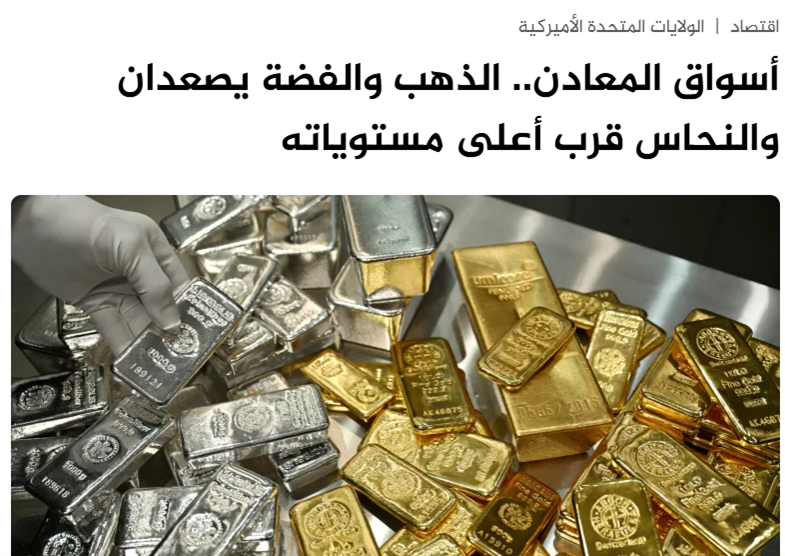
纽约金价5日涨超130美元 银价大涨超7%
Xin Hua Cai Jing· 2026-01-06 01:04
Group 1 - The core viewpoint of the articles highlights the significant rise in gold and silver prices due to geopolitical tensions, particularly the U.S. military action in Venezuela, which has increased safe-haven demand [1][2] - On February 5, 2026, the most actively traded gold futures price rose by $130.1, closing at $4459.70 per ounce, marking a 3.00% increase [1] - Silver futures for March delivery saw a substantial increase of 7.74%, closing at $76.51 per ounce [3] Group 2 - The World Gold Council reported that gold prices experienced a correction in the last week of 2025 but still rose by 67% for the entire year, the best performance since 1979 [2] - Geopolitical instability is expected to continue driving gold demand and price trends in 2026, with market attention on the Federal Reserve's actions, including personnel changes and interest rate policies [2] - Technical analysis indicates that the next bullish target for February gold futures is to break through the strong resistance level of $4584, while the bearish target is to fall below the support level of $4200 [2]
张尧浠:避险与宽松双驱动、金价仍有牛市新高前景
Sou Hu Cai Jing· 2026-01-06 00:50
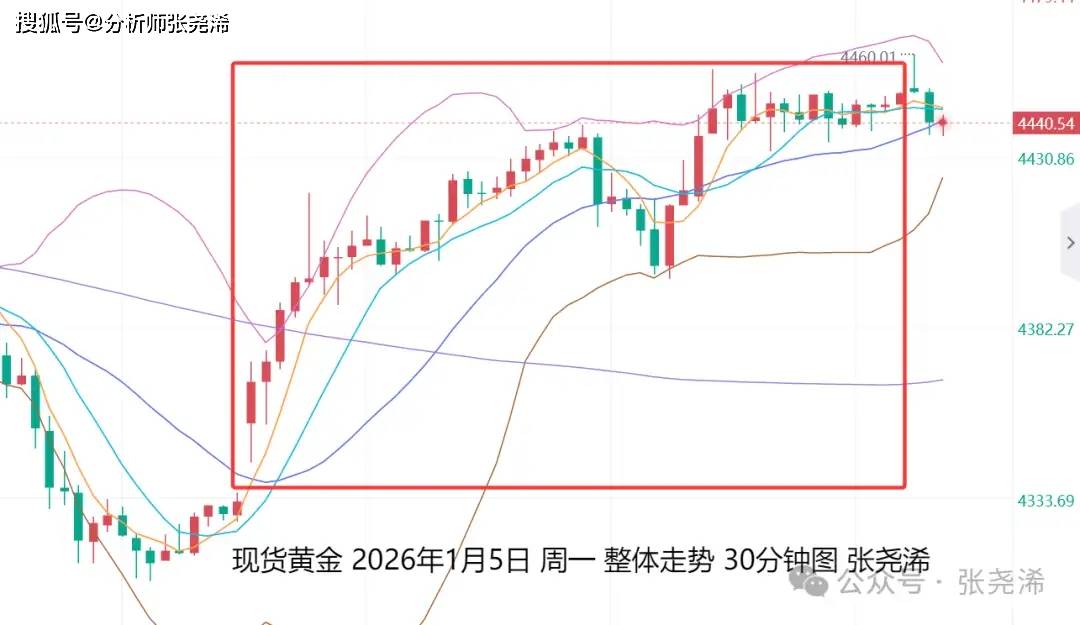
Core Viewpoint - The international gold price has shown strong upward momentum due to the geopolitical situation in Venezuela, reaching a high of $4,455.48 and closing at $4,448.83, marking a significant increase of 2.78% from the previous close of $4,328.35 [1][3][5] Price Movement - Gold opened at $4,346.46 per ounce, recorded a low of $4,344.06, and then rebounded to a high of $4,455.48 during the day, ultimately closing at $4,448.83 with a daily range of $111.42 [3][5] - The market is currently observing a potential pullback due to profit-taking and anticipation of key economic data releases, such as the non-farm payroll report [3][5] Market Outlook - If geopolitical tensions escalate or if U.S. economic data strengthens expectations for aggressive monetary easing by the Federal Reserve, gold prices may challenge historical highs again [3][5] - The market anticipates at least two rate cuts by the Federal Reserve by 2026, which could provide further support for gold prices [5] Technical Analysis - On a monthly basis, gold prices have shown a significant pullback, indicating potential risks of a larger correction towards the $4,000-$3,900 range [7] - However, if the current momentum continues, there is potential for gold to reach $5,500-$6,000 [7] - Weekly analysis suggests that while there may be a pullback towards the 10-week moving average at $4,230, the overall trend remains bullish, providing opportunities for re-entry into long positions [7][9] Support and Resistance Levels - Key support levels for gold are identified at $4,410 and $4,380, while resistance levels are at $4,480 and $4,500 [9] - For silver, support is noted at $75.10 and $74.10, with resistance at $78.00 and $79.30 [9]
黄力晨:地缘风险快速升温 支撑黄金强势上涨
Xin Lang Cai Jing· 2026-01-05 12:07
Core Viewpoint - The gold market remains bullish due to expectations of interest rate cuts by the Federal Reserve, geopolitical tensions, and strong central bank buying, with short-term price movements expected to oscillate at high levels [1][5][6]. Group 1: Market Dynamics - Gold prices experienced fluctuations, testing the $4400 level multiple times, reaching a high of $4402 before retreating to a low of $4309, stabilizing above $4300 [1][5]. - On the following Monday, gold opened higher, breaking through the $4400 resistance and peaking at $4438, currently trading around $4434, aligning with the bullish fundamentals [1][5]. Group 2: Technical Analysis - Short-term technical indicators suggest a need for a rebound, with support levels identified at $4353, $4324, and $4300, while resistance levels are at $4400 and $4450 [1][5]. - The daily chart indicates a strong upward movement, with the potential for further gains if gold maintains above the $4400 support level, which coincides with the 10-day moving average [6][7]. Group 3: External Influences - Recent military actions by the U.S. against Venezuela have heightened market risk aversion, boosting demand for gold as a safe-haven asset [2][3][6]. - The increase in margin requirements for precious metals futures by the CME has led some investors to take profits, contributing to short-term selling pressure, but overall demand remains supported by interest rate cut expectations and central bank purchases [2][6].
有色金属ETF基金(516650)涨2.3%,7日吸金39亿
Sou Hu Cai Jing· 2026-01-05 05:48
Group 1 - The core viewpoint of the news highlights a strong performance in the non-ferrous metals sector, with gold, silver, copper, aluminum, and zinc all showing gains, leading to an increase in related ETFs [1][2] - The recent military action by the U.S. against Venezuela has heightened market risk aversion, pushing spot gold above $4,400 and silver to $75 per ounce [2] - Supply concerns are exacerbated by worker strikes in copper mines, pushing LME copper prices close to $13,000 per ton, nearing record highs [2] Group 2 - The aluminum price has surpassed $3,000 per ton for the first time in over three years, driven by tightening supply and long-term demand expectations [2] - The non-ferrous metals ETF (516650) has seen a net inflow of 3.96 billion yuan over the past seven days, with a 2.3% increase, and has a balanced allocation in copper (33.8%), aluminum (15.7%), and gold (11.9%) [3] - The gold stock ETF (159562) also increased by 2.3%, focusing on gold and copper, while the gold ETF Huaxia (518850) rose by 1.65%, with a net inflow of 1.299 billion yuan over the past 20 days [3]
贵金属数据日报-20260105
Guo Mao Qi Huo· 2026-01-05 03:30
Report Summary 1. Report Industry Investment Rating No information provided. 2. Core Viewpoints - In the short term, precious metal prices are expected to fluctuate widely at high levels. Given the high basis of Shanghai silver, there is a risk of significant price fluctuations in silver. Key events such as the US January non - farm payrolls, the announcement of the new Fed chairperson, and the possible announcement of US critical mineral tariffs at the end of the month should be monitored [3]. - In the long term, the Fed remains in an easing cycle. Global geopolitical uncertainties will persist due to intensified great - power competition and de - globalization. The huge US debt and weakened Fed independence will increase the credit risk of the US dollar. The allocation demand of global central banks, institutions, and residents is likely to continue, so the long - term price center of gold is likely to move upward. Long - term investors are advised to mainly allocate by buying on dips [3]. 3. Summary by Relevant Catalogs 3.1 Price Tracking - **Precious Metal Prices**: On December 31, 2025, London gold spot was at $4329.08/ounce, London silver spot at $71.93/ounce, COMEX gold at $4340.70/ounce, and COMEX silver at $71.54/ounce. Compared with December 30, 2025, the prices of gold and silver decreased, with gold down about 0.8% - 0.9% and silver down about 3.8% [3]. - **Price Differences**: On December 31, 2025, the gold TD - SHFE active price difference was - $0.79/gram, and the silver TD - SHFE active price difference was - $23/kg. The price differences between domestic and foreign markets also changed, with some showing significant percentage changes [3]. 3.2 Position Data - **ETF Positions**: As of January 2, 2026, the gold ETF - SPDR position was 1065.13 tons, a decrease of 0.51% compared with December 31, 2025. The silver ETF - SLV position remained unchanged at 16444.13962 tons [3]. - **COMEX Non - commercial Positions**: The non - commercial long and short positions of COMEX gold and silver also changed. For example, the non - commercial long position of COMEX gold increased by 3.29% from December 31, 2025, to January 2, 2026 [3]. 3.3 Inventory Data - **SHFE Inventory**: As of December 31, 2025, the SHFE gold inventory was 97704.00 kg, unchanged from December 30, 2025, and the SHFE silver inventory was 691638.00 kg, a decrease of 8.48% [3]. - **COMEX Inventory**: As of January 2, 2026, the COMEX gold inventory was 36402970 troy ounces, an increase of 0.41% compared with December 31, 2025, and the COMEX silver inventory was 449773368 troy ounces, an increase of 0.08% [3]. 3.4 Interest Rates, Exchange Rates, and Stock Markets - **Exchange Rates**: On December 31, 2025, the US dollar/Chinese yuan central parity rate was 7.03, with a decrease of 0.09% compared with December 30, 2025 [3]. - **Interest Rates and Stock Indexes**: On January 2, 2026, the US dollar index was 98.46, up 0.19% compared with December 31, 2025. The 2 - year US Treasury yield was 3.47%, unchanged, and the 10 - year US Treasury yield was 4.19%, up 0.24%. The VIX index decreased by 2.94%, the S&P 500 index increased by 0.19%, and NYMEX crude oil decreased by 0.14% [3]. 3.5 Market Review and Influencing Factors - **Market Review**: On December 31, 2025, the main contract of Shanghai gold futures closed down 0.65% to 977.56 yuan/gram, and the main contract of Shanghai silver futures closed down 4.27% to 1707 yuan/kg. During the New Year's Day holiday, as of January 2, London spot gold rose about 0.08% and London spot silver rose about 1.25% compared with the 15:00 closing on December 31 [3]. - **Influencing Factors**: Geopolitical tensions in Iran, Venezuela, etc., during the New Year's Day holiday boosted the demand for safe - haven assets, supporting precious metal prices. However, the relatively strong US dollar index and US Treasury yields limited the upward space of precious metal prices. The silver spot market remained tight, and the price differences showed certain trends [3].
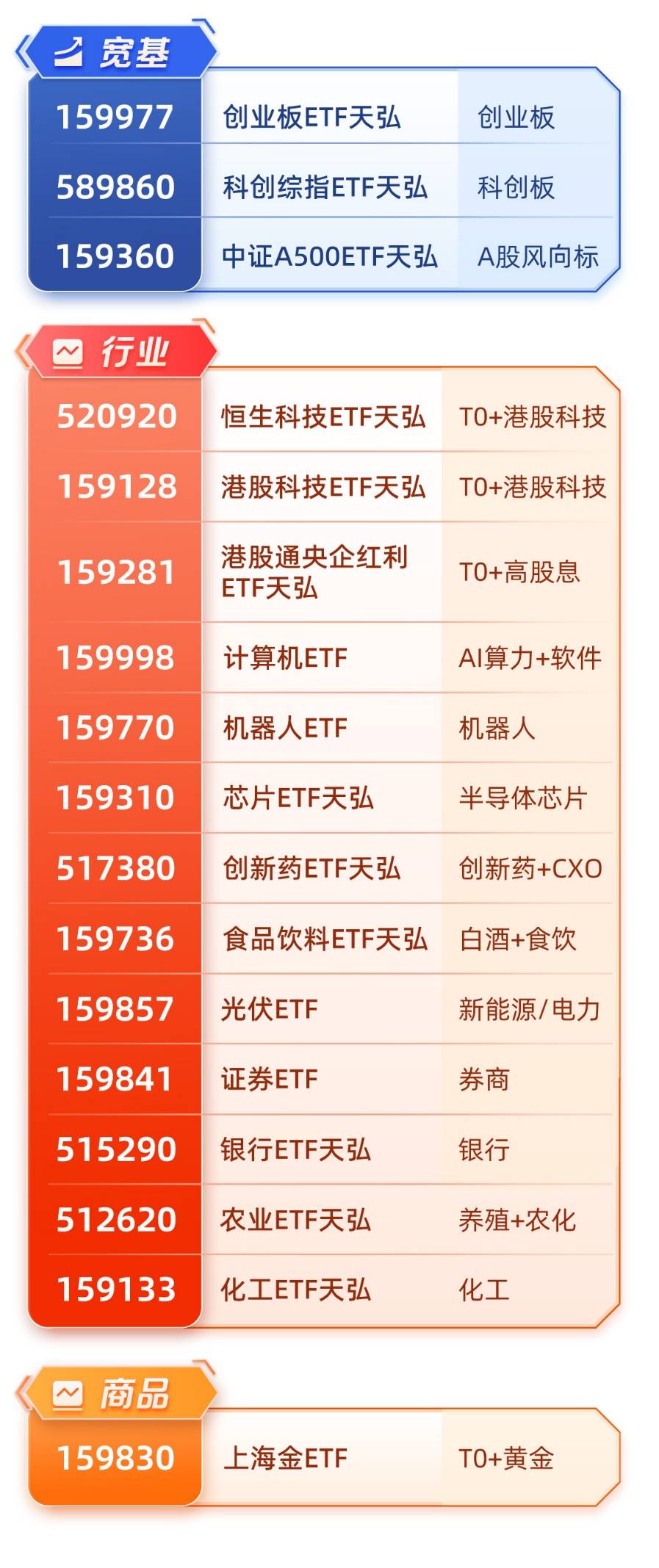
地缘冲突再起!避险需求推动黄金大涨,上海金ETF(159830)最新单日净流入1.54亿元,最新份额创成立以来新高
Sou Hu Cai Jing· 2026-01-05 03:18
Core Viewpoint - The Shanghai Gold ETF (159830) has seen significant trading activity and inflows, driven by rising gold prices due to geopolitical tensions, with expectations for continued price increases in 2026 [1][2][5]. Trading Activity - As of December 31, 2025, the Shanghai Gold ETF (159830) had a turnover rate of 4.53% and a transaction volume of 110 million yuan [1]. - The latest share count for the Shanghai Gold ETF reached 267 million, marking a new high since its inception [1]. Fund Inflows - The Shanghai Gold ETF (159830) recorded a net inflow of 154 million yuan recently, with a total of 178 million yuan accumulated over the past eight trading days [2]. Product Highlights - The Shanghai Gold ETF (159830) closely tracks the Shanghai Gold (SHAU.SGE) and has a management fee of 0.25% and a custody fee of 0.05%, both lower than the average for similar products. The ETF also supports T+0 trading [3]. Market Context - Geopolitical conflicts have reignited, leading to increased demand for gold as a safe haven, with spot gold prices rising above 4,400 USD per ounce, peaking at 4,420 USD per ounce [5]. - Analysts from CITIC Securities predict that gold prices will benefit from a liquidity easing environment due to potential interest rate cuts by the Federal Reserve, with expectations for gold prices to reach new highs in 2026, although the growth rate may slow to 10%-15% [5].