资产荒

Search documents
【十大券商一周策略】3500点后,A股咋走?7月,不错!8—9月,风险较大!
券商中国· 2025-07-13 15:03
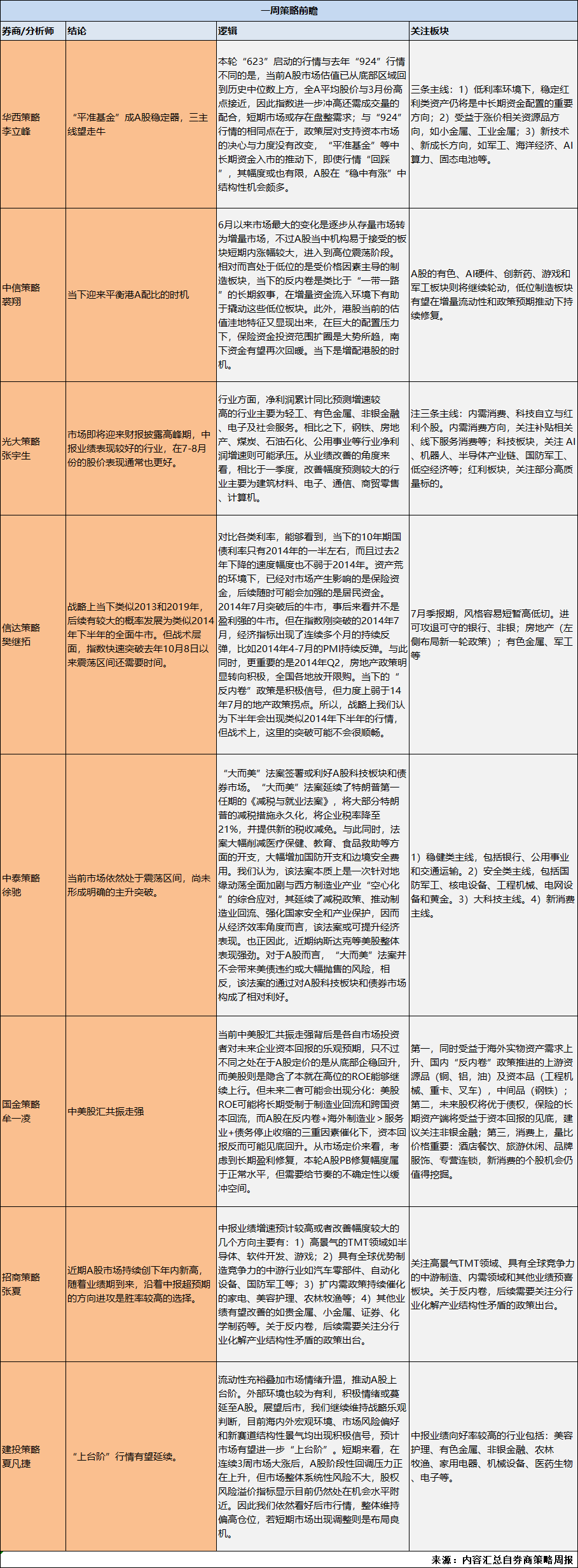
Group 1 - The current market is transitioning from a stock market to an incremental market, with A-shares experiencing high volatility in certain sectors while manufacturing sectors remain undervalued [1] - The "anti-involution" narrative is compared to the "Belt and Road" initiative, suggesting that it will help stimulate low-performing sectors in the context of increased capital inflow [1] - The valuation gap in Hong Kong stocks is becoming apparent, with insurance funds likely to expand their investment scope, indicating a favorable time to increase allocations to Hong Kong stocks [1] Group 2 - The "anti-involution" policy is expected to anchor the basic expectations of the midstream manufacturing sector, with short-term investment opportunities becoming more apparent [2] - The passing of the "Big and Beautiful" bill in the U.S. is expected to enhance fiscal stimulus, reducing the risk of a deep recession and improving visibility for China's supply-demand dynamics by 2026 [2] - The market has already begun to reflect a "bull market atmosphere," with the Shanghai Composite Index breaking through key levels, enhancing risk appetite and spreading profit-making effects [2] Group 3 - A-share market performance has been strong, driven by the upward trend in U.S. stocks and the positive impact of technology leaders reaching new highs [3] - The "anti-involution" policy is expected to alleviate domestic price pressures, with the upcoming earnings season providing a favorable environment for stocks with positive earnings forecasts [3] - The overall earnings improvement rate for A-shares is higher than the same period last year, indicating structural opportunities in high-growth TMT sectors and competitive midstream manufacturing [3] Group 4 - The "transformation bull market" is gaining momentum, driven by a systematic reduction in market discount rates and a favorable shift in economic structure [4] - The willingness of investors to accept risk is increasing, suggesting that the market may consolidate before making new highs [4] - Short-term focus should be on the "anti-involution" theme, with a rotation towards growth sectors continuing [4] Group 5 - Investment strategies should focus on three main areas: AI technology breakthroughs, consumer stock valuation recovery, and the rise of undervalued assets [5] - The recovery cycle in consumer stocks is supported by low valuations, declining interest rates, and policy catalysts, indicating potential opportunities in the sector [5] Group 6 - The capital return in A-shares is expected to stabilize and recover due to the "anti-involution" policy and the cessation of debt contraction [6] - The combination of domestic manufacturing recovery and overseas capital return will enhance the attractiveness of A-shares compared to other markets [6] - Recommended investment strategies include focusing on upstream resource products and capital goods that benefit from both domestic and international trends [6] Group 7 - The current market conditions resemble those of 2014, with a significant disconnect between market performance and earnings [7] - The "anti-involution" policy is seen as a positive signal, although its impact may be weaker than previous real estate policy shifts [7] - The market is expected to experience a similar trend to the second half of 2014, but tactical breakthroughs may not be smooth [7] Group 8 - The A-share index has recently surpassed 3500 points, with financial sectors and technology themes driving market momentum [8] - The market's valuation has recovered from the bottom, indicating that further gains will require increased trading volume [8] - Structural opportunities are abundant, with a focus on stable dividend assets, resource products, and new technology sectors [8] Group 9 - The core drivers of the current market breakthrough include rising policy expectations, the "anti-involution" investment theme, and improved trading activity [9] - July is viewed as a favorable window for investment, with a focus on TMT, non-bank financials, and military sectors [9] - The AI computing sector's performance is closely tied to the strong results of benchmark U.S. stocks, influencing A-share valuations [9] Group 10 - The market is in a new bullish phase, with investor sentiment improving and incremental capital entering the market [10] - The "anti-involution" policy is expected to alleviate income stagnation, potentially leading to a new phase of market growth [10] - Investment strategies should focus on sectors related to the "anti-involution" theme, stable currencies, and sectors with positive earnings forecasts [10]


6万亿金融债变局
Bei Jing Shang Bao· 2025-07-13 13:48
Core Viewpoint - The financial system is undergoing a significant shift towards debt issuance, with over 6 trillion yuan raised in the first half of the year, marking a record high for the period. This trend reflects a change in the financial logic of low-interest rates, where issuing bonds has become a more attractive option compared to attracting deposits [1][3]. Group 1: Financial Institutions' Debt Issuance - Financial institutions have collectively issued 6.05 trillion yuan in bonds as of July 10, 2025, representing a 17.34% increase year-on-year. Commercial banks lead with 5.38 trillion yuan, followed by securities firms and insurance companies [3][7]. - The importance of financial bonds has escalated from a supplementary option in liability management to a strategic tool for financial institutions [4][5]. - The current low-interest environment has made financial bonds a cost-effective means for institutions to raise funds, often at rates lower than traditional deposit rates [7][8]. Group 2: Market Dynamics and Trends - The financial bond market has seen a significant expansion since 1998, with various types of bonds being issued by different financial entities, including policy banks and commercial banks [6]. - The issuance of green financial bonds and technology innovation bonds has surged, directing funds towards key sectors like small enterprises and green industries, thus supporting economic transformation [16][15]. - The demand for financial bonds among institutional investors has increased, driven by the need for stable returns and risk diversification in a low-interest environment [14][13]. Group 3: Economic Implications - Financial bonds play a crucial role in alleviating debt burdens by allowing institutions to replace high-cost short-term debts with lower-cost long-term financing [15]. - The central bank's monetary policy, which remains accommodative, is expected to further enhance the attractiveness of financial bonds by keeping financing costs low [17][18]. - The shift in funding strategies among financial institutions reflects broader economic adjustments, with financial bonds serving as a balancing tool in response to market fluctuations [9][12].

A股分析师前瞻:指数行情的持续性与中报预增方向
Xuan Gu Bao· 2025-07-13 13:28
Core Viewpoint - The current A-share market is experiencing a shift from a stock market dominated by existing shares to one driven by new capital inflows, with a potential for structural opportunities despite short-term consolidation needs [1][3]. Group 1: Market Trends and Strategies - The "623" market rally is distinct from last year's "924" rally, as the A-share market valuation has risen from the bottom to above the historical median, indicating that further index gains require volume support [1][3]. - The strategy outlook suggests a high probability of a market trend similar to the comprehensive bull market of the second half of 2014, driven by low interest rates and potential increases in resident capital inflows [2][4]. - The current 10-year government bond yield is approximately half of what it was in 2014, with a significant decline over the past two years, indicating a favorable environment for market growth [4]. Group 2: Sector Performance and Opportunities - Sectors expected to perform well in the upcoming earnings season include high-growth TMT areas such as semiconductors, software development, and gaming, as well as midstream industries with global competitive advantages like automotive parts and defense [2][3]. - The ongoing domestic demand expansion policies are likely to benefit sectors such as home appliances, beauty care, and agriculture, while other sectors like precious metals and pharmaceuticals are also anticipated to show performance improvements [2][3]. - The market is expected to see better stock performance in July and August for industries with strong mid-year earnings reports, particularly in consumer sectors and technology [3][5].
策略周报:可能重演14年下半年-20250713
Xinda Securities· 2025-07-13 10:45
Core Insights - The report suggests that the market performance has decoupled from earnings since September last year, resembling the period from 2013 to 2015. In the early stages of PPI decline, negative impacts on earnings dominated, but as PPI remained negative for a sufficient duration, policy and liquidity factors improved, leading to a decoupling of market performance from earnings [2][10][11] - The current macro-level asset shortage may exceed that of 2014. If the bull market is driven by liquidity and policy rather than earnings, the logic of asset scarcity becomes more significant. The current 10-year government bond yield is about half of that in 2014, and the rate of decline over the past two years is comparable to that of 2014 [3][20][22] - Insurance funds have already impacted the market, and there is potential for increased inflow from household funds. Since the pandemic in 2020, household deposits have risen rapidly, but their inflow into the stock market has been limited due to the lack of a stable profit-making effect. With the market transitioning from bearish to bullish since September last year, conditions for accelerated household fund inflow are gradually being met [22][24] Market Changes - The report indicates that the A-share market has seen significant increases in major indices, with the ChiNext 50 rising by 2.65% and the ChiNext Index by 2.36%. In contrast, sectors like coal and banking have experienced declines [38][42] - Global stock markets have shown mixed performance, with indices such as Germany's DAX and France's CAC40 performing well, while indices in Brazil and Mexico have declined [39] - The report notes a net inflow of 241.19 billion yuan from southbound funds (Hong Kong Stock Connect) this week, indicating strong market interest [40][48]
“存款搬家”浪潮下,理财揽客又有新招!
第一财经· 2025-07-13 07:50
Core Viewpoint - A wave of "deposit migration" is sweeping the wealth management market as deposit rates continue to decline, leading to a significant shift of funds from traditional bank deposits to wealth management products and non-bank financial institutions [1][10]. Group 1: Trends in Wealth Management - Wealth management companies are adopting various strategies in response to the influx of funds, including lowering fees, introducing floating fee rate products, and offering customized wealth management solutions [1]. - The emergence of floating fee rate products, such as the one launched by China Merchants Bank, links management fees to performance, which has garnered strong market interest, with products selling out on the first day [3][4]. - The rise of "interest-subsidized wealth management" strategies, where additional yield is provided by partner institutions, is becoming popular, although it may pose risks to other investors [1][11]. Group 2: Market Dynamics - The wealth management market is undergoing structural changes, with a record increase in non-bank financial institution deposits, indicating a shift in investor behavior towards money market funds and cash management products [10]. - Despite the growth in the market, there is a contraction in the supply of quality assets, leading to a situation where the demand for high-quality assets exceeds supply, putting pressure on product yields [10]. - The competitive landscape is intensifying, with firms innovating to differentiate their products, as even small yield advantages can significantly influence fund flows [10]. Group 3: Risks and Challenges - The introduction of floating fee rate products raises the bar for investment research and risk management capabilities within wealth management firms, as they must adapt to more complex product designs [12]. - The "interest-subsidized" model, while attractive for growth, may harm the interests of other investors and could lead to liquidity risks if not managed properly [11]. - Firms face challenges in educating investors about the complexities of floating fee structures, which may lead to misunderstandings and potential disputes [12].

吵翻了!银行股走成段子,多空观点刷屏!工行刚超美银,四大行冲顶全球,A股银行巨头大变脸,见顶了吗?
雪球· 2025-07-12 07:46
Core Viewpoint - The article discusses the recent performance of bank stocks, highlighting the significant rise in their market value and the potential for further growth or correction in the future [1][2][5]. Group 1: Market Performance - As of July 11, the total market capitalization of the five major banks (ICBC, ABC, BOC, CCB, and CMB) reached approximately 9.87 trillion yuan, nearing the 10 trillion yuan mark [7]. - ICBC has surpassed Bank of America, becoming the second-largest commercial bank globally, with a market capitalization of around 2.7 trillion yuan [7][9]. - The A-share banking sector has seen a substantial increase, with some banks like SPDB, Qingdao Bank, and Xiamen Bank experiencing year-to-date gains exceeding 36% [5][11]. Group 2: Dividend Trends - The current period marks a peak for cash dividends among listed banks, with total cash dividends for 2024 projected to reach 631.96 billion yuan, a year-on-year increase of 3.03% [11]. - ICBC leads in annual dividends with 109.77 billion yuan, while CCB follows with 100.75 billion yuan [11]. - CMB announced a cash dividend of 2.00 yuan per share, totaling approximately 50.44 billion yuan, reflecting a high dividend payout ratio of 33.99% [11]. Group 3: Global Context - Bank stocks have shown strong performance globally, with indices in various regions, including the US, Europe, and Japan, rising over 50% [13]. - The global banking sector's performance is attributed to a common macroeconomic environment, where banks are viewed as stable, dividend-paying assets amid economic uncertainties [13][17]. Group 4: Investment Logic - The article outlines several key investment rationales for the recent surge in bank stocks, including the end of negative sentiment in the real estate sector, a shift towards defensive investment strategies, and the undervaluation of bank stocks [15][16]. - The banking sector is perceived as a safe haven for investors seeking stable returns, especially in a low-growth economic environment [15][16].


债券ETF快速发展的启示
Zheng Quan Shi Bao· 2025-07-11 17:17
Core Viewpoint - The rapid development of bond ETFs in China is driven by a combination of declining market interest rates, regulatory support, and the need for diversified investment options in a complex bond market [1][2][3] Group 1: Market Overview - As of June 2023, the scale of bond ETFs reached 350 billion yuan, nearly doubling from early 2022, indicating a significant growth rate compared to stock ETFs [1] - The Chinese bond market has a total outstanding size exceeding 188 trillion yuan, with nearly 9,000 bonds listed on the Shanghai Stock Exchange alone, contributing to a diverse investment landscape [1] Group 2: Factors Driving Growth - The decline in market interest rates, with one-year deposit rates falling below 1%, has led investors to seek better returns in the bond market, despite a similar decline in bond yields [1][2] - The emergence of bond ETFs addresses the challenges faced by investors in selecting individual bonds, providing a clear investment direction and convenient liquidity [2] - Regulatory improvements, including faster ETF approvals and the development of the Bond Connect program, have enhanced market liquidity and facilitated the expansion of bond ETFs [2] Group 3: Future Potential - Despite the rapid growth, bond ETFs currently represent only 1.9% of the overall bond market, indicating substantial room for further development [3] - The ongoing evolution towards indexation and institutionalization in the investment market highlights the need for qualified management and quality financial products to meet investor demands [3]
银行股不可盲目追高
Hua Xia Shi Bao· 2025-07-11 10:23
Group 1 - The core viewpoint of the articles indicates that bank stocks have replaced long-term government bonds as the preferred investment choice in 2025, with all banks experiencing price increases and many reaching historical highs [1][2] - In 2025, 18 banks have set historical highs, with 16 banks increasing by over 20% and 32 banks by over 10%, while the Shenwan Bank Index has risen by 35.49% in the past year [1] - The rise in bank stocks is attributed to economic pressures leading investors to seek high-dividend sectors, similar to the previous year's trend with long-term bonds [1][2] Group 2 - Insurance funds, which were previously focused on local government bonds and real estate bonds, have shifted to bank stocks due to their high dividends that cover liability costs [2] - As of Q1 2025, insurance institutions hold A-share bank stocks valued at 265.78 billion, accounting for 45.05% of their heavy industry allocation [2] - Policy changes have facilitated insurance investments in bank stocks, with multiple instances of insurance companies increasing their stakes in banks in 2025 [2] Group 3 - The issuance of secondary capital bonds and perpetual bonds by commercial banks has accelerated, with over 800 billion issued in 2025, indicating strong capital-raising efforts [3] - The average price-to-book ratio for A-share listed banks was 0.74 as of July 11, 2025, with the highest being 1.09 for China Merchants Bank [3] Group 4 - The price-to-book ratio for major banks has nearly doubled since its lowest point in November 2022, driven by policy support and asset scarcity [4] - The sustainability of the current rise in bank stocks is questioned, as policy support has limits and is aimed at improving the financial health of banks [4] Group 5 - Despite the current profitability of commercial banks, net interest margins are declining, and asset growth is slowing, which may lead to reduced profit growth in the future [5] - The total assets of commercial banks grew by 7.2% year-on-year in Q1 2025, but this is a significant decrease from the previous year's growth of 11.7% [5] Group 6 - Future banking strategies may involve reducing asset scales to alleviate capital pressure, suggesting limited upward momentum for bank stock prices [6] - The rise in bank stock prices is viewed as a temporary phenomenon, and investors are advised to approach with caution [6]





【财经分析】“吸金”能力持续增强 熊猫债市场“声量”渐起
Xin Hua Cai Jing· 2025-07-11 09:01
Group 1 - The issuance of Panda bonds has accelerated this year, demonstrating strong capital-raising capabilities, with expectations for continued improvement and innovation in the market [1][2] - The Panda bond market is characterized by a high concentration of domestic enterprises, with foreign credit bonds accounting for only about 25% of total issuances from 2014 to June 2025 [3] - The issuance of Panda bonds is supported by favorable policies and a low domestic interest rate environment, leading to record-high issuance volumes in 2023 and 2024 [2][4] Group 2 - Panda bonds are increasingly favored by international investors due to the cost advantages of RMB financing compared to USD, especially in the context of high US Treasury yields [4][5] - The trading activity of credit Panda bonds has been rising, with the turnover rate for domestic credit Panda bonds reaching 228% in 2023, indicating growing market interest [5] - The market is expected to see more innovative Panda bond products and issuers from various countries, driven by ongoing improvements in issuance and trading rules [3][6] Group 3 - The foreign investment in China's bond market has grown significantly, with foreign holdings increasing from approximately 3.5 trillion yuan to 4.35 trillion yuan from 2020 to May 2025, reflecting a compound annual growth rate of about 12% [8] - The easing of entry for foreign investors, including reduced service fees and tax exemptions, is expected to further enhance participation in the Panda bond market [6][7] - Investors are advised to focus on high-credit-quality issuers and the initial offerings of Panda bonds, as these may present opportunities for yield compression over time [9]
“1时代”债市:交易员追逐0.25BP的波段收益
经济观察报· 2025-07-11 08:59
Core Viewpoint - The importance of swing trading in the bond market has increased due to continuously declining interest rates, leading to a need for traders to be more sensitive to short-term market fluctuations to capture profit opportunities [1][5][10]. Bond Market Trends - The yield on "AAA" rated credit bonds has reached historical lows, with significant declines observed; for instance, yields for AAA city investment bonds have dropped by 50-100 basis points compared to the same period in 2024 [4][9]. - As of July 2025, the yield on 10-year Chinese government bonds was recorded at 1.6570%, while 30-year bonds remained below 2% [4][9]. - The average yield for one-year bank wealth management products is around 1.20%, and three-year products are approximately 1.55% [5]. Investment Strategies - Institutions are increasingly engaging in high-frequency trading to adapt to the low-yield environment, with public funds, insurance asset management, and bank wealth management subsidiaries participating more actively [12]. - Investors are advised to maintain a primary position in city investment bonds for stable cash flow while exploring other higher-yielding assets [21][24]. Challenges in the Market - The low yield environment presents challenges for profitability, as institutions face pressure to meet rigid liability assessments while dealing with shrinking profit margins [15][16]. - The supply of high-yield assets is diminishing, and the overall bond supply remains tight despite some improvements compared to the previous year [16][18]. Future Outlook - Analysts predict that the downward trend in bond yields will continue due to factors such as the real estate cycle downturn and the delayed effects of tariffs, suggesting that there is still room for interest rate cuts [7]. - The current low yield environment is prompting institutions to shift from a debt-driven investment approach to an equity-driven strategy, emphasizing the need for innovation in investment practices [24].