经济复苏

Search documents
A股3600点,后市方向何在?
天天基金网· 2025-07-25 12:37
Group 1 - The market has shown significant sector rotation this year, with increased trading activity and overall market momentum, as evidenced by trading volumes consistently above 1 trillion yuan since May, recently reaching 1.8 trillion yuan [2][3] - Major indices such as the CSI 300, the Zhongzheng A500, and the ChiNext Index have all experienced gains this year, particularly smaller and growth-oriented stocks, indicating that the enthusiasm from hot sectors can spill over into the broader market [3][4] - Historical data shows that the Shanghai Composite Index has stabilized above 3500 points in previous instances (2007, 2015, 2021), suggesting that the sustainability of the current market rally should be monitored [8] Group 2 - The current market rally is driven by multiple factors, including ongoing policy support, capital inflows, and better-than-expected earnings, alongside a flourishing technology theme [10][11] - The stability of the RMB and the relative unattractiveness of US Treasury bonds may lead to a return of global allocation funds to A-shares and Hong Kong stocks, with the market's liquidity expected to remain supportive in the second half of the year [12] - Recent policies aimed at reducing competition in certain industries, such as the "anti-involution" policy, are expected to improve industry dynamics, particularly in sectors like internet services, automotive, and battery technology [12][13][14] - Positive economic indicators, including GDP and industrial data, along with recovering financial metrics like social financing and M2, suggest a more stable economic recovery, with specific attention on sectors like optical modules and technology hardware [15]


市场分析:软件传媒行业领涨,A股震荡整固
Zhongyuan Securities· 2025-07-25 11:34
Investment Rating - The industry is rated as "stronger than the market," indicating an expected increase of over 10% in the industry index relative to the CSI 300 index over the next six months [16]. Core Viewpoints - The A-share market experienced slight fluctuations with cultural media, software development, semiconductors, and internet services performing well, while sectors like cement, construction, diversified finance, and liquor showed weaker performance [2][6] - The average price-to-earnings ratios for the Shanghai Composite Index and the ChiNext Index are 14.83 times and 40.93 times, respectively, which are at the median levels over the past three years, suggesting a suitable environment for medium to long-term investments [2][15] - The Chinese economy continues to show moderate recovery, with consumption and investment being the core driving forces [15] - There is an increasing inflow of long-term funds into the market, with steady growth in ETF sizes and continuous inflow from insurance funds, providing significant support [15] - The market is expected to maintain a steady upward trend in the short term, with a focus on policy, capital, and external market changes [15] Summary by Sections A-share Market Overview - On July 25, the A-share market faced resistance after a rise, with the Shanghai Composite Index encountering resistance around 3608 points before retreating [6] - The Shanghai Composite Index closed at 3593.66 points, down 0.33%, while the Shenzhen Component Index closed at 11168.14 points, down 0.22% [7] - Over 50% of stocks in the two markets rose, with semiconductors, education, medical devices, internet services, and software development leading the gains [6][8] Future Market Outlook and Investment Recommendations - The report suggests focusing on sectors with high mid-year performance growth and technology growth strategies, while also considering high-dividend banks, public utilities, and strategic emerging industries [15] - Short-term investment opportunities are recommended in semiconductors, cultural media, software development, and internet services [15]
别急,经济正在扭转!房子机会也不远了!
Sou Hu Cai Jing· 2025-07-25 06:00
Group 1 - The core issue in the housing market is not a lack of demand but rather a combination of economic fluctuations and reduced income expectations, leading to a situation where people are unable or unwilling to purchase new homes [2] - Over 35% of homes in China were built in 2000 or earlier, and 80% of residents live in environments without elevators, indicating a decline in living quality over time [2] - The economic model that previously relied on "exports + consumption (real estate) + investment (infrastructure)" is facing challenges due to high local hidden debts and rising household debt levels, exacerbated by the pandemic and trade tensions [4] Group 2 - The first step in economic recovery involves debt reduction, including converting hidden local debts into visible debts and lowering mortgage rates to alleviate the financial burden on residents [6] - The second step focuses on preparing for consumption potential by targeting urban populations with purchasing power and testing inventory reduction strategies [8] - A recent article from People's Daily outlines a new economic stimulus plan aimed at the "new citizens" group, which consists of over 200 million people migrating from small to large cities [9] Group 3 - The "new citizens" will benefit from housing security measures, educational equity, and improved healthcare and pension services, allowing them to integrate into urban life and stimulate consumption [11] - The third step involves significant monetary and fiscal stimulus, which is contingent on favorable international conditions, particularly the U.S. monetary policy [15] - The anticipated economic rebound is expected to begin in major cities and coastal areas, with a gradual spread to less developed regions [17] Group 4 - The current economic environment suggests that individuals should focus on skill enhancement, asset optimization, and maintaining stable cash flow [17] - For real estate investments, it is advisable to wait until the end of the year for better market conditions, particularly in first and second-tier cities [19] - The overall sentiment indicates that as the economy recovers, demand for quality housing will increase, leading to reduced negotiation power for buyers [19]

欧洲央行7月利率决议维持利率不变,释放政策转向信号
Xin Hua Cai Jing· 2025-07-24 13:38
Core Viewpoint - The European Central Bank (ECB) has decided to maintain its key interest rates unchanged for the first time after eight consecutive rate cuts since June 2024, signaling a pause in its monetary policy adjustments [1][2]. Group 1: Interest Rate Decisions - The ECB has kept the deposit facility rate at 2.00%, the main refinancing operations rate at 2.15%, and the marginal lending facility rate at 2.40% [1]. - The decision aligns with market expectations, as over 95% of rate futures indicated a likelihood of maintaining rates [1]. Group 2: Economic Context - Current inflation is at the ECB's medium-term target of 2%, with domestic price pressures easing and wage growth slowing [1]. - The Eurozone economy shows resilience amid a complex global environment, although uncertainty remains, particularly due to trade disputes [1]. Group 3: Market Reactions - The ECB's decision has enhanced the attractiveness of euro assets, leading to a short-term rise in the euro against the dollar, surpassing the 1.1757 mark [1]. - The market anticipates that the ECB may delay its final rate cut until December or potentially end the rate-cutting cycle after September [1]. Group 4: Diverging Opinions within the ECB - There are differing views within the ECB regarding the direction of monetary policy, with "dovish" officials advocating for a 25 basis point cut in September, while "hawkish" officials warn against further cuts due to potential asset bubbles [1]. Group 5: Future Outlook - The ECB's decision marks a new phase in Eurozone monetary policy, with the euro's short-term upward potential dependent on the hawkishness of future ECB statements [2]. - Long-term, the ECB must balance economic recovery, inflation management, and geopolitical risks, which will influence global capital flows and asset allocation [2].
大摩最新研判:2025 年二季度中国股市成绩单出炉,这些板块最亮眼!
智通财经网· 2025-07-24 10:44
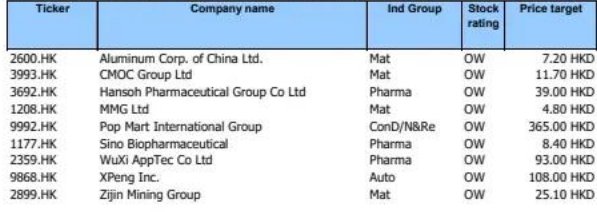
Overall Performance - The second quarter of 2025 shows signs of recovery in the Chinese stock market, with A-shares stabilizing and MSCI China improving [2][3] - As of July 21, 2025, 1,528 A-share companies (30% of total, 25% of total market capitalization) issued earnings forecasts, with a net negative warning rate of -4.8%, an improvement from -18.8% in the previous quarter [2] - The MSCI China index, covering overseas-listed Chinese core assets, reported a net positive warning rate of +6.8%, the highest in four quarters, indicating a rebound in confidence from overseas investors [3] Sector Performance - Strong sectors include financial services, materials, and technology hardware, while consumer services, real estate, and software lag behind [5][6] - Financial services benefit from stable growth policies, materials see gains from commodity price recovery, and technology hardware thrives on innovation [5] - Real estate continues to face pressure due to inventory reduction and financing challenges, while consumer services are affected by slow recovery in domestic demand [5][6] Market Capitalization - Large-cap stocks show stability with a net negative warning rate of -1.4%, indicating strong risk resistance and high earnings certainty [7] - Small-cap stocks have significantly improved, with a net negative warning rate narrowing from -31.1% to -7.4%, reflecting recovery supported by policy and industry revival [7] - Mid-cap stocks perform moderately with a net negative warning rate of -12.7%, showing improvement but still lagging behind large-cap stocks [8] Earnings Forecast Adjustments - Sectors with upward adjustments include technology hardware, consumer staples, and pharmaceuticals, driven by increased orders and stable demand [9] - Sectors facing downward adjustments include semiconductors, utilities, consumer services, and real estate, reflecting cautious market sentiment [9] Investment Recommendations - Morgan Stanley identifies nine stocks to watch, primarily from materials, pharmaceuticals, and technology hardware sectors, based on positive earnings forecasts and analyst ratings [10][11] - Caution is advised for six stocks concentrated in real estate and certain consumer services, reflecting high earnings uncertainty [10][11] Future Outlook - The report suggests focusing on sectors benefiting from policy support, such as finance and infrastructure-related materials, as well as resilient consumer services and technology growth areas [12][13] - The overall recovery remains uneven, and investors are encouraged to prioritize quality stocks with stable earnings and reasonable valuations [13]
茅台重磅公告!吃喝板块重拾升势,白酒、大众品携手上涨!机构:食饮板块整体景气度或有所回升
Xin Lang Ji Jin· 2025-07-24 03:14
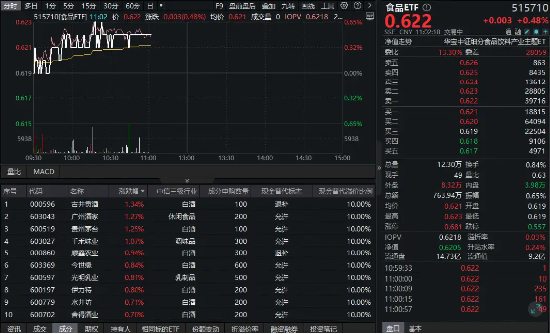
Group 1 - The food and beverage sector has regained upward momentum, with the food ETF (515710) showing a price increase of 0.48% as of the latest report [1] - Key stocks in the sector, such as Kweichow Moutai, Gujing Distillery, and Guangzhou Restaurant, have seen gains exceeding 1% [1] - Kweichow Moutai announced plans to establish a research institute in collaboration with its controlling shareholder, aimed at enhancing technological capabilities and maintaining market position [3] Group 2 - The food ETF (515710) has a significant holding in Kweichow Moutai, accounting for 14.61% of its portfolio as of the second quarter of 2025 [3][4] - The current price-to-earnings ratio of the food ETF's underlying index is 20.58, indicating a favorable valuation for long-term investment [4] - Analysts expect the food and beverage sector to benefit from economic recovery policies, with a potential increase in demand in the second half of the year [5] Group 3 - The food ETF (515710) primarily invests in leading high-end and mid-range liquor stocks, with a diversified portfolio that includes dairy, seasoning, and beer sectors [6] - The ETF's top holdings include major brands like Moutai, Wuliangye, and Yili, reflecting a strategic focus on core assets in the food and beverage industry [6]

金融期货早班车-20250724
Zhao Shang Qi Huo· 2025-07-24 01:52
Report Summary 1. Report Industry Investment Rating No industry investment rating is provided in the report. 2. Core Viewpoints - For stock index futures, the report maintains a long - term bullish view on the economy. It suggests that using stock indices as a long - position substitute can yield certain excess returns, and recommends buying long - term contracts of various varieties on dips [2]. - For treasury bond futures, due to the upward trend in risk appetite and the expectation of economic recovery, it is recommended to conduct high - level hedging for T and TL contracts in the medium - to - long term [2]. 3. Summary by Related Catalogs (1) Stock Index Futures - **Market Performance**: On July 23, the four major A - share stock indices showed mixed performance. The Shanghai Composite Index rose 0.01% to 3582.3 points; the Shenzhen Component Index fell 0.37% to 11059.04 points; the ChiNext Index fell 0.01% to 2310.67 points; the Science and Technology Innovation 50 Index rose 0.45% to 1020.86 points. Market turnover was 1898.4 billion yuan, a decrease of 30.3 billion yuan from the previous day. Non - bank finance, beauty care, and household appliances led the gains, while building materials, national defense and military industry, and machinery led the losses. In terms of market strength, IH > IF > IC > IM. The number of rising, flat, and falling stocks was 1269, 121, and 4025 respectively. Net capital inflows from institutions, main players, large - scale investors, and retail investors in the Shanghai and Shenzhen stock markets were - 17 billion, - 23.8 billion, 1.2 billion, and 39.7 billion yuan respectively, with changes of - 3.2 billion, - 2.3 billion, - 2 billion, and + 7.5 billion yuan respectively [2]. - **Basis and Annualized Yield**: The basis of the next - month contracts of IM, IC, IF, and IH were 107.22, 76.76, 10.57, and - 1.6 points respectively, with annualized basis yields of - 9.43%, - 7.2%, - 1.49%, and 0.33%. Their three - year historical quantiles were 40%, 29%, 43%, and 49% respectively [2]. - **Trading Strategy**: Long - term, maintain a bullish view on the economy, and recommend buying long - term contracts of various varieties on dips [2]. (2) Treasury Bond Futures - **Market Performance**: On July 23, the yields of treasury bond futures rose across the board. Among the active contracts, the implied interest rate of the two - year bond was 1.39, up 2.26 bps from the previous day; the five - year bond was 1.553, up 1.93 bps; the ten - year bond was 1.65, up 1.59 bps; and the thirty - year bond was 1.991, up 0.79 bps [2]. - **Cash Bonds**: The current active contract is the 2509 contract. For the 2 - year treasury bond futures, the CTD bond is 250006.IB, with a yield change of + 2.25 bps, a corresponding net basis of - 0.022, and an IRR of 1.63%. For the 5 - year treasury bond futures, the CTD bond is 240020.IB, with a yield change of + 1.5 bps, a corresponding net basis of - 0.018, and an IRR of 1.6%. For the 10 - year treasury bond futures, the CTD bond is 220010.IB, with a yield change of + 2 bps, a corresponding net basis of - 0.021, and an IRR of 1.62%. For the 30 - year treasury bond futures, the CTD bond is 210014.IB, with a yield change of - 0.82 bps, a corresponding net basis of 0.093, and an IRR of 1.02% [2]. - **Funding Situation**: In open - market operations, the central bank injected 150.5 billion yuan and withdrew 520.1 billion yuan, resulting in a net withdrawal of 369.6 billion yuan [2]. - **Trading Strategy**: With the upward trend in risk appetite and the expectation of economic recovery, it is recommended to conduct high - level hedging for T and TL contracts in the medium - to - long term [2]. (3) Economic Data High - frequency data shows that the real estate sector has recently seen a contraction in prosperity, while the manufacturing sector has recovered in prosperity after the industrial added value in June exceeded the same period [10].
沪指破3600点创年内新高
Sou Hu Cai Jing· 2025-07-23 20:13
Group 1 - A-shares have recently shown a strong upward trend, breaking through significant points of 3500 and 3600, indicating a structural recovery in the Chinese economy [1][2] - The A-share market has seen a notable increase in foreign investment, with a net increase of $10.1 billion in domestic stocks and funds in the first half of the year [2] - The pre-announcement rate for half-year reports among A-share companies has improved, with 44.37% of companies expecting positive results, up from the previous year [3][5] Group 2 - Key sectors such as pharmaceuticals, communications, electronics, and brokerage firms have experienced significant stock price increases, supported by strong half-year performance forecasts [3][4] - High-end manufacturing and AI hardware sectors are particularly prominent, with companies like移远通信 expecting a net profit increase of 121.13% due to advancements in 5G and AI technologies [4] - The performance of listed companies reflects the broader economic recovery, with a notable divergence in recovery rates across different industries, highlighting the resilience of domestic demand and the acceleration of industrial upgrades [5][6]

上半年信贷总量增长结构优化 金融精准滴灌重点领域
Zheng Quan Ri Bao· 2025-07-23 17:19
Core Insights - The People's Bank of China reported a stable growth in total loans, indicating enhanced economic recovery momentum [1][2] - The structure of loans is optimizing, with significant increases in loans to small and micro enterprises, agricultural loans, and loans supporting technological innovation [1][3] Loan Growth Overview - As of the end of Q2 2025, the total balance of RMB loans reached 268.56 trillion yuan, a year-on-year increase of 7.1%, with an addition of 12.92 trillion yuan in the first half of the year [1] - Corporate loans accounted for 89% of the new loans, with an increase of 11.5 trillion yuan, highlighting the strong demand from enterprises [2] Sector-Specific Loan Trends - Green loans reached a balance of 42.39 trillion yuan, growing by 14.4% since the beginning of the year, with an increase of 5.35 trillion yuan in the first half [3] - Loans to technology-based small and medium-sized enterprises (SMEs) increased significantly, with a loan balance of 3.46 trillion yuan, reflecting a year-on-year growth of 22.9% [3] Future Outlook - The loan growth rate is expected to remain stable, with further optimization in structure, particularly in technology and green sectors [4] - The central bank is anticipated to enhance financial support for the real economy, with new loan disbursements expected to maintain a rapid growth trend [4][5]
核心指标释放积极信号 经济复苏态势渐显
Jing Ji Guan Cha Wang· 2025-07-23 08:47
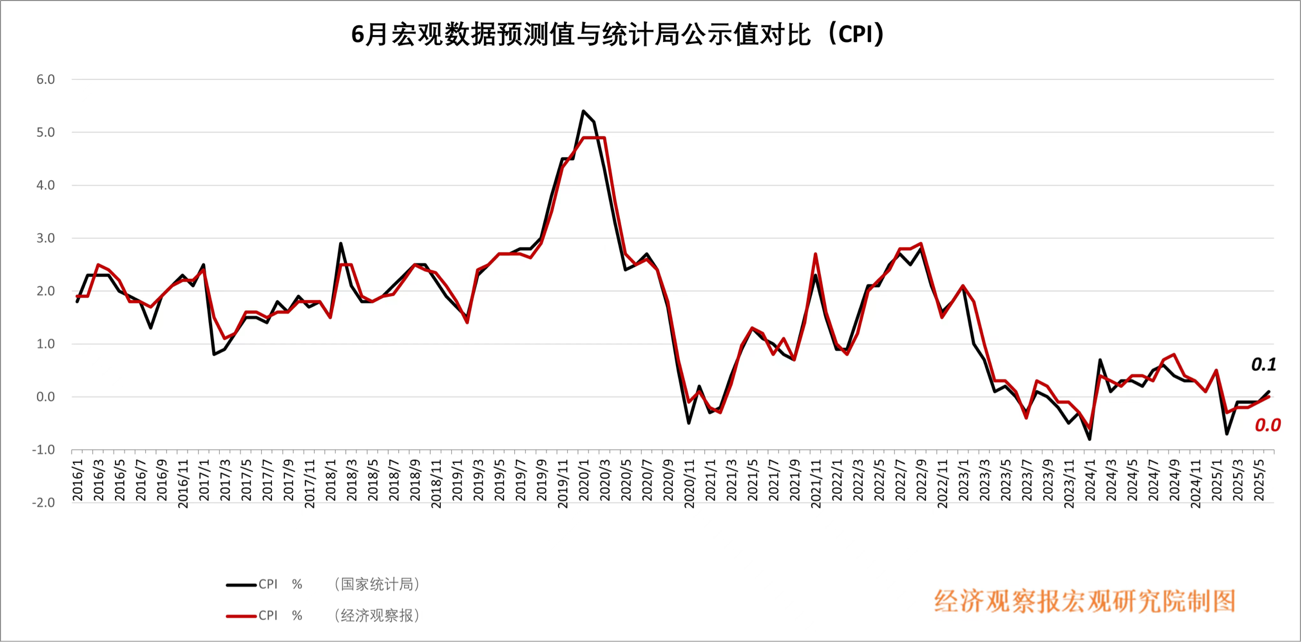
Group 1: Economic Indicators - The core price level is gradually recovering, with financial support for the real economy increasing, indicating a gradual accumulation of internal economic momentum under policy support [1] - In June 2025, the CPI rose from -0.1% to 0.1%, while the PPI decreased from -3.3% to -3.6% [1] - The manufacturing PMI increased from 49.5% to 49.7%, showing slight improvement in manufacturing activity [1] Group 2: CPI Analysis - The core CPI growth has been continuously recovering, with a year-on-year increase of 0.7% in June, the highest in nearly 14 months [4] - Factors contributing to the core CPI recovery include rising gold prices, the "old-for-new" policy supporting durable goods prices, and a moderate rebound in service prices [4] Group 3: PPI Analysis - The PPI fell by 3.6% year-on-year in June, with the decline widening by 0.3 percentage points compared to the previous month [7] - The decrease in PPI is attributed to slower construction in real estate and infrastructure, as well as an oversupply of industrial raw materials [7] Group 4: PMI Insights - The PMI for June was reported at 49.7%, a 0.2 percentage point increase from the previous month, indicating seasonal recovery [10] - Among 21 surveyed industries, 11 are in the expansion zone, reflecting improved manufacturing sentiment [10] Group 5: Fixed Asset Investment - Fixed asset investment in June showed a year-on-year increase of 2.8%, down from 3.7% in May, with real estate development investment declining by 12.9% [13] - The decline in real estate sales and investment growth is contributing to a negative feedback loop with falling housing prices and PPI [13] Group 6: Credit Performance - New RMB loans in June amounted to 22.4 billion yuan, significantly higher than the previous month's 6.2 billion yuan [16] - The strong credit performance is driven by multiple factors, including seasonal increases in lending and effective financial policies [16] Group 7: M2 Growth - M2 growth accelerated to 8.3% in June, the highest in nearly 15 months, with a notable narrowing of the M1-M2 gap [20] - The increase in M2 and M1 indicates improved financial support for the real economy, although M1 growth remains relatively low [20]