
美元指数

Search documents
美元指数的中长期走势与2026年展望
Sou Hu Cai Jing· 2025-12-20 04:26
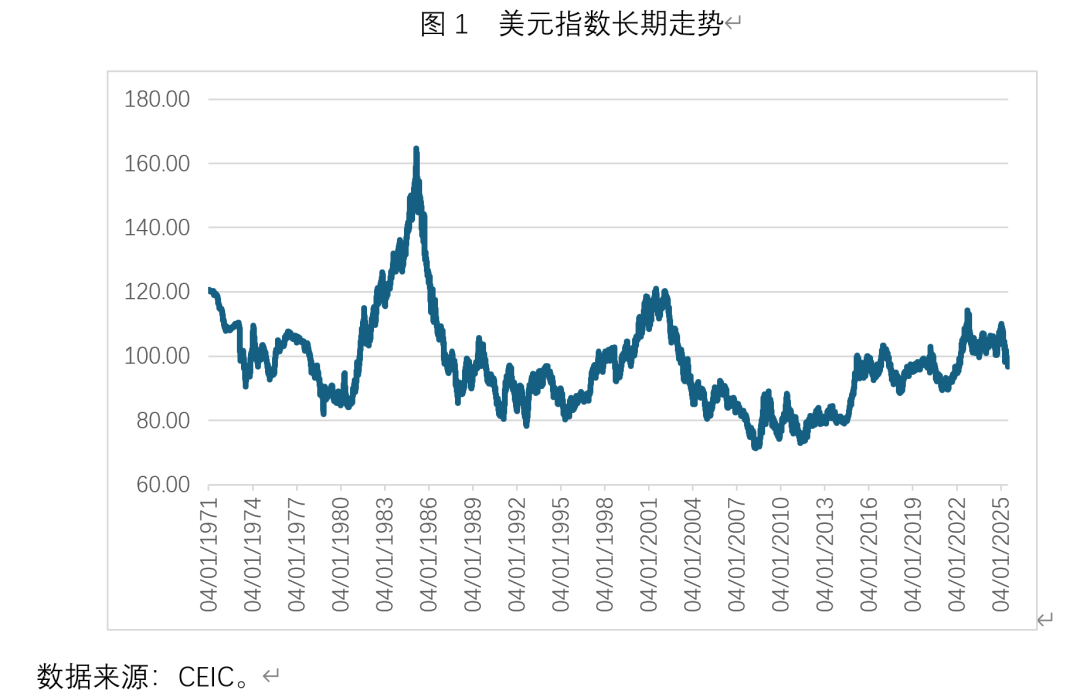
Group 1 - The core viewpoint of the article suggests that the US dollar index is likely entering a prolonged downtrend phase, with significant declines expected in the future [3][10] - Historical analysis indicates that the highest and lowest points of the dollar index have shown a gradual downward trend over three long cycles since 1971, suggesting a weakening of the US economic fundamentals relative to other developed countries [4][10] - The duration of the downtrends in the dollar index has been relatively consistent, averaging around 7-8 years, while the uptrends have been extending, indicating a "short bear, long bull" phenomenon in the dollar index cycles [4][10] Group 2 - The relationship between the dollar index and US interest rates has shown a decreasing correlation in the most recent cycle, with instances of the dollar index declining despite stable or fluctuating interest rates [5][10] - The dollar index has already decreased by 15.1% from September 2022 to June 2025, and the current downtrend may last for another 6-7 years, potentially reaching a low below 71.3 [3][10] - The outlook for the dollar index in 2026 suggests a continued downward trend, with limited declines due to the weak economic fundamentals in the Eurozone and uncertainties surrounding the Japanese yen [12][16][17] Group 3 - The Federal Reserve is expected to continue lowering interest rates in 2026, influenced by a deteriorating labor market and manageable inflation, which may further impact the dollar index [13][10] - Global investor sentiment towards US dollar assets has shifted, contributing to simultaneous declines in US stocks, bonds, and the dollar index, indicating a potential ongoing reduction in confidence in US Treasury securities [15][10] - The economic performance of the Eurozone and Japan is projected to remain weak, which may limit the extent of the dollar index's decline, as the Eurozone's GDP growth is forecasted to be significantly lower than that of the US [16][17]

11月银行结售汇顺差157亿美元,已连续7个月保持顺差
Sou Hu Cai Jing· 2025-12-20 01:26
Core Viewpoint - The foreign exchange market in China is showing resilience, with banks maintaining a surplus in foreign exchange settlement and sales for seven consecutive months, indicating stable cross-border capital flows and foreign exchange market expectations [1][2][3][4]. Group 1: Foreign Exchange Settlement and Sales - In November 2025, banks settled 14,840 billion RMB and sold 13,732 billion RMB, continuing to maintain a surplus, although the difference has narrowed [1]. - Cumulatively from January to November 2025, banks settled 162,781 billion RMB and sold 155,932 billion RMB, reflecting a consistent surplus in foreign exchange settlement and sales [2]. - The surplus in foreign exchange settlement and sales has been observed for seven consecutive months since May 2025 [4]. Group 2: Cross-Border Income and Payments - In November 2025, the total cross-border income and payments for non-bank sectors amounted to 1.3 trillion USD, with a month-on-month increase of 8%, resulting in a surplus of 17.8 billion USD [4]. - In Shenzhen, banks settled 20.6 billion USD and sold 14.9 billion USD in November, achieving a surplus of 5.7 billion USD [4]. Group 3: Market Dynamics and Currency Trends - The US dollar index weakened in November, with a decline of 0.29%, while the Chinese yuan appreciated against the dollar, particularly in late November [5][6]. - The appreciation of the yuan and the bank's foreign exchange settlement and sales are mutually reinforcing, creating a positive feedback loop [7]. Group 4: Future Trends - Experts suggest that as the year-end approaches, there will be an increase in foreign exchange settlement due to corporate financial settlements and profit distributions, potentially driving up the scale of bank foreign exchange settlements [8]. - The impact of seasonal factors, corporate exchange rate management, and policy adjustments may lead to significant monthly variations in bank foreign exchange settlement and sales data, complicating the relationship with cross-border capital flows and yuan exchange rate changes [8].
人民币兑美元汇率升破7.04关口,创去年10月以来新高,业内认为后市可能破7
Sou Hu Cai Jing· 2025-12-19 10:24
Core Viewpoint - The recent appreciation of the Renminbi (RMB) against the US dollar is attributed to a combination of factors, including the decline of the US dollar index and increased demand for currency settlement by enterprises at year-end [1][2]. Group 1: Recent Exchange Rate Movements - The offshore RMB/USD exchange rate broke the 7.04 mark on December 18, 2024, marking a new high since October 2024, while the onshore rate also touched 7.04 [1]. - As of December 19, 2024, the offshore RMB/USD exchange rate was reported at 7.03642, and the onshore rate at 7.0411 [1]. - Since late November, the onshore RMB has appreciated over 700 basis points from around 7.11 to 7.04, while the offshore RMB has risen nearly 800 basis points from 7.11 to approximately 7.03 [1]. Group 2: Year-to-Date Performance - Year-to-date, the offshore RMB/USD exchange rate has appreciated over 4%, while the onshore rate has risen more than 3.5% [2]. - The offshore RMB/USD exchange rate reached a low of 7.42879 on April 8, 2024, before recovering as the Fed's interest rate stance became clearer [2]. Group 3: Future Outlook - Short-term projections suggest that while the RMB may experience temporary fluctuations, it is expected to remain strong, with a potential to break the 7.0 mark due to seasonal settlement demands [3]. - By 2026, the RMB is anticipated to have room for appreciation, supported by seasonal settlement needs, although export support for the exchange rate may weaken [3]. - Analysts predict that the RMB/USD exchange rate may fluctuate between 6.9 and 7.3, with a possibility of breaking 7.0 if the US dollar remains structurally weak [3].
2026年锡期货行情展望:震荡与突围:供给扰动下的再平衡
Guo Tai Jun An Qi Huo· 2025-12-19 10:05
1. Report Industry Investment Rating - Not provided in the content 2. Core Viewpoints of the Report - In 2026, it is predicted that the US dollar will remain relatively volatile, and its impact on tin prices throughout the year will be relatively neutral. The first half of 2026 will be in a shortage pattern of weak supply and demand, and there will be marginal relaxation around the middle of the year as Wa State in Myanmar resumes production. The supply side will see significant incremental releases, with marginal relaxation mainly from the resumption of production in Wa State, Myanmar, and increased production in Indonesia. Attention should also be paid to disturbances in African producing areas such as the Democratic Republic of the Congo, and the supply pattern may be tight in the first half and loose in the second half. The demand side shows that the AI sector has a fast growth rate but a small base, while most terminal demands remain sluggish. Globally, the supply in 2026 will be 369,000 tons with a growth rate of 0.3%, the total demand will be 378,000 tons with a growth rate of -0.8%, and the supply-demand balance gap will be 9,000 tons. In China, the supply will be about 182,000 tons, the demand will be about 185,000 tons, and there may be a supply-demand gap of 3,000 tons. The strategy recommends a buy-on-dip approach in the first half of the year, closely monitoring overseas production increases or disturbances, and suggests an option strategy mainly based on buying calls, as well as considering internal-external positive arbitrage and inter-month positive arbitrage strategies [2][109][111]. 3. Summary According to the Table of Contents 3.1 2025 Tin Price Trend Review - In 2025, the overall price center of Shanghai Tin showed an obvious upward trend. Frequent disruptions in major producing countries such as Myanmar, the Democratic Republic of the Congo, and Indonesia, combined with the start of the macro - interest rate cut cycle and the improvement of semiconductor prosperity, jointly drove the tin price up. By December 18, the annual increase of Shanghai Tin was 36.68%, making it the top - gainer among the six non - ferrous metals. In the overseas market, the increase of LME Tin was even stronger, with a 48.54% increase in the 3M futures by December 17. In terms of positions and trading volume, by December 12, the position of Shanghai Tin was 118,433 lots, at a high level in the past year, and the weekly trading volume was 1,606,972 lots, also at a high level compared with the same period in history. The price fluctuations can be divided into three stages: from New Year's Day to around Tomb - Sweeping Festival, the price fluctuated upward and then rose sharply; from after Tomb - Sweeping Festival to mid - year, the price dropped significantly and then recovered; in the second half of the year, the price started to rise and showed a smooth upward trend [6][11][14]. 3.2 2026 Tin Fundamental Market Outlook 3.2.1 US Dollar Index - It is expected that the US dollar will remain relatively volatile in 2026, with a relatively neutral impact on tin prices throughout the year. Attention should be paid to whether the restart of the US government in Q1 2026 can bring compensatory growth. The US dollar index is considered to be in a relatively balanced state in both the medium - long - term and short - term valuation systems, with limited one - sided driving forces. The annual fluctuation range of the US dollar index is expected to be 96 - 108, with an upward - risk bias, and the Q1 2026 fluctuation range is 97.7 - 102. The judgment on the US dollar in 2026 is based on the current balanced valuation. Factors such as economic relative strength, monetary policy expectations, carry trading, and currency group strength differentiation should be considered [18][19]. 3.2.2 Supply Side - **Myanmar Wa State**: The resumption of production in Wa State has been delayed, and the release of incremental production is slow. The current production suspension can be traced back to April 2023, lasting for more than two years. Although some mining licenses were approved in July 2025, the actual resumption progress is still slow. The factors affecting the resumption include the increase in production costs due to the 30% physical tax, the difficulty in recovering the mining scale, and short - term marginal improvement after the end of abnormal weather. It is expected that the year - on - year decline in monthly shipments will gradually narrow, and the market generally expects the resumption of production around June 2026. The estimated annual incremental import of tin ore from Myanmar to China in 2026 compared with 2025 is about 5,190 metal tons, mainly concentrated in the second half of the year [23][26][28]. - **Democratic Republic of the Congo**: The armed conflict led by the M23 armed organization has escalated, threatening the production and transportation of the Bisie tin mine. It is expected that the recent conflict will bring a marginal reduction of about 1,750 tons in 2026 production. If the impact in 2026 is similar to that in 2025, the conflict is expected to cause a marginal reduction of about 1,750 tons, and the increase in production will be hindered, with an impact of about 400 tons on China's imports [35][36]. - **Other Countries**: In 2025, the import of tin ore from some countries increased. From January to October 2025, the import of tin ore from Australia increased by 6.68% year - on - year (an increase of 1,421.49 tons), from Nigeria by 71.14% (an increase of 6,552.78 tons), and from Bolivia by 81.81% (an increase of 6,249.73 tons). In 2026, if Myanmar's imports increase year - on - year and other countries continue to grow, the overall import may have a large increase. However, there is uncertainty in Nigeria's mining suspension plan, and Bolivia is expected to achieve steady growth [42][43]. - **Global New Capacity Expansion**: In 2026, the new tin mine projects that may be put into production have an annual capacity of about 13,160 tons, and about 6,660 tons are relatively certain. In 2027, it is about 8,950 tons, and there are also 18,200 tons with undetermined production times. Some projects have a risk of delay, such as the Rentails project in Australia and the impact of the acquisition of Atlantic Tin by Xingye Yinxing on the Achmmach tin mine [56][57][59]. - **Indonesia**: In 2025, the export of tin ingots in Indonesia increased significantly. From January to October 2025, the export of tin ingots was 40,134 tons, a year - on - year increase of 14.72%. It is expected that the production of tin ingots in Indonesia will continue to grow in 2026, with the state - owned enterprise PT Timah planning a production of 30,000 tons in 2026, an increase of 8,500 tons compared with 2025. The export of tin ingots is expected to be 55,000 - 60,000 tons in 2026, with an increase of about 6,500 tons. However, the first quarter of 2026 is the seasonal off - season for tin ingot exports in Indonesia [62][63]. - **Domestic**: In 2025, the production of domestic tin ingots was restricted by raw material supply, with a year - on - year decline of 2.91% from January to November. The average operating rate of domestic refined tin enterprises in November was 66.3%, a year - on - year decline of 4.2 percentage points and a month - on - month decline of 0.51 percentage points. In 2026, the growth of tin ingot production still depends on the raw material supply led by the resumption of production in Wa State, Myanmar. The tax policy uncertainty brought by Document No. 770 has affected the production of recycled tin, and the production of recycled tin ingots from January to November 2025 decreased by 21.19% year - on - year. If the tax problem is not resolved in 2026, the production of recycled tin will still face a decline [68][69]. 3.2.3 Demand Side - **AI Field**: In 2025, the AI investment of technology giants continued to heat up, and the data center business of leading chip manufacturers achieved high growth. It is expected that this field will maintain high growth in 2026, providing an increase in demand for tin solder. The estimated tin consumption in data centers in 2026 is about 512 tons, which is not large in scale but has long - term growth potential [74][83]. - **Consumer Electronics**: In 2025, the global consumer electronics market was divided. The smartphone market was sluggish, with the global smartphone shipments increasing by only 1.56% year - on - year in the first three quarters, and it is expected to decline by 0.9% in 2026. The PC market entered an iteration cycle due to the end of Microsoft's support for Windows 10, and the shipments increased by 7.12% year - on - year in the first three quarters. In 2026, the squeezing of upstream memory capacity by AI may affect the consumer electronics market, and the increase in memory prices may lead to a small decrease of less than 1% in market demand [84][86][87]. - **Photovoltaic**: In 2025, the new policies in the photovoltaic field led to a rush - to - install boom in the first half of the year, but the new installations decreased significantly in the third quarter. In 2026, affected by the high - base effect and the promotion of electricity price marketization, the new installations in the photovoltaic field are expected to be flat. It is estimated that the new domestic photovoltaic installations in 2026 will be 200GW, a year - on - year decrease of 33%, and the new overseas installations will be 293GW, a year - on - year increase of 11%. Globally, the new installations are expected to be about 493GW, a year - on - year decrease of 13%, and the tin demand in the photovoltaic field will decrease by 18.8% [95][96][97]. - **Electric Vehicles**: In 2026, the growth rate of the global electric vehicle demand will tend to be moderate, and the improvement of the market penetration rate of the structural market is the core logic. It is estimated that the global total sales of electric vehicles will increase by 13% year - on - year to 23.75 million units, and the domestic demand in China will increase by 11% to 15.66 million units. The tin demand in 2026 is expected to increase by 3.9% year - on - year. China, Western Europe, and emerging Asian regions are the core driving regions, while the American market may have a negative impact [106].
IC平台:美元指数三连涨突破98.50,涨势能否延续?
Sou Hu Cai Jing· 2025-12-19 09:58
Core Viewpoint - The market is cautious ahead of the University of Michigan Consumer Confidence Index release, with the dollar index rising. However, expectations for a Federal Reserve rate cut are increasing due to soft CPI data for November, which may put pressure on the dollar [1][3]. Group 1: Dollar Index and Market Sentiment - The dollar index (DXY) has risen for the third consecutive trading day, trading around 98.60 during the European session [3]. - Traders are closely watching the upcoming release of the December Consumer Confidence Index from the University of Michigan [3]. Group 2: CPI Data and Federal Reserve Expectations - The November Consumer Price Index (CPI) in the U.S. unexpectedly decreased to 2.7%, below the market expectation of 3.1% [3]. - The core CPI, excluding volatile food and energy prices, increased by 2.6%, which is lower than the expected 3.0% and represents the slowest growth rate since 2021 [3]. - According to the CME FedWatch tool, the probability of the Federal Reserve maintaining interest rates in January is 73.3%, down from 75.6% the previous day, while the probability of a 25 basis point rate cut has risen from 24.4% to 26.6% [3]. Group 3: Political Influence on Monetary Policy - President Trump stated that the next Federal Reserve chair will be someone who believes in significant rate cuts, indicating potential shifts in monetary policy [3].
长江有色: 美指下跌及库存去化支撑 17日铝价或上涨
Xin Lang Cai Jing· 2025-12-19 07:27
伦敦金属交易所(LME)12月16日伦铝最新库存量报519600公吨,较上个交易日持平。 长江铝业网讯:12月16日现货铝价,长江现货A00铝锭价报21630元/吨,跌80元;广东现货A00铝锭价 报21520元/吨,跌60元。 宏观层面,周二美国劳工部最新数据显示,11月美国非农就业增长超预期,但失业率升至4.6%,且新 增岗位主要集中在医疗保健等非周期性行业。行业分析师认为,报告内部分化,显示经济周期性动能仍 有限,市场预计美联储短期内或对进一步降息持谨慎态度。不过,美元指数破位下跌0.11%至98.15附 近,触及两个月新低,对以美元计价的铝金属商品形成支撑。国内方面,12月10日至11日召开的中央经 济工作会议备受关注。会议明确将扩大内需列为明年首要任务,提振了市场情绪,多头士气回升,对铝 价构成利好。 长江铝价alu.ccmn.cn短评:美指破位下挫至两个月新低,隔夜伦铝一枝独秀涨0.26%;沪铝供应平稳、 铝锭社库持续去化提供支撑,新能源消费有韧性、下游刚需成交,但现货贴水压制,今现铝或难大涨。 【铝期货市场】:美股全线下挫但美指走软提供支撑,隔夜伦铝一枝独秀,盘中维持偏强运行姿态,最 新收盘报价 ...

长江有色:美11月CPI重回“2时代”助美元反弹 19日铜价或下跌
Xin Lang Cai Jing· 2025-12-19 07:26
长江铜业网讯:今日沪铜主力2602合约低开,开盘价报92560元/吨,跌190元。 长江铜价copper.ccmn.cn短评:美11月CPI重回"2时代"助美元反弹,隔夜伦铜收跌0.13%;国内股指下行 拖累市场情绪,供应虽紧张但现货贴水加深、成交疲软,今现铜或下跌。 【铜期货市场】美11月CPI重回"2时代"助美元反弹,隔夜伦铜震荡走弱;最新收盘报价11727元/吨,收 跌16美元,跌幅0.13%,成交量14534手减少2296手,持仓量344850手增加611手;晚间沪铜盘中涨跌波 动,尾盘勉强翻红,主力月2602合约最新收盘价报92870元/吨,涨120元,涨幅0.13%。 伦敦金属交易所(LME)12月18日伦铜最新库存量报164275公吨,较上个交易日减少2650公吨,跌幅 1.59%。 宏观层面,美国劳工部周四公布的数据显示,11 月美国未季调 CPI 年率录得 2.7%,低于市场预期的 3.1%;剔除食品和能源价格后的核心 CPI 同比上涨 2.6%,同样低于预期,为 2021 年 3 月以来新低,预 期值为 3%。尽管这份因政府停摆推迟发布的报告显示物价压力有所缓和,但因报告编制存在问题,经 ...
张德盛:12.19今日黄金价格还会涨吗?白银行情走势分析操作
Sou Hu Cai Jing· 2025-12-19 02:56
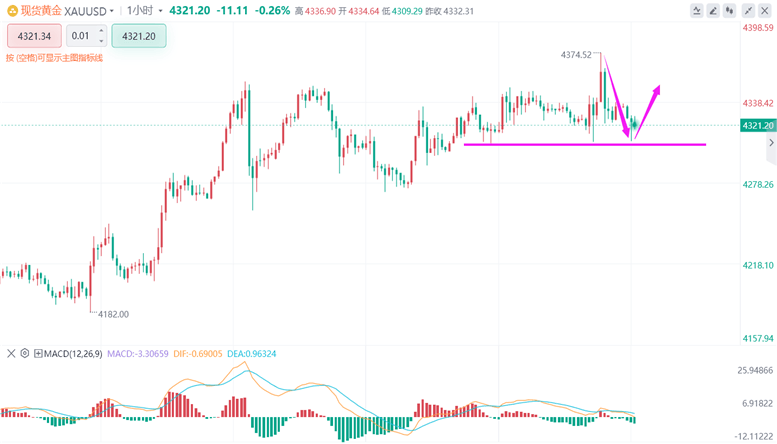
Market Overview - International gold prices are experiencing a weak trend due to recent adjustments and the rebound of the US dollar index, but the overall trend remains bullish with no significant negative pressures in the market [1] - The market is expected to focus on the final consumer confidence index and inflation expectations data from the University of Michigan for December, with mixed expectations [1] - The long-term outlook for gold prices remains bullish, with a target of reaching $5000, supported by factors such as the labor market indicating further rate cuts by the Federal Reserve and escalating geopolitical tensions [1] Gold Price Analysis - Gold experienced a strong rise on Monday, followed by a slight adjustment on Tuesday, and a volatile upward trend on Wednesday, culminating in a significant drop on Thursday [2] - The high point for December gold is established at 4375, with expectations of high-level fluctuations and notable adjustment space [2] - The current trading range for gold is identified as 4375/4250, with a smaller range of 4350/4280, indicating a likely continuation of the bullish trend unless these levels are broken [2] Silver Price Analysis - International silver is showing a clear bullish trend, with adjustments expected around the 64.5 low point, which aligns with recent market behavior [3] - Silver is currently trading near 65, indicating a high-level fluctuation within the bullish trend, with expectations of trading between 64.5 and 66.5 [3] - If silver breaks above 66.5, there is potential for prices to reach 68 or 70 [3]
金属涨跌互现 期铜收升,受美国通胀数据提振【12月18日LME收盘】
Wen Hua Cai Jing· 2025-12-19 00:57
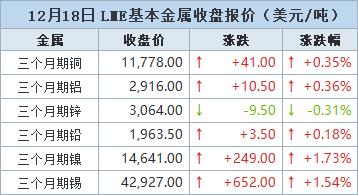
Core Viewpoint - The London Metal Exchange (LME) copper prices rose on December 18, but market direction remained unclear due to a stronger dollar offsetting the positive impact of lower-than-expected U.S. inflation data, leading traders to reduce their positions ahead of the Christmas holiday [1]. Group 1: Market Performance - LME three-month copper increased by $41, or 0.35%, closing at $11,778 per ton [2]. - Other base metals also saw price increases, with three-month aluminum up by $10.5 (0.36%) to $2,916 per ton, and three-month tin rising by $652 (1.54%) to $42,927 per ton [2][4]. - Trading volume was low, with approximately 14,300 contracts exchanged, below the 30-day average of nearly 22,000 contracts [3]. Group 2: Economic Indicators - The U.S. Consumer Price Index (CPI) for November rose by 2.7% year-on-year, lower than the 3% increase in September, which positively influenced market sentiment [3]. - Copper is viewed as a barometer for global economic health, having increased by 34% year-to-date and reaching a record high of $11,952 per ton last week [3]. Group 3: Future Outlook - Analysts from Saxo Bank noted a lack of interest in new positions, with a potential for increased volatility as the year ends [3]. - Goldman Sachs projected that copper prices will outperform aluminum in 2026, with an average price forecast of $11,400 per ton [3].
美元指数今年以来跌超9%
Sou Hu Cai Jing· 2025-12-18 15:35
本报记者 韩昱 近期,美元指数再次呈现出走弱态势。 陕西巨丰投资资讯有限责任公司高级投资顾问朱华雷也对记者分析,近期美元指数走弱,主要是因为美 联储的再度降息。12月11日,美联储完成年内第三次降息,将利率下调25个基点。利率的下降直接导致 美债收益率走低,美元资产的吸引力削弱,直接拖累美元指数下行。 拉长时间看,截至12月17日收盘,美元指数年内下行幅度已达到9.30%。 2026年美元指数将走出怎样的行情?明明认为,明年美元指数偏弱运行的趋势或将延续。基本面方面, 美国就业市场持续走弱,经济动能也正在放缓。 "11月下旬以来,美国披露的经济数据明显走弱,叠加美联储官员释放鸽派信号,推动市场对于美联储 降息预期再度升温,美元指数前期的反弹态势告一段落并转为持续下行。"中信证券首席经济学家明明 在接受《证券日报》记者采访时表示。 如明明所述,近期美国发布的一系列经济数据均呈现出走弱态势。比如,美国劳工部公布的最新数据显 示,美国11月份非农新增就业6.4万人,略高于预期,但失业率意外升至4.6%,创2021年9月份以来新 高。同时,10月份就业大幅下修10.5万人,8月份至9月份合计下修3.3万人;11月份薪 ...