
人工智能泡沫

Search documents
AI泡沫何时破裂?《大空头》原型被质疑又一次“下手太早”
Jin Shi Shu Ju· 2025-12-29 02:52
伯里再启"预言家"模式,斥资1000万美元做空AI双雄。但问题在于他不确定泡沫何时会破。网友调 侃:"他过去预测20次衰退,只中2次"...... 由于过早地嗅到危机而成为人群中的异类,迈克尔·伯里(Michael Burry)对这类"剧情"并不陌生。 正如电影《大空头》(The Big Short)中的经典场景:克里斯蒂安·贝尔(Christian Bale)饰演的伯里, 向投资者说明他做空美国房地产市场的押注。若判断正确,市场崩盘后,这位对冲基金经理将通过类似 保险的合约斩获7亿美元巨额收益;若判断失误,他的基金将在几个季度内破产。 "等着瞧,一定会有回报的,"电影里的伯里说道,"我或许下手早了,但我没说错。" "又是 老一套!"一位投资者反驳道。 如今,现实中的伯里正试图说服华尔街:他能从人工智能(AI)企业英伟达(NVDA)和Palantir (PLTR)的股价下跌中获利。今年以来,AI行业一直是推动市场创下历史新高的核心动力,但过去十 年大多保持低调的伯里,近期再度现身,直言AI板块存在泡沫,且即将破裂。 但问题在于:他不确定泡沫何时会破。 伯里这种直言不讳的"异类",很适合成为迈克尔·刘易斯(Mi ...



诺奖得主斯宾塞:中美主导AI竞赛,中国有望成机器人超级大国
2 1 Shi Ji Jing Ji Bao Dao· 2025-12-28 23:54
Core Insights - The current wave of investment in AI is characterized by significant capital inflows, raising concerns about potential "bubbles" in valuations and whether these investments will translate into productivity gains [1][3] - Despite the concerns, companies investing in AI may find the cost of over-investment less severe than the risk of falling behind competitors [1][2] - China is emerging as a major player in various technological fields, including AI, renewable energy, and robotics, potentially becoming a leading force globally [1][7][8] Investment Trends - AI investments are surging, with major tech companies dominating the market, as evidenced by the "Big Seven" in the US accounting for 40% of the S&P 500 index [1] - The investment landscape is influenced by a "fear of missing out" (FOMO) mentality, leading to potentially excessive capital allocation beyond optimal returns [2][4] - The current investment trend may be likened to an arms race, where companies prioritize staying ahead of competitors over achieving the best investment returns [2][3] Market Valuation - There is a consensus that some level of valuation bubble exists in the AI sector, although the extent is uncertain [3][5] - The market is experiencing high volatility, with no clear consensus on the future direction of valuations [3][4] - Historical parallels are drawn to the internet bubble, where initial overvaluation was followed by the emergence of substantial companies that transformed the market [5][6] China's Technological Advancements - China is making significant strides in AI, green technology, and robotics, with the potential to become a dominant force in these sectors [7][8] - The country is leading in the deployment of industrial robots, surpassing the total number deployed by other nations [8] - China's advancements in AI and technology are expected to narrow the technological gap with the US, with both countries possessing the necessary talent and infrastructure for AI development [7][9] Global Economic Dynamics - The shifting global economic focus towards Asia is expected to strengthen China's relationships with ASEAN countries and the Middle East, fostering mutual benefits [10] - Middle Eastern countries are increasingly investing in technology and digital sectors, which may lead to new economic dynamics and partnerships with Asian nations, including China [10]

绝对主角!黄金、白银上演疯狂假日行情
Di Yi Cai Jing Zi Xun· 2025-12-27 06:42
Group 1: Market Overview - The traditional Christmas holiday period has led to low volatility in markets, but this year is different due to heightened risk aversion and supply-demand imbalances in the precious metals market [1] - The U.S. stock market remains stable despite strong GDP performance, with the 10-year Treasury yield hovering around 4.17%, indicating that current monetary policy is not expected to tighten further [2] - Concerns over the AI bubble and its impact on tech stocks have dampened short-term momentum for these assets, with the VIX index near yearly lows [2] Group 2: Precious Metals Performance - Precious metals like gold and silver have reached historical highs, driven by investor demand amid expectations of Federal Reserve rate cuts and geopolitical tensions [5][6] - Gold prices have surged, with forecasts suggesting it could reach $5,000 by the end of 2026, supported by central bank purchases and a trend towards de-dollarization [5] - Silver has seen significant price increases, attributed to both safe-haven demand and structural growth in industrial applications, particularly in electric vehicles and solar panels [6] Group 3: Company-Specific Insights - Oracle's stock has dropped 30% this quarter, heading towards its largest quarterly decline since the 2001 internet bubble, following disappointing revenue and cash flow results [3] - Oracle plans to invest $50 billion in capital expenditures by FY2026, a 43% increase from previous plans, raising concerns about its ability to meet these obligations without renegotiating contracts [3] - The AI sector's heavy investment and poor returns have led to a significant increase in perceived risk, with 45% of fund managers identifying the AI bubble as a major market risk [5] Group 4: Supply and Demand Dynamics - The silver market has been in a state of supply-demand imbalance since 2021, with increasing demand from energy transition technologies [6][7] - Platinum and palladium prices have surged due to tightening supply and uncertainty in tariff policies, with platinum prices up approximately 176% this year [7][8] - The market for platinum and palladium is smaller than that of gold, leading to greater price volatility with minimal investment shifts [8]

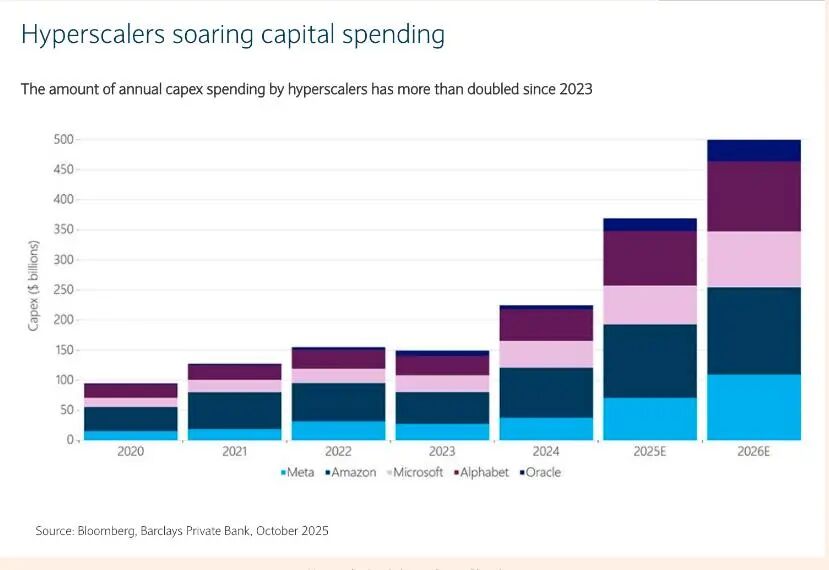
黄金、白银上演疯狂假日行情
第一财经· 2025-12-27 02:07
2025.12. 26 本文字数:2214,阅读时长大约4分钟 作者 | 第一财 经 樊志菁 本周西方迎来传统节日圣诞节,随着诸多市场进入假日交易时段,通常情况下行情往往处于低波动状 态。今年的情况有所不同。 节后首个交易日,避险情绪、供需失衡等因素继续推动资产规模较小的贵金属市场狂欢。 相比之 下,人工智能AI泡沫担忧、货币政策不明朗让流动性更好的明星科技股失去了短期进一步上行的动 力。 美股波澜不惊 作为节前公布的重磅数据,美国三季度国内市场总值(GDP)表现强劲,但美债利率却未出现相应 上扬,美国10年期国债收益率徘徊在4.17%,10年期与2年期国债利差保持31个基点的正值区间。 BK asset management宏观策略师施罗斯伯格(Boris Schlossberg)在接受第一财经采访时表 示,这向市场释放的信号是:当前货币政策虽处于限制性区间,但并不会进一步收紧,是美元走弱、 股市企稳的核心逻辑。他认为,短期内股市表现近似于 "低波动套息资产"——标普500指数与纳斯达 克综合指数保持强势,市场波动性整体受到压制,如恐慌指数(VIX )徘徊在年内低点附近。 率的影响,人工智能概念股的估值已处 ...

变现者对决制造者:2026年人工智能市场或迎分裂格局
Xin Lang Cai Jing· 2025-12-25 19:15
Group 1 - The AI market is expected to experience a fragmented landscape by 2026, with significant volatility observed in tech stocks during the last quarter of 2025, raising concerns about an AI bubble [2][6] - Major companies like Amazon, Microsoft, and Meta are making substantial investments in AI infrastructure providers such as Nvidia and Broadcom, with the first-tier companies, including OpenAI and Anthropic, attracting $176.5 billion in venture capital in the first three quarters of 2025 [2][6] - The Blue Whale Growth Fund emphasizes the importance of distinguishing between companies that are spending on AI and those that are generating profits, as many of the "Magnificent 7" companies have significant valuation premiums [2][6] Group 2 - The bubble components in the AI sector are concentrated in specific sub-sectors rather than the entire market, with risks associated with companies that have not yet turned a profit, particularly in quantum computing [3][7] - The shift in business models among tech giants from asset-light operations to heavy asset models is evident, as they invest heavily in GPUs, data centers, and AI-driven products, altering their risk profiles [3][7] - The valuation standards for companies in the AI space are changing, as it is no longer reasonable to evaluate them based on software or light capital expenditure metrics, especially as firms explore financing for AI initiatives [4][7] Group 3 - Companies are increasingly turning to the bond market for financing AI infrastructure, but there is caution among investors regarding excessive reliance on debt [4][7] - If incremental revenues from AI do not exceed expenditures, profit margins will be pressured, leading to investor skepticism about returns [4][8] - As hardware and infrastructure depreciation occurs, performance disparities among companies may widen, necessitating consideration of these costs in investment evaluations [8]

一家投资OpenAI的硅谷基金的深度研究
3 6 Ke· 2025-12-25 11:33
Core Insights - The discussion revolves around the investment landscape in the U.S., particularly focusing on AI, reindustrialization, and financial innovation as the three main investment themes for the future [12][13]. Group 1: Investment Themes - The three main investment themes identified are AI, reindustrialization, and the digitization of finance, which are interconnected [12][13]. - AI is recognized as a dominant force, with significant investments in chips and cloud infrastructure [13]. - Reindustrialization includes aspects like rare earths, domestic manufacturing, and data centers, with a focus on how these relate to AI [13]. - Financial innovation is highlighted by the introduction of legislation like the Genius Act, which aims to enhance the efficiency of stablecoin payments [14]. Group 2: Market Dynamics - The U.S. stock market has experienced increased volatility post-2020, with multiple downturns compared to historical trends [10]. - The AI sector has seen a surge in interest and investment, particularly in 2023, following a period of market pessimism in 2022 [10][11]. - The investment community is closely monitoring U.S.-China relations and the activity of IPOs in Hong Kong, which could influence future investments in China [14]. Group 3: Company-Specific Insights - OpenAI is viewed as a product company rather than just a model company, with a strong emphasis on user experience and first-mover advantage [15]. - The business model of OpenAI is characterized by high costs associated with training and inference, leading to a negative cash flow initially, but with potential for future profitability [16][18]. - OpenAI's revenue streams are diversified, with significant contributions from ChatGPT, API services, and potential advertising revenue [19][22]. - Anthropic is noted for its strong business model focused on B2B services, with a rapidly improving profit margin [38]. Group 4: Competitive Landscape - OpenAI's main competitors are identified as Google, which has a strong market position due to its integrated services [25]. - The competitive dynamics between OpenAI and Google are highlighted, with Google leveraging its existing services to maintain market share [27]. - The emergence of new AI model companies is noted, with varying degrees of success and investment interest [44]. Group 5: Future Outlook - The prediction market is identified as a new and rapidly growing sector, with significant trading volumes and potential for expansion [63][64]. - The overall sentiment in the investment community is cautiously optimistic, with a focus on identifying disruptive technologies and companies that can capture large market opportunities [61].
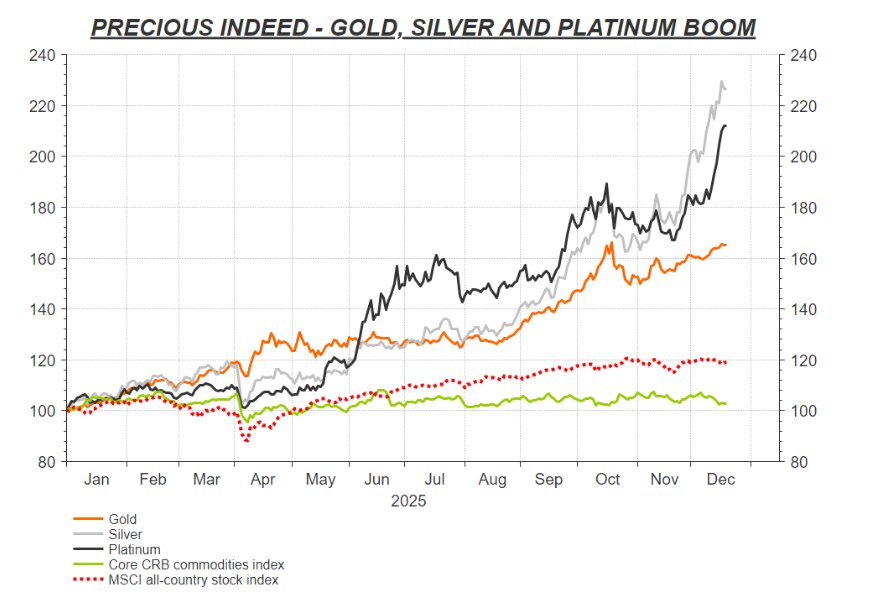
《枪炮、病菌与钢铁》的2025年金融版:枪炮与贵金属封神! 其他“传统避风港”集体失灵
智通财经网· 2025-12-23 14:08
Core Viewpoint - Gold is projected to be the biggest winner among commodities and safe-haven assets in 2025, with a significant increase in its price, while traditional safe-haven assets have underperformed compared to the S&P 500 index [1][4]. Group 1: Precious Metals Performance - Precious metals, including gold, silver, and platinum, have collectively surged in 2025, outperforming the MSCI global stock index, with gold prices rising over 70%, marking the largest increase since the 1979 oil crisis [1][4]. - Silver and platinum have also seen their prices more than double, indicating a strong performance across the precious metals sector [1][4]. Group 2: Market Dynamics - The unexpected resilience of the global economy, coupled with rising geopolitical tensions and concerns over an "AI bubble," has contributed to the extreme pricing dynamics where traditional safe-haven assets have failed [1][7]. - The defense and military sector has emerged as an alternative safe haven, with U.S. aerospace and defense stocks rising by 36% and European counterparts increasing by 55% due to rearmament efforts in Europe [4][8]. Group 3: Traditional Safe-Haven Assets - Traditional safe-haven assets, such as government bonds and defensive stocks, have underperformed significantly, with global government bond prices unexpectedly declining by about 1% [15][17]. - The performance of traditional defensive sectors, including utilities and consumer staples, has lagged behind the S&P 500 index, with consumer staples being the worst-performing sector, rising only about 2% [17][18]. Group 4: Currency Performance - The Japanese yen and Swiss franc, typically viewed as safe-haven currencies, have also disappointed in 2025, with the yen declining approximately 4% against major trading partners [20][21]. - The U.S. dollar index (DXY) experienced a significant drop of 12% during periods of geopolitical turmoil, indicating a lack of safe-haven characteristics for both the dollar and yen in 2025 [23][21]. Group 5: Volatility Strategies - Volatility strategies, often used as hedging tools, have failed to deliver returns in 2025, with the VIX index reflecting lower volatility levels by year-end compared to the beginning of the year [24][26].
“货币医生”坦言夜不能寐,预警通胀失控+美股泡沫双重危机!
Jin Shi Shu Ju· 2025-12-23 10:50
Group 1 - The core concern is that inflation in the U.S. may spiral out of control, exceeding the Federal Reserve's ability to manage it [1][2] - The stock market is currently overvalued, indicating a potential crash back to reality [2] - The M2 money supply has surged by $3.5 trillion over the past five years, which is a critical indicator for inflation outlook [2][3] Group 2 - The Federal Reserve has initiated a rate-cutting cycle, which may lead to an acceleration in inflation despite not fully controlling it [2][3] - The end of quantitative tightening by the Federal Reserve is expected to loosen financial conditions, potentially increasing inflationary pressures [3] - Relaxation of credit rules in early next year will enhance banks' ability to expand the money supply, further exacerbating inflation [3] Group 3 - Increased issuance of short-term government bonds by the U.S. Treasury to finance deficits will also contribute to rising money supply and inflation [3] - The technology sector, particularly driven by the AI boom, is facing significant overvaluation risks, with warnings of a potential market correction [4] - Historical parallels are drawn to the internet bubble, suggesting that AI companies may face similar challenges if growth expectations are not met [4]
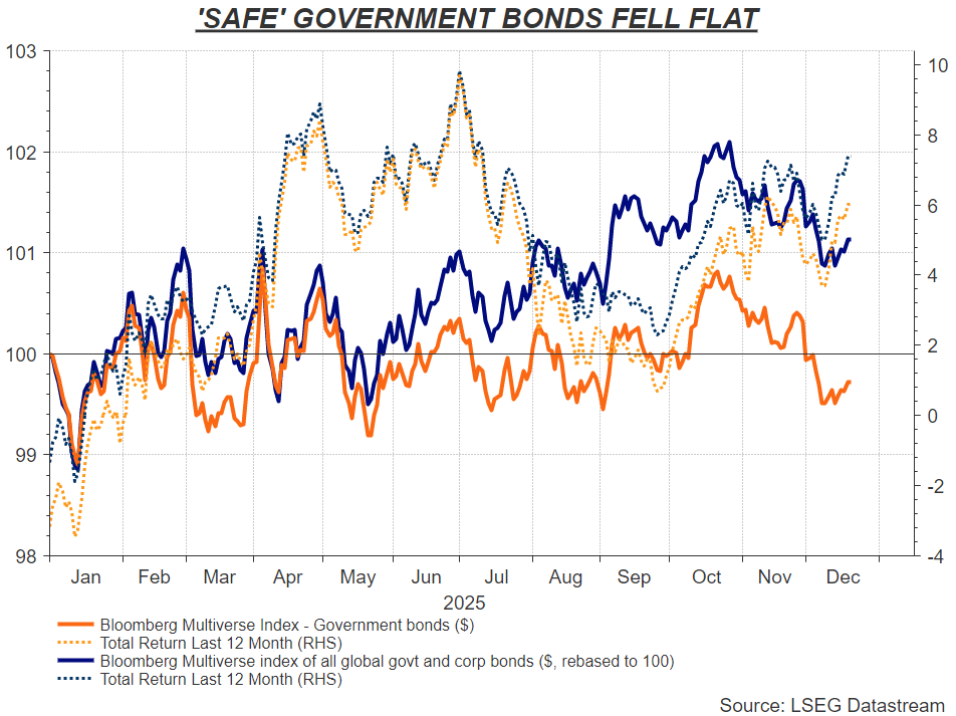
2025年避险资产大洗牌:贵金属独领风骚,传统安全港集体失色
Jin Shi Shu Ju· 2025-12-23 08:22
Group 1: Market Overview - In 2025, precious metals emerged as the biggest winners, while traditional "safe-haven" investments performed poorly amid market turmoil, conflicts, and concerns over an AI bubble [1] - The global economy showed strong growth, with politicians advocating for loose monetary policies, leading to a decline in recession fears and a surge in AI enthusiasm, alongside escalating geopolitical tensions [1] - The commodity index performed poorly due to an oversupply of crude oil, with oil prices dropping by 20% year-on-year, currently at about half of the previous highs [1] Group 2: Defense Sector Performance - For investors concerned about global conflicts, the best investment option was the defense sector, with U.S. aerospace and defense stocks rising by 36% and European counterparts increasing by 55% as Germany and Europe accelerated military rearmament [1] Group 3: Bond and Defensive Asset Performance - Most traditional hedging tools and safe assets underperformed this year, with global "risk-free" government bond indices declining by approximately 1% and total returns slightly exceeding 6% [2] - The Bloomberg Multiverse index, which includes government, supranational, agency, and corporate bonds, saw a price increase of about 1% and total returns close to 7% [2] Group 4: Stock Market Insights - The MSCI All-Country Stock Index's performance was more than double that of government bonds, indicating a strong recovery in the stock market [4] - The S&P 500 index rose by 15% due to the boost from large tech stocks and AI themes, with growth stocks outperforming value stocks by more than double [4] - Defensive sectors like utilities, healthcare, and financials saw gains over 10%, but still lagged behind major indices, while the consumer staples sector had a meager increase of about 2% [4] Group 5: Currency Performance - Traditionally safe-haven currencies like the yen and Swiss franc underperformed, with the yen dropping approximately 4% against its major trading partners despite initial gains [7] - The Swiss franc maintained its early-year gains, becoming one of the few standout safe-haven assets alongside gold and silver [7] - The U.S. dollar index fell by 12% during the year's most turbulent months, raising questions about its status as a safe-haven asset [7] Group 6: Volatility and Investment Strategies - Strategies involving options and volatility indices failed to yield profits in 2025, with the VIX closing down 2 points from the beginning of the year [9] - The MOVE index for bond market volatility was less than two-thirds of its initial level, indicating a decline in market volatility [9] - Overall, overly cautious investment strategies did not prove profitable this year [10]
摩根资管周奂彤:中长线继续看好内地和香港市场 建议趁市况波动吸纳高息股
Zhi Tong Cai Jing· 2025-12-22 07:27
她续提到,预期明年初可能仍然由增长型股份带动,但年中若重燃通胀担忧,抗跌力会较佳。在市况波 动下,成为增长板块以外的一个避风港。 临近年底,港股交投转淡,上周日均成交续低于2,000亿港元,市场预期资金或留待明年首季才再度大 举涌入。摩根资产管理环球市场策略师周奂彤分析,有两大因素支撑,中长线继续看好内地和香港市 场,人工智能(AI )板块短期或仍有忧虑,建议可趁市况波动吸纳高息股。 她指出,关税战不确定性已延至明年第四季,近期出口数据显示内地市场变得更多元化,相关忧虑的迫 切性已有所减少;内地居民存款率高企,但明年会有更多中长期存款到期,"存款搬家"或带动资金流入 内地和香港市场,利好股市。 她续指,香港多只早前上市的IPO禁售期即将届满,或令资金面短期受压,但近期有不少受欢迎的人工 智能(AI)相关股份准备上市,有机会抵消相关影响。 另一方面,周奂彤亦密切注视生物科技板块,"内地创新药在全球创新药份额已飙升至约3成,行业已非 再由欧美等成熟市场主导。"她补充,市场短期对人工智能泡沫(AI Bubble)仍有忧虑,令投资气氛受到 影响,料明年AI板块不确定性会较今年高。 ...