债券市场

Search documents
南方基金固收类夺冠,汇添富债基翻车了!
Xin Lang Cai Jing· 2026-01-27 12:30
Core Insights - The performance of fixed-income funds in 2025 significantly declined compared to 2024, with an average return of 2.15% across 3,988 funds, down from 4% in 2024 [2][35] - The total profit from fixed-income funds in 2025 was 372.31 billion yuan, a decrease of 264.15 billion yuan from 636.47 billion yuan in 2024 [2][46] - Despite poor overall performance, the management scale of fixed-income funds increased to 26.12 trillion yuan by the end of 2025, up nearly 2 trillion yuan from the end of 2024 [2][57] Fund Performance - The top-performing fund was Southern Changyuan Convertible Bond A, achieving a return of 48.77%, while the worst performer was Huatai Fuheng Pure Bond A, with a return of -7.7%, resulting in a performance gap of 56.47% [2][39] - Among 3,648 bond funds, the average return was 2.23%, with 3,311 funds generating positive returns and 337 funds reporting losses [5][37] - Convertible bond funds performed exceptionally well, with an average return of 23.34%, while index bond funds lagged with an average return of 0.82% [5][37] Management Scale Changes - By the end of 2025, the management scale of fixed-income funds increased by 1.96 trillion yuan, representing an 8.11% growth [25][57] - 33 fund companies saw their bond fund management scale grow by over 10 billion yuan, while 51 companies experienced similar growth in money market funds [36][61] - However, some companies, such as Bosera Fund, saw significant reductions in their bond fund management scale, with a decrease of 457.91 billion yuan [31][62] Profit Distribution - In 2025, 32 fund companies reported net profits exceeding 3 billion yuan from fixed-income products, with 12 companies surpassing 10 billion yuan [2][51] - The top profit-generating fund was Tianhong Yuerbao, with a profit of 9.256 billion yuan [48][49] - Conversely, 442 fixed-income funds reported negative profits, with 21 funds losing over 1 billion yuan [50][51] Company-Specific Insights - E Fund led the profit rankings among fund companies with a total profit of 19.974 billion yuan from fixed-income products [52][51] - Six companies, including Xinghe Fund and Huachen Future Fund, reported negative profits, primarily from their bond funds [52][53] - The performance of fund managers also varied, with some experiencing significant underperformance compared to benchmarks [43][45]


【宏观与债市周报】中央财政为股权投资机构发债提供增信支持,国债收益率下行
Xin Lang Cai Jing· 2026-01-26 11:09
Macroeconomic Overview - In mid-January 2026, prices of 29 out of 50 monitored production materials increased, while 13 decreased and 8 remained stable [1][4] - As of January 23, 2026, the 10-year U.S. Treasury yield decreased by 6 basis points to 4.24%, with the effective federal funds rate remaining stable at 3.64% [1][4] - In December 2025, the seasonally adjusted non-farm employment in the U.S. increased by 50,000, with previous months' figures revised downwards, totaling a downward revision of 76,000 jobs [1][4] - The unemployment rate in December fell to 4.4%, a decrease of 0.1 percentage points from November [1][4] - The Eurozone benchmark interest rate remains at 2.15%, while Japan's benchmark rate is at 0.75% [1][4] Bond Market Insights - The yields on both 10-year and 2-year government bonds declined last week, with the 10-year yield down by 0.95 basis points to 1.8298% and the 2-year yield down by 1.13 basis points to 1.3959% as of January 23 [2][5] - As of the end of December, the M2 money supply was 340.29 trillion yuan, reflecting a year-on-year growth of 8.5% [2][5] - The People's Bank of China conducted a 125 billion yuan 7-day reverse repurchase operation on January 23, with a net liquidity injection of 38.3 billion yuan for the day [2][5] - The total social financing stock was 442.12 trillion yuan in December 2025, with a financing growth rate of 8.3%, narrowing the gap with M2 growth by 0.7 percentage points from November [2][5] - Last week, 308 credit bonds were successfully issued, with 135 classified as local government financing bonds, accounting for 43.8% of the total [2][5] Policy and Market Developments - The People's Bank of China aims to accelerate the construction of a cross-border payment system for the yuan and implement strict regulatory measures for payment institutions [3][6] - The central government has allocated risk-sharing funds to support bond issuance for private enterprises and private equity investment institutions [3][6] - The Governor of the People's Bank of China announced plans to establish a risk-sharing tool for technology innovation and private enterprise bonds, along with providing re-lending support [3][6] - The Ministry of Finance will conduct market support operations for government bonds with maturities of 3 and 5 years starting January 20 [3][6] - Recent announcements from local government financing entities involve equity transfers, asset disposals, and changes in control [3][6] Information from Far East Credit - Far East Credit published a guide on the application of large language models in corporate credit evaluation [3][6] - Far East Credit's rating facilitated the successful issuance of the first medium-term note for Zhejiang Jiaxing Lake District Science and Technology Control Group in 2026 [3][6]
大类资产早报-20260126
Yong An Qi Huo· 2026-01-26 05:48
Global Asset Market Performance - The latest yields of 10-year government bonds in major economies: US 4.226%, UK 4.511%, France 3.493%, Germany 2.905%, Italy 3.512%, Spain 3.270%, Switzerland 0.278%, Greece 3.506%, Japan 2.248%, Brazil 6.208%, China 1.825%, South Korea 3.603%, Australia 4.818%, New Zealand 4.589% [3] - The latest yields of 2-year government bonds in major economies: US 3.595%, UK 3.722%, Germany 2.127%, Japan 1.240%, Italy 2.205%, China (1Y yield) 1.273%, South Korea 2.924%, Australia 4.183% [3] - The latest exchange rates of the US dollar against major emerging - economy currencies: Brazil 5.286, South Africa (zar) 16.127, South Korean won 1464.000, Thai baht 31.195, Malaysian ringgit 4.007 [3] - The latest exchange rates of the RMB: on - shore RMB 6.963, off - shore RMB 6.949, RMB central parity rate 6.993, RMB 12 - month NDF 6.817 [3] - The latest values of major economies' stock indices: S&P 500 6915.610, Dow Jones Industrial Average 49098.710, Nasdaq 23501.240, Mexican stock index 68195.150, UK stock index 10143.440, France CAC 8143.050, Germany DAX 24900.710, Spanish stock index 17544.400, Russian stock index (not available), Nikkei 53846.870, Hang Seng Index 26749.510, Shanghai Composite Index 4136.164, Taiwan stock index 31961.510, South Korean stock index 4990.070, Indian stock index 8951.010, Thai stock index 1314.390, Malaysian stock index 1719.990, Australian stock index 9189.871, emerging - economy stock index 1501.110 [3] - The latest values of credit - bond indices: US investment - grade credit - bond index 3555.310, euro - zone investment - grade credit - bond index 266.753, emerging - economy investment - grade credit - bond index 290.590, US high - yield credit - bond index 2933.910, euro - zone high - yield credit - bond index 412.990, emerging - economy high - yield credit - bond index 1838.807 [3] Stock Index Futures Trading Data - Index performance: A - share closing price 4136.16 (up 0.33%), CSI 300 closing price 4702.50 (down 0.45%), SSE 50 closing price 3032.19 (down 0.69%), ChiNext closing price 3349.50 (up 0.63%), CSI 500 closing price 8590.17 (up 2.42%) [4] - Valuation: PE(TTM) of CSI 300 14.08 (down 0.09%), SSE 50 11.49 (down 0.11%), CSI 500 38.90 (up 0.83%), S&P 500 27.62 (up 0.01%), Germany DAX 19.32 (up 0.03%) [4] - Risk premium: 1/PE - 10 - year interest rate of S&P 500 - 0.61 (up 0.01%), Germany DAX 2.27 (down 0.03%) [4] - Fund flow: A - share latest value - 58.18, main - board latest value - 331.92, ChiNext latest value 183.94, CSI 300 latest value - 814.22, A - share 5 - day average - 466.98, main - board 5 - day average - 321.96, ChiNext 5 - day average - 123.99, CSI 300 5 - day average - 457.40 [4] - Transaction amount: Shanghai and Shenzhen stock markets latest value 30852.24 (up 3934.91), CSI 300 latest value 7556.18 (up 653.83), SSE 50 latest value 2004.56 (up 70.45), small - and medium - sized board latest value 6259.27 (up 921.92), ChiNext latest value 8169.10 (up 1353.75) [5] - Main contract basis and spread: IF basis 6.70 (0.14%), IH basis 5.61 (0.18%), IC basis 68.03 (0.79%) [5] Treasury Futures Trading Data - Treasury futures closing prices: T2303 108.20 (up 0.04%), TF2303 105.88 (up 0.04%), T2306 108.19 (up 0.06%), TF2306 105.90 (up 0.05%) [5] - Fund interest rates: R001 1.4654% (down 8.00BP), R007 1.5360% (down 1.00BP), SHIBOR - 3M 1.5980% (unchanged) [5]
债市空方筹码拥挤,修复的边界在哪?
ZHONGTAI SECURITIES· 2026-01-25 06:58
1. Report Industry Investment Rating - The industry rating is "Overweight", indicating an expected increase of over 10% in the industry index relative to the benchmark index over the next 6 - 12 months [25] 2. Core View of the Report - The bond market is currently in a technical buying window. Based on refined observation, trading opportunities can be grasped through the repair of term spreads and short - covering in bond - type portfolio strategies. When the trading price approaches the key point, further breakthrough requires an increase in trading volume, and attention should also be paid to changes in equity sentiment and institutional liability ends [1][21] 3. Summary by Relevant Catalogs 3.1 Bond Market May Be in a Technical Buying Window - This week, the bond market showed a recovery. As of January 23, the yields of 10Y and 30Y treasury bonds decreased by 1.26BP and 1.65BP respectively compared to last Friday. The 30Y treasury bond yield showed a greater decline on Wednesday and Friday, which was a supplementary repair lagging behind the 10Y treasury bond yield [1][5] - There may be technical trading opportunities: 1) "Short - sellers are exhausted", and there is a valuation repair due to short - covering of ultra - long treasury bonds. For example, on Tuesday (1/20), the borrowing concentration of 25 Te Guo 06 reached a record high of 31.92%, and after 25 Te Guo 02's borrowing concentration rose to a recent high, it declined on Wednesday, with securities firms leading the short - covering, driving the valuation of two 30 - year treasury bond active bonds to repair by over 2BP [7] - The "short local bonds" strategy based on supply concerns has increased recently. For example, the borrowing volume of 30 - year local bonds such as 25 Henan Bond 111 has significantly increased, and securities firms have contributed the main increase [9] - In terms of institutional behavior, large banks had a net purchase guidance for long - term bonds last week. From January 12 - 16, large banks had a cumulative net purchase of about 65 billion yuan of 7 - 10Y interest - rate bonds, and continued to increase their holdings this week, with a total net purchase of over 120 billion yuan in two weeks [11] - The duration of pure - bond funds has dropped to a low level, and there is a repair of the duration strategy space this week. On January 15, the duration of pure - bond funds dropped to the 12% historical quantile level since last year and showed a rebound near the 75% quantile (2.76 years) in the past five years [11] - The recent change in bond market trading strategies is that the bond - type portfolio strategy of "short local bonds + long treasury bonds" has replaced the term spread strategy of "short 30 - year + long 10 - year". The 30 - year treasury bond short - selling strategy is already crowded, and there is not a strong logic for further short - selling in the short term [14] 3.2 Possible "Flaws" in Local Bond Borrowing - It is uncertain whether shorting local bonds can become a common strategy in the bond market. Currently, the participation ranking is securities firms > small and medium - sized banks > large banks. Due to the lower liquidity, smaller single - bond scale, and more frequent bond - swapping operations of local bonds compared to treasury bonds, the trading is more difficult [15] - Some one - sided short positions in local bonds may lead to losses when the entire bond market rises. For example, during this week's bond market recovery, the yield of Shandong bonds decreased, although the decline of 26 Shandong 02 (5BP) was less than that of 2602 (9BP) [15] - The short - term ultra - long bond underwriting capacity is acceptable, and the supply concern at the beginning of the year may be overestimated. The issuance of ultra - long local bonds this week was stable, and the underwriting capacity mainly comes from banks with sufficient underwriting quotas at the beginning of the year and insurance companies as the current interest rate of local bonds (2.4% - 2.5%) has reached their acceptable allocation point [17] 3.3 China's Bond Market Supply - Demand Issue May Not Be Isolated - The current price repair may not mean an increase in trading volume. The bond market supply - demand contradiction remains unresolved in the medium term. In the short term, it is difficult to see a reduction in the supply of ultra - long bonds or an adjustment in the term structure. The supply of ultra - long bonds in Q1 is expected to be about 2.4 trillion yuan, not significantly less than last year [18] - If the primary issuance remains unchanged, banks may face greater pressure in underwriting. Insurance companies may find it more cost - effective to purchase ultra - long bonds from the secondary market. The incremental funds from insurance companies for ultra - long bond allocation may be insufficient [19] - The supply - demand issue has been discussed for a long time, and the bond market has taken a long time to digest it. The yield of Japanese and US bonds has also significantly adjusted this week, indicating that the supply - demand contradiction may not be a problem unique to China [21] 3.4 Specific Strategies - In the short term, attention can be paid to the change in the borrowing concentration of active bonds. The risk of one - sided shorting of local bonds is relatively high. A strategy combination can be made by combining the short - covering repair of 30 - year treasury bonds, and opportunities for the repair of term spreads that have moved quickly in the early stage can be grasped. Small - position trading can be used to maintain a competitive state. This week, funds significantly increased their holdings of Tier 2 and perpetual bonds, and short - term Tier 2 and perpetual bonds may benefit from the establishment of various fixed - income + strategies [22] - For the TL contract, the price has support at 111.5 - 112.0 yuan and a first - level pressure zone at around 112.8 yuan. If the bullish sentiment breaks through the resistance level, the next repair target may be 113.55 yuan. According to the modified duration of 25 Te Guo 06, the lower limit of the corresponding valuation yield of the 30 - year treasury bond active bond may be 2.20%. If the term spread narrows to 40BP, the lower limit of the 10 - year treasury bond yield may be around 1.80% [2][22]
中欧红利优享灵活配置混合A:2025年第四季度利润6.6亿元 净值增长率6.68%
Sou Hu Cai Jing· 2026-01-24 04:52
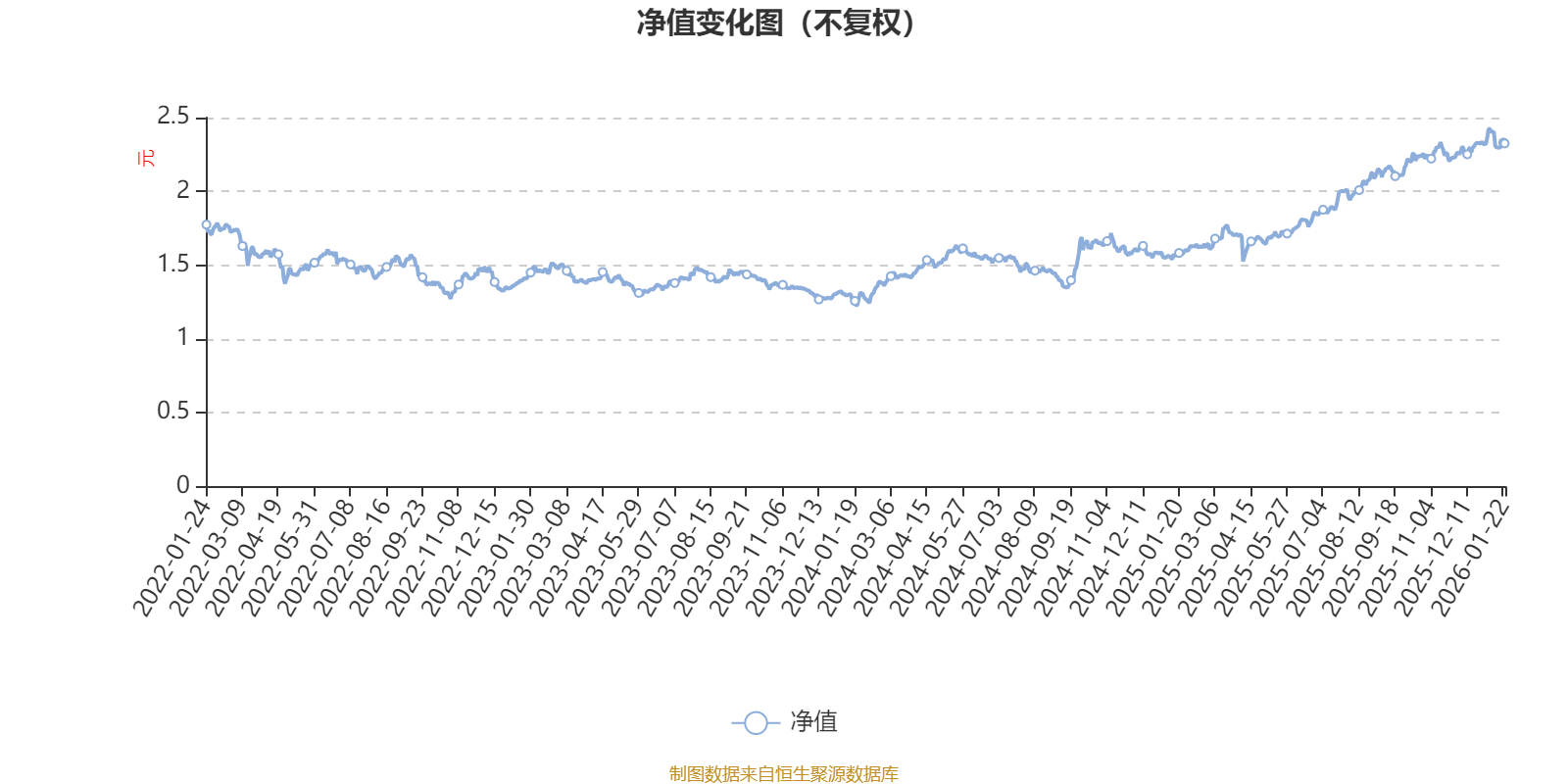
Core Viewpoint - The AI fund, China Europe Dividend Enjoy Flexible Allocation Mixed A (004814), reported a profit of 660 million yuan for Q4 2025, with a weighted average profit per fund share of 0.1483 yuan, and a net value growth rate of 6.68% for the period [2]. Fund Performance - As of January 22, the fund's unit net value was 2.325 yuan, with a recent three-month net value growth rate of 9.05%, ranking 607 out of 1286 comparable funds [3]. - The fund's six-month net value growth rate was 22.06%, ranking 625 out of 1286, while the one-year growth rate was 54.66%, ranking 264 out of 1286 [3]. - Over three years, the fund achieved a growth rate of 68.17%, ranking 92 out of 1286 [3]. Risk and Return Metrics - The fund's Sharpe ratio over the past three years was 1.2202, ranking 37 out of 1275 comparable funds [8]. - The maximum drawdown over the past three years was 19.38%, with a ranking of 265 out of 1264 [10]. - The highest drawdown in a single quarter occurred in Q1 2020, at 19.96% [10]. Investment Strategy - The fund maintained an average stock position of 90.5% over the past three years, compared to a peer average of 72.57% [13]. - The fund's highest stock position was 93.74% at the end of Q1 2022, while the lowest was 79.19% in mid-2021 [13]. Fund Size and Holdings - As of the end of Q4 2025, the fund's total size was 9.938 billion yuan [15]. - The top ten holdings included major companies such as China Ping An, China Life, and Zijin Mining [18].
深耕债券市场沃土 浇灌实体经济之花
Zhong Guo Zheng Quan Bao· 2026-01-23 21:02
Group 1: Core Insights - The bond market in China is experiencing significant growth, with an average annual compound growth rate of 8.46% from 2021 to 2025, and a projected market size increase of 70.61% by the end of 2025 compared to 2020 [2][3] - Financial institutions, particularly state-owned enterprises like Caixin Securities, are committed to supporting national strategies and local economic development through innovative bond financing [4][5] Group 2: Market Structure Changes - The proportion of interest rate bonds has increased to 70.03% by the end of 2025, up by 7.64 percentage points from 2020, highlighting their role as a stabilizing force in the capital market [3] - The credit bond market is undergoing a transformation, with a shift away from high-leverage real estate financing towards new credit bond varieties that support emerging economic drivers, such as technology innovation [3][4] Group 3: Innovations in Bond Issuance - Caixin Securities has issued nearly 300 billion yuan in bonds during the "14th Five-Year Plan" period, ranking 23rd in the market for company bonds [5] - The company has been a leader in green finance, issuing nine green low-carbon transition bonds totaling over 2 billion yuan, including the first rural revitalization low-carbon transition bond in China [6] Group 4: Risk Management and Compliance - The company emphasizes a robust risk management framework, achieving an A-class rating for bond business quality from the China Securities Association for six consecutive years [7] - A comprehensive internal control system is in place to manage risks throughout the entire bond issuance process, from project initiation to ongoing management [8] Group 5: Future Development Strategies - The company plans to focus on high-growth technology innovation enterprises and major R&D projects, aiming for significant growth in technology bond issuance during the "15th Five-Year Plan" [8][9] - There is a commitment to enhancing digital capabilities and expanding service stations to improve financing services and better meet local economic needs [8][9]
证券公司学习宣传贯彻党的二十届四中全会精神 | 财信证券党委书记、董事长刘宛晨:深耕债券市场沃土,浇灌实体经济之花
Zhong Guo Zheng Quan Bao· 2026-01-23 08:21
Core Viewpoint - The article emphasizes the ongoing reforms in the capital market and the strategic opportunities for the securities industry, highlighting the role of financial institutions like Caixin Securities in supporting the real economy and driving innovation in the bond market [1][2]. Group 1: Bond Market Development - The bond market in China has shown a compound annual growth rate of 8.46% from 2021 to 2025, with the total market size expected to grow by 70.61% compared to the end of 2020 [3]. - By the end of 2025, the proportion of interest rate bonds is projected to reach 70.03%, an increase of 7.64 percentage points from the end of 2020 [4]. - The transformation of the credit bond market is notable, with a shift from high-leverage financing in infrastructure and real estate to a more rational pricing of risks, particularly in the context of policies aimed at preventing hidden debt risks [4][5]. Group 2: Company Initiatives and Achievements - Caixin Securities has underwritten nearly 300 billion yuan in bonds during the "14th Five-Year Plan" period, ranking 23rd in the market for 2025 with 600.07 billion yuan in bond underwriting, including 510.23 billion yuan in corporate bonds [6]. - The company has actively participated in the issuance of innovative financial products, including the first low-carbon transformation bonds linked to rural revitalization and the first green bonds for rural "two waters" projects [7][8]. - In the field of technology finance, Caixin Securities has underwritten 31.35 billion yuan in innovation and entrepreneurship bonds and 48 billion yuan in technology innovation bonds during the "14th Five-Year Plan" period [7]. Group 3: Risk Management and Compliance - The company emphasizes a robust risk management framework, implementing a three-tier internal control system to ensure comprehensive oversight from project initiation to issuance and post-issuance [8][11]. - Caixin Securities has maintained an A-class rating in the bond business quality evaluation by the China Securities Association for six consecutive years from 2020 to 2025, reflecting its commitment to compliance and quality control [8][11]. Group 4: Future Strategies - The company plans to focus on high-growth technology innovation enterprises and major R&D projects, aiming for significant growth in technology bond underwriting during the "15th Five-Year Plan" [9][10]. - Caixin Securities will enhance its digital capabilities by establishing an intelligent underwriting platform and expanding its service stations to improve financing services in key economic areas [10]. - The company aims to strengthen collaboration with banks, insurance, and fund institutions to create a diversified financing ecosystem that supports the real economy [11][12].
这类产品,资金狂买!最高净申购超60亿份
Zhong Guo Ji Jin Bao· 2026-01-23 01:33
Group 1 - The total scale of public funds reached 31.62 trillion units by the end of 2025, with a net subscription of 706.79 billion units in the fourth quarter, representing a growth rate of 2.29% [1] - Various fund types, including money market, index, QDII, bond, commodity, and FOF, experienced net subscriptions, while mixed funds saw the highest net redemptions, shrinking by 82.30 billion units [1][5] - Despite overall net redemptions in actively managed equity and mixed funds, 38 actively managed equity funds attracted net subscriptions exceeding 500 million units, with the highest being 6.20 billion units [2][3] Group 2 - The top actively managed equity fund, managed by Zhang Haiqiao, attracted a net subscription of 6.20 billion units, with a net subscription ratio of 2126.19% [2] - The second highest net subscription was for a fund managed by Zhang Lu, which garnered 5.22 billion units and a net subscription ratio of 513.27% [2] - The bond market showed a "rise then fall" trend, with bond funds achieving a net subscription of 824.34 billion units, increasing their total scale to 9.09 trillion units [6] Group 3 - QDII funds saw a net subscription of 1.31 trillion units, increasing their total scale to 8.17 trillion units, with a leading net subscription ratio of 19.04% [6] - Commodity funds achieved a net subscription of 238.42 billion units, with a total scale of 943.89 billion units, marking the highest net subscription ratio of 33.8% among fund types [6] - The mixed fund category experienced a net redemption of 82.30 billion units, reducing its total scale to 2.65 trillion units, with a net redemption ratio of 3.02% [5][6]
FPG财盛国际:金价与加密资产联动加剧
Xin Lang Cai Jing· 2026-01-22 14:13
Core Viewpoint - The correlation between digital assets and traditional macro policies has reached a historical high amid the current volatile global financial environment, with Bitcoin's recent price movements reflecting market sensitivity to geopolitical policy statements [1][4]. Group 1: Market Reactions - Bitcoin experienced a "first dip then rise" trend during Asian trading hours, dropping to approximately $87,300 before quickly rebounding to the $90,000 mark after the easing of trade conflict expectations [1][4]. - Ethereum fell below $3,000 but quickly recovered to above $3,020, while Solana and XRP also saw rebounds to around $130 and $1.95, respectively, indicating a synchronized market recovery [1][4]. Group 2: Bond Market Influence - The marginal improvement in the bond market provided relief for risk assets, with the rise in long-term treasury yields earlier in the week being a primary factor suppressing cryptocurrency performance [2][4]. - The decline in Japanese government bond yields and reassuring statements from officials have alleviated global interest rate pressures, contributing to a slight recovery in major tokens [2][4]. Group 3: Asset Characteristics - The current volatility highlights the precarious position of digital assets, which, despite being touted as independent from traditional financial systems, exhibit high-risk characteristics during periods of geopolitical tension and policy uncertainty [2][5]. - As capital is withdrawn from high-leverage positions for preservation, digital assets often bear the brunt of this "contagion effect," particularly in crowded trading positions [5]. Group 4: Future Outlook - The market's focus will be on the critical psychological level of $90,000, with external markets like oil and gold entering a consolidation phase, while the stability of the dollar index will be crucial for the continuation of the cryptocurrency rebound [2][5]. - If the positive sentiment from Davos persists and the bond market does not experience unexpected turbulence, major tokens may establish a solid support base at current levels [2][5]. Group 5: Overall Market Dynamics - Global political dynamics and bond market performance remain the "behind-the-scenes" factors influencing cryptocurrency market volatility [3][5]. - As market logic shifts from emotional speculation to fundamental valuation, asset differentiation will gradually become apparent, with high-quality assets exhibiting stronger risk resilience likely to stand out during the upcoming volatility [3][5].

交易商协会:2025年发行超10万亿元债务融资工具
Sou Hu Cai Jing· 2026-01-22 11:19
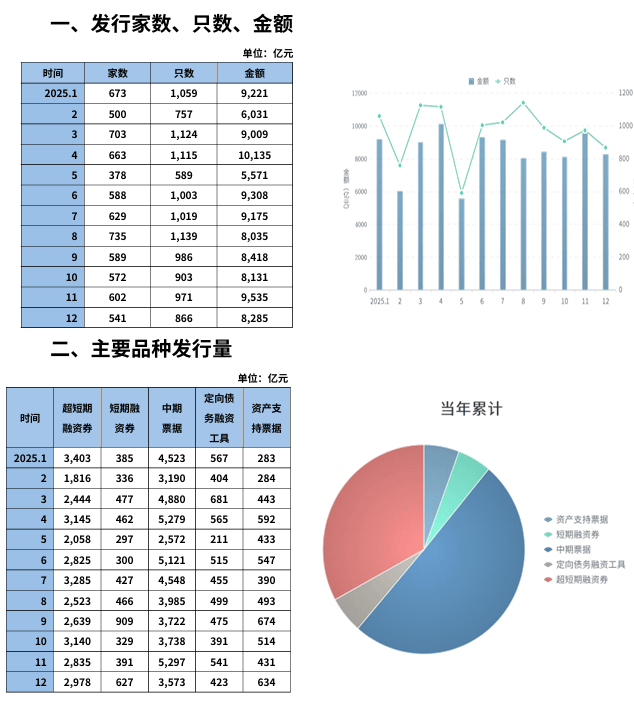
Group 1 - The core point of the article is that the interbank bond market in China issued a total of 8,285 billion yuan in debt financing instruments in December 2025, with a total of 11,531 instruments issued throughout the year amounting to 10.09 trillion yuan [1][2]. Group 2 - In December 2025, the breakdown of the debt financing instruments issued includes: 2,978 billion yuan in super short-term financing, 627 billion yuan in short-term financing, 3,573 billion yuan in medium-term notes, 423 billion yuan in targeted debt financing instruments, and 634 billion yuan in asset-backed notes [1][3]. - The total number of debt financing instruments issued in December 2025 was 866 [1][2]. - The issuance of debt financing instruments throughout 2025 was 11,531, indicating a robust market activity [1][2]. Group 3 - The issuance of innovative products in December 2025 included 448 billion yuan in green debt financing instruments, 66 billion yuan in rural revitalization notes, 145 billion yuan in asset-backed commercial papers, 54 billion yuan in sustainable development-linked bonds, and 1,345 billion yuan in science and technology innovation notes [6]. - The cumulative issuance of panda bonds reached 8,587 billion yuan by the end of December 2025, with 1,563 billion yuan issued in that year [8]. Group 4 - The custody statistics for debt financing instruments show that the custody volume for super short-term financing bonds was 14,802 billion yuan, short-term financing bonds at 5,213 billion yuan, medium-term notes at 131,665 billion yuan, targeted debt financing instruments at 19,336 billion yuan, and asset-backed notes at 7,074 billion yuan [10]. - The custody volume for innovative products included 3,188 billion yuan in panda bonds, 11,475 billion yuan in science and technology innovation notes, 158 billion yuan in sustainable development-linked bonds, 5,854 billion yuan in green debt financing instruments, 1,237 billion yuan in rural revitalization notes, and 1,053 billion yuan in asset-backed commercial papers [12].