
市场供需

Search documents
玻璃纯碱周度报告:国泰君安期货能源化工-20260104
Guo Tai Jun An Qi Huo· 2026-01-04 08:35
1. Report Industry Investment Rating No relevant content provided. 2. Core Views - Glass: Short - term is strong, medium - term is a volatile market. Supply contraction and demand weakness will cause price fluctuations. In 2026, it may not be a continuous decline pattern [2]. -纯碱: Medium - term is volatile and weak, short - term is strong. Supply surplus and downstream demand pressure are the main drivers of price decline, but low valuation provides support [3]. 3. Summary by Related Catalogs Glass Supply - There are 265 float glass production lines in the country, with 212 in operation, and the daily melting volume is 151,405 tons, a decrease of 2,700 tons from last week. The industry capacity utilization rate is 82.14%. 4 production lines were shut down and cold - repaired this week [2]. - In 2025, the total daily melting volume of cold - repaired production lines is 18,630 tons/day; the total daily melting volume of ignited production lines is 15,010 tons/day. The potential new ignition production lines have a total daily melting volume of 14,190 tons/day, and the potential old - line restart has a total daily melting volume of 7,930 tons. The potential cold - repaired production lines have a total daily melting volume of 9,100 tons/day [6][7][8]. - The current in - production capacity is about 154,500 tons/day, and the peak capacity in 2021 was 178,000 tons/day [14]. Demand - As of December 15, 2025, the average order days of national deep - processing sample enterprises is 9.7 days, a month - on - month decrease of 4.2% and a year - on - year decrease of 22.6%. The orders in the northern region continue to decline, while the central and eastern regions remain stable, and the southern region shows a moderate increase [2]. Inventory - As of December 31, the total inventory of key monitored provincial production enterprises is 53.78 million weight boxes, a decrease of 1.55 million weight boxes from last Thursday, a decline of 2.80%. The inventory days are 28.66 days, a decrease of 0.53 days from last Thursday [2]. Price and Profit - The price in Shahe is about 1,010 - 1,040 yuan/ton; in central China's Hubei region, it is about 1,020 - 1,060 yuan/ton; in eastern China's Jiangsu and Zhejiang regions, the price of some large manufacturers is about 1,180 - 1,240 yuan/ton [21]. - The profit of using petroleum coke as fuel is about - 7 yuan/ton, the profit of using natural gas is about - 186 yuan/ton, and the profit of using coal is about - 21 yuan/ton [29]. Strategy - Unilateral: Volatile and weak, with upper pressure at 1,150 - 1,180 and lower support at 900 - 930. -跨期: Do not participate for the time being. -跨品种: Do not participate for the time being. If trading the inflation expectation factor in 2026, glass may be stronger, but there are many uncertainties in the market [2]. Photovoltaic Glass Price and Profit - The market trading has weakened recently, and this situation is expected to continue. The mainstream order price of 2.0mm coated panels is 10.5 - 11 yuan/square meter, a month - on - month decrease of 6.52%; the mainstream order price of 3.2mm coated panels is 17.5 - 18.5 yuan/square meter, a month - on - month decrease of 2.70% [41][43]. Capacity and Inventory - There are 402 photovoltaic glass production lines in operation in the country, with a total daily melting volume of 87,940 tons/day, unchanged from last week. The inventory is expected to increase seasonally later [45]. Soda Ash Supply and Maintenance - This week, the domestic soda ash production is 711,800 tons, a month - on - month decrease of 9,600 tons, a decline of 1.32%. The comprehensive capacity utilization rate is 81.65%, a month - on - month decrease of 1.09% [3]. - Some soda ash plants have carried out phased maintenance and production reduction [53]. Inventory - As of December 31, the total inventory of domestic soda ash enterprises is 1.34 million tons (including the external warehouse inventory of some manufacturers), of which the heavy - soda inventory is 594,000 tons [3]. Price and Profit - The low - end price in the Shahe area is 1,140 yuan/ton, and a small number of prices have increased slightly. The nominal prices in Shahe and Hubei are about 1,140 - 1,300 yuan/ton [67][68]. - The profit of the joint - alkali method in East China (excluding Shandong) is - 21 yuan/ton, and the profit of the ammonia - alkali method in North China is - 57 yuan/ton [72]. Strategy - Unilateral: There is still pressure in the medium - term, with upper pressure at 1,250 - 1,300 and lower support at 1,080 - 1,100. -跨期: Do not participate for the time being. -跨品种: Do not participate for the time being. If trading the inflation expectation factor in 2026, glass may be stronger, but there are many uncertainties in the market [3].
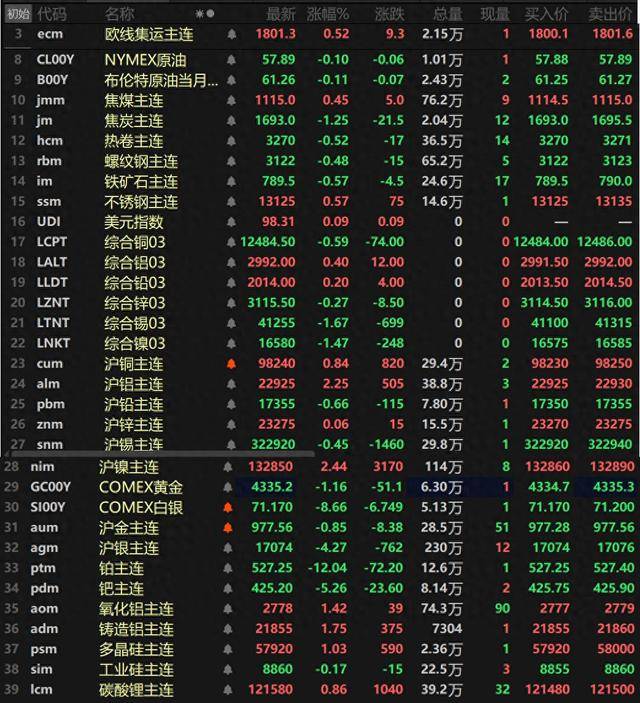
金属涨跌互现 沪铝沪镍涨逾2% 纽银大跌超8% 铂主连跌逾12%
Sou Hu Cai Jing· 2025-12-31 08:45
Metal Market - Domestic base metals generally rose, with only lead and tin declining by 0.66% and 0.45% respectively. Nickel and aluminum both increased by over 2%, with nickel rising 2.44% to a new high of 135,570 yuan/ton, and aluminum up 2.25% to 23,030 yuan/ton, marking the highest since March 2022 [1] - In the external market, base metals mostly fell, with only London aluminum and lead rising by 0.4% and 0.2% respectively. Tin and nickel dropped over 1%, with tin down 1.67% and nickel down 1.47% [1] - Precious metals saw declines, with COMEX gold down 1.16% and silver down 8.66%. Domestic gold and silver also fell by 0.85% and 4.27% respectively [1] Macro Environment - The National Bureau of Statistics reported that China's manufacturing PMI for December was 50.1%, indicating a recovery in economic activity. The new orders index rose to 50.8%, and the production index increased to 51.7%, reflecting positive changes in the manufacturing sector [5] - The National Development and Reform Commission announced a total of approximately 295 billion yuan for early-stage construction projects and central budget investments for 2026, aimed at stabilizing investment [6] - The People's Bank of China conducted a net injection of 502.8 billion yuan through reverse repos, maintaining the operation rate at 1.40% [7] - The USD/CNY exchange rate was reported at 7.0288, with the dollar index rising 0.09% to 98.31. The Federal Reserve's meeting minutes indicated a potential for future rate cuts if inflation decreases as expected [8] Oil Market - Both WTI and Brent crude oil prices fell slightly, with WTI down 0.1% and Brent down 0.11%. Analysts predict a nearly 20% decline in oil prices in 2025, with Brent potentially experiencing the longest annual decline in history due to oversupply [11] - OPEC+ is expected to pause production increases in the first quarter of 2026, with analysts forecasting that supply will exceed demand, leading to further price drops [11]

国投期货综合晨报-20251225
Guo Tou Qi Huo· 2025-12-25 05:20
Group 1: Energy and Metals Crude Oil - Geopolitical conflicts such as US tanker seizures, Russian port attacks, and potential supply cuts in Kazakhstan have raised concerns about supply disruptions, but the fundamental supply is still loose, and geopolitical factors may trigger short - term rebounds [2] Precious Metals - The Fed's easing prospects and geopolitical risks have supported the strength of precious metals, but short - term volatility may increase after the Christmas holiday [3] Copper - Domestic spot supply - demand gives more downward pressure on copper prices, but raw material shortages may be transmitted to refined copper, and it is recommended to hold long positions with an adjusted support level and set a stop - profit [4] Aluminum - The fundamentals of the aluminum market have limited contradictions. With the approach of the Christmas holiday, funds are leaving. It is recommended that long positions be held against the 40 - day moving average [5] Cast Aluminum Alloy - The spot price of ADC12 has been raised. When the spread between cast aluminum alloy and Shanghai aluminum expands to over 1,000 yuan, pay attention to the opportunity to shrink the spread [6] Alumina - Alumina has an oversupply situation, and costs may decline. It will be weak until large - scale production cuts occur [7] Zinc - External inventory increases have put short - term pressure on zinc prices. It is expected to fluctuate in the range of 22,800 - 23,800 yuan/ton [8] Lead - Lead is in a low - level consolidation pattern. Pay attention to the resistance at 17,500 yuan/ton [9] Nickel and Stainless Steel - The nickel market is currently dominated by policy sentiment. It is recommended to wait and see for the time being [10] Tin - In the first quarter of 2026, tin supply is expected to turn to recovery, while consumption in traditional fields is weak. It is recommended to pay attention to short - position reduction and use put options [11] Lithium Carbonate - The price of lithium carbonate has broken through 120,000 yuan. The overall fundamentals are strong, and the short side is under pressure [12] Industrial Silicon - The market is mainly driven by the expectation of production cuts at the end of the month, and it is expected to show a strong and volatile trend in the short term [13] Polysilicon - The industry has strong expectations but weak reality. After rule adjustments, the short - term market is expected to fluctuate and decline [14] Group 2: Steel and Related Products Rebar and Hot - Rolled Coil - The demand for rebar has recovered slightly, while the supply and demand of hot - rolled coils have both declined. The overall market is expected to fluctuate slightly stronger in the short term [15] Iron Ore - The supply of iron ore is strong, and the demand is at a low level. The short - term market is expected to fluctuate [16] Coke - The third round of price cuts has been fully implemented. The price is expected to fluctuate [17] Coking Coal - Some coal mines have reduced or stopped production. The price is expected to fluctuate after repairing the discount [18] Manganese Silicon - The spot price of manganese ore has increased. It is recommended to try long positions at low prices [19] Silicon Iron - The supply of silicon iron has decreased significantly. It is recommended to try long positions at low prices [20] Group 3: Shipping Container Shipping Index (European Line) - The market is in a game between "strong expectations" and "weak reality". The near - month contract is expected to continue to fluctuate around the spot price [21] Group 4: Fuel and Chemicals Fuel Oil and Low - Sulfur Fuel Oil - The demand for fuel oil has not been significantly boosted. High - sulfur fuel oil is in a game between geopolitical support and supply surplus, while low - sulfur fuel oil is expected to remain weak [22] Asphalt - The supply - demand of asphalt is marginally loose. Geopolitical factors may bring short - term rebounds, but it will eventually return to a price - pressured situation [23] Urea - The supply - demand of urea has improved marginally, and the market is running strongly [24] Methanol - The port inventory has increased significantly. The short - term market may fluctuate weakly in the range, while there is an upward drive in the long - term [25] Pure Benzene - The port inventory of pure benzene has increased. Consider long - position in the month - spread in the medium - term [26] Styrene - The cost support of styrene is insufficient, and the supply pressure is difficult to reverse [27] Polypropylene, Plastic, and Propylene - The prices of polypropylene and plastic have declined, and the market is under pressure [28] PVC and Caustic Soda - PVC may run at a low level, and the upward range of caustic soda is expected to be limited [29] PX and PTA - The PX market has a strong expectation, and it is recommended to maintain a long - position idea in the medium - term [30] Ethylene Glycol - The short - term pressure of ethylene glycol has eased, but it is still under long - term pressure [31] Short - Fiber and Bottle Chips - The long - term supply - demand of short - fiber is relatively good, while bottle chips are mainly driven by cost [32] Group 5: Building Materials Glass - The industry inventory has increased, and it is recommended to wait and see in the short term [33] 20 - Rubber, Natural Rubber, and Butadiene Rubber - The demand has weakened, and it is recommended to take a bullish strategy [34] Soda Ash - Soda ash is facing long - term supply - demand surplus pressure. It is recommended to short on rebounds and consider a spread strategy [35] Group 6: Agricultural Products Soybeans and Soybean Meal - The trading logic focuses on US soybean exports and South American harvest expectations. Soybean meal prices are expected to follow the fluctuations of US soybeans [36] Soybean Oil and Palm Oil - Both soybean oil and palm oil have continued to rebound. Pay attention to the macro - atmosphere [37] Rapeseed and Rapeseed Oil - The mid - term strategy for rapeseed is to short on rebounds, and the short - term strategy is to wait and see [38] Soybean No.1 - The price of domestic soybeans is oscillating strongly. Pay attention to the auction results [39] Corn - The price of corn is expected to fluctuate weakly in the short term. Pay attention to the selling progress in the Northeast and auctions [40] Live Pigs - The short - term price of live pigs has rebounded slightly, but the main contract is expected to be weak in the medium - term [41] Eggs - The egg market has turned optimistic in the long - term, but beware of rapid price increases [42] Cotton - The domestic cotton market is oscillating strongly. It is recommended for the industry to consider hedging and buy at low prices [43] Sugar - The international sugar market has sufficient supply, and the domestic market focuses on the new - season production [44] Apples - The apple market is bearish, and it is recommended to maintain a short - position idea [45] Wood - The wood price is at a low level. The low inventory provides some support, and it is recommended to wait and see [46] Pulp - The pulp market is oscillating. It is recommended to wait and see or conduct short - term operations [47] Group 7: Financial Products Stock Index - The A - share market has risen, and the stock index futures are affected by the trends of the US dollar and precious metals. Track geopolitical and domestic policy developments [48] Treasury Bonds - In the context of increasing counter - cyclical adjustment policies, the long - term interest rate has risen significantly, and the yield curve may continue to steepen [49]
新世纪期货交易提示(2025-12-24)-20251224
Xin Shi Ji Qi Huo· 2025-12-24 05:10
Report Industry Investment Ratings - Iron ore: Volatile [2] - Coking coal and coke: Volatile [2] - Rebar and hot-rolled coils: Volatile [2] - Glass: Volatile [2] - Soda ash: Volatile [2] - CSI 500: Rebound [4] - CSI 1000: Rebound [4] - Gold: Volatile and bullish [6] - Silver: Volatile and bullish [6] - Logs: Volatile [6] - Pulp: Volatile [8] - Offset paper: Weakly volatile [8] - Soybean oil: Rebound [8] - Palm oil: Rebound [8] - Rapeseed oil: Rebound [8] - Soybean meal: Volatile and bearish [8] - Rapeseed meal: Volatile and bearish [8] - Soybean No. 2: Volatile and bearish [8] - Soybean No. 1: Volatile and bearish [8] - Live pigs: Volatile [9] - Rubber: Volatile [12] - PX: Widely volatile [12] - PTA: Widely volatile [12] - MEG: Volatile [12] - PR: On the sidelines [12] - PF: On the sidelines [12] Core Views - The iron ore market features loose supply, low demand, and rising port inventories. The new global mine production in 2026 is expected to reach 64 - 65 million tons, with growth far exceeding that of crude steel. The current hot metal output is decreasing, and steel mills' maintenance expectations are rising. The implementation of the steel export license management system is a definite negative for raw materials [2]. - The coking coal and coke markets are supported by capacity inspections, safety supervision, and anti - involution policies. However, the steel export license management system has shifted market expectations from supply - side policy benefits to demand - side negatives [2]. - The steel market has seen improved sentiment due to the emphasis on expanding domestic demand. The implementation of the steel export license management system requires a downward adjustment of next year's steel export expectations, and attention should be paid to whether it matches the crude steel production control policy [2]. - The glass market has a supply - demand contradiction. With the decline in absolute prices, there are expectations of production line cold repairs, but the supply contraction is less than expected, and demand is weak due to the continuous decline in real - estate completion [2]. - The financial market shows short - term volatility and medium - term upward trends. High - tech industries continue to grow. The implementation of local special bond balance limits has supported year - end general fiscal expenditures [4]. - The precious metals market is supported by central bank gold purchases, geopolitical risks, and increased physical gold demand in China. Although the Fed's interest rate policy and risk - aversion sentiment may cause short - term fluctuations, the long - term upward logic remains unchanged [6]. - The logs market has a weak supply - demand pattern. Supply pressure is gradually weakening, and demand is relatively soft, so prices are expected to be volatile [6]. - The pulp market has a loose supply - demand situation. Although cost supports prices, paper mills' low acceptance of high - priced pulp due to high inventory and low profitability may keep prices volatile [8]. - The oil and fat market has seen a short - term rebound driven by strong crude oil prices. However, demand prospects are uncertain, and attention should be paid to weather in South American soybean - producing areas and palm oil production and sales in Malaysia [8]. - The meal market is generally volatile and bearish. Global soybean inventories are relatively loose, and the weak performance of US soybeans and abundant domestic supplies may lead to a downward trend [8]. - The live pig market is expected to be volatile. The average trading weight may decline, and the slaughtering rate may fall after the Winter Solstice [9]. - The natural rubber market is affected by weather in major producing areas, and demand support is insufficient. With inventory accumulation, prices are expected to be volatile [12]. - The PX and PTA markets are affected by geopolitical factors and oil price fluctuations. PX prices are currently strong, while PTA may face cost - side instability [12]. - The MEG market has long - term inventory pressure, and prices are expected to be volatile with upward pressure [12]. - The PR and PF markets are affected by raw material prices, but terminal demand is weak, and processing fees may be compressed [12] Summary by Related Catalogs Black Industry - **Iron ore**: In 2026, global mine production will increase by 64 - 65 million tons. Current demand is weak, and the steel export license system is negative for raw materials. Short - term rebounds can be used to enter short positions [2] - **Coking coal and coke**: Supported by policies but affected by the shift in steel export expectations. Short - term, the disappearance of export orders may impact raw material demand and prices [2] - **Rebar and hot - rolled coils**: Market sentiment has improved, but export expectations need adjustment, and attention should be paid to production control policies [2] - **Glass**: Supply - demand contradiction is prominent. Cold repairs are expected, but demand is weak due to real - estate factors [2] - **Soda ash**: No significant information provided other than being grouped as volatile [2] Financial - **Stock index futures/options**: Previous trading day's index performance varied. Central enterprise policies and infrastructure investment are positive for the market [4] - **Treasury bonds**: The yield of 10 - year Treasury bonds is down, and market trends are slightly rebounding. The implementation of local special bond balance limits supports fiscal expenditures [4] Precious Metals - **Gold and silver**: Prices are volatile and bullish, supported by central bank purchases, geopolitical risks, and increased physical demand in China. The Fed's interest rate policy and risk - aversion sentiment are short - term factors [6] Light Industry - **Logs**: Supply pressure is weakening, demand is soft, and prices are expected to be volatile. Spot prices are stable, and to - port volumes are expected to decrease [6] - **Pulp**: Supply - demand is loose. Cost supports prices, but paper mills' low acceptance of high - priced pulp may keep prices volatile [8] - **Offset paper**: Supply is stable, and demand from publication orders provides some support, but social orders are average. Prices are expected to be weakly volatile [8] Oilseeds and Oils - **Oils**: Short - term rebound driven by crude oil, but demand prospects are uncertain. Attention should be paid to South American weather and Malaysian palm oil production and sales [8] - **Meals**: Volatile and bearish. Global soybean inventories are loose, and domestic supplies are abundant [8] Agricultural Products - **Live pigs**: Average trading weight may decline, and the slaughtering rate may fall after the Winter Solstice. Prices are expected to be volatile [9] Soft Commodities - **Rubber**: Affected by weather in major producing areas, demand support is insufficient. With inventory accumulation, prices are expected to be volatile [12] Polyester - **PX**: Geopolitical factors drive oil price increases, and PX supply is high. PXN spreads are temporarily stable, and prices are strong [12] - **PTA**: Oil price fluctuations may loosen the cost side. Although short - term supply - demand has improved, seasonal weakening is inevitable [12] - **MEG**: Long - term inventory pressure exists, and prices are expected to be volatile with upward pressure [12] - **PR and PF**: Affected by raw material prices, but terminal demand is weak, and processing fees may be compressed [12]
华宝期货晨报煤焦-20251224
Hua Bao Qi Huo· 2025-12-24 03:19
Group 1: Report Industry Investment Rating - No relevant content provided Group 2: Core View of the Report - After the rapid decline in the previous period, the pessimistic sentiment in the market has been released. Coupled with a slight improvement in market expectations, the price has staged a phased rebound. However, the fundamentals remain weak, resulting in a lackluster price rebound [3] Group 3: Summary According to the Report Content Market Performance - Yesterday, the prices of coking coal and coke futures fluctuated with relatively sharp price movements. In the spot market, the price of high - quality primary coking coal in Shanxi remained stable. Steel mills completed the third round of price cuts for coke, and downstream may replenish raw materials after the price drop [2] Import Data - In recent months, China's coking coal imports have remained at a relatively high level. In November, China imported 10.7315 million tons of coking coal, a month - on - month increase of 1.31% and a year - on - year decrease of 12.72%. From January to November 2025, China's cumulative coking coal imports reached 105 million tons, a year - on - year decrease of 6.687 million tons, a decline of 5.99%. In November, Mongolia's coking coal imports were 6.2441 million tons, a month - on - month increase of 16.38% and a year - on - year increase of 19.65%. High - frequency data shows that Mongolia's coal clearance remained high in December, with inventory increasing in the port supervision area [2] Supply Side - In the short term, the fundamentals have not changed significantly. Last week, some coal mines in the main production areas resumed production after face - changing operations and increased production to meet the annual production targets, resulting in a slight increase in output. However, as it is the peak period for year - end coal mine maintenance, the increase in output may be limited. With downstream coke and steel enterprises starting to replenish inventory, the trading of coking coal has improved [2] Demand Side - Last week, the blast furnace hot metal output dropped to 2.2655 million tons, a month - on - month decrease of 26,500 tons and a year - on - year decrease of 28,600 tons, which continued to suppress the rigid demand for raw materials [2] Future Focus - Pay attention to changes in steel mill blast furnace operations and coal mine复产 conditions [3]
招商期货-期货研究报告:商品期货早班车-20251224
Zhao Shang Qi Huo· 2025-12-24 02:37
1. Report Industry Investment Ratings No investment ratings are provided in the report. 2. Core Views of the Report The report analyzes multiple commodity futures markets, including basic metals, agricultural products, and energy chemicals. It provides market performance, fundamentals, and trading strategies for each commodity, suggesting different trading approaches based on supply - demand dynamics, price trends, and other factors [1][4][6]. 3. Summary by Commodity Category Basic Metals - **Copper**: Market hit a new high. Supply is tight, and it's recommended to buy on dips [1]. - **Aluminum**: Price is expected to oscillate. Supply is increasing, while demand is weak [1]. - **Alumina**: Price is likely to be weak and oscillating. Supply is stable, and cost support is limited [1]. - **Zinc**: It's advised to sell on rallies. Supply is abundant, and demand is in the off - season [1]. - **Lead**: Interval trading with a focus on buying at lows is suggested. Supply is mixed, and demand is differentiated [1]. - **Industrial Silicon**: The market is expected to oscillate weakly. Supply and demand are balanced, and it's recommended to wait and see [2]. - **Lithium Carbonate**: If downstream destocking is strong, the price may rise in the short - term; otherwise, there is a risk of correction [2]. - **Polysilicon**: It's advisable to try buying on dips after the price returns to the spot trading range. Supply decline is less than demand decline, and inventory is expected to increase [2]. - **Tin**: Wait for opportunities to buy on dips. Macro sentiment is positive, but inventory is rising [3]. Agricultural Products - **Soybean Meal**: Trade the expectation of South American bumper harvest and weak exports. The global supply - demand is expected to be loose [4]. - **Corn**: Futures price will oscillate. Spot price is expected to be weak due to reduced purchasing enthusiasm [4]. - **Oils and Fats**: The market may oscillate, and varieties will be differentiated. Pay attention to production and bio - diesel policies [4]. - **Sugar**: Short - sell in the futures market and sell call options. International and domestic prices are under pressure [4]. - **Eggs**: Futures price is expected to oscillate weakly. Supply is sufficient, and demand is affected by price [4]. - **Pigs**: Futures price will oscillate. Supply is abundant, and demand is seasonally increasing [5]. Energy Chemicals - **LLDPE**: Short - term: oscillate weakly; long - term: buy far - month contracts on dips. Supply pressure eases, and demand is in the off - season [6]. - **PVC**: Use reverse arbitrage. Supply increases, and demand decreases seasonally [6]. - **PTA**: PX has a strong outlook, and PTA may see inventory accumulation in the off - season. Consider buying processing margins in the 05 contract [6]. - **Glass**: Use reverse arbitrage. Supply and demand are weak, and inventory is high [7]. - **PP**: Short - term: oscillate weakly; long - term: buy far - month contracts on dips. Supply increases, and demand weakens [7]. - **MEG**: Take profit in the short - term and watch for mid - term destocking opportunities. Supply is high, and inventory is accumulating [7]. - **Crude Oil**: Short - sell on rallies. Supply is abundant, and demand is in the off - season [7]. - **Styrene**: Short - term: oscillate weakly; mid - term: buy styrene on dips or use reverse arbitrage. Supply and demand are weak [8]. - **Soda Ash**: Short - sell or use reverse arbitrage. Supply increases, and demand is weak [8].
能源化工日报-20251223
Wu Kuang Qi Huo· 2025-12-23 00:45
1. Report Industry Investment Rating No relevant content provided. 2. Core Viewpoints of the Report - For crude oil, although the geopolitical premium has disappeared and OPEC's production increase is minimal with supply not yet increasing significantly, short - term oil prices should not be overly bearish. Maintain a range strategy of buying low and selling high, but currently, it's advisable to wait and see, waiting for a decline in OPEC exports when oil prices fall for verification [3]. - For methanol, after the bullish factors are realized, the market will enter a short - term consolidation. There are still pressures on the port, and the fundamentals have some pressure. It is expected to be sorted out at a low level, and it is recommended to wait and see [6]. - For urea, the overall supply - demand situation has improved. With support from export policies and costs, the downside space is limited. It is expected to build a bottom in a range. At low prices, consider going long on dips [10]. - For rubber, currently hold a neutral view, recommend short - term operations, and hold the hedging position of buying RU2601 and selling RU2609 [15]. - For PVC, the domestic supply is strong and demand is weak, and the fundamentals are poor. In the short - term, there is a rebound driven by sentiment. In the medium - term, the idea is to short on rallies before significant production cuts in the industry [17]. - For pure benzene and styrene, the non - integrated profit of styrene is neutral to low, and there is a large space for valuation repair. Before the first quarter of next year, consider going long on the non - integrated profit of styrene [20]. - For polyethylene, the long - term contradiction has shifted from cost - driven decline to production mismatch. Consider going long on the LL5 - 9 spread on dips [23]. - For polypropylene, under the background of weak supply and demand, the overall inventory pressure is high. It may be supported when the oversupply situation on the cost side changes in the first quarter of next year [25]. - For PX, it is expected to have a slight inventory build - up in December. Pay attention to the opportunity of going long on dips [28]. - For PTA, pay attention to the opportunity of going long on dips in the expected trading [30]. - For ethylene glycol, there is a risk of a rebound due to unexpected maintenance. The supply - demand pattern needs significant production cuts to improve [32]. 3. Summary by Related Catalogs Crude Oil - **Market Information**: The main INE crude oil futures rose 10.50 yuan/barrel, or 2.46%, to 437.90 yuan/barrel. High - sulfur fuel oil rose 46.00 yuan/ton, or 1.91%, to 2458.00 yuan/ton, and low - sulfur fuel oil rose 73.00 yuan/ton, or 2.51%, to 2982.00 yuan/ton. European ARA weekly data showed that gasoline inventory increased by 0.94 million barrels to 10.16 million barrels, diesel inventory decreased by 0.27 million barrels to 14.70 million barrels, etc. The total refined oil inventory increased by 0.67 million barrels to 45.89 million barrels [2]. - **Strategy Viewpoint**: Maintain a range strategy of buying low and selling high, but currently wait and see [3]. Methanol - **Market Information**: Regional spot prices in Jiangsu decreased by 11 yuan/ton, in Lunan by 5 yuan/ton, etc. The main futures contract rose 7 yuan/ton to 2155 yuan/ton, and the MTO profit was - 378 yuan [5]. - **Strategy Viewpoint**: After the bullish factors are realized, the market will enter a short - term consolidation. It is expected to be sorted out at a low level, and it is recommended to wait and see [6]. Urea - **Market Information**: Regional spot prices in Shandong remained unchanged, in Henan rose 10 yuan/ton, etc. The main futures contract rose 1 yuan/ton to 1698 yuan/ton, and the overall basis was - 8 yuan/ton [8]. - **Strategy Viewpoint**: The overall supply - demand situation has improved. With support from export policies and costs, the downside space is limited. At low prices, consider going long on dips [10]. Rubber - **Market Information**: Rubber prices were oscillating weakly. Rubber winter - storage buying demand is a bullish factor. As of December 18, 2025, the operating load of all - steel tires of Shandong tire enterprises was 64.66%, and that of semi - steel tires was 72.76%. The total social inventory of natural rubber in China was 115.2 tons, and the inventory in Qingdao was 49.42 tons. Spot prices of some rubber products declined [12][13][14]. - **Strategy Viewpoint**: Currently hold a neutral view, recommend short - term operations, and hold the hedging position of buying RU2601 and selling RU2609 [15]. PVC - **Market Information**: The PVC05 contract fell 61 yuan to 4591 yuan. The spot price of Changzhou SG - 5 was 4340 yuan/ton. The overall operating rate was 77.4%, and the downstream operating rate was 45.4%. Factory and social inventories decreased [15]. - **Strategy Viewpoint**: The domestic supply is strong and demand is weak, and the fundamentals are poor. In the short - term, there is a rebound driven by sentiment. In the medium - term, the idea is to short on rallies before significant production cuts in the industry [17]. Pure Benzene and Styrene - **Market Information**: The spot price of pure benzene in East China rose 35 yuan/ton to 5315 yuan/ton, and the spot price of styrene rose 100 yuan/ton to 6550 yuan/ton. The upstream operating rate was 69.13%, and the three - S weighted operating rate on the demand side was 40.60% [19]. - **Strategy Viewpoint**: The non - integrated profit of styrene is neutral to low, and there is a large space for valuation repair. Before the first quarter of next year, consider going long on the non - integrated profit of styrene [20]. Polyethylene - **Market Information**: The main contract closed at 6240 yuan/ton, down 80 yuan/ton. The upstream operating rate was 82.34%. Production enterprise inventory increased by 1.72 tons, and the downstream average operating rate was 42.45% [22]. - **Strategy Viewpoint**: The long - term contradiction has shifted from cost - driven decline to production mismatch. Consider going long on the LL5 - 9 spread on dips [23]. Polypropylene - **Market Information**: The main contract closed at 6119 yuan/ton, down 94 yuan/ton. The upstream operating rate was 78.05%. Production enterprise inventory increased by 0.07 tons, and the downstream average operating rate was 53.8% [24]. - **Strategy Viewpoint**: Under the background of weak supply and demand, the overall inventory pressure is high. It may be supported when the oversupply situation on the cost side changes in the first quarter of next year [25]. PX - **Market Information**: The PX03 contract rose 188 yuan to 7258 yuan. The PX CFR rose 26 dollars to 892 dollars. The Chinese load was 88.1%, and the Asian load was 78.9%. PTA load was 73.2%. In the first and middle of December, South Korea's PX exports to China were 28.3 tons [27]. - **Strategy Viewpoint**: It is expected to have a slight inventory build - up in December. Pay attention to the opportunity of going long on dips [28]. PTA - **Market Information**: The PTA05 contract rose 158 yuan to 5040 yuan. The spot price in East China rose 135 yuan to 4885 yuan. The PTA load was 73.2%, and the downstream load was 91.2%. Social inventory decreased by 1.9 tons [29]. - **Strategy Viewpoint**: Pay attention to the opportunity of going long on dips in the expected trading [30]. Ethylene Glycol - **Market Information**: The EG05 contract fell 3 yuan to 3735 yuan. The spot price in East China fell 20 yuan to 3613 yuan. The supply - side load was 72%, and the downstream load was 91.2%. Port inventory increased by 3 tons [31]. - **Strategy Viewpoint**: There is a risk of a rebound due to unexpected maintenance. The supply - demand pattern needs significant production cuts to improve [32].
菲律宾延长食糖进口禁令至2026年12月
Zhong Guo Xin Wen Wang· 2025-12-21 14:04
Core Viewpoint - The Philippines has extended its sugar import ban until December 2026 to protect domestic sugar production and stabilize market supply and demand [1] Group 1: Policy Changes - The Department of Agriculture in the Philippines announced that the import ban, initially expected to be lifted by mid-2026, will now last until the end of 2026 [1] - The decision to extend the ban is based on an assessment of current sugar production and market demand forecasts, indicating a need for a longer import restriction than previously planned [1] Group 2: Domestic Production - The domestic raw sugar production for the 2024/2025 season is projected to exceed 2 million tons, surpassing the earlier target of 1.7 million tons [1] - Predictions from the U.S. Department of Agriculture suggest that the raw sugar production for the 2025/2026 season will remain stable compared to the 2024/2025 season [1] Group 3: Regulatory Measures - The Department of Agriculture will enhance oversight of local sugar mills to ensure accurate data on refined sugar inventories, preventing misinformation and speculative pricing in the market [1]
纯苯、苯乙烯日报:纯苯库存累积压力加大,苯乙烯低开工延续去库-20251216
Tong Hui Qi Huo· 2025-12-16 10:01
Report Industry Investment Rating - Not provided in the content Core Viewpoints - The pure benzene market faces significant supply - demand pressures. Domestically, port inventories are accumulating, especially in East China. Overseas, there's a possibility of repair in the US - South Korea price difference. Demand is weak, and although supply - side reduction plans and decreasing imports may relieve inventory pressure, the market remains under pressure, expected to oscillate in the short term [2]. - The styrene market maintains a pattern of low operation and steady inventory reduction. Port inventories are falling, but weak demand lacks upward momentum. With the approaching of December, the market enters the off - season, and inventory pressure still exists. Supply - side changes have limited impact due to unremarkable demand recovery [3]. Summary by Relevant Catalogs 1. Daily Market Summary (1) Fundamental Information - **Price**: On December 15, the styrene main contract closed up 0.70% at 6,487 yuan/ton, and the pure benzene main contract closed up 0.52% at 5,448 yuan/ton. The spot price of East China pure benzene was 5,315 yuan/ton (+15 yuan/ton) [2]. - **Cost**: On December 15, Brent crude closed at $57.4 per barrel (-$0.2 per barrel), and WTI crude closed at $61.1 per barrel (-$0.2 per barrel) [2]. - **Inventory**: Styrene port inventory was 14.7 tons (-1.4 tons), and pure benzene port inventory was 26.0 tons (+3.6 tons) [2]. - **Supply**: Styrene weekly output was 34.2 tons (+0.7 tons), and factory capacity utilization was 68.3% (-0.6%) [2]. - **Demand**: The overall demand of downstream 3S industries recovered. EPS capacity utilization was 53.8% (-2.6%), ABS capacity utilization was 70.5% (+2.2%), and PS capacity utilization was 58.3% (-0.7%) [2]. (2) Views - **Pure Benzene**: The short - term market will oscillate. Attention should be paid to downstream operation recovery and import arrivals, and the market will seek a balance between inventory and supply [2]. - **Styrene**: The market lacks upward momentum due to weak demand, and supply - side changes have limited impact [3]. 2. Industrial Chain Data Monitoring (1) Styrene and Pure Benzene Prices - Styrene futures main contract increased 0.70% from December 12 to December 15, and the spot price increased 0.06%. Pure benzene futures main contract increased 0.52%, and the East China spot price increased 0.28% [5]. (2) Styrene and Pure Benzene Output and Inventory - From November 28 to December 5, 2025, Chinese styrene output increased 2.32%, and pure benzene output decreased 1.70%. Styrene port and factory inventories decreased, while pure benzene port inventory increased 36.59% [6]. (3) Capacity Utilization - From November 28 to December 5, 2025, the capacity utilization of styrene in pure benzene downstream increased 1.56%, and that of caprolactam decreased 7.53%. Among styrene downstream industries, EPS capacity utilization increased 1.61%, ABS decreased 2.90%, and PS increased 1.40% [7]. 3. Industry News - Canada provided CAD 235 million in aid to Ukraine. The US ADP employment in November decreased by 32,000, falling short of market expectations. Fitch lowered the oil price forecast from 2025 to 2027. Venezuela's daily oil exports in November exceeded 900,000 barrels. The US Treasury Secretary mentioned economic weakness and the need for interest - rate cuts. The US EIA crude inventory in the week ending November 28 increased by 574,000 barrels, and the strategic petroleum reserve inventory increased by 250,000 barrels [8]. 4. Industrial Chain Data Charts - The content mainly includes charts of styrene and pure benzene prices, output, inventory, and capacity utilization, with data sources from iFinD and Steel Union Data [11][20][28][29]
钢材&铁矿石日报:政策扰动再现,钢矿震荡运行-20251215
Bao Cheng Qi Huo· 2025-12-15 10:28
1. Report Industry Investment Rating - No information about the report industry investment rating is provided in the content [1][3] 2. Core Viewpoints - **Rebar**: The main contract price of rebar rebounded from the bottom, with a daily increase of 0.13%, and both trading volume and open interest expanded. Currently, the low - supply pattern supports steel prices, but demand is weak, and the fundamentals have not improved substantially. Steel prices in the off - season are still prone to pressure. The relatively positive factors are the low valuation and policy expectations. Steel prices are expected to continue the trend of oscillating to find the bottom under the game between expectations and reality. Attention should be paid to changes in steel mill production [5][38]. - **Hot - rolled coil**: The main contract price of hot - rolled coil oscillated, with a daily decline of 0.15%, and both trading volume and open interest expanded. At present, both supply and demand of hot - rolled coils have weakened, the industrial contradiction has not been alleviated, and the inventory reduction pressure is relatively large, so the price of hot - rolled coils continues to be under pressure. The relatively positive factor is the low valuation. Under the weak reality pattern, hot - rolled coils will continue the weakly oscillating operation trend. Attention should be paid to steel mill production [5][38]. - **Iron ore**: The main contract price of iron ore oscillated weakly, with a daily decline of 0.92%, and both trading volume and open interest expanded. Currently, iron ore demand continues to weaken, while supply remains at a high level. The fundamentals of the iron ore market are weak, and iron ore prices are still prone to pressure. The relatively positive factor is that the structural contradiction in the spot market remains unresolved. It is expected that iron ore prices will continue the high - level oscillating operation trend. Attention should be paid to the performance of steel products [5][39]. 3. Summary by Directory 3.1 Industry Dynamics - **National Economic Situation in November**: The added value of industrial enterprises above the designated size nationwide increased by 4.8% year - on - year and 0.44% month - on - month. The added value of the mining industry increased by 6.3% year - on - year, the manufacturing industry increased by 4.6%, and the production and supply of electricity, heat, gas and water increased by 4.3%. The added value of the equipment manufacturing industry increased by 7.7% year - on - year, and the high - tech manufacturing industry increased by 8.4%. The manufacturing PMI was 49.2%, up 0.2 percentage points from the previous month, and the business production and operation activity expectation index was 53.1%, up 0.3 percentage points. From January to October, the total profit of industrial enterprises above the designated size nationwide was 5950.3 billion yuan, a year - on - year increase of 1.9% [7]. - **Real Estate Development Investment from January to November**: The national real estate development investment was 7859.1 billion yuan, a year - on - year decrease of 15.9%. The investment in residential buildings was 6043.2 billion yuan, a decrease of 15.0%. The construction area of real estate development enterprises was 6.56066 billion square meters, a year - on - year decrease of 9.6%. The new construction area was 534.57 million square meters, a decrease of 20.5%, and the completed area was 394.54 million square meters, a decrease of 18.0% [8]. - **Australia's Anti - dumping Review of Chinese Rebar**: Australia's Anti - Dumping Commission postponed the release of the basic facts report and final - ruling suggestions on the anti - dumping review of steel reinforcing bars imported from Baowu Group Echeng Iron and Steel Co., Ltd. It is expected to complete the basic facts report by December 23, 2025, and submit the final - ruling report to the Australian Minister of Industry and Science by February 16, 2026 [9]. 3.2 Spot Market - **Steel Products**: The spot price of rebar (HRB400E, 20mm) in Shanghai was 3240 yuan, in Tianjin was 3150 yuan, and the national average price was 3289 yuan. The spot price of hot - rolled coil (Shanghai, 4.75mm) in Shanghai was 3250 yuan, in Tianjin was 3170 yuan, and the national average price was 3285 yuan. The price of Tangshan steel billet (Q235) was 2940 yuan, and the price of Zhangjiagang heavy scrap (≥6mm) was 2080 yuan. The spread between hot - rolled coil and rebar was 10 yuan, and the spread between rebar and scrap was 1160 yuan [10]. - **Iron Ore**: The price of PB fines at Shandong ports was 772 yuan, the price of Tangshan iron concentrate (wet basis) was 773 yuan, the Australian freight was 10.11 yuan, the Brazilian freight was 22.03 yuan, the SGX swap (current month) was 106.05, and the Platts Index (CFR, 62%) was 105.20 [10]. 3.3 Futures Market - **Rebar**: The closing price of the active contract was 3074 yuan, with a daily increase of 0.13%. The highest price was 3086 yuan, the lowest price was 3031 yuan, the trading volume was 1,232,643 lots (an increase of 258,307 lots), and the open interest was 1,627,666 lots (an increase of 20,609 lots) [14]. - **Hot - rolled Coil**: The closing price of the active contract was 3233 yuan, with a daily decrease of 0.15%. The highest price was 3247 yuan, the lowest price was 3194 yuan, the trading volume was 706,855 lots (an increase of 218,669 lots), and the open interest was 1,224,554 lots (an increase of 34,067 lots) [14]. - **Iron Ore**: The closing price of the active contract was 753.0 yuan, with a daily decrease of 0.92%. The highest price was 760.5 yuan, the lowest price was 748.0 yuan, the trading volume was 367,137 lots (an increase of 123,572 lots), and the open interest was 469,396 lots (an increase of 3,908 lots) [14]. 3.4 Related Charts - **Steel Inventory**: There are charts showing the weekly changes and total inventory of rebar and hot - rolled coil, including the inventory of steel mills and social inventory [17][19]. - **Iron Ore Inventory**: There are charts showing the inventory of 45 ports in China, the inventory of 247 steel mills, and the inventory of domestic mine iron concentrate [22][27]. - **Steel Mill Production**: There are charts showing the blast furnace operating rate, capacity utilization rate, profitability ratio of 247 steel mills, the operating rate of 87 independent electric furnaces, and the profit and loss of 75 building materials independent electric arc - furnace steel mills [36][32]. 3.5后市研判 (Translated as Future Outlook) - **Rebar**: Supply and demand continue to weaken. The weekly output of rebar decreased by 10.53 tons, and demand decreased by 13.89 tons. Low - supply supports steel prices, but weak demand still exerts pressure. With low valuation and policy expectations, steel prices will continue to oscillate to find the bottom. Attention should be paid to steel mill production [38]. - **Hot - rolled Coil**: The supply - demand pattern remains weak. The weekly output decreased by 5.60 tons, and demand is weak. Although the output of cold - rolled products in the main downstream is rising, there are concerns about external demand due to policy disturbances. With high inventory and low valuation, hot - rolled coils will continue the weakly oscillating trend. Attention should be paid to steel mill production [38]. - **Iron Ore**: The supply - demand pattern changes little. Ore demand is weak, and supply is at a high level. Although there is a structural contradiction in the spot market, iron ore prices will continue the high - level oscillating trend. Attention should be paid to the performance of steel products [39].