
期限溢价

Search documents
数十年来鲜见!美联储降息美债收益率却攀升 华尔街激辩背后原因
智通财经网· 2025-12-07 23:43
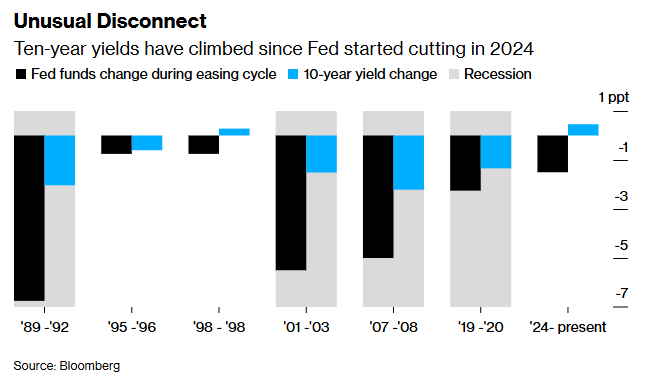
智通财经APP获悉,美国国债市场对美联储降息的反应极不寻常。按某些衡量标准来看,如此明显的背离——即在美联储 降息时美债收益率却继续攀升——自上世纪90年代以来从未出现过。这种背离意味着什么引发了激烈争论。观点五花八 门,从乐观(显示市场有信心经济不会陷入衰退)、到中性(回归2008年前的市场常态)、再到所谓"债券义警"最青睐的解释 (投资者对美国能否控制不断膨胀的国债失去信心)等各种看法。 然而,作为美国消费者和企业借贷成本主要基准的关键美债收益率却根本没有下降。自美联储开始放松货币政策以来,10 年期美债收益率已上升近半个百分点至4.1%,30年期美债收益率更是上涨超过0.8个百分点。 通常情况下,当美联储上调或下调短期政策利率时,长期债券收益率往往会随之变动。即使在过去四十年中仅有的两次非 衰退期降息周期(1995年和1998年,当时美联储每次各降息75个基点)中,10年期美债收益率也要么下降,要么其涨幅远小 于本轮降息周期。 摩根大通全球利率策略主管杰伊·巴里(Jay Barry)认为背后主要有两个因素。首先,在疫情后通胀飙升阶段,美联储加息幅 度如此之大,以至于市场在美联储真正转向之前就已提前消化了 ...

2026年债市展望:从利率比价视角看当前债市
Shanxi Securities· 2025-12-05 11:51
Report Summary 1. Report Industry Investment Rating - Not mentioned in the provided content. 2. Core Viewpoints - Interest rates and their price - ratio relationships are important for macro - economic equilibrium and resource allocation. Different financial instruments form price - ratio relationships, and through the arbitrage mechanism, funds flow to higher - return areas, guiding investment and financing activities and resource allocation [2]. - Maintaining a reasonable interest rate price - ratio relationship is necessary for the smooth transmission of monetary policy. In the real world, the price - ratio relationship may be imbalanced, hindering the effectiveness of monetary policy [3]. 3. Summary of Related Catalogs Five important interest rate price - ratio relationships - **Relationship between central bank policy rates and market rates**: In a normal situation, short - term money market rates revolve around the policy rate center. In early 2025, the DR007 rate deviated from the 7 - day reverse repurchase rate, but now the price - ratio relationship is reasonable. In the future, the guiding role of policy rates on market rates will be strengthened [4]. - **Relationship between commercial banks' asset - end and liability - end rates**: Deposit rates are the main liability cost, and loan rates are the main asset yield. Before 2024, their trends deviated, narrowing the net interest margin. After 2024, the pressure was relieved, stabilizing the relationship and increasing the space for counter - cyclical monetary policy adjustment [5]. - **Relationship between different types of asset yields**: There are differences between loan rates and bond yields. Bond yields are more market - oriented and may deviate from loan rates. For the same entity, the cost of bond financing and loan rates should not differ too much [5]. - **Relationship between different - term rates**: The difference between short - term and long - term rates reflects the term premium. Currently, the term spread of Treasury bond yields is still narrow, and the yield curve may face steepening pressure. The odds of long - bond rate decline are relatively limited [6]. - **Relationship between different - risk rates**: The difference in financing costs of different credit - rated entities reflects the risk premium. It is unreasonable and unsustainable for corporate financing rates to be lower than Treasury bond yields [6]. 2026 Bond Market Outlook - The guiding role of policy rates on market rates will be strengthened. The long - end bond positions are still crowded, and the long - bond rate decline odds are limited, suitable only for trading - oriented funds. Short - term varieties are more valuable and suitable for allocation - oriented funds [6].
PGIM警告:即便哈塞特执掌美联储,也没能力按特朗普意愿“快速降息”
美股IPO· 2025-12-04 13:36
PGIM固定收益联席首席投资官认为,哈塞特不具备足够的威信在美联储内部促成共识,因此难凭借一己之力推动快速降息。债券市场也印证了这一点。 他还强调,美联储的独立性"仍然是投资者的一个主要关切点"。 Peters的核心论点在于,美联储主席的个人意志并不能完全主导货币政策的走向。由于利率决策由联邦公开市场委员会(FOMC)通过投票决定,主席 需要有足够的能力在委员会内部建立共识。 "他在委员会内部是否拥有推动共识的信誉?"Peters在接受媒体采访时提出质疑,并给出了自己的判断: "我们不知道答案。但我认为他不具备那种信誉。我想这就是债券市场正在告诉你的信息。" 据媒体此前报道,包括美国财政部借款顾问委员会成员在内的债券投资者,已就哈赛特可能被任命为美联储主席一事向美国财政部表达了担忧。 面对外界的质疑,哈赛特本周进行了反驳。他援引一次强劲的美国国债拍卖结果,作为市场并未因他可能接任的传闻而感到恐慌的迹象。他本人对其获 得提名的可能性则保持低调。 近日,PGIM固定收益公司的联席首席投资官Gregory Peters在接受媒体采访时警告称, 即便现任白宫国家经济委员会主任哈赛特最终被任命为下一届 美联储主席,他可 ...

日本版“特拉斯冲击”或将上演,超长债供需失衡尚未完全定价
Hua Er Jie Jian Wen· 2025-11-20 11:01
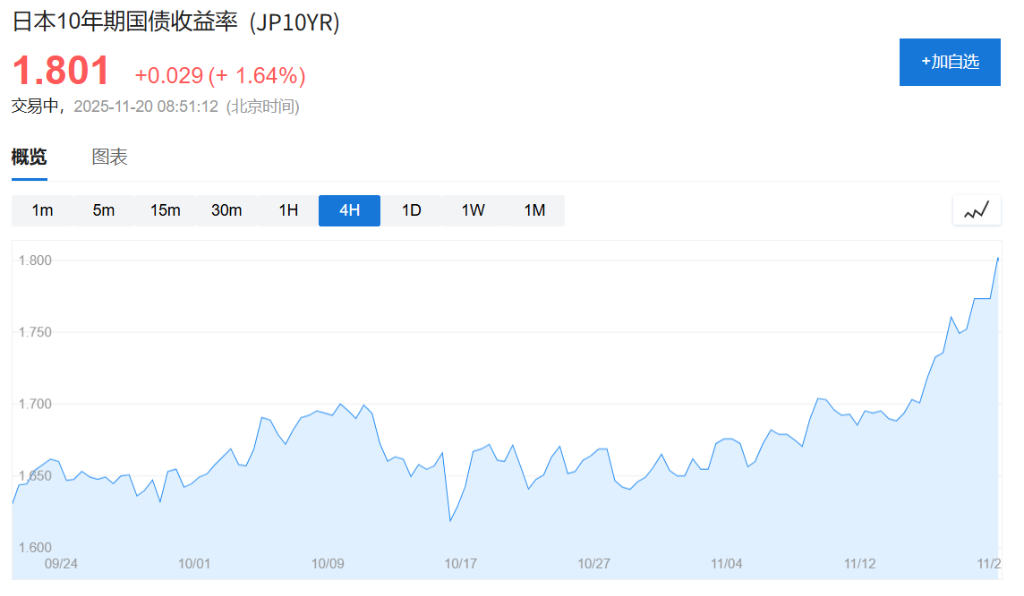
Core Insights - Japan is facing significant fiscal risks similar to the "Truss Shock" in the UK, as the market has not fully priced in the deterioration of supply and demand for ultra-long-term government bonds [1][4] - The Japanese government is finalizing a large-scale economic stimulus plan, with government spending estimated at 21.3 trillion yen, potentially reaching a total of 42.8 trillion yen when including private sector investments, raising concerns about fiscal discipline [1][6] - The Japanese bond market is experiencing a severe sell-off, with the 30-year government bond yield hitting a historical high, and both 10-year and 5-year yields reaching their highest levels since 2008 [1][4] Fiscal Policy Concerns - Nomura Securities warns that ongoing concerns about a "Truss Shock" will lead foreign investors to continue avoiding the Japanese market, exacerbated by a weakening yen and poor performance of ultra-long-term bonds [4][6] - The market is focused on whether the ruling Liberal Democratic Party can gain momentum for further fiscal expansion, which could heighten concerns about fiscal policy [6][7] - The Japanese Finance Minister has raised the urgency of addressing yen depreciation, indicating that the quality and scale of economic stimulus measures should not undermine confidence in the yen or Japanese government bonds [7][8] Yield Curve Dynamics - There is significant potential for the steepening of the yield curve if the supply and demand for ultra-long-term bonds deteriorate further, with the current supply premium indicator for 30-year bonds at 48 basis points, down from a peak of 67 basis points earlier this year [6][8] - The analysis indicates that the yield curve steepening driven by fiscal concerns has not fully reflected the extent of supply and demand deterioration observed in April and May [8][10] Market Reactions - The market's response suggests a lack of effective communication from the government, as expectations for interest rate hikes have not changed despite discussions between the Prime Minister and the Bank of Japan Governor [7][8] - The current market conditions reflect deep investor concerns regarding Japan's policy outlook, emphasizing the need for the government to balance economic stimulus with maintaining fiscal credibility to avoid a "Truss Shock" scenario [10]
从“股债失联”到“股债同源”
Guoxin Securities· 2025-11-14 05:38
1. Report Industry Investment Rating No relevant content provided. 2. Core Viewpoints of the Report - The probability of "stocks and bonds being homologous" is increasing, and they are likely to be homologous to the nominal growth rate, which is of greater macro - significance to the country than the real growth rate [34] - When the stock index returns to EPS and the bond market level matches the current policy and fundamental aspects, the probability of stocks and bonds being homologous increases [34] - The overall long - term interest rate center's rise and fall will return to fundamental factors: growth or prices [32] 3. Summary by Relevant Catalogs "Stock - Bond Disconnection" - After "9.24" in 2024, both stocks and bonds were bullish under the stimulus of loose monetary policy. In 2025, there was a "seesaw" form where stocks were strong and bonds were weak, with the median return of a certain scale of interest - rate bond public funds around 0.2%. The stock index rose nearly 800 points while the interest rate only increased by 20 points [7][8] - The reason for "stock - bond disconnection" is that they have their own driving main lines. In 2025, the driving factors of stocks and bonds were mostly different, but there was a common linkage effect during the anti - involution market from June to August [9][11] - The main line of the bond market in 2025 was the revision and adjustment of expectations, including the revision of policy expectations and economic expectations [12][17] "Increasing Probability of Stock - Bond Homology" - The bull market of stocks requires both PE and EPS. Currently, it seems to enter a period where EPS needs to take over. PE - driven stock markets tend to weaken the stock - bond seesaw effect, while EPS - driven ones strengthen it. When the stock market focuses on EPS, the probability of stock - bond homology increases [22] - The long - term interest rate's rise and fall in the past year was mainly determined by the term premium. Currently, the term premium is at a reasonable level, and the overall long - term interest rate center's rise and fall will return to fundamental factors such as growth or prices [32] - When the stock index returns to EPS and the bond market level matches the current policy and fundamental aspects, the probability of stocks and bonds being homologous increases [34] "What is the Focus of Homology?" - In terms of the 2035 goals, the real growth has limited elasticity, while prices still have elasticity. Industry profit changes are closely related to prices, which is crucial for the stock market. Whether to get out of deflation is crucial for the bond market [38] - Since 2016, there has been significant differentiation in the internal price trends. Non - food (or core) prices are more demand - driven, while food prices are more supply - driven. Monetary policy and market interest rates pay more attention to demand - dominated prices, especially non - food prices [41][43][47] - Under neutral assumptions, there is a possibility of getting out of deflation. The risk lies in whether the month - on - month data can reach the neutral level in recent years. The trend is determined, and it is unlikely to return to the 2024 pattern [50][51] - "Anti - involution" is an important policy arrangement. In the short - term, the implementation path is under observation, with the goal of improving the profit margins of key industries. In the long - term, the path is clear, aiming to establish a unified national market through mergers, reorganizations, and reforms [60][61] - In the short - term, administrative production control may be used to improve industry profit margins. Attention should be paid to whether there will be production control policies for anti - involution key industries, which account for over 30% of China's PPI [69][70]
这个世界不存在零风险、高收益的馅饼!一文揭示投资赚钱的本质
雪球· 2025-11-07 13:01
Core Viewpoint - The article discusses the concept of risk premium, explaining why investments in stocks and funds can yield significantly higher returns compared to bank wealth management products, which typically offer lower returns due to their lower risk profile [3][11]. Group 1: Risk-Free Investments - The safest asset in the financial world is typically short-term government bonds, which are backed by national credit, providing a "floor price" for all yields [4]. - An assumed interest rate for a 30-day short-term government bond is around 4%, which serves as the baseline return for virtually risk-free investments [5]. Group 2: Types of Risk Premium - **Term Premium**: Investors require higher interest rates for locking their money in longer-term bonds due to the uncertainty associated with time, leading to a term premium. For example, a 5-year bond might require a 5% yield, while a 10-year bond might require a 6% yield, reflecting a 2% term premium for the additional time risk [7]. - **Credit Premium**: When comparing a 10-year government bond yielding 6% to corporate bonds from stable companies like Moutai or Tencent, investors demand a higher yield for the additional credit risk associated with corporate bonds. This additional yield is termed the credit premium, which might be around 1% higher than government bonds [10]. Group 3: Relationship Between Risk and Return - The article emphasizes that as risk increases, the required compensation (risk premium) also increases. For instance, junk bonds may require yields of 12%, while stocks might necessitate expected returns of 10%-13% due to their higher risk profile [12][19]. - The relationship between risk and return is illustrated as a positive correlation, where higher potential returns are associated with higher risks [18]. Group 4: Investment Strategy Insights - Understanding risk premium helps investors make rational decisions, avoiding scams that promise high returns with low risk. For example, a project claiming a guaranteed 30% return is likely fraudulent, as such returns correspond to high-risk investments [20]. - The article suggests that a balanced investment strategy should include both low-risk bonds for stable returns and higher-risk stocks for potential higher risk premiums, allowing investors to find their optimal risk-return balance [20][21].

每日机构分析:11月7日
Sou Hu Cai Jing· 2025-11-07 12:12
Group 1: US Treasury and Labor Market - The US Treasury's financing strategy is expected to become more flexible and proactive, considering market structure factors, which may not lead to a significant rise in yields from refinancing announcements [1] - The US labor market showed weakness with over 150,000 layoffs in October, the largest since 2003, leading to market overreactions regarding labor market signals [2] - Analysts suggest that if expectations for significant Fed rate cuts persist, the 10-year US Treasury yield could drop to 3.8%-3.9% in the next three to six months [2] Group 2: UK and Eurozone Monetary Policy - Nomura Securities has adjusted its forecast for the Bank of England's rate cuts, now expecting the current cycle to end in April next year, with a potential cut in December [2] - Societe Generale's analysts believe that for German 10-year bond yields to exceed 3%, the European Central Bank would need to raise rates further and accumulate term premiums [3] Group 3: Economic Forecasts - Barclays raised its GDP growth forecast for South Korea in 2026 from 1.7% to 2.1%, attributing this to a recovery in the semiconductor industry and increased foreign investment [3] - The current account surplus forecast for South Korea was also increased from $8.4 billion to $11 billion for 2026 [3]
经济数据优于预期 美债收益率普遍回升
Xin Hua Cai Jing· 2025-11-05 23:52
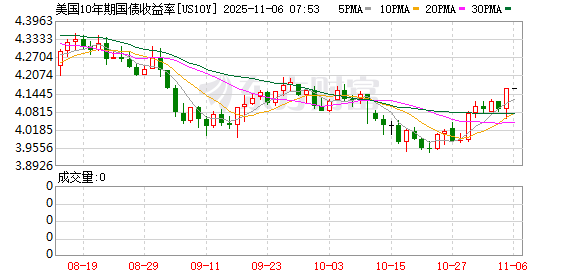
Group 1 - The overnight rise in U.S. Treasury yields was driven by strong economic data, with all maturities experiencing increases [2] - The latest non-farm payroll data showed an increase of 206,000 jobs in June, surpassing economists' expectations of 190,000, while the unemployment rate remained steady at 4.1% and average hourly earnings rose by 3.9% year-on-year, above the expected 3.8% [2] - The Federal Reserve's policy path remains unclear, with Powell emphasizing that a rate cut in December is not guaranteed, which could lead to further rebounds in Treasury yields if the Fed slows its rate-cutting pace [2] Group 2 - Despite strong economic data, inflation pressures continue to be a focal point for the market, with the U.S. Consumer Price Index rising by 3% year-on-year in September and 0.3% month-on-month, driven by a 4.1% increase in energy prices and rapid food price increases [3] - The U.S. Treasury has alleviated long-term Treasury supply pressures through increased short-term bond issuance and adjustments in financing strategies, contributing to a decline in "term premium" [3] Group 3 - Columbia Threadneedle bond manager Ed Al-Hussainy noted that the core issue is not whether to buy U.S. Treasuries, but rather if there are better alternatives available, highlighting the challenges faced by those who shorted Treasuries earlier in the year [4]
美债上演大反攻 “Sell America”大错特错! 嘴上喊“美国例外论坍塌”的机构实际上狂买美债?
智通财经网· 2025-11-03 04:47
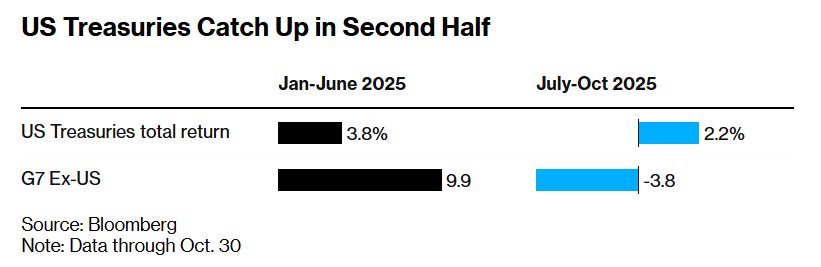
Core Viewpoint - Despite concerns over budget deficits and the independence of the Federal Reserve's monetary policy, the U.S. government debt market has solidified its position as the most trusted sovereign debt asset globally, with significant inflows from investors driving a rebound in U.S. Treasury bonds in the second half of the year [1][2][5]. Group 1: Market Dynamics - The U.S. Treasury market, valued at $30 trillion, has seen investment returns of approximately 6% this year, heading towards its best performance since 2020 [2]. - The demand for U.S. Treasuries has surged despite previous bearish sentiments, attributed to controlled inflation under high interest rates and a shift towards short-term bonds by the Treasury [5][14]. - The "cleanest dirty shirt" analogy is used to describe the U.S. as a relatively better investment choice compared to other developed nations facing similar fiscal challenges [5][20]. Group 2: Economic Factors - The Federal Reserve's recent rate cuts have contributed to lower borrowing costs and increased returns on U.S. debt, with the 10-year Treasury yield dropping to around 4% [6][25]. - Concerns about a potential recession due to trade wars have led to a flight to safety, with investors flocking to U.S. Treasuries [7][8]. - The U.S. Treasury's increased revenue from tariffs and a focus on reducing budget deficits have also played a role in the attractiveness of U.S. debt [5][19]. Group 3: Global Comparisons - U.S. Treasury yields have decreased significantly compared to other G7 countries, where long-term borrowing costs have risen due to fiscal concerns [21][25]. - The U.S. remains the largest and most liquid fixed-income market globally, making it a preferred choice for foreign investors despite ongoing economic uncertainties [5][20][28]. - The overall environment in the U.S. market, while chaotic, still presents competitive opportunities for investors compared to other industrialized economies [20].
中金:美联储降息节奏可能放缓 不宜抱过度乐观预期
Xin Hua Cai Jing· 2025-10-30 00:48
Core Viewpoint - The Federal Reserve is expected to lower interest rates by 25 basis points in October, but Chairman Powell's comments indicate a hawkish stance, suggesting that a rate cut in December is not guaranteed. This reflects a growing internal consensus within the Fed to pause rate cuts [1]. Group 1: Interest Rate Outlook - The Fed has the potential for further easing, but the pace of rate cuts may slow down, and overly optimistic expectations should be avoided [1]. - The current round of rate cuts may have a weaker stimulative effect compared to previous cycles, primarily due to a diminished refinancing effect [1]. - The Fed plans to end quantitative tightening (QT) in December, which is viewed as a technical decision rather than a significant policy shift [1]. Group 2: Future Rate Cut Projections - Under normal circumstances, the Fed has room for three more rate cuts, which would correspond to long-term interest rates of 3.8-4.0% [1]. - The current difference between actual rates and natural rates is 0.8%, and three additional cuts of 25 basis points could align financing costs with investment returns, leading to a nominal neutral rate of 3.5% [1]. - Assuming a term premium of 30-50 basis points, the 10-year U.S. Treasury yield would be projected at 3.8-4.0% [1]. Group 3: Influencing Factors - The short-term path for rate cuts will depend on factors such as the resolution of government shutdowns and the release of new employment data, as well as inflation trends [1]. - The independence of the new Federal Reserve Chair and the Fed's autonomy will be significant variables affecting the rate cut trajectory in 2026, potentially increasing policy uncertainty [1].