
滞胀

Search documents
2026年,美联储迎战“三重困境”
2 1 Shi Ji Jing Ji Bao Dao· 2026-01-08 13:18
Group 1: Federal Reserve's Divergence and Monetary Policy - The Federal Reserve is experiencing significant internal divergence, with a notable split in opinions regarding interest rate adjustments, as evidenced by the December meeting where 9 voted for a 25 basis point cut and 3 opposed, marking the highest dissent since 2019 [1] - The dot plot indicates a divided outlook, with 7 officials advocating for no changes until 2026, while 8 support at least two rate cuts [1] - Some officials predict inflation will peak in Q1 2025 due to tariffs, while others express concerns about persistent high inflation [1] Group 2: Employment Market Trends - The U.S. job market is cooling, with job vacancies dropping to 7.15 million in November 2025, a decrease of 885,000 from the previous year, exceeding market expectations [2] - The ADP reported a modest increase of 41,000 in private sector non-farm employment in December 2025, falling short of the consensus estimate of 48,000 [2] Group 3: Labor Market Characteristics - The current labor market is characterized by "low hiring, low layoffs," reflecting cautious decision-making by companies amid economic uncertainty [3] - Tight immigration policies are contributing to a reduced labor supply, further entrenching this cautious hiring environment [3] - While AI can enhance productivity, it may not independently support stable economic growth without broad employment increases [3] Group 4: Future Economic Outlook - The economic landscape for 2026 is expected to remain complex, with the Federal Reserve facing challenges in balancing employment and inflation risks [4] - The market anticipates a potential shift towards a rate-cutting cycle in 2026, but achieving a balance between employment and inflation will be difficult [4] Group 5: Federal Reserve's Independence - The independence of the Federal Reserve is under unprecedented scrutiny, particularly with political pressures from figures like President Trump [6] - The upcoming changes in the Federal Reserve's leadership, including the potential appointment of a more dovish chair, could influence monetary policy direction [7] Group 6: Leadership Transition - Jerome Powell's term as chair will end in May 2026, raising questions about his future role within the Federal Reserve [9] - There is speculation about whether Powell will remain on the board after his chairmanship, which could impact the Fed's independence and policy direction [10][11]
金银价格 回调
Shang Hai Zheng Quan Bao· 2026-01-08 08:43
值得注意的是,蒋睿补充道,近日白银价格回调的核心原因,还是在于彭博商品指数(BCOM)年度再 平衡引发了被动抛售。作为全球大宗商品核心基准的彭博商品指数于2026年1月8日至1月14日进行年度 权重调整。2025年,白银价格迎来爆发式上涨,使其在该指数中占比提升,而2026年目标权重将降至 4%以下。相关被动型基金为了符合新权重,需大额抛售白银持仓,直接构成白银回撤的核心压力。 2026年伊始,开年以来连涨3日的金银价格出现连续下跌。 机构看好金银资产长期表现 Choice数据显示,1月8日,黄金期货与白银期货的价格再度回调。截至当日15点发稿,COMEX黄金期 货价格跌至4440美元/盎司附近,盘中最低触及4423.6美元/盎司;COMEX白银期货价格回落到75美元/ 盎司附近,跌逾2%。受此影响,黄金、白银类基金净值也纷纷下挫,国投白银LOF当日跌幅相对较 大。 不过,机构普遍继续看好金银的长期投资价值。 短期回调的原因是什么? 刘庭宇认为,在当前宏观环境下,美国出现滞胀的概率较高,欧洲主要经济体也同样面临财政状况恶化 与滞胀风险的双重压力。从历史数据来看,黄金在滞胀周期中,相对其他大类资产始终具备显著优 ...
摩根大通交易部门:2026年初开始采取战术性看涨立场:原因及四大首选交易
摩根· 2026-01-07 03:05
Investment Rating - The report indicates a tactical bullish stance for 2026, with a focus on both bullish and bearish factors [2][20]. Core Insights - The macroeconomic environment is improving, characterized by strong earnings growth and a de-escalation of trade tensions [2][16]. - Consumer cash reserves have increased significantly, with the top 40% of income earners holding more cash than at the end of 2019, contributing to higher retail spending [3][6]. - The labor market shows signs of stability, although there are concerns about rising unemployment rates and potential economic slowdowns [10][12]. - Earnings growth is projected to continue, with expectations of a 7.2% revenue increase and a 15.0% rise in earnings per share for the fiscal year 2026 [11][13]. Summary by Sections Macroeconomic Overview - The overall economic outlook is positive, with strong earnings growth and a reduction in trade tensions expected to support market performance [2][16]. Consumer Insights - Adjusted for inflation, the cash reserves of the top 40% of income earners have increased, leading to a significant rise in retail spending, which is a key driver of GDP growth [3][6]. Labor Market Analysis - The labor market is stabilizing, with a slight increase in unemployment rates and a potential for economic slowdown if costs cannot be passed on to consumers [10][12]. Earnings Outlook - Projections for Q4 2025 indicate a revenue growth of 7.6% and an 8.3% increase in earnings per share, with a net profit margin of 12.8% [11][13]. Trade Relations - Improvements in trade relations, particularly between the U.S. and China, are expected to positively impact the market, with a decrease in effective tariff rates [16][35]. Technical Factors - The report highlights that stock buybacks are expected to reach approximately $1 trillion in fiscal year 2026, indicating strong corporate confidence [19][20]. Investment Themes - The report identifies key investment themes, including technology, media, and communications (TMT), as well as international markets, particularly in Asia and Latin America [48].

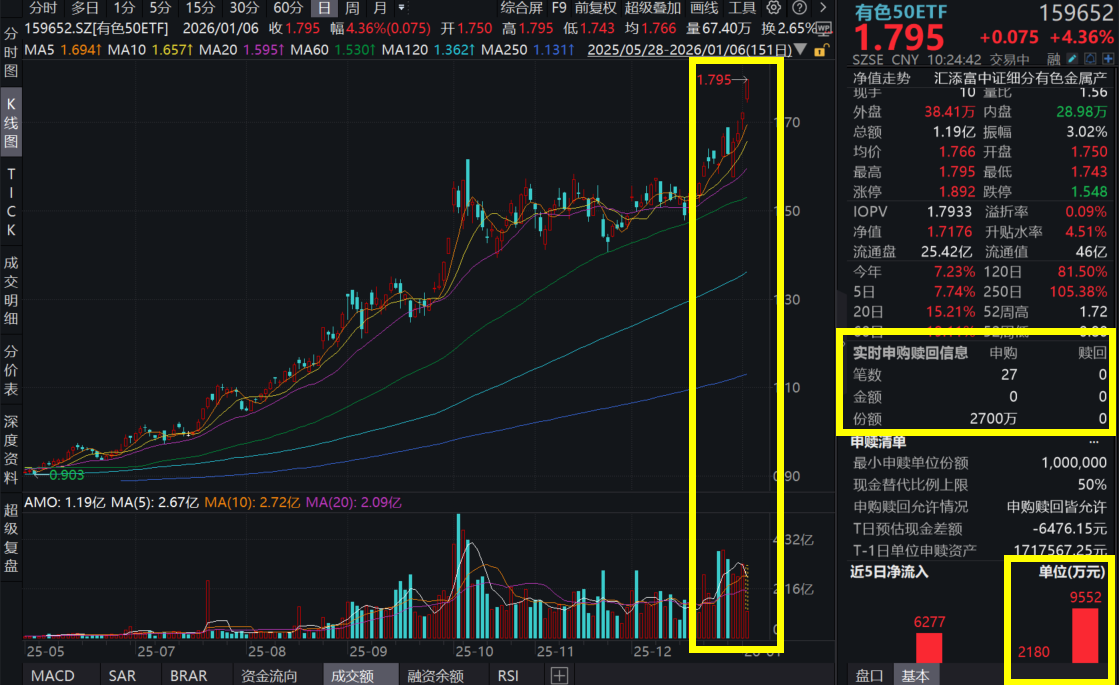
金银铜上攻,铜价再创新高!紫金矿业涨超6%,市值突破1万亿!有色50ETF(159652)飙涨超4%,再创新高,盘中吸金超5000万元!
Xin Lang Cai Jing· 2026-01-06 02:56
Group 1 - The A-share market continues to rise, with copper prices hitting new highs, leading to a strong opening in the non-ferrous sector [1] - The Non-ferrous 50 ETF (159652) has seen a significant increase of over 4%, reaching a new high since its listing, with strong capital inflow exceeding 50 million yuan [1] - Major non-ferrous stocks such as Zijin Mining and China Aluminum have shown substantial gains, with increases of 5.93% and 6.91% respectively [2] Group 2 - Geopolitical tensions have made precious metals a focal point, with COMEX gold rising by 3% and silver by over 7% [3] - The market is closely watching the upcoming U.S. non-farm payroll report, which is expected to provide guidance on the Federal Reserve's future monetary policy [3] - Supply disruptions in industrial metals are ongoing, with strikes and indefinite shutdowns reported in key mining operations [3] Group 3 - The outlook for the gold market in 2026 is optimistic, driven by expected monetary and fiscal easing from the Federal Reserve and ongoing inflationary pressures [4] - The copper market is influenced by both cyclical and structural factors, with a projected supply-demand gap of approximately 830,000 tons in 2026, leading to potential price increases [6] - The Non-ferrous 50 ETF (159652) is positioned to benefit from a comprehensive exposure to various metal sectors, including gold, copper, aluminum, lithium, and rare earths [5][9] Group 4 - The Non-ferrous 50 ETF (159652) has a leading "gold-copper content" of 45%, with significant representation in copper (31%) and gold (14%) [8] - The ETF's top five constituent stocks have a high concentration of 36%, indicating a strong focus on key strategic metals [9] - Since 2022, the Non-ferrous 50 ETF has outperformed peers with a cumulative return of 86.28%, driven by earnings rather than valuation expansion [13]




2026年,最容易赚钱的两条方向
虎嗅APP· 2026-01-05 23:57
Core Viewpoint - The article emphasizes the potential for significant investment opportunities in the commodities sector, particularly in metals like gold, silver, and copper, as they are expected to perform well in 2025 due to various economic factors and geopolitical uncertainties [5][6]. Group 1: A-shares Market - The A-share market is projected to experience a slow bull market in 2025, with the Shanghai Composite Index rising by 18.41% and the ChiNext Index increasing by 49.57% [7]. - The bull market is supported by stable policy and improving macroeconomic conditions, particularly a phase of easing in China-U.S. relations [8][9]. - The market is expected to continue its structural bull market into 2026, characterized by selective sector performance rather than broad-based gains [10][11]. Group 2: Hong Kong Stock Market - The Hong Kong stock market is anticipated to show a mixed performance, with strong IPO activity in 2025 leading to liquidity constraints [18][19]. - The Hang Seng Index's earnings per share (EPS) forecasts have been downgraded to a range of -1.4% to -2.7%, reflecting weak fundamentals [19][20]. - The market's recovery is closely tied to the improvement of the mainland Chinese economy, which significantly influences Hong Kong's market dynamics [20]. Group 3: U.S. Stock Market - The U.S. stock market faces risks from high valuations and potential corrections if growth expectations are adjusted downward [22][23]. - Despite concerns about a tech bubble, the underlying technological advancements are seen as a long-term positive for the market [22]. - Key risks include the potential for high inflation leading to "stagflation" and the effectiveness of the Federal Reserve's monetary policy in stimulating the economy [23][24]. Group 4: Gold Market - Gold prices have surged, with COMEX gold rising approximately 64% in 2025, driven by central bank demand and geopolitical tensions [26][27]. - The shift in market sentiment towards safety and the changing macroeconomic environment are expected to sustain gold's attractiveness as an investment [27][28]. - The article notes that while gold's price growth may not be as rapid as in 2025, the long-term outlook remains positive due to increasing inflation and fiscal challenges [28][29]. Group 5: Bond Market - The bond market is currently facing challenges, with the 10-year Treasury bond ETF showing minimal growth in 2025 [32][34]. - The mismatch between market expectations and actual monetary policy actions has led to a decline in bond prices despite a generally favorable interest rate environment [34][35]. - Short-term bonds are recommended for risk-averse investors, while longer-duration bonds may be more suitable for those willing to engage in market timing [37][38].

2026的市场共识与风险
2026-01-04 15:35
Summary of Key Points from Conference Call Industry Overview - The discussion revolves around the U.S. economy and the stock market, particularly focusing on the S&P 500 index and its projected performance for 2026 [2][3]. Core Insights and Arguments - **Market Consensus for 2026**: Wall Street's consensus is optimistic, with predictions for the S&P 500 index ranging from a low of 7,000 to a high of 8,100 points by the end of 2026. The average forecast is around 7,500 to 7,600 points, indicating a general expectation of growth despite potential risks [2][3]. - **Economic Growth Drivers**: The anticipated growth is attributed to advancements in AI, tax reduction policies, and the Federal Reserve's interest rate cuts, which are expected to collectively boost the economy [2][3]. - **Potential Economic Scenarios**: Three potential scenarios for the U.S. economy in 2025 are outlined: 1. **Mainstream Scenario**: Continued robust growth driven by AI and consumer spending, supported by tax cuts and interest rate reductions, leading to a stable economic environment [4][5]. 2. **Upward Risk Scenario**: Significant productivity gains from AI, leading to a strong stock market performance and a favorable investment climate [4][5]. 3. **Downward Risk Scenario**: Slower-than-expected AI adoption and adverse political actions could lead to economic fragmentation and increased market volatility [4][5]. Additional Important Content - **Venezuela's Oil Production Challenges**: Venezuela faces significant hurdles in increasing oil production due to outdated infrastructure and complex political situations, which could exacerbate geopolitical risks and market uncertainties [5][6]. - **Macroeconomic Environment**: Current conditions indicate potential simultaneous tightening of supply and demand, increasing the risk of stagflation. Concerns include rising credit risks and questions about the sustainability of fiscal policies and the independence of the Federal Reserve [7]. - **Stock Market Performance Under Different Scenarios**: - In a **rebalanced cycle**, the stock market may see modest gains, with funds shifting from tech to defensive sectors [8]. - In a **productivity boost scenario**, the market could rise over 20%, particularly benefiting tech sectors [8]. - In a **stagflation scenario**, increased volatility and poor performance are expected, with funds moving towards defensive sectors [8]. - **Bond Market Dynamics**: The bond market is expected to react differently under various scenarios, with potential fluctuations in yields based on economic conditions and Federal Reserve policies [9]. - **Dollar Exchange Rate Influences**: The dollar's performance will be influenced by the relative strength of the U.S. economy compared to other major economies. In a recovery phase, the dollar may weaken, while significant productivity gains could lead to a slight appreciation [10][11]. This summary encapsulates the key points discussed in the conference call, highlighting the optimistic outlook for the U.S. economy while acknowledging the potential risks and challenges ahead.
阿波罗:美国经济以强劲姿态步入2026年,AI动能将抵御滞胀风险
智通财经网· 2026-01-02 13:00
Core Viewpoint - The U.S. economy is entering the 2026 trading year with strong momentum, despite facing significant headwinds in 2025, which saw economic growth consistently exceed expectations [1][2]. Economic Growth - Economic growth in 2025 has shown resilience, overcoming challenges such as trade tensions, tariff uncertainties, stricter immigration rules, and the resumption of federal student loan repayments [1]. - The Congressional Budget Office (CBO) estimates that the "Big Beautiful Bill" could boost the GDP by nearly one percentage point in 2026 [1]. Investment Factors - Strong investments related to artificial intelligence (AI) and data center expansion continue to drive economic activity [1]. - A weakening dollar and potential fiscal policy support are also contributing positively to the economic outlook [1]. Future Outlook - There is a warning of a potential short-term stagflation period, with expected growth slowdown as additional tariffs come into effect, while inflation rates are projected to remain above the Federal Reserve's target (around 3%) [1]. - Despite a consensus expectation of nearly a 30% chance of recession in 2026, the overall outlook remains constructive, with a belief that growth will accelerate again driven by AI [1][2].

从减税到关税企稳:2026年美国经济有望迎来稳健增长
Xin Lang Cai Jing· 2025-12-31 13:49
Economic Overview - The U.S. economy faced initial predictions of recession or "stagflation" following Trump's global tariff plan, with a GDP contraction of 0.6% in Q1, but rebounded with a growth rate of 3.8% in Q2 and 4.3% from July to September [1][5] - If the Atlanta Fed's GDPNow model's prediction of 3% growth for Q4 holds true, the annual growth rate could reach 2.8%, surpassing the consensus forecast of 2.1% [1][5] Inflation and Consumer Prices - Inflation has stabilized, with a decrease to 2.7% in November, despite ongoing consumer dissatisfaction with high prices [1][5] - Consumer prices increased by approximately 2% during Trump's first year, compared to a 6% increase during Biden's first year [6] Trade Deficit and Tariff Impact - The trade deficit unexpectedly narrowed to $52.8 billion in September, the lowest level since June 2020, attributed to a significant increase in exports and a slight rise in imports [7][8] - Trump attributes these improvements to the administration's trade measures, claiming a 60% reduction in the trade deficit and significant GDP growth [8] Employment Trends - The unemployment rate rose to 4.6% in November, the highest since September 2021, raising concerns about potential negative impacts on employment due to economic uncertainty [8] Future Economic Outlook - Economists express cautious optimism for 2026, with Goldman Sachs predicting a growth rate of 2.6% and BNP Paribas forecasting a consensus of 1.9% [9] - Factors supporting this outlook include fiscal stimulus from the "Inflation Reduction Act," ongoing AI capital expenditures, and a reduction in the trade deficit [9][10] Monetary Policy and Interest Rates - The Federal Reserve is expected to implement at least one more rate cut in 2026, following three cuts in 2025, which may positively influence the economy [10] - The focus is on the Fed's ability to manage interest rate signals amid inflation concerns, with potential impacts from the anticipated replacement of the current chair [10] Economic Contributions and Risks - Continued advancements in AI, a bullish stock market forecast, and strong household balance sheets may contribute positively to GDP [10] - Despite the optimistic outlook, there are warnings of potential risks that could arise in the economic landscape [11]
通胀与通缩的两端:中美经济的不同挑战
Sou Hu Cai Jing· 2025-12-31 11:00
Group 1: U.S. Inflation Challenges - The U.S. inflation rate reached 2.9% in August 2025, the highest since January of the same year, with a monthly increase of 0.4% in the Consumer Price Index (CPI) [3] - Food prices surged by 0.6% in a single month, marking the largest monthly increase in nearly three years, while oil prices rose by 1.9% [3] - 72% of the CPI components are experiencing price increases exceeding the Federal Reserve's 2% target, indicating a broadening inflationary trend [3] Group 2: Factors Driving U.S. Inflation - U.S. tariffs on key sectors like semiconductors and pharmaceuticals have led to cost increases for manufacturers, with some experiencing a 2%-5% rise in costs due to tariffs [6] - The labor market is tightening, with immigration policies causing labor shortages in sectors like agriculture, leading to price increases for fresh produce [6] - Internal divisions within the Federal Reserve complicate responses to inflation, with differing views on maintaining high interest rates versus considering preventive rate cuts [6] Group 3: China's Deflationary Pressures - China's CPI growth has remained near zero since 2023, with the GDP deflator index negative for eight consecutive quarters, indicating persistent deflationary pressures [9] - Despite a 5% actual GDP growth, the negative GDP deflator suggests that economic growth is not reflected in nominal terms, leading to a cold perception among businesses and consumers [9] - The Producer Price Index (PPI) has experienced over 30 months of negative growth, contrasting with previous periods where PPI was negative but CPI was positive [9] Group 4: Structural Issues in China's Economy - Weak housing prices and income expectations are creating a negative feedback loop that suppresses consumption and home buying, further dragging down prices [12] - The monetary supply (M2) has increased by approximately 20% from October 2022 to December 2024, yet price indicators remain low, indicating a blockage in the monetary policy transmission mechanism [13] - The real estate market's downturn is causing credit contraction in the private sector, leading to reduced investment and fiscal stress for local governments [14] Group 5: Comparative Policy Responses - The Federal Reserve's focus is on controlling inflation without triggering a recession, constrained by political pressures and rising costs from tariffs [16] - China's policy approach is shifting towards repairing the internal economic cycle and expanding domestic demand, moving away from traditional investment-driven growth [17] - The contrasting economic conditions in the U.S. and China are leading to increased global financial market uncertainty and reshaping global trade dynamics [17]

中金:维持超配黄金,把握短期波段机会与流动性外溢机会
3 6 Ke· 2025-12-26 00:44
Core Viewpoint - The report from China International Capital Corporation (CICC) suggests that the current monetary policy of the Federal Reserve remains accommodative, and the U.S. economy is facing stagflation, indicating that the bull market for gold may continue until a clear turning point in U.S. policy and economy is observed [1] Group 1: Gold Market Insights - Gold has seen significant price increases this year, leading to a high valuation, with expectations that the Fed's easing will taper off by early 2026, which could pose risks [1] - If gold prices experience a notable correction early next year, it may present a buying opportunity for investors looking to increase their allocation [1] Group 2: Broader Commodity Trends - Following the substantial rise in gold prices, other commodities such as copper and silver have also shown strong performance, reflecting the liquidity spillover effect from gold [1] - Commodities can serve as a hedge against geopolitical risks and the overheating of the U.S. economy, prompting a recommendation to adjust commodity allocations to benchmark levels, with a particular focus on non-ferrous metals [1] Group 3: Risk Considerations - The report highlights that metals like silver have a smaller market size and lower liquidity compared to gold, which could lead to greater volatility and correction risks if gold prices fluctuate next year [1] - It is advised to implement risk control measures to avoid impulsive buying during price surges [1]