
融资成本

Search documents
“大漂亮法案”过了,美债发行潮也要来了
华尔街见闻· 2025-07-05 12:59
Core Viewpoint - The article discusses the impending surge in the supply of short-term U.S. Treasury bonds due to significant fiscal deficits resulting from the recent tax and spending legislation, which is projected to increase the national deficit by up to $3.4 trillion from fiscal years 2025 to 2034 [2][3]. Group 1: Supply and Demand Dynamics - The U.S. Treasury is expected to issue a large volume of short-term debt to manage the financing needs, as the current yield on one-year and shorter-term bonds has risen above 4%, which is still lower than the nearly 4.35% yield on ten-year bonds, making short-term debt a cost-effective option [3][4]. - The market is currently experiencing a shift in focus from concerns about long-term bond sell-offs to the potential oversupply of short-term bonds, with predictions that the proportion of short-term debt could rise from 20% to 25% of total outstanding debt [5][6]. - There is a significant demand for front-end debt, supported by approximately $7 trillion in money market funds, which is expected to absorb the increased supply of short-term Treasury bonds [5][6]. Group 2: Market Sentiment and Future Outlook - Some market participants express optimism that the next financial crisis will not stem from short-term bonds, citing the substantial liquidity in the market and the attractive real yields available [7][8]. - The Federal Reserve is anticipated to intervene if any supply-demand imbalances arise, providing support to stabilize the market [8].


中国燃气(00384):毛差稳健提升,自由现金流再创新高
Shenwan Hongyuan Securities· 2025-06-30 06:45
Investment Rating - The report maintains a "Buy" rating for China Gas [2][7][8] Core Views - The company reported a revenue of HKD 79.26 billion for the fiscal year 2024/25, a decrease of 2.6% year-on-year, while the net profit attributable to shareholders was HKD 3.25 billion, an increase of 2.1% [7] - Free cash flow reached a record high of HKD 4.66 billion, up 8.7% year-on-year, supporting a dividend of HKD 0.50 per share, resulting in a dividend yield of 6.8% [7] - The retail sales volume of natural gas showed a slight increase, with a total sales volume of 39.96 billion m³, down 4.2% year-on-year, but the gross margin improved to HKD 0.537 per m³, an increase of HKD 0.036 per m³ [7] - The connection business faced challenges, with new residential users decreasing by 15.5% year-on-year, but the decline is expected to narrow in the future [7] - Value-added services and comprehensive energy solutions are growing steadily, with revenue from value-added services reaching HKD 3.73 billion, a year-on-year increase of 2.1% [7] Financial Data and Profit Forecast - Revenue projections for the next fiscal years are as follows: HKD 78.49 billion for 2025/26, HKD 75.36 billion for 2026/27, and HKD 76.31 billion for 2027/28 [6] - Net profit forecasts are HKD 3.51 billion for 2025/26, HKD 3.89 billion for 2026/27, and HKD 4.33 billion for 2027/28, reflecting a growth trend [6] - The earnings per share (EPS) are projected to be HKD 0.64 for 2025/26, HKD 0.71 for 2026/27, and HKD 0.79 for 2027/28 [6] - The price-to-earnings (PE) ratio is expected to be 11 for 2025/26, 10 for 2026/27, and 9 for 2027/28, indicating a favorable valuation compared to industry peers [7][8]

美国总统特朗普:如果鲍威尔降息,融资成本就会更加便宜。
news flash· 2025-06-27 16:13
Core Viewpoint - President Trump stated that if Powell lowers interest rates, financing costs will become cheaper [1] Group 1 - The potential for lower interest rates could lead to increased borrowing and investment opportunities for companies [1] - A decrease in financing costs may stimulate economic growth and consumer spending [1]
两千亿库存待消化,绿城保持“战时状态”
2 1 Shi Ji Jing Ji Bao Dao· 2025-06-25 13:52
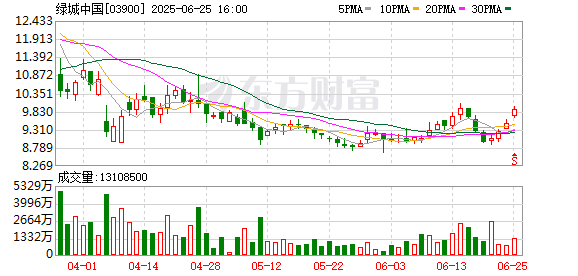
Core Insights - The new management team of Greentown China, led by Chairman Liu Chengyun, emphasizes the need for market-oriented support amid challenges in the real estate industry [2][3] - Liu Chengyun acknowledges the past lack of collaboration between China Communications Construction Company (CCCC) and Greentown, and outlines three areas for future cooperation [4] - Greentown's inventory management is a key focus, with a current inventory scale of approximately 200 billion yuan, of which 50 billion yuan is considered difficult to handle [6][7] Financing and Support - Greentown's financing costs are positioned between top-tier companies like China Overseas and Poly, and lower-tier firms like Vanke and Gemdale, with recent issuance of medium-term notes at a record low of 3.94% [5][6] - CCCC's backing is expected to help reduce Greentown's financing costs further, although Greentown remains an independent legal entity [5][6] - The management aims to maintain stable operations while balancing risk and development, with a focus on optimizing debt structure and reducing reliance on credit financing [7] Inventory Management - Greentown's inventory has decreased from 600 billion yuan to 200 billion yuan, with strategies in place to address difficult inventory through government negotiations and project optimizations [6][7] - The company has set ambitious targets for inventory reduction, with over one-third of annual marketing assessment weight dedicated to inventory clearance [6] Investment Strategy - Greentown prioritizes safety and prudence in its investment strategy, particularly in core cities like Beijing and Shanghai, where land prices are significantly high [7][8] - The company is exploring innovative sales models, drawing from international experiences, to enhance cash flow and investment logic [8] Long-term Vision - Liu Chengyun encourages shareholders to adopt a long-term perspective, emphasizing the importance of stability and strategic decision-making in the current market environment [9]
金融服务提振经济预期或支撑市场,港股国企ETF(159519)涨超1%
Sou Hu Cai Jing· 2025-06-20 02:21
Group 1 - The main driver of the economy in Hong Kong is the financial services sector, with most bank loans linked to the HIBOR interest rate, and a reduction in financing costs is expected to stimulate the credit cycle and invigorate economic activity [1] - The correlation between the year-on-year growth of the Hang Seng Index and the year-on-year change in China's manufacturing PMI is as high as 56%, while the correlation with changes in HIBOR and US Treasury yields is relatively low [1] - Changes in interest rates have a more significant impact on local stocks, as lower interest rates can expand liquidity, reduce leverage costs, and stimulate market activity [1] Group 2 - Economic prosperity is highly correlated with the growth rate of M2, and lower financing costs are expected to boost the economy [1] - The current balance of forces on the RMB exchange rate suggests a low likelihood of significant tightening in HKD liquidity, and any fluctuations due to policy adjustments may create opportunities for increased allocation [1] - The Hong Kong Stock Connect ETF (code: 159519) tracks the state-owned index (code: H11153), which primarily includes state-owned enterprises listed on the Shanghai or Shenzhen Stock Exchanges, focusing on key sectors such as energy, finance, and industry [1]

华润置地20250617
2025-06-18 00:54
Summary of China Resources Land Conference Call Company Overview - **Company**: China Resources Land - **Period**: January to May 2025 Key Financial Metrics - **Total Revenue**: 20.4 billion CNY, up 10% year-on-year [2] - **Operating Real Estate Revenue**: 13.3 billion CNY, up 13% year-on-year [2] - **Shopping Center Rental Income**: 11.4 billion CNY, up 17% year-on-year, with same-store growth of 6% [2] - **Office Rental Income**: Decreased by 7% year-on-year [5] - **Hotel Revenue**: Decreased by 9% year-on-year [5] - **Contracted Sales Amount**: 86.9 billion CNY, down 6% year-on-year [3] - **Contracted Area**: 3.22 million square meters, down 19% year-on-year [3] - **New Land Acquisitions**: 14 plots for a total of 42.7 billion CNY [3] Retail Performance - **Shopping Center Retail Sales Growth**: Approximately 20% year-on-year for January to May, with same-store growth in high single digits [6] - **Customer Traffic Growth**: 35% year-on-year for both January to May and May alone [6] - **Luxury Shopping Centers**: 13 luxury centers outperformed overall growth rates [6] Development and Sales Strategy - **New Saleable Resources**: Over 900 billion CNY added, totaling over 5 trillion CNY in saleable resources [2][7] - **Expected Contracted Sales Growth**: Slight increase anticipated for the year, with improved absorption rates [7] - **Focus on High-Quality Cities**: Emphasis on high-net-worth cities and project return metrics [2][10] Financial Management - **Gross Margin**: Maintained around 15% [10] - **Net Profit Margin**: Expected between 8% to 10% [10] - **Internal Rate of Return (IRR)**: Targeted at over 15% [10] - **Debt Management**: Total interest-bearing debt expected to rise slightly, but net debt ratio remains stable due to asset growth [21] Land Acquisition Strategy - **Land Market Activity**: Active in first-tier cities, with land acquisition amounts exceeding last year's levels [9] - **Investment Discipline**: Focus on high-value cities without land acquisition anxiety [10] Capital Expenditure and Cash Flow - **Capital Expenditure**: Expected to peak this year, with ongoing projects impacting future cash flow [15][16] - **Future Financing Costs**: Anticipated to remain stable, with a focus on domestic financing [25][26] Dividend Policy - **Dividend Stability**: Maintained at 37% of core net profit, unchanged since 2022 [29] Strategic Outlook - **Asset Management Transformation**: Transitioning to a large asset management model to enhance value realization [30] - **Public REITs**: Successful injection of assets into REITs, with significant valuation increases [30] - **Future Growth Opportunities**: Focus on high-growth assets and projects to create new value opportunities [30] Risk Management - **Inventory Management**: Not relying on price cuts to drive sales; instead, focusing on sales velocity through strategic pricing [18] - **Potential Impact of Housing Policy Changes**: Uncertainty regarding the implementation of existing housing sale policies and their effects on cash flow and project returns [19] Conclusion China Resources Land demonstrates a solid financial performance with strategic focus on high-quality urban developments, disciplined investment practices, and a commitment to maintaining stable dividends while navigating market challenges.

粤开宏观:中美关税战的终局在经济韧性与财政空间:中美财政空间比较
Yuekai Securities· 2025-06-15 12:13
Group 1: Economic Context - The current US-China tariff war has entered a temporary easing and negotiation phase, but high tariffs and Trump's unpredictable stance suggest a prolonged struggle ahead[1] - The outcome of the tariff war will ultimately depend on the economic resilience and fiscal space of both countries, as evidenced by historical conflicts[1] Group 2: Economic Impact of the Tariff War - Economic shocks from the tariff war can lead to growth declines and resource depletion, with the party that stabilizes its economy having a stronger negotiating position[2] - The tariff war has created a "triple whammy" for the US, prompting it to seek negotiations due to rising financial risks[2] Group 3: Fiscal Space Comparison - China's fiscal space is greater than that of the US, providing it with a stronger position in the tariff war[2] - Key indicators show that from 2004 to 2024, China's average fiscal deficit rate is 3.5%, while the US's is 6.0%[16] - As of 2024, China's government debt-to-GDP ratio is 60.9%, significantly lower than the US's 124.1%[15] Group 4: Debt and Financing Costs - China's government bond issuance rates are on a downward trend, with an average rate of 1.68% in May 2025, compared to the US's 4.29%[32] - In 2024, China's interest payments accounted for only 1.6% of GDP, while the US's was 3.8%, indicating a lower debt service burden for China[41] Group 5: Inflation and Economic Stability - China's current low inflation environment, with a CPI growth rate of -0.1% in May 2025, allows for greater fiscal expansion without the risk of high inflation[51] - In contrast, the US is experiencing higher inflation pressures, with a CPI growth rate of 2.4% in May 2025, complicating its fiscal situation[51]
财经聚焦|钱流向哪了?——透视前4个月金融数据
Xin Hua She· 2025-05-14 13:06
Core Insights - The financial statistics for April indicate a stable credit environment, with a total loan balance of 265.7 trillion yuan, a year-on-year growth of 7.2% [1] - The People's Bank of China (PBOC) is expected to maintain a steady growth in financial volume, supported by a recent policy package that includes a 0.5 percentage point reserve requirement ratio cut [1][2] Group 1: Credit Allocation - Over 90% of new loans in the first four months were directed towards enterprises, with long-term loans accounting for over 60% of this amount, providing strong support for investment and production [3] - The balance of inclusive small and micro loans reached 34.31 trillion yuan, growing by 11.9% year-on-year, while medium to long-term loans in the manufacturing sector increased by 8.5% [3][4] - The proportion of loans to small and micro enterprises has risen from 31% to 38% since 2021, indicating a shift in credit allocation towards smaller businesses [4] Group 2: Interest Rates and Financing Costs - The average interest rate for newly issued corporate loans in April was approximately 3.2%, down about 50 basis points from the previous year, while the rate for personal housing loans was around 3.1%, down 55 basis points [4] - A recent policy rate cut of 0.1 percentage points is expected to further lower the loan market quotation rate (LPR) by a similar margin, reducing the financial burden on both enterprises and residents [7] Group 3: Broader Financing Landscape - As of April, the balance of corporate bonds increased by 3.2% year-on-year, reflecting a more balanced development between the bond and credit markets [8] - The introduction of technology innovation bonds in the bond market is anticipated to channel more funds into the technology sector, enhancing direct financing growth [8]

宁夏金融总量合理增长融资成本稳中有降
Sou Hu Cai Jing· 2025-05-04 06:04
总体来看,一季度全区社会融资规模稳步扩大,存贷款总量合理增长,信贷结构持续优化,融资成本稳 中有降。分部门看,住户贷款余额3867.63亿元,同比增长7.5%;企事业单位贷款余额6323.73亿元,一 季度新增90.52亿元。从期限看,全区中长期贷款余额6874.74亿元,一季度新增109.77亿元,占各项贷 款增量的48.0%,有力支持了我区重大项目建设和个人合理住房需求;短期贷款余额2490.00亿元,同比 增长5.8%,一季度新增151.06亿元,占各项贷款增量的66.1%,有效满足了企业的合理流动性融资需 求。 在信贷总量、政府债券以及银行承兑汇票持续增长的带动下,全区社会融资规模增势较好。一季度,全 区社会融资规模增量为486.91亿元,同比多增191.20亿元,金融支持实体经济力度不断加大。其中,对 实体经济发放的人民币贷款、地方政府债券融资、未贴现的银行承兑汇票增量分别占社会融资规模增量 的47.2%、28.3%和19.9%。据了解,截至3月末,全区个人非住房类消费贷款余额同比增长9.1%,明显 高于各项贷款增速,有效满足了消费领域的融资需求。工业及基础设施贷款投放力度较大,一季度,全 区工业贷 ...
一季度山东金融总量平稳较快增长
Da Zhong Ri Bao· 2025-04-29 01:07
Financial Overview - In the first quarter, Shandong's social financing scale grew better than the national average, with a year-on-year increase of 10.5%, compared to the national growth of 2.13 percentage points lower [2] - The total financial value in Shandong increased steadily, with the financial industry's added value growing by 5%, surpassing the national growth rate by 1.2 percentage points [2] Interest Rates and Financing Costs - The average interest rate for newly issued corporate loans in Shandong was 3.69%, a decrease of 0.27 percentage points year-on-year, while the average interest rate for debt financing tools was 2.49%, down by 0.53 percentage points [3] - The cost of loans for agricultural and small enterprises was lower by over 0.3 percentage points compared to other funding sources [3] Real Estate Financing - Real estate financing in Shandong showed stable growth, with a total of 820 projects included in the "white list" for financing, amounting to a loan balance of 197.4 billion yuan [4] - The monthly average issuance of real estate development loans in 2024 reached 1.32 times that of 2023, indicating a recovery in housing loan demand [5] Support for Private Enterprises - Over 11,000 private enterprises benefited from ongoing financial support services, with 5,130 companies receiving a total of 110.65 billion yuan in financing [6] - The balance of loans to non-state-owned enterprises reached 3.21 trillion yuan, an increase of 186.98 billion yuan since the beginning of the year [6] Inclusive Finance - The balance of inclusive small and micro loans reached 2.2 trillion yuan, with a year-on-year growth of 14.1% [7] - Shandong has initiated a financial asset investment company pilot program, signing 13 funds with an initial scale exceeding 10 billion yuan [7]