
K型经济

Search documents
世界正从“1920s”滑向“1930”?
3 6 Ke· 2026-01-23 04:10
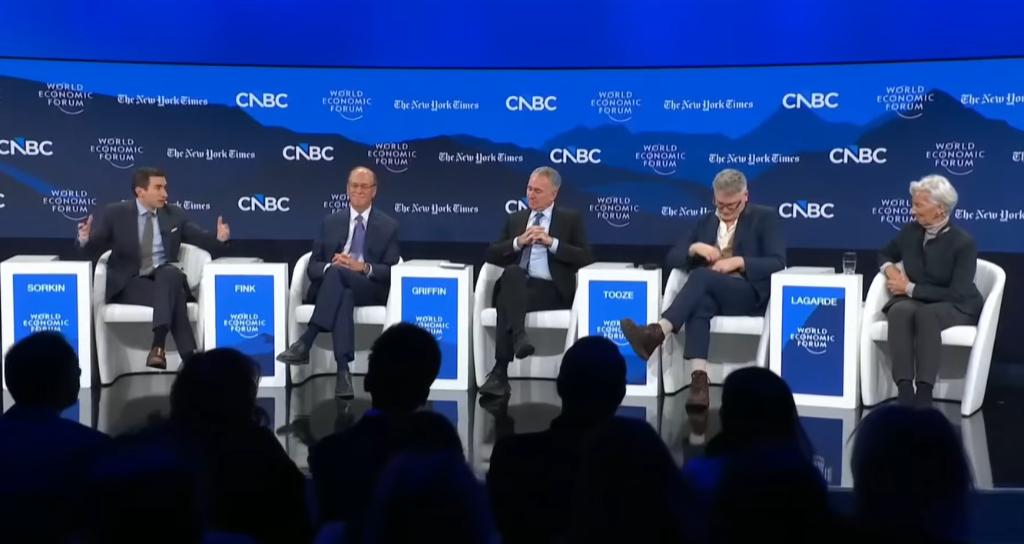
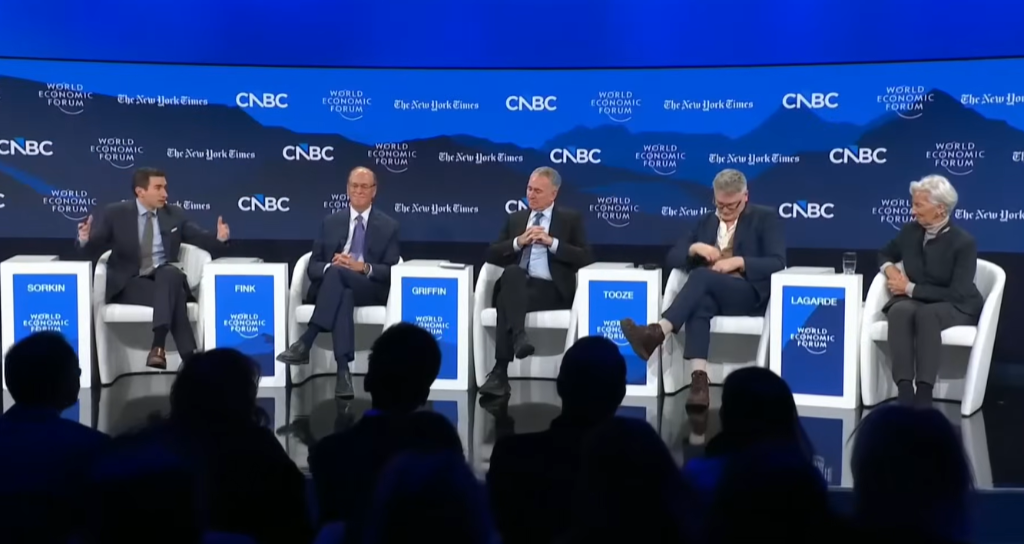
Core Viewpoint - Global financial leaders warn that government fiscal irresponsibility and geopolitical fragmentation may offset the productivity gains from AI technology [1][3] Group 1: Historical Parallels - ECB President Christine Lagarde and historian Adam Tooze highlight alarming similarities between the current "technological boom + trade protection + geopolitical fragmentation" and the path leading to the Great Depression in the 1930s [4] Group 2: Debt Crisis - Ken Griffin criticizes reckless government spending, particularly in the U.S., as the primary threat to the market, stating that "all governments are overspending, almost without exception" [5][10] - Larry Fink believes AI is not a bubble but will create a "winner-takes-all" scenario, where large companies with scale and data will dominate [5][11] Group 3: Tariffs and Fragmentation - Lagarde warns that geopolitical fragmentation and protectionism will hinder the data flow and energy access necessary for AI, leading to decreased efficiency [5] - Average tariffs between the U.S. and Europe have risen from 2% to over 12%, with a potential increase to 15%, which could negatively impact inflation [6][13] Group 4: Central Bank Independence - Lagarde emphasizes the importance of central bank independence, stating that fiscal consolidation cannot rely on central banks as a safety net [7][14] Group 5: Economic Disparities - Fink notes that the high cost of developing cutting-edge AI models, estimated at $1 billion, creates a barrier that only large-scale operators can overcome, exacerbating economic disparities [11] - Griffin points out that the capital expenditure for U.S. data centers is projected to reach $600 billion this year, indicating a significant financial commitment to AI infrastructure [11]


世界正从“1920s”滑向“1930”?
华尔街见闻· 2026-01-22 08:22
Core Insights - The discussion highlighted the alarming similarities between the current economic climate and the prelude to the Great Depression of 1929, driven by technological exuberance, rising sovereign debt, and geopolitical fragmentation [2][3][8] Debt Crisis - Ken Griffin criticized reckless government spending, particularly in the U.S., as the primary threat to the market, stating that nearly all governments are overspending [4][9] - The U.S. national debt has reached $38 trillion, raising concerns about the sustainability of such spending without significant productivity gains from AI [9] Tariff Costs - Lagarde noted that tariffs between the U.S. and Europe have surged from an average of 2% to over 12%, with potential increases to 15% [5][12] - Griffin warned that tariffs act as a regressive tax on consumers and could foster crony capitalism, stifling the vitality of small and medium enterprises [5][13] Central Bank Independence - Lagarde emphasized the importance of central bank independence, arguing that fiscal consolidation should not rely on central banks as a safety net [6][15] - The current political climate necessitates maintaining the "knave-proof" nature of central banks to prevent moral hazard [17] AI and Economic Disparity - Larry Fink described the current economic landscape as a "K-shaped" recovery, where large firms leverage AI to gain a competitive edge over smaller companies [10] - The cost of developing cutting-edge AI models has skyrocketed to $1 billion, creating a high barrier to entry that favors large capitalized firms [10] Geopolitical Fragmentation - Lagarde warned that geopolitical tensions and protectionism are undermining the data flow and energy access necessary for AI efficiency, posing a significant threat to its expansion [9][10]

产业链视角看为何本轮补库弱弹性?:波澜互错,洪峰未至
Changjiang Securities· 2026-01-22 06:20
Investment Rating - The report maintains a "Positive" investment rating for the textile, apparel, and luxury goods industry [9]. Core Insights - The current inventory replenishment cycle in the U.S. apparel industry is characterized by weak elasticity due to several factors, including K-shaped consumer spending, misalignment in brand recovery rhythms, and constraints faced by comprehensive sports brands [3][6]. - Despite the transition from inventory destocking to replenishment, the expected rebound in manufacturing performance and market response has not materialized as anticipated [6][19]. - The report forecasts limited replenishment elasticity in the near term, with potential improvements in terminal demand expected after the current interest rate cycle concludes [3][8]. Summary by Sections Introduction - The report discusses the weak momentum in the current manufacturing replenishment cycle, noting that the U.S. apparel industry has transitioned to a phase of active replenishment after reducing inventory to healthy levels since Q1 2023 [6][17]. Analysis of Weak Replenishment Cycle - **Macro Perspective**: U.S. consumer spending is experiencing K-shaped differentiation, where high-income households support overall consumption while lower-income households face suppressed purchasing power and willingness to spend [7][32]. - **Brand Perspective**: The misalignment in recovery rhythms among brands has diluted overall replenishment elasticity, with brands like Adidas and Deckers already undergoing several quarters of replenishment without strong retail catalysts [7][30]. - **Industry Perspective**: The growth potential in the sports category is diminishing due to factors such as slowing penetration rates, reduced technological innovation, and diminishing returns from direct-to-consumer (DTC) strategies [7][30]. Future Replenishment Elasticity Expectations - In the short term, historical inventory cycles suggest that mature brands may experience shorter replenishment periods, while growth-oriented brands could see longer cycles [8][19]. - The report indicates that after the current interest rate cycle, retail demand may improve, leading to a more resilient growth trajectory for top brands transitioning into replenishment phases [8][19]. - Recommended stocks include Crystal International and Shenzhou International, with a focus on companies like Wah Lee and Yue Yuen [8][19].

“1920s vs 2020s”!华尔街教父、欧央行行长与历史学家激辩:“AI、关税和地缘”把世界拖向“1930”?
Hua Er Jie Jian Wen· 2026-01-22 02:22
Group 1 - Global financial leaders warn that government fiscal irresponsibility and geopolitical fragmentation may negate the productivity gains from AI [3][4] - The discussion at the World Economic Forum highlighted the parallels between the current economic climate and the pre-Great Depression era, particularly in terms of technological advancements and political failures [4][7] - Ken Griffin emphasized that the core risk in 2026 is not from private capital markets but from reckless government spending, with U.S. national debt reaching $38 trillion [5][7] Group 2 - Adam Tooze pointed out that the current technological boom, driven by AI, mirrors the 1920s' electrification and mass production, but political failures could lead to economic collapse [4][7] - Christine Lagarde noted that global trade is under unprecedented pressure due to geopolitical fragmentation and tariffs, which could hinder the scale effects needed for AI [4][10] - The average tariff between the U.S. and Europe has surged from 2% to over 12%, with a potential rise to 15%, impacting inflation and economic growth [10][11] Group 3 - Larry Fink stated that AI is not a bubble but will lead to significant failures, creating a "K-shaped" economy where large firms benefit disproportionately [6][8] - The cost of developing cutting-edge AI models is around $1 billion, and U.S. capital expenditure on data centers is projected to reach $600 billion this year [8][10] - Lagarde warned that geopolitical divisions and protectionism could obstruct the data flow necessary for AI efficiency [8][10] Group 4 - The discussion highlighted the importance of central bank independence in managing fiscal policies and avoiding reliance on monetary solutions to address structural imbalances [12][33] - Lagarde emphasized that not all debt is equal, and productive investments will always find funding, while non-productive debt will face challenges [33][42] - The need for cooperation in managing AI's development and its implications for society was underscored, with concerns about energy consumption and social consequences [32][34]
新浪财经隔夜要闻大事汇总:2026年1月22日
Xin Lang Cai Jing· 2026-01-21 22:53
Market - US stock market closed higher on January 22, with the Dow, Nasdaq, and S&P 500 all rising after President Trump canceled the threat of new tariffs on Europe [2] - Major stocks included Intel, which surged 11.72% after securing a $151 billion contract, and AMD, which rose 7.71% with an upgraded target price [3] - The Nasdaq Golden Dragon Index, which tracks Chinese stocks, increased by 2.21%, with Baidu up 8.17% and Alibaba up 3.87% [4] Macro - President Trump discussed the US economy at the Davos World Economic Forum, claiming that trade and tariff policies have not led to inflation, despite a decrease in actual factory spending and manufacturing jobs [9] - Trump announced that he would not impose tariffs on several European countries after reaching a framework agreement regarding Greenland and the Arctic region [12] - The European Parliament indefinitely postponed the vote on the US-EU trade agreement until the US returns to a cooperative path, citing concerns over US threats to EU member states [27] Company - Nvidia's CEO highlighted the rising demand for skilled trades in the AI era, suggesting that plumbers and electricians could earn six-figure salaries due to increased investment in data centers [31] - Jeff Bezos's Blue Origin plans to deploy 5,408 satellites for a new communication network starting in Q4 2027, aiming for data transmission speeds of up to 6Tbps [30] - The EU is set to review simultaneous bids from Netflix and Paramount for Warner Bros, which could reshape Hollywood's power dynamics [29]

达沃斯面临两大难题,特朗普或许还是较易解决的那个
Xin Lang Cai Jing· 2026-01-21 16:24
Core Insights - The 2026 World Economic Forum has transformed into an urgent meeting for global elites to address two interconnected threats: the presence of U.S. President Donald Trump and the complex issue of "K-shaped economy" [3][9] - The "K-shaped economy," popularized by economist Peter Atwater, describes the widening gap between the wealthy and the poor since 2020, where the rich have become richer while the poor have become poorer following the pandemic [3][9] Economic Disparities - The gap between the top and bottom of the K-shaped curve continues to widen nearly six years later, with stock markets near historical highs despite a decline in vacationing Americans, while luxury hotel bookings remain strong [4][10] - The real estate market faces an affordability crisis, yet housing supply shortages are driving up prices, benefiting a segment of the population [4][10] - The pandemic has exacerbated the disconnect between the upper and lower classes, leading to a "cognitive blind spot" for the wealthy regarding the struggles of the lower classes [4][10] Forum Critique - Larry Fink, CEO of BlackRock, highlighted the core contradiction of the forum: it is an elite gathering attempting to create an ideal world for all, while those most affected by the discussed issues are absent [5][11] - Critics argue that the forum has a history of being reactive rather than proactive, often recognizing issues only after they have escalated [6][12] Global Implications - Severe wealth inequality poses a threat to stability, as evidenced by recent events in Iran, where high inflation and poor financial management have led to public outrage and protests [7][13] - The upper class may not realize that any additional pressure could trigger a crisis, indicating a precarious situation that requires immediate action rather than mere discussion [7][13]

特朗普突袭、K型经济肆虐,2026达沃斯已成为一场“紧急会议”!
Jin Shi Shu Ju· 2026-01-21 10:20
Group 1 - The World Economic Forum in Davos has evolved into an urgent meeting for global elites to address the dual threats of the trade war led by President Trump and the K-shaped economy, which highlights the widening wealth gap since 2020 [1] - The K-shaped economy indicates that while the pandemic affected everyone, the recovery has diverged, with the wealthy becoming richer and the poor becoming poorer, leading to an expanding gap between the top and bottom of the economic spectrum [1] - Despite a decrease in vacationing Americans, luxury hotel bookings remain strong, illustrating the stark contrast in economic experiences, with a housing affordability crisis on one end and soaring property values on the other [1] Group 2 - The disconnect between the wealthy and the lower classes has been exacerbated by the pandemic, leading to reduced interactions and a growing awareness of the disparities [2] - Larry Fink, CEO of BlackRock, highlighted the core tension of the forum, noting that those most affected by the discussions rarely attend, which raises questions about the effectiveness of the elite gathering [2] - Historical misjudgments by the Davos crowd regarding global events, such as Brexit and the rise of populism, indicate a pattern of failing to recognize significant societal shifts [3] Group 3 - The severe inequality present in society is inherently destructive, with historical examples demonstrating that such disparities can lead to significant unrest, as seen in Iran [3] - Experts suggest that the wealthy must acknowledge the potential consequences of maintaining extreme levels of wealth, as increasing vulnerabilities could lead to explosive societal reactions [4]
K型经济与大宗商品价格
2026-01-19 02:29
Summary of Key Points from Conference Call Industry Overview - The global economy is experiencing a K-shaped recovery, with rapid capital expansion in technology and renewable energy sectors, while traditional sectors and small to medium enterprises face challenges. This has led to a divergence in prices between non-ferrous metals and traditional energy [1][2] - The overall environment for a comprehensive rise in industrial product prices in 2026 is not favorable, with continued price differentiation between non-ferrous metals and black energy products due to geopolitical risks and low capacity utilization [1][3] Core Insights and Arguments - **Global Demand**: Total global demand remains stable without significant turning points. Despite the Federal Reserve's interest rate cuts and other economic measures, the elasticity of demand is limited, and long-term interest rates remain high, indicating weak real growth [2][4] - **Price Performance**: The poor price performance in 2025 was primarily due to low capacity utilization rates across major economies, which are still 3-4 percentage points below 2012 peaks. This suggests that even with strong demand, supply can be increased by improving capacity utilization, preventing widespread inflation [5] - **Market Divergence**: The current market shows a pronounced K-shaped divergence, with emerging sectors like chips and renewable energy seeing rapid capital expansion, while traditional sectors struggle. Non-ferrous metals are at historical highs, while traditional energy and black metals are at relative lows [6][7] - **Impact of Energy Transition**: The energy transition has led to significant changes in the global commodity market, with traditional energy markets potentially shifting from scarcity to surplus. The decline in energy prices has resulted in substantial capital outflows, some of which have flowed into precious metals like gold [9][10] Additional Important Insights - **Future Trends**: The K-shaped divergence is expected to continue into 2026, with strong demand for non-ferrous metals driven by technology, while black metals face low capacity utilization. The potential for oil to become a surplus commodity could further influence market dynamics [11] - **Gold Market Dynamics**: Gold has performed well due to multiple factors, including central bank purchases, retail demand, and geopolitical risks. However, the market size has expanded significantly, making further large price increases more challenging [12][14] - **Geopolitical Risks**: Rising geopolitical risks have profound implications for global financial markets, increasing demand for safe-haven assets and benefiting defense and high-end equipment sectors [15][16] - **Long-term Liquidity Pressure**: In 2026, long-term liquidity pressure, particularly related to the Japanese yen, may lead to increased volatility in financial markets as interest rates rise and market conditions change [17]
淡水泉陶冬:2026年 穿越“K型分化” 坚守“资产为王”
2 1 Shi Ji Jing Ji Bao Dao· 2026-01-15 14:36
Core Viewpoint - The global economy in 2026 is expected to experience significant differentiation, with geopolitical and economic uncertainties likely easing compared to 2025, while the logic of liquidity driving asset prices upward remains valid [1][4]. Economic Trends - The current economic landscape is characterized by a "K-shaped" development, where the disparity between GDP growth and the average citizen's living experience is stark, particularly in the U.S. [2][3]. - AI investments have surged, accounting for over 50% of total investments in the U.S., while other sectors are lagging and require new credit cycles to stimulate growth [2][6]. - The consumer market reflects similar disparities, with the top 10% of income earners capturing approximately 25% of stock market gains, while the lowest 10% are largely excluded from stock market benefits [2]. Political Implications - Economic disparities are translating into significant political changes globally, with moderate centrist influences declining and political polarization increasing [3]. Monetary Policy - The Federal Reserve is facing pressure to adjust its monetary policy due to rising wealth inequality, with potential leadership changes expected to lead to a more responsive approach to fiscal demands [4][5]. - The structure of the global bond market is changing, with rising long-term interest rates in Japan and Europe prompting a return of overseas funds to seek higher returns, impacting U.S. Treasury demand [5]. AI Investment Landscape - 2026 is anticipated to be a pivotal year for AI, transitioning from a focus on technological competition to a demand for profitability and sustainable business models [6][7]. - The financing landscape for AI companies is shifting, with some turning to bond markets and private credit, raising concerns about transparency and potential systemic risks [7][8]. Asset Allocation Strategies - The liquidity-driven asset price revaluation seen in 2025 is expected to continue into 2026, with a strong outlook for the Chinese yuan due to substantial trade surpluses [9][10]. - Precious metals are projected to remain attractive due to their independence from central bank policies and increasing industrial demand driven by technological revolutions [9]. - A-shares and Hong Kong stocks are likely to outperform U.S. stocks in 2026, attributed to valuation disparities and a low-interest-rate environment in China [10].
邦达亚洲:美联储独立性受质疑 美元指数小幅收跌
Xin Lang Cai Jing· 2026-01-15 08:53
Group 1: Retail Sales Data - The U.S. retail sales increased by 0.6% month-on-month in November, surpassing the expected 0.5% [1][6] - October's retail sales data was revised down to -0.1% from the initial value [1][6] - Year-on-year, retail sales grew by 3.3%, indicating robust overall consumer data despite structural economic disparities [1][6] - Core retail sales, excluding volatile automobile categories, also saw a 0.5% month-on-month increase, exceeding market expectations [1][6] - The retail sales control group, a key GDP reference, rose by 0.4% month-on-month, aligning with expectations [1][6] - Year-on-year, total retail sales increased by 5.1%, supporting strong GDP growth expectations for Q4 [1][6] Group 2: Economic Activity and Employment - The Federal Reserve's Beige Book reported economic activity growth in most regions, with stable employment conditions [2][7] - Out of 12 Federal Reserve districts, 8 reported economic activity growth, while 8 indicated stable hiring [2][7] - Price increases were noted as "moderate" in most regions, with only two districts reporting "slight" price hikes [2][7] - The outlook for future economic activity is cautiously optimistic, with expectations of slight to moderate growth in the coming months [2][7] Group 3: Currency Exchange Rates - The U.S. Dollar Index experienced a slight decline, trading around 99.10, influenced by profit-taking and concerns over the Fed's independence [3][8] - The Euro saw a minor increase, trading around 1.1640, supported by a weaker dollar and expectations of an end to ECB rate cuts [4][9] - The British Pound rose slightly, trading at 1.3430, buoyed by a weaker dollar and profit-taking, although strong U.S. economic data limited its upward movement [5][10]