
全球化

Search documents
2018年,叫嚣让儿子当“101%美国人”的中国教授,今下场大快人心
Sou Hu Cai Jing· 2025-11-29 16:46
Core Insights - The article narrates the life-changing journey of a once-prominent Chinese economics professor who decided to immigrate to the United States, leading to significant personal and professional challenges [1][2]. Group 1: Background and Initial Success - The individual was a rising star in the Chinese academic community, achieving professorship at a young age and enjoying a comfortable life in Beijing [1]. - He developed a strong interest in Western economics, which began to influence his teaching style and classroom discussions [1]. Group 2: Decision to Immigrate - In 2017, after attending an international economic forum, he made the drastic decision to sell all his assets and move to the U.S., despite his wife's objections [1]. - He sold his property in Beijing at a price below market value and took all his savings to start anew in America [1]. Group 3: Struggles in the U.S. - Upon arrival, he faced harsh realities, as his Chinese qualifications were not fully recognized, leading to unsuccessful job applications at several prestigious universities [2]. - His savings quickly diminished due to high living costs, including rent and medical expenses, forcing him to take a job washing dishes in a Chinese restaurant [3]. Group 4: Psychological Impact and Cultural Reflection - The drastic change in circumstances led to feelings of humiliation, especially after being recognized by former students while working in a low-status job [4]. - In an attempt to seek validation, he expressed extreme views online, denigrating his cultural background and praising Western ideals, which did not earn him the respect he sought [4][6]. - Eventually, he recognized that true cultural confidence comes from understanding and embracing one's own culture rather than outright rejection or blind admiration of another [7]. Group 5: Conclusion and Broader Implications - After a series of setbacks, he returned to China, reflecting on the importance of balancing cultural confidence with openness in a globalized world [9].


海辰储能的成长图鉴:ESG、全球化、盈利力如何全面拉满?
Sou Hu Cai Jing· 2025-11-29 12:00
这波逆势崛起绝非空谈,一组爆发式增长的业绩数据直接亮出了底牌。2025年上半年,海辰储能营收狂飙至69.71亿元,同比暴涨224.6%,更让人惊喜的 是,公司实现净利润2.13亿元,成功扭亏为盈。更硬核的是市场地位:全球储能电池出货量、电力储能出货量双双冲进Top2,硬生生从储能赛道的"后起之 秀"变成了"顶流玩家"。但这波逆袭绝非偶然,背后藏着两大"制胜法宝"——把ESG做成"硬通货",让全球化落地成"家常菜"。 很多企业还在把ESG当成"面子工程"时,海辰储能早就把它刻进了企业基因里。2025年,公司拿下了EcoVadis金牌评级,直接跻身全球前5%,还入选了"能 源ESG100"双十佳案例,这些奖项可不是靠花钱就能刷来的。秘诀在于一套实打实的战略:制定"HIMPACT2037"可持续发展战略对接联合国目标,从绿色 工厂到供应链协同,搭建全生命周期环境管理体系。 更关键的是,这些投入真的转化成了商业优势——公司拿到了储能可融资性A评级,对项目开发商来说,这简直是"定心丸":用海辰的产品,银行贷款不仅 批得快,利息还更低,相当于给合作方直接送钱,谁能不心动?原来ESG从来不是成本,而是能赚钱的"软实力"。 ...
对话百望股份陈杰:驾驭数据智能时代,开启全球化新篇章
2 1 Shi Ji Jing Ji Bao Dao· 2025-11-29 02:13
Core Insights - The return of the founder and chairman Chen Jie as CEO signals a strategic shift for the company towards a "second entrepreneurship" phase, focusing on data intelligence in a rapidly evolving market [1][5] - The company aims to transform from merely providing data services to becoming a "refiner" of data, creating high-value products from its extensive data assets accumulated over the past decade [2][5] Group 1: Company Strategy - The company has completed two significant transformations over the past decade, evolving from information security products to SaaS services and then to inclusive finance, serving 28.5 million enterprises and accumulating over 1,000 trillion yuan in real-time transaction data [2] - A clear product roadmap has been established, which includes introducing an AI full-stack toolchain, launching intelligent product matrices for various industry applications, and exploring machine payment and data exchange based on the X402 protocol [3] Group 2: Global Expansion - The company is pursuing a global strategy that involves exporting "lightweight infrastructure" rather than simply replicating Chinese experiences, with plans to serve Chinese enterprises going abroad and entering markets in Southeast Asia and the Middle East [4] - The X402 protocol is viewed as a key application scenario for data intelligence and a new infrastructure for the AI economy, enabling monetization of data assets through various charging models [4] Group 3: Long-term Vision - The company aims to convey a strong long-term value signal to investors, emphasizing its favorable conditions, including supportive policies, unique data assets, and a top-tier team [5] - The transition to a full-stack solution model is expected to fundamentally change the company's gross margin structure, customer loyalty, and lifecycle, marking a significant shift in its operational strategy [5]
16大年度词,说透所有车企的难与盼
汽车商业评论· 2025-11-28 23:06
Core Insights - The automotive marketing industry is facing intense competition with a slight market growth and a significant increase in the penetration of new energy vehicles, which has surpassed 50% [4] - The concept of "intelligence" is becoming central to product definitions and user decision-making, with AI-generated content influencing consumer perceptions [5][7] - Companies are adapting to new marketing paradigms, focusing on brand strategy, sales growth, and user communication amidst a complex market environment [4][5] Group 1: Industry Trends - The automotive industry is undergoing profound changes driven by the integration of AI and smart technologies, creating both challenges and opportunities for companies [10] - The rise of "smart" as a key marketing and product development focus is evident, with companies needing to embrace new paradigms and multi-modal strategies [7][10] - The market for pure electric large three-row SUVs is growing, with significant sales increases indicating a shift away from hybrid and fuel models [24] Group 2: Company Strategies - One company emphasizes "oil-electric intelligence" as a brand strategy, showcasing a commitment to smart upgrades across its product line [10] - Another company highlights its focus on "deep cultivation of circles and ecological empowerment," positioning vehicles as intelligent hubs and energy platforms [13] - A brand is transitioning to a dual technology strategy, launching new hybrid models to meet diverse market demands [17] Group 3: Marketing Approaches - The concept of "listening to advice" is highlighted as essential for responding to both expressed and unexpressed consumer needs [37] - Companies are encouraged to return to the essence of communication and user engagement, emphasizing sincerity and genuine interaction [30] - The importance of global insights and respect for diverse markets is underscored as a strategy for successful international expansion [34]

泡泡玛特(09992):跨区域+扩IP,支撑长线运营
Shenwan Hongyuan Securities· 2025-11-28 10:15
Investment Rating - The report maintains a "Buy" rating for the company [1] Core Insights - The company is expanding its global presence and IP portfolio, which supports long-term operations. The retail store expansion is expected to activate new user demand in various regions [9] - The company has demonstrated strong IP operation capabilities, maintaining fan engagement through product innovation and iteration. The overall brand strength has significantly improved [9] - The long-term business model is viewed positively, with competitive advantages in IP design, operation, and supply chain management [9] - Revenue and profit forecasts have been revised upwards for 2025-2027, reflecting confidence in the company's growth trajectory [9] Financial Data and Profit Forecast - Revenue projections for 2023 to 2027 are as follows: - 2023: 6,301 million RMB - 2024: 13,038 million RMB - 2025E: 38,865 million RMB - 2026E: 52,738 million RMB - 2027E: 66,946 million RMB - Net profit projections for the same period are: - 2023: 1,184 million RMB - 2024: 3,220 million RMB - 2025E: 13,648 million RMB - 2026E: 18,429 million RMB - 2027E: 23,569 million RMB - The company expects significant growth rates, with net profit growth rates reaching 324% in 2025 [7][10]

中国银河证券:双轮驱动下的行业变革 2026年Robotaxi迈入规模化商用拐点
Zhi Tong Cai Jing· 2025-11-28 06:49
Core Viewpoint - The report from China Galaxy Securities indicates that by 2026, the Robotaxi sector is expected to reach a commercialization turning point driven by policy support, technological advancements, and cost reductions [1][4]. Group 1: 2025 Overview - The Chinese automotive industry in 2025 is characterized by stable volume and gradual price increases, driven by both domestic demand recovery and the dual engines of exports and new energy vehicles [2]. - The wholesale and retail sectors are projected to grow year-on-year, with an increasing penetration rate of new energy vehicles, while exports continue to contribute positively despite external challenges [2]. - The ongoing price war is expected to further pressure industry profitability, leading to a situation where revenue growth outpaces profit growth [2]. Group 2: 2026 Outlook - The exemption of the purchase tax for new energy vehicles will continue until the end of 2025, with a planned reduction to half in 2026-2027, which may significantly impact sales, especially for vehicles priced below 300,000 yuan [3]. - Companies like Hongmeng Zhixing, Leap Motor, Geely, and JAC are entering a period of intensive new product launches, which may help them increase sales and market share due to their technological advantages and diverse product offerings [3]. - Major automakers are expected to scale up new electric models based on validated platforms, while L3-level intelligent driving technology is anticipated to become a key driver for new model launches in 2026 [3]. Group 3: Emerging Businesses - The Robotaxi sector is benefiting from policy support, technological progress, and cost reductions, leading to a commercial breakthrough, with major manufacturers and tech giants expanding their operations both domestically and internationally [4]. - Low-speed unmanned logistics vehicles and mining trucks are gradually moving towards scale due to policy support and economic advantages [4]. - The integration of the intelligent automotive supply chain with the robotics industry is expected to create multiple advantages, including technological migration, precision manufacturing capabilities, and supply chain resource consolidation [4]. Group 4: Investment Recommendations - The report recommends focusing on leading passenger vehicle companies in a strong new car cycle, as well as the intelligent and humanoid robotics sectors, highlighting Geely and Great Wall Motors as key players in the passenger vehicle segment [4]. - In the intelligent sector, companies such as Suyuan Juchuang, Desay SV, Bertley, Kobot, and Jingwei Hengrun are recommended, with Horizon Robotics identified as a beneficiary [4]. - For the humanoid robotics sector, Top Group is recommended, along with beneficiaries like Aikedi, Junsheng Electronics, Zhongding Holdings, and Anpeilong [4].

中国银河证券:双轮驱动下的行业变革 2026年Robotaxi迈入规模化商用拐点 @李程
Zhi Tong Cai Jing· 2025-11-28 05:41
Core Insights - The report from China Galaxy Securities highlights that by 2026, the Robotaxi sector is expected to reach a commercialization turning point driven by policy support, technological advancements, and cost reductions [1][3] - The automotive industry in China is projected to experience stable volume and gradual price increases in 2025, with a dual drive from exports and new energy vehicles [1][2] Group 1: 2025 Overview - In 2025, the Chinese automotive industry is expected to achieve a pattern of "stable volume and gradual price increase," supported by the effective recovery of domestic demand due to vehicle replacement policies [1] - Both wholesale and retail sales are anticipated to grow year-on-year, with an increasing penetration rate of new energy vehicles [1] - The industry is facing continued price wars, leading to further pressure on profitability, with revenue growth outpacing profit growth [1] Group 2: 2026 Outlook - The exemption of the new energy vehicle purchase tax is expected to continue until the end of 2025, with a reduction to half in 2026-2027, potentially impacting sales significantly, especially for vehicles priced below 300,000 yuan [2] - Major automakers like Hongmeng Zhixing, Leap Motor, Geely, and JAC are entering a period of intensive new product launches, which may enhance their sales and market share [2] - The mainstream automakers' pure electric platforms are expected to be validated by 2025, with new models being launched at scale in 2026 [2] - The rollout of L3-level intelligent driving technology is imminent, becoming a key driver for new model launches in 2026 [2] Group 3: Emerging Business Opportunities - The Robotaxi sector is benefiting from policy support, technological progress, and cost reductions, leading to a commercial breakthrough, with major manufacturers and tech giants expanding their operations [3] - Low-speed unmanned logistics vehicles and mining trucks are moving towards scale due to policy support and economic advantages [3] - The integration of the intelligent automotive supply chain with the robotics industry is creating multiple advantages, including technological migration and resource consolidation [3] Group 4: Investment Recommendations - The report recommends focusing on leading passenger vehicle manufacturers, the intelligent industry chain, and humanoid robotics industry, highlighting companies like Geely and Great Wall Motors as key players [3] - Beneficiary stocks include JAC Motors and Leap Motor in the passenger vehicle sector, and companies like SUTENG and Desay SV in the intelligent sector [3] - In the humanoid robotics sector, companies such as Top Group and Aikodi are identified as beneficiaries [3]



中国银河证券:双轮驱动下的行业变革 2026年Robotaxi迈入规模化商用拐点 @李程
智通财经网· 2025-11-28 05:36
Core Viewpoint - The report from China Galaxy Securities indicates that by 2026, the Robotaxi sector is expected to reach a commercialization turning point driven by policy support, technological advancements, and cost reductions [1][4] Group 1: 2025 Overview - In 2025, the Chinese automotive industry is projected to achieve a stable volume and gradual price increase, driven by both domestic demand recovery and the dual engines of exports and new energy vehicles [2] - The wholesale and retail sectors are expected to see year-on-year growth, with an increasing penetration rate of new energy vehicles [2] - The ongoing price war is likely to further pressure industry profitability, leading to a scenario where revenue growth outpaces profit growth [2] Group 2: 2026 Outlook - The exemption of the purchase tax for new energy vehicles will continue until the end of 2025, with a planned reduction to half in 2026-2027, which may significantly impact sales, especially for products priced below 300,000 yuan [3] - Companies like Hongmeng Zhixing, Leap Motor, Geely, and JAC are expected to enter a period of intensive new product launches, potentially increasing their sales and market share due to their technological advantages and diverse product offerings [3] - Major automakers are anticipated to scale up new models based on validated pure electric platforms by 2026, while L3-level intelligent driving technology is nearing implementation, becoming a key driver for new model launches [3] - Global expansion efforts by companies like BYD are set to materialize with new factories in Hungary, Thailand, and Brazil, leading to increased overseas production capacity in 2026 [3] Group 3: Emerging Business Opportunities - The Robotaxi sector is benefiting from a combination of policy support, technological progress, and cost reductions, leading to a commercial breakthrough, with major manufacturers and tech giants developing this business both domestically and internationally [4] - Low-speed unmanned logistics vehicles and mining trucks are gradually moving towards scale due to policy support and economic advantages [4] - The integration of the intelligent automotive supply chain with the robotics industry is expected to create multiple advantages, including technological migration, precision manufacturing capability reuse, and supply chain resource integration [4] - Investment recommendations include leading passenger vehicle manufacturers in a strong new car cycle, as well as companies in the intelligent and humanoid robotics sectors, with specific mentions of Geely, Great Wall Motors, and others [4]
麦肯锡:中国企业全球化加速,外企重塑在华战略
Guo Ji Jin Rong Bao· 2025-11-28 04:38
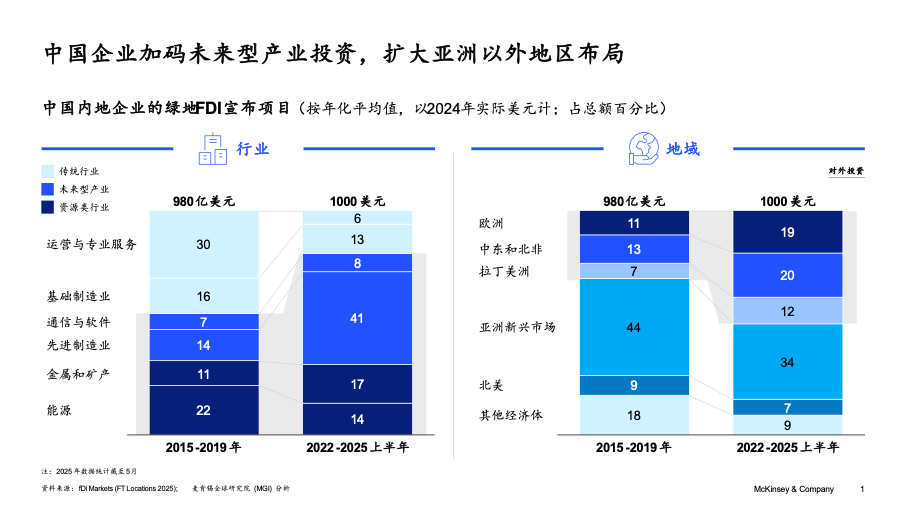
Core Insights - McKinsey's recent media day in Shanghai focused on strategies for companies to succeed in the future Chinese market and navigate global expansion [1] Group 1: Foreign Investment Trends - Global capital flows are undergoing structural changes, with China transitioning from a major recipient of foreign direct investment (FDI) to a key global investor [2] - Chinese companies are increasing capital deployment in Europe, Latin America, and the Middle East and North Africa by over two-thirds [2] - Since 2022, China's annual greenfield investment has decreased by 65% compared to pre-pandemic levels, while outbound investment in future industries and resources has grown by 54% [2] Group 2: Automotive Industry Developments - Chinese automotive companies have shifted from "market for technology" to "technology for the world," gaining approximately 30% market share from multinational joint ventures in the domestic market [5] - By 2030, it is expected that 3 to 5 Chinese companies will be among the top ten global automakers, with Chinese brands projected to capture 10% to 20% of core overseas markets [6] - In 2025, two Chinese automakers are anticipated to enter the global top ten in sales, with 2023 expected to see record-high annual exports, surpassing Japan and Germany [6] Group 3: Pharmaceutical Industry Evolution - China's innovative drug development has seen significant growth, with about one-third of global innovative drug pipelines originating from China [11] - Chinese pharmaceutical companies need to evolve from developing globally competitive products to establishing a global presence [11] - Three strategic upgrades are necessary for Chinese pharmaceutical firms: transitioning from specialized talent to global and diverse talent, from efficient decision-making to a balance of agility and stability, and from following innovation to leading innovation [12] Group 4: Manufacturing Sector Opportunities - China has evolved from a "world factory" to a strategic market and innovation hub for global advanced industrial enterprises [15] - Leading Chinese manufacturers are integrating digitalization, AI, and IoT technologies to maintain competitive advantages [15] - For multinational companies, deep engagement in China's vibrant industrial ecosystem is essential for enhancing global competitiveness [15] Group 5: Consumer Market Dynamics - The middle class in China is expected to grow, with high-income households projected to reach 259 million by 2030, accounting for 62% of urban families [16] - Despite declining consumer confidence, retail sales in China grew by 4.6% year-on-year in the first eight months of 2025, with significant increases in home appliance and electric vehicle sales [16] - E-commerce platforms are evolving from a fresh food-centric model to a comprehensive category approach, driving growth through new consumption scenarios [19]
展望“十五五” 一场大会、两份报告为汽车产业供应链转型“护航”
Zhong Guo Jing Ying Bao· 2025-11-28 00:04
Core Insights - The automotive supply chain's collaborative innovation is a key driver for high-quality development in the industry, especially as China transitions from the "14th Five-Year Plan" to the "15th Five-Year Plan" [1] - The "2025 China Automotive Supply Chain Conference" focused on innovation, transformation, and international development within the automotive supply chain, aiming to create a new blueprint for its future [1] Group 1: Industry Development - The Chinese automotive industry is advancing towards electrification, intelligence, connectivity, and low-carbon initiatives, establishing a resilient and comprehensive new energy vehicle supply chain [1][2] - The automotive supply chain must evolve into a proactive, efficient, collaborative, resilient, and robust system to achieve significant historical progress [2] Group 2: Key Contributions and Reports - The conference featured the release of two authoritative industry reports that analyze the current state of key supply chain areas and provide insights into technology paths, market structures, and challenges for the "15th Five-Year Plan" [3] - The "2025 China Automotive Supply Chain Development Report" highlighted four major achievements in the automotive parts industry during the "14th Five-Year Plan," including enhanced innovation capabilities and a more resilient industrial ecosystem [4] Group 3: Globalization and Strategic Framework - The globalization of China's automotive parts industry has shifted from an optional strategy to a necessary one, with significant opportunities for investment and collaboration in the global market [4] - The "2025 China Automotive Parts Industry Development Report" introduces a "5C" globalization strategy framework, focusing on compliance, supply chain, capital, brand, and talent to guide companies in their international expansion [5] Group 4: Innovation and Collaboration - The conference recognized 96 projects from 83 companies for their innovative contributions to the automotive supply chain and chip innovation, emphasizing the importance of addressing key technological challenges [6] - A "Supply Chain Expert Database" was established to leverage industry expertise in solving critical supply chain issues, enhancing collaboration and innovation within the sector [6]