人民币升值

Search documents
中信证券港股2026年度策略:将迎来第二轮估值修复+业绩触底反弹 把握五条主线
智通财经网· 2025-11-20 00:51
Core Viewpoint - The Hong Kong stock market is expected to benefit from internal "14th Five-Year Plan" catalysts and external "fiscal + monetary" easing policies from major economies, particularly the US and Japan, leading to a rebound in valuations and performance by 2026 [1] Group 1: Market Outlook - The Hong Kong stock market is projected to experience a second round of valuation recovery and performance resurgence by 2026, supported by a complete domestic AI industry chain and an influx of quality A-share companies listing in Hong Kong [1] - The Hang Seng Index is currently seen as a valuation low point among major global markets, with an estimated equity risk premium (ERP) of 5.7% [1] - The expected net profit growth for the Hang Seng Index and Hang Seng Tech in 2026 is 8.5% and 29.9%, respectively, indicating a positive outlook for earnings recovery [1][4] Group 2: Strategic Investment Directions - Five long-term investment directions are recommended: 1) Technology sector, including AI and consumer electronics; 2) Healthcare, particularly biotechnology; 3) Resource products benefiting from overseas inflation and de-dollarization; 4) Essential consumer goods expected to recover in valuation; 5) Paper and aviation sectors benefiting from RMB appreciation [1] - The "14th Five-Year Plan" emphasizes the construction of a modern industrial system and high-level technological self-reliance, which is expected to support strategic emerging industries such as new energy, new materials, and aerospace [2] Group 3: Emerging Industries - The solid-state battery industry is anticipated to reach a market value of 1.2 trillion yuan from 2024 to 2030, marking a new wave of electrification innovation [3] - The brain-computer interface sector is gaining government attention, with new policies expected to address clinical challenges [3] - The bio-manufacturing market is projected to reach a trillion-level scale, driven by continuous application expansion [3] Group 4: Performance Expectations - The market expects the performance growth of Hong Kong stocks to bottom out in 2025, with revenue and profit growth projected to reach 5.5% and 9.2% in 2026, respectively [4] - The earnings sentiment for Hong Kong stocks has begun to warm, with upward adjustments in profit forecasts since July 25 [4][5] Group 5: Capital Flows - Southbound capital inflows into Hong Kong stocks reached 1.26 trillion HKD from the beginning of the year to the end of October, becoming a core driver for the market [6] - The trend of passive management funds increasing their allocation to Hong Kong stocks is evident, with a significant rise in the proportion of passive funds in the Southbound Stock Connect [6] - Retail investors are expected to play a larger role in the market, with ETF inflows into Hong Kong stocks exceeding 270 billion HKD since June [6]

中信证券:港股市场明年或将迎来第二轮估值修复以及业绩进一步复苏行情
Mei Ri Jing Ji Xin Wen· 2025-11-20 00:21
Core Viewpoint - The report from CITIC Securities indicates that the Hong Kong stock market is expected to experience a second round of valuation recovery and further earnings revival by 2026, driven by a rebound in the fundamental outlook and significant valuation discounts [1] Long-term Investment Directions - Technology sector, including AI-related sub-sectors and consumer electronics [1] - Healthcare sector, particularly biotechnology [1] - Resource products benefiting from rising overseas inflation expectations and de-dollarization, including non-ferrous metals and rare earths [1] - Consumer staples sector, which is relatively stagnant and undervalued, is expected to see valuation recovery [1] - Paper and aviation sectors benefiting from the appreciation of the Renminbi [1]
中信证券港股2026年策略:港股市场将迎来第二轮估值修复与业绩复苏行情
Zheng Quan Shi Bao Wang· 2025-11-20 00:15
Core Viewpoint - The report from CITIC Securities indicates that the Hong Kong stock market is expected to experience a second round of valuation recovery and further earnings revival by 2026, driven by a rebound in the fundamental outlook and significant valuation discounts [1] Long-term Investment Directions - Technology sector, including AI-related sub-sectors and consumer electronics [1] - Healthcare sector, particularly biotechnology [1] - Resource products benefiting from rising overseas inflation expectations and de-dollarization, including non-ferrous metals and rare earths [1] - Essential consumer goods sector, which is relatively undervalued and expected to see valuation recovery as the domestic economy further recovers [1] - Paper and aviation sectors benefiting from the appreciation of the Renminbi [1]
兴业证券王涵 | 人民币升值:重估之旅刚启程
王涵论宏观· 2025-11-19 06:41
Core Viewpoint - The article discusses the significant appreciation of the RMB against the USD in 2023 and explores the potential for further appreciation in the coming year, driven by differing monetary policies in the US and China, as well as the gradual correction of the RMB's systemic undervaluation [2][8]. Short-term Analysis - The US is likely to adopt a passive easing monetary policy due to fiscal pressures, while China maintains a proactive and stable monetary policy, supporting the continued appreciation of the RMB against the USD [8][15]. - The US faces approximately $400 billion in additional interest burdens, which may compel the Federal Reserve to implement quantitative easing alongside interest rate cuts to alleviate fiscal pressures [9][15]. Medium-term Analysis - The RMB has been approximately 6% undervalued since 2023, with concerns about its systemic undervaluation gradually dissipating [17][20]. - The establishment of an independent cross-border payment network for the RMB, alongside the failure of US financial sanctions against Russia, has catalyzed the internationalization of the RMB [20][24]. Long-term Perspective - The changing perception of the US's hard power and its impact on soft power is expected to gradually influence currency dynamics, with the RMB's undervaluation likely to correct over time [3][26]. - The "small yard, high wall" policy of the Trump administration may further accelerate the shift in currency dynamics, undermining the dollar's role as a global transaction medium [26].


2026年港股行业比较投资策略:乘势外资东风,锚定核心资产
Shenwan Hongyuan Securities· 2025-11-17 14:12
Core Insights - The report emphasizes that the improvement in PPI year-on-year will drive corporate profit recovery, which is a key factor for foreign capital returning to Chinese assets [3] - It is anticipated that the RMB exchange rate will continue to appreciate in 2026, leading to a re-evaluation of Chinese assets by foreign investors [3][12] - The report highlights that during historical phases of PPI recovery, both A-share and Hong Kong stock ROE have shown significant improvement, indicating a positive correlation between PPI growth and corporate profitability [16] Historical Review - Historical data shows a strong positive correlation between the RMB exchange rate and PPI year-on-year growth, particularly during phases of PPI recovery and RMB appreciation [7][9] - The report outlines four cycles of RMB appreciation and depreciation since 2015, noting that during appreciation phases, both A-shares and Hong Kong stocks generally experienced price increases [10][12] - The report identifies that the leading sectors during the appreciation phases were internet and cyclical stocks, benefiting from improved profitability expectations [15] Profitability Trends - The report indicates that during periods of PPI year-on-year growth, there is a notable improvement in ROE for both A-shares and Hong Kong stocks, suggesting a direct impact of PPI on corporate earnings [16] - The report notes that as of the third quarter of 2025, A-share ROE has stabilized at the bottom, and Hong Kong stock ROE is expected to improve alongside PPI growth in 2026 [3][22] Foreign Investment Insights - The report highlights that foreign capital has been reassessing Chinese assets, with a significant increase in foreign participation in Hong Kong IPOs in 2025, indicating heightened interest in core assets [4] - The report mentions that the A-H premium is expected to continue narrowing, reflecting increased foreign interest in Hong Kong-listed core assets [4] - It is noted that over 30 major market cap companies in the A-share and Hong Kong markets belong to sectors such as technology, high-end manufacturing, and quality dividend stocks, which are expected to benefit from improving profitability [3][4] Sector Focus - The report identifies key sectors expected to benefit from improving ROE in 2026, including power equipment, internet (AI-related core assets), and cyclical sectors [3] - It emphasizes that sectors with strong competitive advantages, such as high-end manufacturing and specialty consumption, are likely to attract foreign investment [3] - The report also points out that domestic funds have room to increase their holdings in Hong Kong stocks, with significant portions of public fund portfolios allocated to Hong Kong [4][22]
固收|从“外汇占款到“资金中枢”央行“两难的变与不变
2025-11-16 15:36
Summary of Key Points from Conference Call Industry Overview - The discussion primarily revolves around the Chinese economy, focusing on the impact of currency exchange rates, particularly the renminbi (RMB), on exports and monetary policy [1][2][3]. Core Insights and Arguments - **Export Surplus Accumulation**: China's export surplus has accelerated, attributed to price differences between China and the US, as well as other countries. This trend reflects a long-term shift in competitiveness due to China's low inflation amidst global inflation [1][2]. - **Increase in Corporate Foreign Exchange Settlement**: There has been a significant increase in corporate foreign exchange settlement surplus, indicating a shift from hoarding US dollars to converting them into RMB assets. This trend may lead to upward pressure on the RMB and requires the central bank to consider increasing monetary supply to meet market demand [1][3]. - **RMB Appreciation and Economic Transition**: RMB appreciation plays a crucial role in China's economic transition. Historical examples from Japan and South Korea suggest that currency appreciation can indicate successful economic transformation. High-tech industries may benefit, while labor-intensive sectors could face challenges [1][5]. - **Impact on Domestic Demand and Prices**: RMB appreciation has complex effects on domestic demand and prices. It may lower import prices while simultaneously increasing domestic prices for goods, leading to a dual effect on inflation [3][9]. - **Central Bank's Monetary Policy Strategy**: The central bank's strategy has evolved through different market phases, focusing on nominal GDP growth and balancing monetary supply with market changes. The current phase of RMB appreciation presents a dilemma between supporting exports and allowing natural currency appreciation [10][11]. Additional Important Insights - **Shift in Corporate Behavior**: The current trend of increasing foreign exchange settlements suggests a growing confidence among enterprises in the RMB, which could indicate a long-term shift in currency dynamics [6]. - **International and Domestic Environment Changes**: The changing international landscape, including US interest rate cuts and a weaker dollar, alongside rising domestic asset returns, influences corporate preferences for holding RMB assets [7][8]. - **Future Monetary Policy Predictions**: Depending on nominal GDP trends, two scenarios for monetary policy and their impact on the bond market can be anticipated for 2026. A rebound in nominal GDP may lead to tighter monetary policy, while continued low GDP may necessitate more accommodative measures [12][13].
美国经济焦虑升级,万亿美元或换人民币,人民币升值成定局
Sou Hu Cai Jing· 2025-11-15 17:25
Core Viewpoint - The article discusses the potential for a significant capital flow back to China, estimated at $1 trillion to $1.3 trillion, which could lead to a 10% appreciation of the Renminbi due to the weakening of the US dollar as the Federal Reserve begins to lower interest rates starting in 2024 [1][3][12]. Economic Context - The US national debt is projected to reach $38 trillion by 2025, significantly impacting the economy and leading to a decline in the attractiveness of the dollar [1][3]. - The Federal Reserve is expected to lower the federal funds rate to between 3.75% and 4.00% by October 2025, which will further decrease the dollar's appeal [3][10]. Capital Flow Dynamics - Chinese companies have accumulated over $2 trillion in overseas assets during the pandemic, primarily in bonds and equities, with a 15% annual increase from 2021 to 2023 [5][12]. - The capital repatriation is expected to occur in phases, starting with the sale of short-term bonds worth approximately $500 billion, followed by the transfer of equity investments from US markets back to China or Hong Kong [6][12]. Sector Preferences - The repatriated funds are likely to favor sectors such as semiconductors and renewable energy, with semiconductor market share projected to rise from 15% in 2020 to 25% by 2025 [8][14]. - The electric vehicle industry is also set to benefit, with production expected to increase from 2 million units in 2020 to 8 million units by 2025 [8][14]. Currency and Investment Implications - The narrowing interest rate differential, projected to decrease from 2% in 2024 to 1% in 2025, will amplify changes in capital flows and could exert pressure on US capital markets and government bonds [8][10]. - The appreciation of the Renminbi could lead to lower import costs and necessitate recalibrations in profit margins for foreign investors and exporters [16]. Long-term Outlook - The anticipated capital flow back to China is viewed as a catalyst for transformation, with investments directed towards infrastructure and high-end manufacturing, including aviation, semiconductors, and renewable energy [14][16]. - By 2026, the major withdrawal of capital is expected to be completed, marking a significant shift in global investment patterns [12][16].
人民币破7在望,在岸价升至7.0908创一年来新高
21世纪经济报道· 2025-11-14 09:16
Core Viewpoint - The article discusses the recent performance of the RMB against the USD, highlighting a stable and slightly appreciating trend due to a weaker USD environment and strong domestic equity market attracting foreign investment [2][4]. Exchange Rate Performance - On November 14, the RMB/USD central parity rate was adjusted up by 40 basis points to 7.0825, with a year-to-date increase of approximately 1000 basis points [4]. - The onshore and offshore RMB also showed slight increases, with onshore RMB at 7.0937 and offshore RMB at 7.0935 as of noon on November 14 [4]. - The overall trend for the USD against the RMB has been a one-sided decline throughout the year, with the USD starting at 7.27 RMB and reaching a low of 7.08532 RMB on September 17 [5]. Future Outlook - Analysts predict that the RMB will continue to operate in a strong state in the short term, with potential for moderate appreciation by 2026 [2][7]. - Factors influencing this outlook include the anticipated acceleration of Fed rate cuts and the limited upward space for the USD index due to the impact of US tariff policies [7][9]. - The central bank's policies are expected to provide substantial support for the RMB, ensuring stability in the exchange rate [9]. Market Sentiment - There is a potential for the RMB central parity to test the "7" level, supported by a weak USD and seasonal demand for currency settlement [8]. - Optimistic scenarios suggest that the USD/RMB exchange rate could approach 7.0 by year-end, with a new equilibrium potentially around 6.7 [8][10]. - The RMB is expected to maintain a dual-directional fluctuation pattern, with limited risks of rapid appreciation or depreciation [8].

轮到美国焦虑!美经济学者预言:万亿美元变人民币,升值或成定局
Sou Hu Cai Jing· 2025-11-13 11:37
Core Insights - The U.S. has accumulated a significant debt burden, with national debt reaching $38 trillion, over 124% of GDP, a nearly fivefold increase since 2003 [2][4] - The Federal Reserve's high interest rate policy has been aimed at combating inflation, but recent economic data suggests a shift towards interest rate cuts to stimulate growth [5][7] - The return of capital from Chinese enterprises, estimated to be between $1 trillion and $1.3 trillion, is expected to strengthen the yuan against the dollar, with a potential appreciation of up to 10% [7][11] Debt Dynamics - U.S. national debt has surged due to government stimulus measures, with foreign ownership dropping to less than 25% [4] - The debt growth rate has accelerated from an average of 10% to over 20% annually from 2022 to 2025 [2][13] - The burden of debt is increasingly falling on domestic institutions and households, with each American carrying nearly $110,000 in debt [13] Economic Policy Shifts - The Federal Reserve's interest rate cuts, with the federal funds rate dropping to 3.75%-4.00% by late October 2025, are a response to weak employment data and persistent inflation [5][7] - The shift in monetary policy is expected to lead to a capital outflow from the U.S. as borrowing costs decrease, redirecting funds to higher-return regions [9][15] Capital Reallocation - Chinese enterprises have accumulated over $2 trillion in overseas dollar assets, primarily in bonds and equities, with a projected return of these assets to China [9][11] - The reallocation process involves selling short-term bonds and shifting equity investments back to domestic or Hong Kong markets, with a completion target by 2026 [9][11] Currency and Trade Implications - The depreciation of the dollar, with an 8% drop in the dollar index, is expected to enhance the return on investments in China, facilitating capital repatriation [11][15] - The internationalization of the yuan is projected to increase, with its share in global payments rising from 2% in 2020 to 4% by 2025 [15][22] Infrastructure and Economic Growth - The return of capital is anticipated to boost investments in key sectors such as semiconductors and renewable energy, with semiconductor global market share expected to rise from 15% in 2020 to 25% by 2025 [11][15] - Infrastructure projects, including high-speed rail expansion from 38,000 km in 2020 to 45,000 km by 2025, will benefit from this capital influx [19][20]
上周三大人民币汇率指数全线上行 市场对人民币升值预期继续升温
Xin Hua Cai Jing· 2025-11-10 05:32
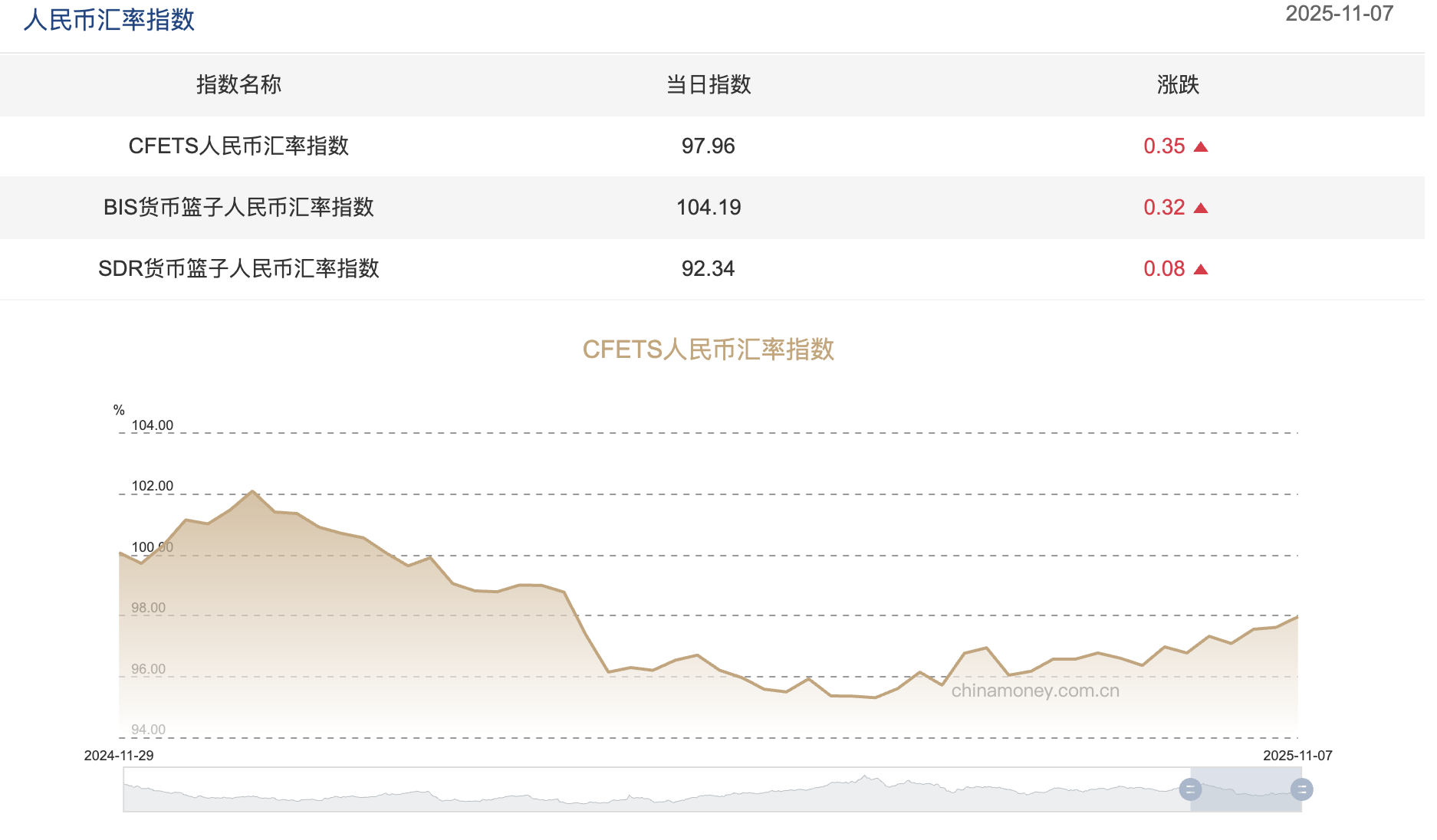
Core Viewpoint - The Chinese yuan's exchange rate indices have shown significant increases, reaching new highs since April 2025, indicating a strengthening trend in the yuan against a basket of currencies [1][5]. Exchange Rate Indices - The CFETS yuan exchange rate index is reported at 97.96, up 0.35% week-on-week, marking a new high since April 2025 [1][2]. - The BIS currency basket yuan exchange rate index stands at 104.19, with a weekly increase of 0.32%, also a new high since April 2025 [1][2]. - The SDR currency basket yuan exchange rate index is at 92.34, reflecting a weekly rise of 0.08%, reaching a new high since April 2025 [1][2]. Market Dynamics - The US dollar index experienced fluctuations, ultimately declining by 0.18% to close at 99.54 points for the week [5]. - The onshore yuan against the US dollar closed at 7.1210, with a weekly increase of 10 basis points, while the offshore yuan closed at 7.1252, down 28 basis points [5]. - The yuan's central parity rate against the US dollar was set at 7.0836, up 31 basis points for the week [5]. Internal Factors - The yuan's central parity rate has reached a yearly high, with a strong performance against a basket of currencies, supporting the CFETS yuan exchange rate index near 98 [5]. - The increase in net settlement of foreign exchange is expected to continue, driven by policy guidance, contributing to the long-term appreciation of the yuan [5]. Economic Outlook - Upcoming economic data releases for October are anticipated to provide further insights into the yuan's performance [6]. - Analysts predict that 2025 may mark the beginning of a new appreciation cycle for the yuan, with expectations of the yuan potentially breaking the 7.0 mark against the US dollar by 2026 [6]. - The diversification of export structures and the internationalization of the yuan are expected to reduce the exchange rate risk associated with the US dollar [6][7].