出口管制

Search documents
台当局将华为中芯等纳入“出口管制名单”,国台办回应
news flash· 2025-06-25 02:56
国台办举行例行新闻发布会。近日,台经济主管部门称,已将601个实体纳入"出口管制名单",其中包 括华为、中芯国际等大陆芯片研发企业。有岛内投资者担心,相关"出口禁令"会冲击台湾半导体企业。 对此有何评论?国台办发言人朱凤莲表示,民进党当局对于损台害台的关税霸凌,无底线卑躬屈膝、跪 地求饶;对于互惠互利的两岸经济合作,却屡下黑手,频施恶招,甚至把配合美国打压大陆企业作为向 美输诚、"倚外谋独"的"投名状",种种卑劣行径令人不齿。我们将采取有力措施坚决维护两岸经贸交流 合作正常秩序,维护两岸同胞利益福祉。(日月谭天) ...

小米申请“XRING O2”商标,玄戒O2芯片或在研发中
Guan Cha Zhe Wang· 2025-06-25 02:41
Group 1 - Xiaomi has applied for the trademark "XRING O2," indicating potential development of its second-generation flagship chip, "玄戒O2" [1] - The first-generation flagship SoC, "玄戒O1," was launched in May 2023, utilizing a 3nm process with ARM's latest CPU and GPU architectures [1] - Xiaomi's president, Lu Weibing, stated that flagship chips are challenging to develop and will primarily be used in flagship products, emphasizing the importance of chip capabilities for long-term differentiation [1] Group 2 - A Xiaomi store in Shanghai reported limited availability of the Xiaomi 15S Pro, which features the "玄戒O1" chip, with only two units in stock for the second batch [2] - Recent U.S. export controls on EDA tools to China may impact domestic chip design firms, as they may not receive further updates after existing contracts expire [2] - Despite the export restrictions, existing EDA/IP tools can still be used, but firms may face challenges in maintenance and support [2]



有色月跟踪:小金属涨价周期已至,重视战略矿产资源价值评估
Minmetals Securities· 2025-06-25 02:16
Investment Rating - The report rates the non-ferrous metals sector as "Positive" [4] Core Insights - The small metals market is experiencing a significant price increase due to limited strategic metal reserves, high extraction difficulty, and insufficient supply elasticity, coupled with rapid growth in downstream demand from sectors like new energy, semiconductors, and military industries. Geopolitical tensions and China's export controls on tungsten, antimony, and rare earths have exacerbated supply-demand conflicts, leading to a sustained upward price trend for small metals [12][15][17] - In May 2025, the overall non-ferrous metals sector saw a moderate increase, with precious metals (gold) and strategic small metals (rare earths, tungsten) leading the gains. The geopolitical situation has intensified, causing a decline in risk appetite in international financial markets, which has driven gold prices higher as a traditional safe-haven asset [12][15] Summary by Sections 1. Focus Areas: Supply-Demand Conflicts and Geopolitical Impact - The small metals market is currently hot, with prices rising due to limited reserves and high extraction difficulty. The rapid growth in demand from new energy and military sectors, along with geopolitical tensions, has intensified supply-demand conflicts [12][15] 2. Small Metals Price Increase Cycle and Strategic Resource Valuation - Small metals are experiencing a significant price increase, with tungsten concentrate prices reaching historical highs of 169,000 yuan/ton, and antimony concentrate prices increasing by 57.02%. The main drivers include limited reserves, high extraction costs, and increased demand from various industries [15][17] 3. Market Trends: Macroeconomic Sentiment Recovery and Non-Ferrous Sector Growth - The non-ferrous metals sector showed a recovery in May, with small metals leading the way. The report highlights the importance of monitoring the Federal Reserve's interest rate decisions and China's economic recovery [12][46] 4. Policy Changes: Global Policies on Key Mineral Resource Protection and Development - Multiple countries are implementing policies to protect and develop key mineral resources, including the U.S. signing a "mineral agreement" with Ukraine and South Africa launching a critical minerals strategy. China is also taking measures to combat smuggling of strategic minerals [13][27] 5. Key Industry and Company Developments - Harmony Gold's acquisition of Macarthur Copper for $1.03 billion and other significant mergers and acquisitions in the mining sector are noted. Companies are using diverse capital strategies to strengthen resource control and optimize capacity [14][15]
金属行业2025年中期投资策略系列报告之小金属&新材料篇 战略金属重新定价,新材料迭代创机遇
2025-09-26 02:28
Summary of Key Points from the Conference Call Industry Overview - The report focuses on the **metal industry**, particularly **strategic metals** and **new materials** for the first half of 2025, highlighting the revaluation of strategic metals and opportunities in new materials due to technological iterations [1][3][29]. Core Insights and Arguments - **Strategic Metals Pricing**: By mid-2025, the pricing of strategic metals has fully reflected actual metal prices, influenced by global uncertainties and U.S. tariff policies [1][3]. - **Focus on Key Metals**: Emphasis on rare earth magnets, tungsten, and antimony, which have strong domestic resource control [1][3]. - **Export Controls**: China has implemented export controls on gallium, germanium, antimony, tungsten, bismuth, molybdenum, and indium to counter U.S. technology restrictions, leading to significant price increases in overseas markets compared to domestic prices [1][6][9][11]. - **Supply-Demand Dynamics**: The supply-demand balance is expected to improve gradually, potentially shifting from surplus to shortage, which will drive prices upward [2][12]. Specific Metal Insights - **Tungsten**: - The tungsten quota has decreased for two consecutive years due to resource depletion, with demand linked to macroeconomic conditions and growth in sectors like 3C and military, pushing prices to historical highs [4][15][16]. - Current tungsten prices exceed 170,000 yuan per ton, with production challenges due to low ore grades [14][15]. - **Antimony**: - Antimony market is strong, with domestic supply accounting for over 60% of global production. The photovoltaic industry is a major driver of demand, expected to grow as installation capacity expands [4][17][18]. - **Molybdenum**: - Molybdenum prices are expected to remain high due to stable production and lack of new mining projects, with demand primarily from stainless steel and special steel applications [19][22]. New Materials Sector - **Growth Opportunities**: The electronic and military sectors are highlighted as key areas for growth in new materials, driven by advancements in AI and electronic components [5][23][24]. - **Technological Upgrades**: The demand for upgraded electronic materials is increasing, particularly for components like capacitors and inductors, which require smaller particle sizes and higher performance [23][24]. Geopolitical and Market Impacts - **China's Dominance**: China holds a significant advantage in the smelting of strategic metals, with over 90% of rare earth separation occurring domestically, despite U.S. technology restrictions [1][10][11][12]. - **U.S. Dependency**: The U.S. remains highly dependent on China for strategic metals, with significant portions of its tungsten, antimony, and rare earth needs met by Chinese imports [11]. Emerging Trends - **Military Sector Recovery**: The military industry is showing signs of recovery, particularly in aerospace, with increased demand for strategic metals [26]. - **New Applications**: The demand for tantalum, niobium, and titanium in high-temperature applications and aerospace is expected to grow, driven by advancements in technology and military needs [28]. Conclusion - The strategic metals market is poised for growth, supported by strong demand fundamentals and geopolitical factors. Companies in this sector, such as Jinchuan Group and Xiamen Tungsten, are recommended for their promising outlooks [29].
FDA紧急叫停涉“细胞流至敌对国家”临床试验,对华生物技术限制或再升级
仪器信息网· 2025-06-24 07:02
Core Viewpoint - The FDA has announced an immediate review of clinical trials involving the transfer of live human cells from American citizens to laboratories in China and other "hostile countries" for genetic engineering, indicating a shift towards stricter biotechnology restrictions against China [4][5]. Group 1 - The FDA's review is prompted by concerns that international transfers and genetic engineering operations may occur without patient knowledge or consent, potentially leading to the misuse of sensitive genetic data by foreign governments, including those of hostile nations [5]. - The Biden administration's data security rules set in December 2024 included export controls but allowed a "comprehensive exemption" for clinical trial biological samples, creating regulatory loopholes that permitted participation from Chinese-funded enterprises [5]. - FDA Commissioner Marty Makary emphasized the importance of the integrity of the biomedical research system and stated that actions are being taken to protect patients, rebuild public trust, and defend America's biomedical leadership [5].

国联民生证券:看好有色金属板块投资机会 推荐黄金、稀土及铜铝板块
Zhi Tong Cai Jing· 2025-06-24 06:08
Group 1: Investment Outlook for Non-Ferrous Metals - The allocation ratio of funds to the non-ferrous metals sector increased by 1.07 percentage points to 4.59% in Q1 2025, with copper, gold, and aluminum being the key focus for increased allocation [1] - The non-ferrous metals industry index rose by 8.11% from the beginning of 2025 to May 30, 2025, outperforming the CSI 300 index by 10.52 percentage points, ranking third among 31 industry indices [1] - The net profit attributable to shareholders for the non-ferrous metals sector is projected to be 141.46 billion yuan in 2024, with a year-on-year growth of 0.01%, while Q1 2025 net profit is expected to reach 45.27 billion yuan, a 70.2% increase year-on-year [1] Group 2: Factors Driving Gold Price Increase - Multiple factors are contributing to the rise in gold prices, including the onset of a rate-cutting cycle by the Federal Reserve, which is expected to enhance liquidity and benefit gold [2] - Gold's investment value is highlighted by rising inflation expectations in the U.S., alongside ongoing tariff uncertainties that increase demand for gold as a safe-haven asset [2] - Geopolitical risks and major central banks continuing to increase their gold reserves are anticipated to further push gold prices upward [2] Group 3: Rare Earth Supply and Demand Dynamics - The supply and demand dynamics for rare earths are marginally improving, driven by policies promoting new energy vehicles and home appliances, which are expected to increase demand for rare earth permanent magnet materials [3] - The domestic control over rare earth mining growth is slowing, and while imports from Myanmar have temporarily recovered, future import stability remains uncertain due to seasonal factors [3] - Export controls on heavy rare earths implemented in April 2025 are expected to drive up overseas rare earth prices, which will likely lead to domestic price increases [3] Group 4: Copper and Aluminum Market Fundamentals - The aluminum sector is supported by ongoing domestic policies, with high demand expected from the power grid, photovoltaics, and new energy vehicles, while supply growth is anticipated to slow down [4] - Short-term uncertainties remain due to tariff disruptions and economic fluctuations, but the long-term outlook for aluminum prices is upward due to supply constraints [4] - The copper market faces short-term supply disruptions and long-term constraints due to declining ore grades and insufficient capital expenditure, which are expected to support copper prices [4]

有色金属行业报告(2025.06.16-2025.06.20):铀价有望重启上涨
China Post Securities· 2025-06-23 03:56
Investment Rating - The industry investment rating is "Outperform the Market" and is maintained [2] Core Views - Precious metals are expected to perform well in the long term despite a recent pullback, with a recommendation to overweight this sector [5] - Copper prices are expected to remain strong, with a support level around 9,350 USD per ton, influenced by macroeconomic factors and trade dynamics [6] - Aluminum prices are anticipated to trend upward, supported by easing trade tensions and a decrease in inventory levels [6] - Rare earth prices are projected to rise following a significant drop in export volumes, with expectations of increased demand due to recent diplomatic agreements [7] - Uranium prices have seen a significant increase, with expectations for a new upward trend in the second half of the year [8] Summary by Sections Industry Overview - The closing index for the industry is at 4,846.95, with a weekly high of 5,047.03 and a low of 3,700.9 [2] Price Movements - Basic metals saw price changes: Copper up 0.13%, Aluminum up 2.34%, Zinc up 0.86%, Lead up 0.13%, and Tin down 0.27% [20] - Precious metals experienced declines: Gold down 1.98%, Silver down 1.15%, while Platinum and Palladium saw increases of 4.08% and 1.69% respectively [20] Inventory Changes - Global visible inventories showed a decrease in Copper by 12,511 tons, Aluminum by 5,439 tons, and Zinc by 5,004 tons, while Lead saw an increase of 18,731 tons [34]
武汉中原长江科技发展有限公司违反国家出口管制法被罚4.3万元
Qi Lu Wan Bao· 2025-06-23 02:24
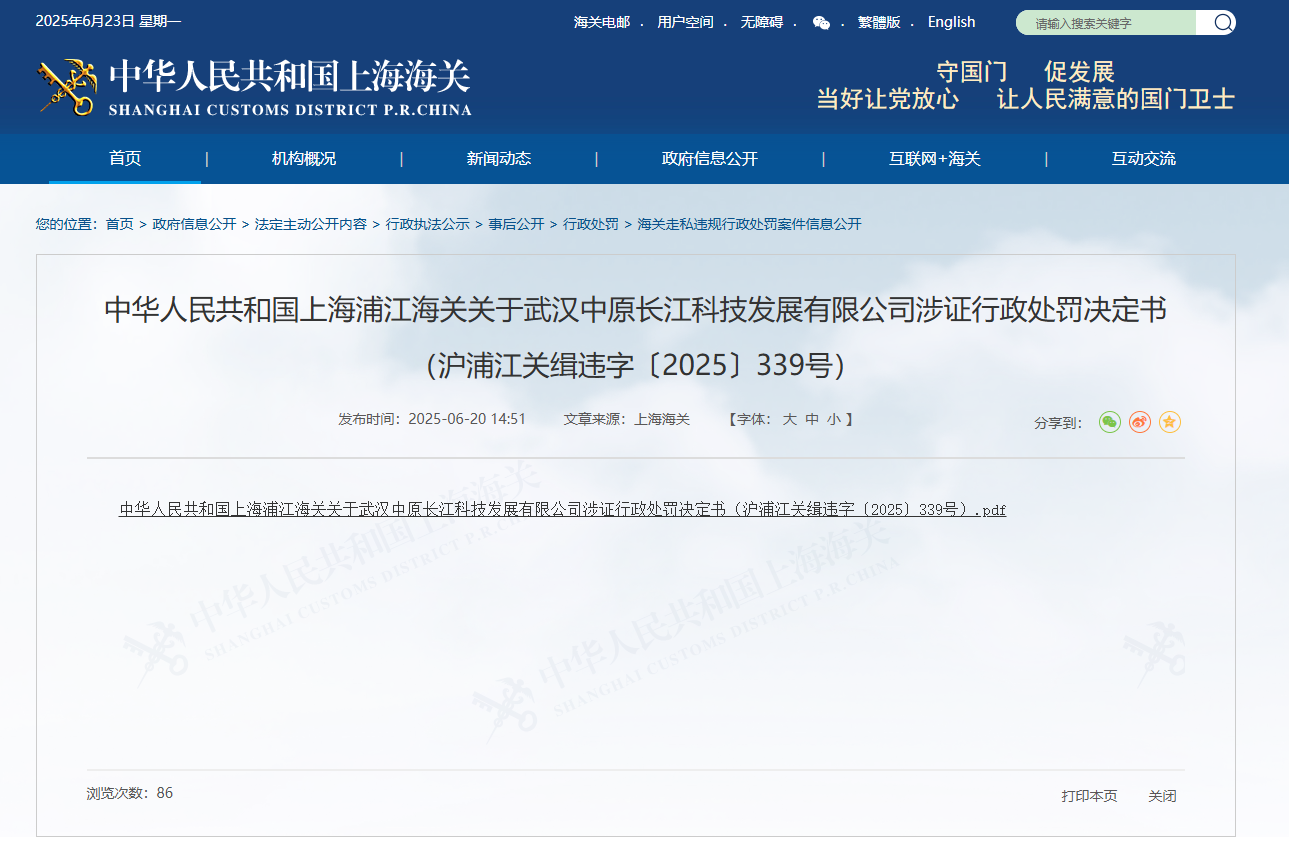
Core Viewpoint - Wuhan Zhongyuan Yangtze Technology Development Co., Ltd. was fined 43,000 RMB for violating national export control regulations regarding the export of lithium thionyl chloride batteries [1][3][10] Summary by Relevant Sections Administrative Penalty - The penalty was issued by Shanghai Pujiang Customs on June 19, 2025, for the company's failure to provide necessary export licenses for controlled items [1][3] - The total value of the exported batteries involved in the violation was approximately 1,132,508.16 USD, with a determined illegal operating amount of 85,546.95 RMB [3][5] Violation Details - The company exported lithium thionyl chloride batteries from May 2022 to April 2024, involving 17 customs declarations [3][5] - The thionyl chloride component is listed in the national "Dual-Use Items and Technologies Export License Management Catalog," requiring an export license that the company did not submit [3][5] Compliance and Appeal Process - The company must pay the fine within 15 days of receiving the penalty notice, with a daily late fee of 3% applicable if not paid on time [3][7] - The company has the right to appeal the decision within 60 days to Shanghai Customs or file a lawsuit within six months to the Shanghai Second Intermediate People's Court [3][7] Company Background - Wuhan Zhongyuan Yangtze Technology Development Co., Ltd. is part of China Electronics Corporation and has a long history in the development and production of physical and chemical power sources, being one of the pioneers in lithium battery research and production in China [10]
刚刚,开盘跳水!
Zhong Guo Ji Jin Bao· 2025-06-23 02:07
Market Reaction - Asian markets, particularly Japan and South Korea, experienced significant declines, with the South Korean composite index dropping over 1.6% before narrowing to a 1.14% decrease [2] - The Nikkei 225 index in Japan fell nearly 1% during trading, ultimately down 0.64% [4] Chip Sector Performance - The semiconductor sector in both Japan and South Korea saw widespread declines, with Samsung Electronics dropping over 2.8% [6] - Other notable declines included Samsung SDI and Hanmi Semiconductor, both down over 4%, and SK Hynix down over 3% [7] - In Japan, Kioxia Holdings fell over 6% amid reports of potential changes in U.S. export controls affecting major semiconductor manufacturers, including TSMC, Samsung, and SK Hynix [8] Gold Market Dynamics - Gold prices experienced a sharp decline after initially rising to $3,400 per ounce, reflecting a rapid drop in geopolitical risk premium [10] - Deutsche Bank indicated that the current decline in gold's geopolitical risk premium may be misleading, suggesting that gold could rebuild its risk premium in the coming weeks [11] - Citigroup analysts forecast that gold prices may peak between $3,100 and $3,500 per ounce in Q3 2023 before gradually declining to a range of $2,500 to $2,700 per ounce by the second half of 2026, representing a potential drop of 20% to 25% from current forward prices [11]
中欧就电动汽车反补贴案等议题进行了磋商,为中欧今年重要议程做好准备
Di Yi Cai Jing· 2025-06-20 11:56
Group 1 - The core viewpoint emphasizes the need for China and the EU to work together to prepare for important economic and trade agendas, promoting a healthy and stable development of their economic relationship [1][3] - The Chinese Ministry of Commerce has maintained close communication with the EU at all levels, focusing on enhancing bilateral trade and investment cooperation, and addressing trade disputes through dialogue [3][4] - China is committed to high-level openness and aims to provide European companies with a broad market and development opportunities, while opposing any actions that undermine China's development rights [5][6] Group 2 - The EU has been implementing various industrial policies and providing substantial subsidies to support European companies, with over €1.44 trillion in subsidies planned from 2021 to 2030, and more than €300 billion already disbursed by 2024 [4][6] - The Chinese government criticizes the EU's protectionist measures, which it views as a double standard, and calls for a fair, transparent, and non-discriminatory business environment for Chinese enterprises [6][7] - The EU's recent decision to restrict Chinese companies from participating in public procurement projects over €5 million has raised concerns about fairness and the impact on long-standing cooperation in the medical sector [7][8]