
以旧换新政策

Search documents
无惧变化,转型延续——经济数据与当下宏观热点
2025-06-16 15:20
Summary of Key Points from Conference Call Records Industry Overview - The conference call discusses the macroeconomic environment in China, focusing on industrial growth, consumer spending, and investment trends for 2025. [1][2][8] Core Insights and Arguments - **Industrial Growth**: In May 2025, industrial added value exceeded expectations with a month-on-month growth rate higher than previous years, indicating resilience in the production sector. The probability of GDP growth exceeding 5% in the first half of the year is high. [1][2] - **Investment Trends**: Real estate investment continues to decline, with a drop of 10.7% in May 2025. However, manufacturing and infrastructure investments show growth, with manufacturing up 8.5% and infrastructure up 10.4%. Adjustments in local government debt limits are expected to support major project construction in the second half of the year. [5][8] - **Consumer Spending**: Retail sales growth reached 6.4% year-on-year in May 2025, the first time exceeding 6% since last year. The "trade-in" policy and promotional events significantly boosted sales, particularly in home appliances and communication equipment. [6][9] - **Employment Stability**: The urban surveyed unemployment rate remains stable at 5%, consistent with the previous year, indicating a solid overall employment situation that supports economic development. [7][8] - **Economic Outlook**: The economic growth in the second half of 2025 is expected to be weaker than the first half, but fluctuations are anticipated to be minor. The foundation laid in the first half, along with increased local budgets and expanded major project space, supports the likelihood of achieving annual targets. [8][11] Additional Important Insights - **Impact of Policies**: The "trade-in" policy has led to significant sales, with total sales reaching 1.1 trillion yuan from January to May 2025, supported by approximately 130 billion yuan in fiscal funding. However, some regions have adjusted or paused the policy due to rapid fund usage. [4][10] - **Trade Dynamics**: Exports showed a mixed performance, with a 34.5% decline in exports to the U.S. attributed to extreme tariff impacts. Despite this, the reliance of the U.S. on Chinese imports remains high, suggesting a potential for recovery in trade. [15][16] - **Financial Data**: The growth rate of social financing has narrowed, with weak credit performance. Government bond issuance has become a key factor in supporting the economy, and the financial system's support for the real economy has strengthened. [19][20] - **Macroeconomic Policy**: There is a call for maintaining macroeconomic policy stability while promoting domestic demand to foster long-term growth. The necessity of existing policies is emphasized, even with some economic data exceeding expectations. [21] This summary encapsulates the key points discussed in the conference call, providing insights into the current economic landscape and future expectations for the industry.
5月经济延续平稳增长,稳楼市扩内需政策仍将加力
2 1 Shi Ji Jing Ji Bao Dao· 2025-06-16 14:11
关联内容 国家统计局答21:无人机、智能车载设备增长强劲 21世纪经济报道记者周潇枭 北京报道 6月16日,国家统计局发布5月经济数据。 从5月经济数据来看,我国出口依然维持相当韧性,表现更亮眼的在于消费品以旧换新政策支持下的消 费在加快回升。不过,外部不确定性仍然较大,国内房地产投资依然在下行通道中,扩内需、稳楼市政 策仍需继续发力。5月生产端的数据表现更为稳定,5月规模以上工业增加值同比增长5.8%,全国服务 业生产指数同比增长6.2%,经济延续平稳增长态势。 6月13日,国务院常务会议明确指出,要对全国房地产已供土地和在建项目进行摸底,进一步优化现有 政策,更大力度推动房地产市场止跌回稳。另外,今年用以支持消费品以旧换新的3000亿元超长期特别 国债,目前已经下达1600亿元,剩余的约1400亿元资金也会加快下达。 政策推动消费加快回升 去年1500亿元"国补"资金收效良好,今年3000亿元"国补"资金的政策效应仍在持续释放。5月份,社会 消费品零售总额同比增长6.4%,比上月加快1.3个百分点,为2024年以来月度最高增速。 具体来看,受"国补"政策带动,5月份,限额以上单位家用电器和音像器材类、通信 ...
国泰海通证券:5月外需修复,内需分化
Ge Long Hui· 2025-06-16 13:43
Economic Overview - In May, external demand showed signs of recovery while internal demand remained mixed, supported by policy measures and holiday effects [3][5] - The industrial added value in May grew by 5.8% year-on-year, slightly down from 6.1% in April, but still above 5% [5][7] - Service sector production index increased by 6.2% year-on-year, driven by information technology and retail sectors [9] Production Insights - The production recovery was evident, with industrial added value showing a month-on-month increase of 0.61%, higher than the previous month [5][7] - Export-oriented industries and those benefiting from favorable policies exhibited divergent performance, with transportation equipment and electrical machinery facing significant declines [7] - The automotive sector saw a notable rebound, with production growth increasing by 2.4 percentage points, attributed to policy incentives and market demand [7] Consumption Trends - Retail sales growth in May reached 6.4%, with significant contributions from the "old-for-new" policy and pre-holiday promotions [13][14] - Online retail sales surged by 11.5%, reflecting the impact of early promotions and policy support [14] - Categories benefiting from the "old-for-new" initiative, such as home appliances and communication equipment, experienced substantial growth rates of 53% and 33% respectively [14] Investment Dynamics - Fixed asset investment growth slowed to 2.9% year-on-year in May, marking a decline from 3.6% in April [17][18] - Manufacturing, infrastructure, and real estate investments showed weakening trends, with real estate investment declining by 12.0% [17][21] - Infrastructure investment requires acceleration in physical work volume formation, with current construction PMI readings indicating slower growth [18] Real Estate Market - The real estate market showed mixed signals, with sales area and sales revenue declining by 3.3% and 6.0% year-on-year respectively [21] - New housing starts and completion areas also saw significant declines, although the rate of decline has narrowed [21] - The demand side of the real estate market is showing signs of weakening, necessitating ongoing policy support [21]


2025年下半年宏观经济展望:产业重塑下的宏观剧本
Minsheng Securities· 2025-06-16 09:58
Group 1: Economic Outlook - The biggest surprise in the first half of 2025 was the unpredictability of Trump's policies, leading to a divergence between expectations and actual economic performance[1] - The negative impacts of Trump's policies are expected to gradually manifest in the second half of the year, particularly affecting consumer spending and non-residential investment, which may slow down significantly[2] - The U.S. economy is projected to experience a "stagflation" environment, with inflation remaining high and economic growth slowing down, leading to a downward adjustment of overall growth expectations[31] Group 2: Policy Implications - The fiscal policy, particularly the tax reduction bill, is likely to pass Congress and be signed into law, which could boost economic expectations despite increasing debt burdens[24] - The Federal Reserve has significant policy space and may lower interest rates if signs of an economic soft landing appear, despite currently being inactive[28] - The implementation of domestic demand stabilization measures, such as enhancing the pension system and increasing subsidies, is crucial for achieving annual economic targets[3] Group 3: Asset Performance - In a "stagflation" scenario, gold is considered a viable asset choice, while the attractiveness of dollar-denominated assets is declining[2] - If U.S. Treasury bonds face risks, the likelihood of simultaneous declines in stocks, bonds, and currencies increases significantly[2] - The current economic environment suggests that gold may perform well, similar to its historical performance during previous stagflation periods[38]
5月经济数据解读:政策效果充分释放,经济表现好于预期
Yin He Zheng Quan· 2025-06-16 08:43
Economic Performance - In May, industrial added value grew by 5.8% year-on-year, while the service production index increased by 6.2%[1] - The GDP growth rate for May is estimated at 5.6%, consistent with the previous value[1] - Social retail sales in May rose by 6.4% year-on-year, marking the highest growth rate since 1999[1] Consumption Trends - The "old-for-new" policy significantly boosted consumption, with home appliance sales increasing by 53.0% and communication equipment by 33.0%[1] - "Self-indulgence" consumption categories, such as sports and entertainment goods, saw growth rates of 28.3% and 21.8% respectively[1] Investment Insights - Fixed asset investment (excluding rural households) reached 191,947 billion yuan, growing by 3.7% year-on-year; manufacturing investment grew by 8.5%[1] - Real estate development investment fell by 10.7% year-on-year, with an estimated monthly decline of 11.98%[1] Industrial Production - Industrial added value for May was 5.8%, down from 6.1% in April, indicating a marginal slowdown[2] - Manufacturing investment growth is expected to slow down further due to external uncertainties and diminishing returns from equipment renewal policies[1] Employment Situation - The urban survey unemployment rate decreased to 5.0% in May, down from 5.1% in April[2] - Local household unemployment improved significantly, while unemployment among migrant workers increased slightly[2]
国家统计局:5月份消费增速回升,家电零售额同比增长超5成
Nan Fang Du Shi Bao· 2025-06-16 07:59
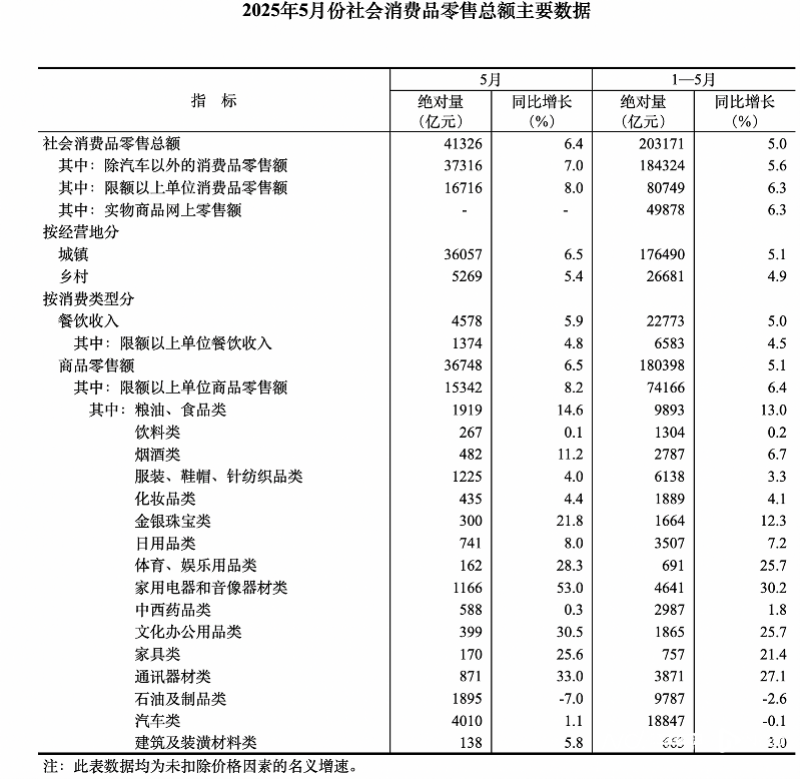
Core Viewpoint - The Chinese economy showed stable growth in May, driven by effective macro policies and a significant rebound in consumer spending, particularly due to the "old-for-new" policy and e-commerce promotions [1][2][5] Economic Performance - In May, the total retail sales of consumer goods reached 41,326 billion yuan, marking a year-on-year increase of 6.4%, the highest growth rate in 2024 [1][2] - The retail sales excluding automobiles amounted to 37,316 billion yuan, with a growth rate of 7.0% [2][4] - From January to May, the total retail sales of consumer goods were 203,171 billion yuan, growing by 5.0% [2][4] Consumer Trends - The "old-for-new" policy significantly boosted sales in various categories, with retail sales of home appliances and audio-visual equipment, communication devices, cultural office supplies, and furniture growing by 53.0%, 33.0%, 30.5%, and 25.6% respectively [1][4] - Online retail sales of physical goods accounted for 24.5% of total retail sales, with food items showing a growth rate of 14.5% [4][6] Regional Performance - Urban retail sales in May reached 36,057 billion yuan, up 6.5%, while rural retail sales were 5,269 billion yuan, growing by 5.4% [5] - For the first five months, urban retail sales totaled 176,490 billion yuan, increasing by 5.1%, and rural retail sales were 26,681 billion yuan, up 4.9% [5] Impact of Promotions - The "618" e-commerce promotion, which started on May 13, combined with the "old-for-new" policy, significantly accelerated online retail sales [5][6] - The total online retail sales reached 60,402 billion yuan from January to May, with a year-on-year growth of 8.5% [6]
网购促销等拉动消费 5月中国市场销售明显回升
Zhong Guo Xin Wen Wang· 2025-06-16 07:19
Group 1 - In May, China's retail sales of consumer goods increased by 6.4% year-on-year, accelerating by 1.3 percentage points compared to the previous month [1] - From January to May, the retail sales of services grew by 5.2%, which is a slight acceleration of 0.1 percentage points compared to the first four months of the year [1] - The policy of replacing old consumer goods with new ones has shown significant results, leading to a rapid increase in sales of related products [1] Group 2 - In May, retail sales of household appliances and audio-visual equipment, communication equipment, cultural and office supplies, and furniture increased by 53%, 33%, 30.5%, and 25.6% respectively, contributing 1.9 percentage points to the total retail sales growth [1] - The "6·18" online retail promotion, which started on May 13, combined with the old-for-new policy, accelerated online retail sales [1] - From January to May, the online retail sales of physical goods increased by 6.3% year-on-year, accounting for 24.5% of total retail sales [1] Group 3 - The May holidays led to a rapid increase in consumption in areas such as cultural tourism, travel services, and dining out, with restaurant income growing by 5.9% year-on-year [2] - From January to May, retail sales in tourism consulting, transportation services, and cultural and recreational services maintained double-digit growth [2] - The expansion of visa-free entry for foreign visitors has stimulated the consumption market, with a more than 70% year-on-year increase in the number of foreign visitors entering under the visa-free policy during the "May Day" holiday [2]
国家统计局:5月以旧换新政策持续显效,消费市场增长加快
news flash· 2025-06-16 07:09
Core Insights - The consumer market in May showed significant recovery, driven by effective consumption policies, early promotional events, and increased holiday periods, leading to a notable rise in consumer demand [1][4] Group 1: Market Sales Performance - In May, the total retail sales of consumer goods reached 41,326 billion yuan, marking a year-on-year growth of 6.4%, with an acceleration of 1.3 percentage points compared to April, representing the highest monthly growth rate in 2024 [1] - The retail sales in county and rural markets grew by 5.4% from January to May, outpacing urban retail sales growth by 0.6 percentage points, with the county and rural market accounting for 38.9% of total retail sales, an increase of 0.1 percentage points year-on-year [1] Group 2: Product Category Growth - In May, retail sales of goods increased by 6.5%, with nearly 90% of product categories in large retail units experiencing growth. Notable increases were seen in sports and entertainment goods (28.3%), staple food (14.6%), and tobacco and alcohol (11.2%) [1] - The "old-for-new" policy significantly boosted sales in categories such as home appliances (53%) and communication equipment (33%), with growth rates accelerating by 14.2 and 13.1 percentage points respectively compared to April [2] Group 3: Online and Offline Retail Dynamics - From January to May, online retail sales of physical goods grew by 6.3%, outpacing overall retail sales growth by 1.3 percentage points, with online sales accounting for 24.5% of total retail sales [3] - Physical retail stores showed stable improvement, with retail sales in large retail units growing by 4.5% from January to May, with warehouse membership stores exceeding 30% growth [3] Group 4: Service Retail Market Trends - Service retail sales increased by 5.2% from January to May, slightly outpacing goods retail growth, driven by enhanced service offerings and diverse consumption scenarios [4] - The tourism and dining sectors saw significant growth, with dining revenue increasing by 5.0% compared to the previous period, reflecting a strong recovery in consumer spending [4]
5月汽车零售同比环比增长均超10%,经销商要抓住窗口期
Zhong Guo Qi Che Bao Wang· 2025-06-16 01:23
Group 1 - The retail sales of passenger cars in China reached 1.932 million units in May 2025, representing a year-on-year increase of 13.3% and a month-on-month increase of 10.1% [1] - Cumulative retail sales for the year reached 8.811 million units, showing a year-on-year growth of 9.1% [1] - The retail market has shown a strong growth trend, with May 2025 sales surpassing the peak level of 1.81 million units in May 2018 by 6% [1] Group 2 - The automotive market has been buoyed by the "two new" policies, with local consumption promotion policies being implemented across various provinces [3] - As of May 31, the number of applications for the old-for-new vehicle subsidy reached 4.12 million, with May's applications estimated at 1.23 million, a 13% increase from April [3] - Approximately 70% of private car buyers benefited from the old-for-new policy, indicating a shift towards consumption upgrades [3] Group 3 - The automotive industry is undergoing significant changes in product structure, user demand, and channel development, necessitating proactive measures from dealers and industry players [3] - Dealers are encouraged to leverage favorable policies to explore new revenue streams and adapt their strategies accordingly [4] - The importance of digital transformation and the shift from sales to service in the automotive dealership model is emphasized, with a focus on utilizing digital marketing and data assets [4] Group 4 - The relationship between manufacturers and dealers is evolving, with a need for harmonious partnerships to adapt to the new market dynamics [5] - The automotive industry is facing challenges such as excessive dealership networks and profitability issues, leading to a necessary industry consolidation [5] - The establishment of exit mechanisms in dealership contracts is proposed to create a fairer and more orderly brand authorization cooperation model [6]

做好以旧换新的政策衔接
Sou Hu Cai Jing· 2025-06-11 23:21
Group 1 - The "old for new" policy has significantly boosted consumer goods sales, exceeding 1.1 trillion yuan, benefiting millions of families through fiscal subsidies [1] - The policy has particularly benefited inland provinces like Henan, enhancing rural markets and improving living standards for middle and low-income families [1][2] - Challenges have emerged with some localities suspending subsidies, which may affect consumer expectations and highlight the need for better policy continuity [1][2] Group 2 - Local governments face challenges in executing the "old for new" policy, including tight budgets and complex operational platforms [2] - There is a recommendation for phased implementation of fiscal subsidies to ensure continuity and predictability in the policy [2] - The effectiveness of fiscal policies in driving consumption depends not only on the amount of subsidies but also on their proper utilization and consumer protection [2][3] Group 3 - The current "old for new" policy is larger in scale and scope, focusing on green technology and actual consumer needs [3] - For the future, better utilization of fiscal funds, efficient local execution, and adherence to regulations by enterprises are crucial for sustained market recovery [3]