汽车智能化

Search documents
“智”问下半场:做好科技平权与和谐共生
Zhong Guo Qi Che Bao Wang· 2025-09-01 03:17
Group 1 - The automotive industry is experiencing a transformation with the integration of AI technologies, particularly in the areas of L3 autonomous driving and Robotaxi, which are entering a critical phase of commercialization [1][5] - The shift from electric vehicle growth to a focus on intelligent technology is evident, as the industry faces challenges in globalization and regulatory upgrades [1][5] - The need for high-quality development over mere quantity is emphasized, with a call for the industry to embrace low growth while pursuing technological advancements [3][4] Group 2 - The concept of "technology equity" is highlighted, stressing that it should not be mistaken for free access but rather a means to lower costs and enhance consumer experience [6][7] - Companies are encouraged to focus on user needs and avoid overwhelming consumers with technical jargon, promoting a clearer understanding of technology's value [7][8] - The automotive ecosystem is diversifying, with some companies opting for full-stack self-research while others collaborate with tech firms to enhance product competitiveness [8][9] Group 3 - The balance between full-stack self-research and collaborative partnerships is crucial for the industry's future, as both models will coexist [9][10] - Companies must focus on their strengths and collaborate on core components like chips and sensors to optimize their offerings [10]


汽车周观点:8月第3周乘用车环比+9.4%,继续看好汽车板块-20250901
Soochow Securities· 2025-09-01 02:13
Investment Rating - The report maintains a positive outlook on the automotive sector, suggesting an increase in investment weight towards automotive dividend style configurations for the second half of 2025 [3][52]. Core Insights - The automotive sector experienced a week-on-week increase of 9.4% in insurance registrations, indicating a continued recovery in demand [2][46]. - The report highlights the performance of various segments, with commercial cargo vehicles leading the gains at +1.6%, followed by commercial passenger vehicles at +0.8% [2]. - Key companies such as BYD and Great Wall Motors reported significant revenue growth in Q2 2025, with BYD achieving a revenue of 200.92 billion yuan, up 14.0% year-on-year [2][3]. Summary by Sections Weekly Review - The total insurance registrations for passenger vehicles reached 470,000 units, reflecting a 9.4% increase from the previous week [46]. - The report notes that the automotive sector's performance in A-shares ranked 14th, while Hong Kong shares ranked 5th [7][9]. Market Trends - The report indicates that the automotive industry is at a crossroads, with the end of the electric vehicle dividend and the rise of automotive intelligence [3]. - It suggests a focus on dividend and structural opportunities in segments such as buses, heavy trucks, and two-wheelers [3]. Company Performance - Great Wall Motors reported a revenue of 52.3 billion yuan in Q2 2025, with a year-on-year increase of 30.7% [2]. - BYD's Q2 2025 revenue was 200.92 billion yuan, with a gross margin of 16.3%, reflecting a slight decline compared to previous quarters [2]. Future Outlook - The report anticipates a strong demand for passenger vehicles in 2025, projecting a total retail sales volume of 23.7 million units, a 4.1% increase year-on-year [47][48]. - The introduction of policies to support vehicle scrappage and replacement is expected to further boost domestic consumption [47][55].




从“大6座”到“大三排”,家庭出行需求下的SUV进化论
Zhong Guo Qi Che Bao Wang· 2025-09-01 01:03
Core Insights - The "large three-row" SUV segment is rapidly gaining popularity, replacing the previously favored "large six-seat" SUVs due to changing consumer preferences for space, comfort, and smart features [2][3][4] - The shift in family structures and increased consumer budgets are driving the demand for "large three-row" SUVs, which are seen as more suitable for modern family needs compared to traditional "large six-seat" SUVs and MPVs [4][6] Market Trends - The "large three-row" SUVs can accommodate seven passengers with a more spacious third row, enhancing comfort and usability compared to "large six-seat" SUVs, which often leave the third row underutilized [3][4] - The introduction of advanced features in "large three-row" SUVs, such as independent climate control and entertainment options for the third row, significantly improves the passenger experience [7][10] Technological Advancements - The market is witnessing a transition towards pure electric models, with innovations in electric vehicle architecture addressing the shortcomings of traditional "large three-row" SUVs [6][9] - Consumer research indicates that 60% of "large three-row" SUV users prioritize "quiet space" and "practicality," making pure electric models increasingly attractive [6] Future Outlook - The market for "large three-row" SUVs is expected to grow, with projections indicating that by 2025, approximately 58% of new SUVs will be pure electric, while the share of range-extended and plug-in hybrid models will be around 32% [9] - The evolution of smart features in SUVs is becoming a key differentiator, with advanced sensor systems enhancing safety and driving assistance capabilities [10]

【招商电子】景旺电子:AI PCB高端产能升级与新兴领域布局双向驱动成长潜力
招商电子· 2025-08-31 07:50
Core Viewpoint - The company reported a 20.93% year-on-year increase in revenue for the first half of 2025, reaching 7.095 billion yuan, while net profit attributable to shareholders decreased by 1.06% to 650 million yuan, indicating a mixed performance amid capacity expansion and high-end product growth [2][3]. Group 1: Financial Performance - In Q2 2025, the company achieved revenue of 3.752 billion yuan, a year-on-year increase of 20.08% and a quarter-on-quarter increase of 12.22% [3]. - The net profit attributable to shareholders for Q2 was 325 million yuan, down 4.11% year-on-year, while the net profit excluding non-recurring items was 306 million yuan, a decrease of 1.26% year-on-year but up 31.75% quarter-on-quarter [3]. - The gross margin for Q2 was 21.95%, down 1.52 percentage points year-on-year but up 1.17 percentage points quarter-on-quarter [3]. Group 2: Capacity and Product Development - The company is experiencing a ramp-up in capacity and an increase in high-end product orders, particularly in AI servers and high-speed optical modules, with significant improvements in production capabilities at its Zhuhai Jinwan base [3][4]. - Multiple core technology breakthroughs have been achieved, enhancing competitiveness in high-end markets, including advancements in high-density interconnect (HDI) products for AI computing and autonomous driving applications [4][5]. - The company maintains a leading position in the automotive PCB sector, being the largest global supplier, and is accelerating the introduction of advanced products for intelligent driving and AI applications [5][6]. Group 3: Strategic Outlook - The company is strategically positioned to benefit from the growth in AI computing infrastructure and automotive intelligence, with ongoing investments in high-end capacity and customer structure optimization [5][6]. - The focus on high-value products such as AI servers, optical modules, and high-speed switches is expected to drive future revenue growth, supported by the expansion of production capacity in both domestic and international markets [5][6]. - The company’s technological advancements and strong customer relationships in consumer electronics are anticipated to enhance market share, particularly in emerging areas like AR and wearable devices [6].

上海汽车产业持续回暖焕新升级 新能源车和智能化高附加值产品成重要引擎 下半年车市销量有望进一步攀升
Jie Fang Ri Bao· 2025-08-31 02:24
Core Viewpoint - The automotive industry in Shanghai is experiencing a strong recovery, with significant growth in both production and consumption, driven by industry optimization and corporate transformation efforts [1][2]. Group 1: Production Growth - In the first seven months of the year, Shanghai's automotive manufacturing output reached 391.12 billion yuan, nearly matching the historical high of 397.7 billion yuan [2]. - The automotive manufacturing sector accounted for 18% of Shanghai's total industrial output, making it the largest segment in manufacturing and a crucial growth engine for the city's economy [2]. - SAIC Motor's vehicle sales in July reached 338,000 units, a year-on-year increase of 34.2%, marking seven consecutive months of sales growth [2]. - The production value of automotive parts and components in Shanghai increased by 9.5% year-on-year, reaching 198.99 billion yuan in the first seven months [3]. Group 2: Consumption Market - In July, Shanghai's retail sales of automobiles reached 15.85 billion yuan, a year-on-year increase of 5.0%, marking the first positive growth this year [4]. - The growth in the automotive consumption market is attributed to favorable policies, including adjustments to new energy vehicle license policies and "trade-in" subsidy expansions [4]. - The registration of new energy passenger vehicles in Shanghai increased by 6.47% year-on-year in July, with a cumulative growth of 7.62% from January to July [4]. Group 3: New Product Launches - Many automotive companies are launching new models in August to prepare for the peak sales season in September and October, which is expected to further boost sales [7]. - SAIC launched several new models in August, including the MG4 electric vehicle and the Audi E5 Sportback, which are anticipated to drive sales growth [7]. - The collaboration between SAIC and Huawei on the new model, Shangjie H5, saw over 50,000 pre-orders within 18 hours of its launch [7]. Group 4: Future Prospects - Shanghai automotive companies are proactively expanding production capacity, with significant investments in new production bases and projects aimed at enhancing output [8]. - The establishment of new energy vehicle projects, such as the Lexus electric vehicle project, is expected to further accelerate the transformation of Shanghai's automotive industry [8]. - Shanghai is positioning itself as a hub for automotive design and innovation, with ongoing projects that will enhance its global competitiveness in the smart electric vehicle sector [8].
东吴证券:新一代智驾架构集中落地 继续看好智能化主线
智通财经网· 2025-08-30 23:35
Core Viewpoint - The automotive industry is on the brink of a revolution driven by smart technology, with 2025 expected to be a pivotal year for the adoption of Level 3 (L3) automation, particularly in urban environments [1][2]. Group 1: Automotive Smart Technology - L3 automation is anticipated to significantly influence consumer purchasing decisions, becoming one of the top three considerations when buying a car [1]. - The penetration rate of L3 automation is projected to increase from 10% in 2025 to over 80% by 2027, indicating a rapid adoption phase [1]. - The future automotive landscape is expected to be categorized into three types of companies: B-end Robotaxi operators, C-end personalized brands, and high-end vehicle manufacturers [2]. Group 2: Market Trends and Developments - In August, the penetration rate of urban NOA (Navigation on Autopilot) reached 23.2%, reflecting a month-on-month increase of 0.9 percentage points [3]. - Companies like Li Auto and XPeng are leading in smart technology adoption, with XPeng's smart technology penetration exceeding 70% and Li Auto's at 59.4%, despite a slight decline [3]. - The introduction of next-generation driving architectures, such as VLA, is being implemented in new models, enhancing the capabilities of smart driving systems [3]. Group 3: Investment Recommendations - The report suggests a focus on smart vehicles and related components, highlighting companies in both Hong Kong and A-share markets, such as XPeng Motors, Li Auto, BYD, and SAIC Motor [4]. - Investment opportunities are identified in AI chips, domain controllers, and electronic components, with specific companies recommended for each category [4].


一季度利润暴增!奇瑞汽车再次IPO
Xin Lang Cai Jing· 2025-08-30 18:24
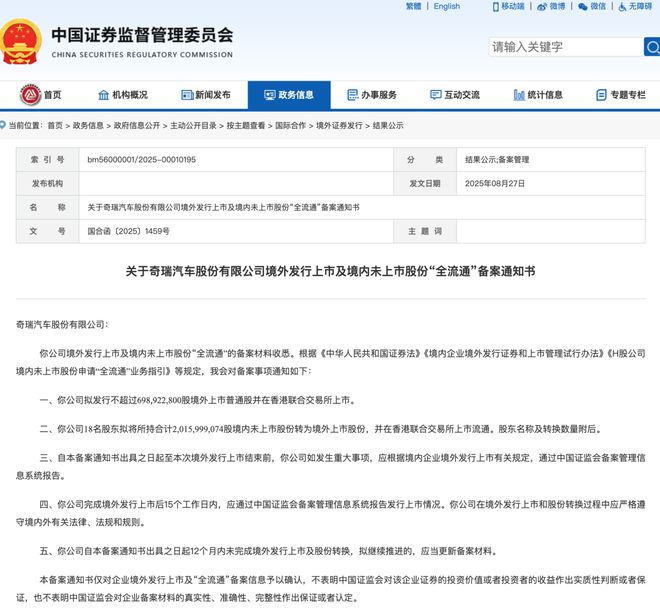
Core Viewpoint - Chery Automobile's application for a Hong Kong IPO has expired, but it has received approval from the China Securities Regulatory Commission (CSRC) for overseas issuance, indicating it meets the conditions for listing [1][3][11] Group 1: IPO Process - Chery submitted its IPO application to the Hong Kong Stock Exchange (HKEX) on February 28, but it has not received any hearing news for over six months, leading to the expiration of its application [1] - On August 29, Chery resubmitted its IPO application to the HKEX [3] - The CSRC's approval allows Chery to issue up to 698,922,800 overseas listed shares and convert 2,015,999,074 domestic unlisted shares into overseas shares for listing [1][3] Group 2: Financial Performance - Chery's projected revenues for 2022, 2023, and 2024 are RMB 92.62 billion, RMB 163.20 billion, and RMB 269.90 billion, respectively, with net profits of RMB 5.81 billion, RMB 10.44 billion, and RMB 14.33 billion [3][5] - As of Q1 2025, Chery reported revenues of RMB 68.22 billion and a net profit of RMB 4.73 billion [3][5] Group 3: Historical Context - Chery's IPO attempts date back to 2004, with multiple failed attempts due to various issues, including complex shareholding structures and market conditions [6] - The current IPO attempt marks Chery's sixth attempt to go public [6] Group 4: Shareholding Structure - Chery has 18 shareholders, with Chery Holdings being the largest shareholder at 38.6% [6][7] - Other significant shareholders include Anhui Credit Guarantee Group and Luxshare Precision, each holding over 5% [7] Group 5: Strategic Initiatives - Chery plans to use the funds raised from the IPO for R&D of various passenger car models, enhancing core technology capabilities, expanding overseas markets, and improving production facilities [7] - In May, Chery established the "Chery Intelligent Center" to accelerate its smart technology strategy by integrating its subsidiaries [8]
奥迪威(832491):2025H1收入增长16% 医疗、消费电子、机器人等新领域多元布局展开
Xin Lang Cai Jing· 2025-08-30 16:42
Group 1 - The company achieved revenue of 330 million yuan in H1 2025, representing a year-over-year increase of 16%, with a net profit attributable to shareholders of 50.47 million yuan, up 8% year-over-year [1] - In Q2 2025, the company reported revenue of 173 million yuan, an 8% year-over-year increase and a 10% quarter-over-quarter increase, with a net profit of 27.46 million yuan, up 4% year-over-year and 19% quarter-over-quarter [1] - The company's cash flow from operating activities improved significantly, reaching 44.46 million yuan in H1 2025, a 73% year-over-year increase, while maintaining good control over expense ratios [1] Group 2 - Sensor revenue increased by 29% in H1 2025, driven by continuous R&D investment and product upgrades, while actuator revenue decreased by 33.16% due to reduced sales of electroacoustic devices [1] - Domestic revenue grew by 30% in H1 2025, while overseas revenue remained stable, indicating the company's efforts to expand in the domestic market [1] - R&D expenses increased by 12% in H1 2025, with an R&D expense ratio of 8.1%, reflecting the company's commitment to innovation and industry collaboration [2] Group 3 - The company launched several new products, including ultrasonic distance measurement solutions for lawnmowers and lead-free innovative products for smart devices, which are expected to drive revenue growth [2] - The company is well-positioned to capitalize on opportunities in automotive intelligence, consumer electronics, robotics, and medical fields, which may lead to sustained performance growth [3] - Profit forecasts for the company indicate net profits of 98 million yuan, 124 million yuan, and 147 million yuan for 2025, 2026, and 2027 respectively, with corresponding PE ratios of 47.8, 37.8, and 31.8 [3]
【汽车智能化9月投资策略】新一代智驾架构集中落地,继续看好智能化主线!
东吴汽车黄细里团队· 2025-08-30 15:23
Core Viewpoint - The article emphasizes the importance of automotive intelligence as a revolutionary shift in transportation, highlighting the transition to L3 automation and the emergence of Robotaxi services as key drivers for automakers to enhance sales and revenue through software monetization [3][9]. Group 1: Automotive Intelligence Overview - Automotive intelligence represents a significant transformation in the industry, characterized by three main phases: L3 automation aiding vehicle sales, L4 Robotaxi services enabling software revenue, and the global rise of domestic brands [3][9]. - The year 2025 is projected to be a pivotal point for automotive intelligence, with urban NOA (L3 automation) becoming a top consideration for consumers when purchasing vehicles. The penetration rate of L3 automation is expected to rise from 10% in 2025 to over 80% by 2027 [3][9]. - The automotive intelligence landscape is described as a competitive elimination process, categorizing companies into three types: B-end Robotaxi operators, C-end personalized brands, and high-end vehicle manufacturers. Component suppliers are divided into modular and single-category suppliers [3][9]. Group 2: August Intelligence Summary - The focus in August was on the iteration of next-generation driving architectures, with notable advancements such as the launch of the Li Auto VLA architecture and the introduction of the new XPeng P7 featuring advanced self-driving capabilities [4][10]. - The penetration rate of urban NOA reached 23.2% in July, reflecting a month-on-month increase of 0.9 percentage points. XPeng's smart driving penetration exceeded 70%, while Li Auto's overall urban NOA penetration was 59.4%, showing a slight decline of 2.2 percentage points [4][10]. Group 3: Investment Recommendations for 2025 - The article maintains a positive outlook on smart vehicles, emphasizing that intelligence is the core, with new vehicle cycles and monthly sales being critical metrics. The focus is on Hong Kong-listed companies such as XPeng Motors, Li Auto, and Xiaomi, as well as A-share companies like BYD and SAIC [5][9]. - There is a strong interest in incremental components related to automotive intelligence, including AI chips, domain controllers, steer-by-wire systems, and automotive electronics, with specific companies highlighted for investment potential [5][9]. Group 4: Market Trends and Projections - The article outlines a forecast for the automotive intelligence market, indicating that by 2025-2027, the goal is to achieve a 50%-80% penetration rate for new energy vehicles, with a focus on hardware business models. The software monetization model is expected to face challenges in achieving substantial breakthroughs [19][20]. - The anticipated growth in Robotaxi services is expected to lead to significant commercialization and a qualitative leap in the automotive industry, marking the beginning of a new industrial trend [19][20].

汽车智能化月报系列二十七:尚界H5搭载HUAWEI ADS 4辅助驾驶系统,地平线HSD首搭奇瑞星途E05【国信汽车】
车中旭霞· 2025-08-30 09:34
Core Viewpoint - The automotive intelligence industry is evolving around data flow, focusing on the acquisition, storage, transmission, computation, and application of data to achieve intelligent driving and human interaction through various sensory modalities [4]. Industry News - Waymo has received the first autonomous vehicle testing permit in New York City [17]. - The Shangjie H5 SUV, co-developed by Huawei and SAIC, is set to launch with the HUAWEI ADS 4 driver assistance system [13]. - Horizon's HSD system has been upgraded and will first be featured in the Chery Xingtu E05 model [18]. - Xiaoma Zhixing has officially launched autonomous driving services in Shanghai's Pudong area [21]. - WeRide has introduced a one-stage end-to-end driver assistance solution, expected to be mass-produced by 2025 [20]. - Hesai Technology has secured a laser radar production contract with a Toyota subsidiary, set to begin mass production in 2026 [23]. High-Frequency Core Data Updates - As of June 2025, the penetration rate of 800万像素 cameras in passenger vehicles reached 39.7%, up 22 percentage points year-on-year [5]. - NVIDIA's driving chip penetration in passenger vehicles is 31%, with a year-on-year increase of 25.4% for Horizon and a decrease for others [5]. - The penetration rate of laser radar in passenger vehicles is 10%, with Huawei holding a 47% market share [5]. - The penetration rate of L2 and above functions in passenger vehicles reached 29.7% in June 2025, a year-on-year increase of 13 percentage points [7]. - The penetration rates for various sensors in June 2025 were 67.6% for front-view cameras, 57.4% for forward millimeter-wave radars, and 9.7% for laser radars [7]. - The penetration rate of automatic driving domain controllers in passenger vehicles reached 30.9%, a year-on-year increase of 13.1 percentage points [7]. Smart Connectivity - The penetration rates for OTA and T-BOX in June 2025 were 76.8% and 69.0%, respectively [7]. Investment Suggestions - The automotive intelligence sector is witnessing significant advancements in technology and market penetration, indicating potential investment opportunities [10].