美联储货币政策

Search documents
研究所晨会观点精萃-20251120
Dong Hai Qi Huo· 2025-11-20 01:21
Report Investment Ratings - The report does not provide an overall industry investment rating. However, specific ratings for different asset classes are as follows: - Index: Short - term shock, short - term cautious wait - and - see [2][3] - Treasury bonds: Short - term shock, cautious long [2] - Commodity sectors: - Black metals: Short - term shock, short - term cautious wait - and - see [2] - Non - ferrous metals: Short - term shock, short - term cautious wait - and - see [2] - Energy and chemicals: Short - term shock, cautious wait - and - see [2] - Precious metals: Short - term shock, short - term cautious wait - and - see, long - term buy on dips [3] Core Views - The global market is affected by the Fed's monetary policy expectations, domestic economic growth, and policy stimulus. The short - term upward drive of the macro - economy has weakened, and different asset classes show short - term shock characteristics. Attention should be paid to domestic economic growth and the implementation of incremental policies [2][3] Summary by Categories Macro Finance - Overseas, the Fed's meeting minutes showed serious differences, and many thought it was not suitable to cut interest rates in December. The market expected no rate cut this year, leading to a rise in the US dollar and Treasury yields, and an increase in global risk appetite. Domestically, China's October economic data slowed down year - on - year and fell short of expectations, and the central bank restarted Treasury bond trading to release liquidity. The short - term macro - upward drive has weakened, and the index will be in short - term shock [2] - Index: Driven by sectors such as precious metals, it rose slightly. Affected by economic data and the Fed's hawkish signals, the short - term upward drive has weakened, and it will be in short - term shock. Short - term cautious wait - and - see [3] - Precious metals: The market rose slightly at night on Wednesday. Affected by the Fed's possible inaction in December and the strong US dollar, short - term shock, long - term upward pattern remains. Short - term cautious wait - and - see, long - term buy on dips [3] Black Metals - Steel: The spot and futures markets declined on Wednesday. Demand continued to weaken, inventory decreased, and production decreased. There are no new contradictions, and the price is expected to fluctuate in a range [4][6] - Iron ore: The spot price fell slightly on Wednesday, and the futures price remained strong. The bottom of iron - making water production is uncertain, supply has changed slightly, and it is expected to fluctuate in a range [6] - Silicon manganese/silicon iron: The spot price was flat on Wednesday, and the futures price was affected by coal. Demand is still poor, and the futures price is expected to fluctuate in a range [7] - Soda ash: The main contract was weak on Wednesday. Supply decreased marginally but remained loose, and demand improved marginally. Short - term range shock, long - term bearish [8] - Glass: The main contract was weak on Wednesday. Supply was stable, demand improved marginally, and inventory was at a high level. It is expected to run weakly in the short term [8] Non - ferrous Metals and New Energy - Copper: Overnight, LME copper rebounded slightly. Supply concerns still exist, but US and domestic inventories are high, and there is a risk of price decline [10] - Aluminum: On Wednesday, Shanghai aluminum prices rebounded. Technically, there may be room for further rebound, but inventory is at a three - year high, and there may be a large correction later [10] - Tin: Supply is tight, demand is weak, inventory has increased for two consecutive weeks, and the price is expected to fluctuate at a high level [11] - Lithium carbonate: The main contract rose on Wednesday. The price of lithium ore increased, and the trading volume increased. Hold long positions cautiously [12] - Industrial silicon: The main contract rose on Tuesday. The organic silicon industry plans to reduce emissions and support prices. Pay attention to the continuation of funds and buy on dips [12] - Polysilicon: The main contract rose on Tuesday. There is a game between strong policy expectations and weak reality. It is expected to fluctuate in a high - level range [13][14] Energy and Chemicals - Crude oil: EIA data showed an increase in US refined oil inventories, and the hope of restarting peace talks between Russia and Ukraine led to a decline in oil prices. It is expected to remain under pressure [15] - Asphalt: The price remained low. Inventory was decreasing slightly, but demand was weak, and the over - supply pressure was high. Pay attention to the fluctuation of crude oil [15] - PX: The import from Japan is uncertain, and PTA demand provides some support. It is in a tight supply situation, and pay attention to cost changes [16] - PTA: The import of PX is uncertain, and downstream demand is weak. The supply is high, and the long - term bearish pressure is large [16] - Ethylene glycol: Port inventory has accumulated significantly, downstream demand is weakening, and the price is expected to remain low and fluctuate [16] - Short fiber: It rebounded slightly in the short term, but the later pressure is large. The terminal orders are decreasing seasonally, and it can be shorted on highs in the medium term [17] Agricultural Products - US soybeans: The overnight market declined. Brazil's November export volume is expected to increase, and there is an export order to China [19] - Soybean and rapeseed meal: The supply and demand of domestic oil mills are loose, the basis is weak, and there may be a phased correction [19] - Soybean and rapeseed oil: The price was boosted by EPA biodiesel news. The supply of domestic soybean oil is strong, and rapeseed oil inventory is at a low level [20] - Palm oil: The Malaysian futures market continued to rise, but domestic inventory increased, and it is expected to fluctuate widely [20] - Corn: The price in Northeast China remained stable. Inventory is low, and there is a willingness to buy in the market. The futures may repair the basis [20] - Live pigs: The morning price was stable and strong. Supply is excessive, and the futures may continue to decline [21]
香港第一金:美联储纪要来袭,凌晨03:00黄金波动率恐翻倍!
Sou Hu Cai Jing· 2025-11-19 09:40
Core Viewpoint - The article discusses the current market resistance and support levels, along with trading strategies based on these levels, particularly in light of upcoming economic data and Federal Reserve announcements [2][4]. Market Analysis - Resistance levels are identified at 4100 (psychological level & initial resistance) and 4120-4130 (stronger resistance zone, former support turned resistance) [2]. - Support levels are noted at 4060-4070 (recent fluctuation low area) and 4040 (key support, breaking below this could open larger downside potential) [2]. Trading Strategies - The company suggests looking for short-selling opportunities near key resistance levels due to an overall weak trend [2]. - Specific entry zones for short positions are identified at 4100-4110, with a stop-loss above 4125 and a target of 4080-4065 [4]. - A breakout strategy is proposed if prices effectively break below the 4060-4070 support area, with a light position taken at 4075-4085, stop-loss above 4100, targeting 4040-4020 [4]. - For low-level rebound plays, a strong support area of 4040-4050 is highlighted, with confirmation signals needed before positioning, and a stop-loss below 4030, targeting 4070-4085 [4]. Key Upcoming Events - The Federal Reserve's monetary policy meeting minutes are highlighted as a critical upcoming event, scheduled for November 20 at 03:00 Beijing time, which may reveal the Fed's latest internal views on inflation and interest rates, potentially causing significant market volatility [4]. - Other important data/events to watch include U.S. housing data tonight and initial jobless claims tomorrow evening [4]. Risk Management - Strict stop-loss measures are emphasized, with any strategy requiring pre-set stop-loss levels to prevent significant losses [6]. - Position management is advised, suggesting a reduction of positions to 50% or below normal levels before the Fed minutes are released to mitigate uncertainty risks [6]. - Attention is drawn to potential market volatility immediately following the release of the minutes, with recommendations to exit positions or set stop-loss orders in advance [8].


中国9月减持美债5亿美元,日本连续增持
Guo Ji Jin Rong Bao· 2025-11-19 09:12
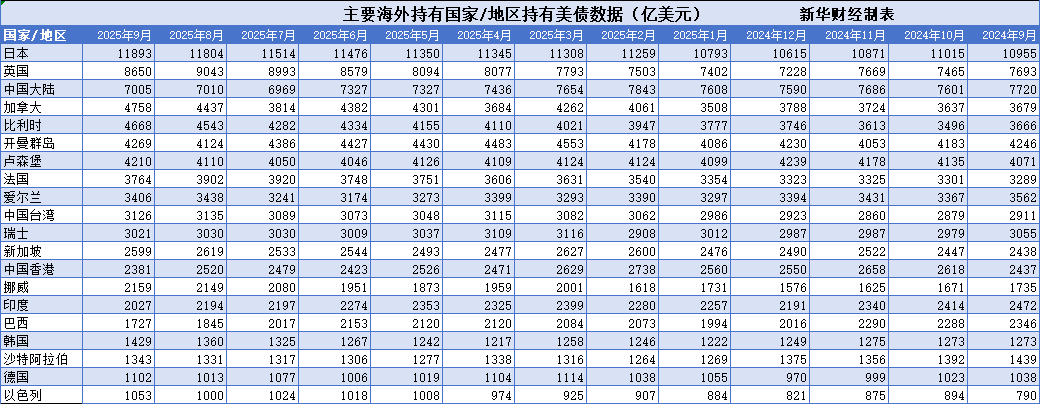

Group 1: U.S. Treasury Holdings - As of September, foreign investors held a total of $9.249 trillion in U.S. Treasury securities, down from $9.2662 trillion in the previous month [1] - Japan, the largest foreign holder of U.S. Treasuries, increased its holdings by $8.9 billion in September, reaching a total of $1.189 trillion, the highest since August 2022 [2] - China reduced its holdings by $0.5 billion in September, bringing its total to $700.5 billion, marking the fifth reduction this year [2] Group 2: Central Bank Policies and Market Impact - The Federal Reserve's monetary policy and the U.S. government debt issue are key factors influencing the U.S. Treasury market [4] - U.S. Treasury yields fluctuated, with the 10-year yield dropping below 4% during August and September, but has since risen to 4.15% [4][6] - Federal Reserve officials have indicated a shift in stance, with some advocating for stable interest rates to combat inflation, while others suggest the economy's resilience does not support recent rate cuts [5][6] Group 3: U.S. Government Debt Situation - As of October 21, the U.S. federal government debt exceeded $38 trillion for the first time [8] - The IMF projects that the U.S. public debt-to-GDP ratio will rise from 122% in 2024 to 143% by 2030, significantly above the average for developed economies [8] - Moody's downgraded the U.S. credit rating from Aaa to Aa1 in May, indicating a loss of the highest credit rating from all three major rating agencies [8]
11月19日上期所沪银期货仓单较上一日下跌15986千克
Jin Tou Wang· 2025-11-19 08:56
Group 1 - The total silver futures warehouse receipts reported by the Shanghai Futures Exchange on November 19 is 547,685 kilograms, with a decrease of 15,986 kilograms compared to the previous day [1][2] - The main silver futures contract opened at 11,760 yuan per kilogram, reached a high of 12,173 yuan per kilogram, and closed at 12,148 yuan per kilogram, reflecting an increase of 2.19% [1] Group 2 - The total warehouse receipts in Shanghai decreased by 14,322 kilograms, with specific declines noted in various warehouses, including Zhongchu Wusong and Waiyun Huadong Hongqiao [2] - Federal Reserve Governor Barkin indicated that the current economic state is "not ideal," with inflation above the 2% target and no clear upward or downward trend [3] - Barkin expressed caution regarding the labor market due to recent layoffs announced by major companies like Amazon, Verizon, and Target, suggesting that inflation remains slightly high but unlikely to rise significantly [3]
黄金迎来新一轮考验
Qi Huo Ri Bao· 2025-11-19 08:40
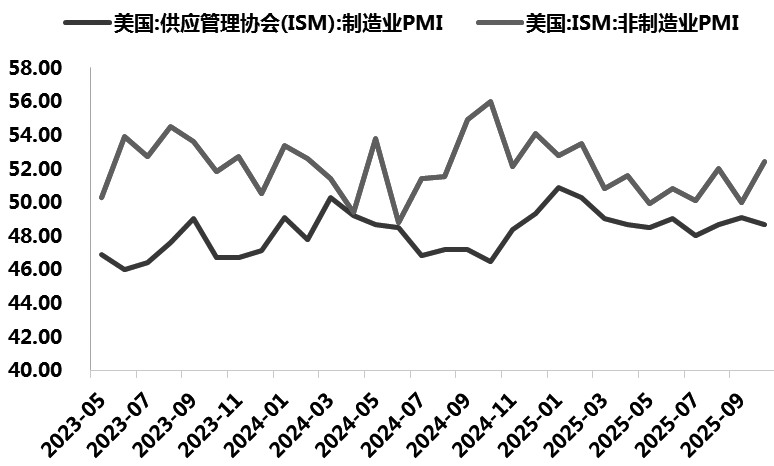
Core Viewpoint - The recent end of the longest government shutdown in the U.S. has shifted market focus back to the Federal Reserve's monetary policy and the impact of tariffs on inflation, with gold prices experiencing volatility in response to changing interest rate expectations [1][2]. Economic Data and Trends - The resumption of the U.S. government has led to the scheduled release of key economic data, including September non-farm payrolls and the PCE price index, which are expected in mid-November [2]. - The October ISM manufacturing PMI unexpectedly dropped to 48.7, indicating widespread weakness in the manufacturing sector, while the services PMI rose to 52.4, suggesting resilient demand despite increasing inflationary pressures [2]. - The October ADP employment report showed an increase of 42,000 jobs, the highest since July, but another high-frequency employment indicator revealed a loss of 45,000 jobs, marking the largest monthly decline since March 2023 [6]. Consumer Confidence and Inflation Expectations - The preliminary consumer confidence index for November fell to 50.3, the lowest level since June 2022, with inflation expectations slightly rising to 4.7% [6]. - The ongoing government shutdown has further deteriorated consumer confidence, while inflation expectations remain elevated due to tariffs and other economic pressures [6]. Federal Reserve Policy Outlook - There is significant division among Federal Reserve officials regarding the decision for a potential rate cut in December, with some citing increased risks in the labor market and others emphasizing the need for more economic data [7]. - Market expectations for a December rate cut have decreased from 90% to around 45% recently, reflecting uncertainty in the economic outlook [7]. Gold Market Dynamics - Global geopolitical tensions and economic downturn risks have led to increased demand for gold, with total global gold demand rising to 1,258 tons in Q3 2025, a 16% increase from Q2 [9]. - Central banks, particularly in China, India, Turkey, and Poland, have continued to increase their gold reserves, with China's reserves reaching 2,304.5 tons by the end of October [9]. - The investment landscape for gold is expected to shift as more central banks increase their holdings, potentially driving precious metals back into a bull market in the medium to long term [10].
美债海外需求维持高位 日本连续9个月买入 中国持仓保持稳定
Xin Hua Cai Jing· 2025-11-19 02:28
Core Viewpoint - The latest TIC report from the U.S. Treasury reveals a decline in U.S. Treasury holdings by major foreign investors, with a total decrease of $13.6 billion in September 2025, bringing the total to $9.25 trillion, after four consecutive months of increases [1] Group 1: Foreign Holdings of U.S. Treasury Securities - Major foreign holders of U.S. Treasury securities showed mixed actions; Japan continued to increase its holdings, buying $8.9 billion in August and $29 billion in September [1] - The UK increased its holdings by $5 billion in September but subsequently sold $39.3 billion [1] - China's holdings remained stable, with a slight increase of $4.1 billion in August followed by a decrease of $0.5 billion in September, totaling $700.5 billion [1][2] Group 2: Changes in Major Foreign Investors - Canada significantly increased its U.S. Treasury holdings by a total of $94.4 billion over two months, with increases of $62.3 billion in August and $32.1 billion in September, moving from the eighth to the fourth largest holder [2][3] - Other countries like Belgium, Luxembourg, Norway, South Korea, and Saudi Arabia also bought U.S. Treasuries in August and September, with total purchases of $38.6 billion, $16 billion, $7.9 billion, $10.4 billion, and $2.6 billion respectively [3] Group 3: U.S. Treasury Market Performance - U.S. Treasury yields decreased during August and September, with the 10-year yield experiencing a maximum fluctuation of over 40 basis points, briefly falling below 4% [5] - The Federal Reserve announced a 25 basis point reduction in the federal funds rate target range to between 4.00% and 4.25% on September 17, 2025, amid signs of a slowing labor market [5][6] Group 4: U.S. Federal Debt Situation - As of August 11, 2025, the total outstanding public debt of the U.S. surpassed $37 trillion, raising concerns about the sustainability of U.S. debt levels [6] - The U.S. federal debt is projected to reach 126.8% of GDP in 2024, significantly exceeding the IMF's recommended threshold of 100% for developed economies [7] - Interest payments on the debt are expected to exceed $1 trillion this year, making it the second-largest item in the federal budget after defense and Medicare [8]
商品期货早班车-20251119
Zhao Shang Qi Huo· 2025-11-19 02:24
Report Industry Investment Rating No relevant content provided. Core Viewpoints The report analyzes the market performance, fundamentals, and provides trading strategies for various commodity futures, including precious metals, base metals, black industries, agricultural products, and energy chemicals. It also points out that each commodity has its own supply - demand characteristics and market influencing factors, and investors should make decisions based on these factors and market signals. Summary by Commodity Categories Precious Metals - Gold rebounded at night on Tuesday, with London gold back above $4000. The US employment data was weak, and domestic gold ETFs continued to flow in. It is recommended to buy at the lower support level [4]. - Silver's tight situation is gradually easing, and it is recommended to gradually reduce long positions [4]. Base Metals - Copper prices oscillated weakly. The supply of copper ore remained tight, and domestic weekly start - up data improved. It is advisable to wait for clearer macro signals [3]. - Aluminum prices may continue to decline in the short term. The electrolytic aluminum plants maintained high - load production, and the social inventory of aluminum ingots increased [3]. - Alumina prices are expected to be weak. Some alumina plants carried out early maintenance or reduced loads, and the supply - demand surplus pattern was difficult to change [5]. - Industrial silicon prices are expected to fluctuate between 8600 - 9400 yuan/ton. The supply decreased slightly, and the organic silicon industry planned to cut production by 30% [5]. - Lithium carbonate prices have support in the short term but face weak long - term expectations. The demand was strong in November - December, but the long - term demand was expected to decline [5]. - Polysilicon prices are affected by news. The supply decreased slightly, and the market was disturbed by news, so it is recommended to wait and see [5]. - Tin prices oscillated strongly. The supply of tin ore was tight, and the market was concerned about the continued low exports from Indonesia [5]. Black Industry - Rebar futures are undervalued, and hot - rolled coil futures are overvalued. The supply and demand of steel were weak, and the structural differentiation was significant. It is recommended to hold short positions in hot - rolled coil 2605 [7]. - Iron ore prices may decline. The supply and demand of iron ore were weak, and the futures were in a forward - discount structure [7]. - Coking coal prices may decline. The steel mills continued to lose money, and the coking coal futures were in a forward - premium structure [7]. Agricultural Products - Soybean meal: US soybeans are short - term strong, but the bullish factors have basically emerged. The domestic market may be weak in the short term, and the medium - term trend depends on tariff policies and production in the producing areas [8]. - Corn: As the supply of corn in Northeast China is approaching, the futures price is expected to decline. It is recommended to hold short positions [9]. - Oils: The overall trend of oils is expected to be oscillating and strong. Attention should be paid to future production and biodiesel policies [9]. - Sugar: It is recommended to short in the futures market and sell call options. The international sugar market may decline in the long term, and the domestic market will follow [9]. - Cotton: It is recommended to wait and see. The international cotton harvest rate was lower than in previous years, and the domestic commercial inventory was higher [9]. - Eggs: The futures price is expected to be weak. The supply pressure decreased, but the demand was weak [9]. - Pigs: The futures price is expected to be weak. The supply was abundant, and the demand increased seasonally [9]. - Apples: It is recommended to wait and see. The high - quality apple production decreased, and the inventory decreased [10]. Energy Chemicals - LLDPE: In the short term, it will oscillate, and in the long term, it is recommended to short at high prices. The supply pressure increased, and the demand declined [10]. - PVC: It is recommended to short or conduct a reverse spread. The supply increased, and the demand was weak [10]. - PTA: It is recommended to short the processing margin in the far - month contracts. The supply pressure was large in the long term [10]. - Rubber: It is recommended to operate in a band - trading manner. The raw material prices were strong, and the inventory increased [10][11]. - Glass: It is recommended to conduct a reverse spread. The supply and demand were weak, and the inventory was high [11]. - PP: In the short term, it will oscillate weakly, and in the long term, it is recommended to short at high prices. The supply pressure increased, and the demand was weak [11]. - MEG: It is recommended to short at high prices. The supply pressure was large in the long term, and the demand entered the off - season [11]. - Crude oil: The price is expected to oscillate in the short term. The supply was affected by sanctions and geopolitical risks, and the demand was in the off - season [11][12]. - Styrene: In the short term, it will oscillate. The supply and demand improved marginally, but the overall contradiction was still large [12]. - Soda ash: It is recommended to wait and see. The supply and demand were balanced [12]. - Urea: The price is expected to oscillate. The supply was sufficient, and the demand was in the off - season, but the export news had a certain impact [12].
投资者评估数据补发 美债收益率盘前走低
Xin Hua Cai Jing· 2025-11-18 14:36
Group 1 - The U.S. Treasury yields fell across the board on November 18, with the 2-year yield down 3.7 basis points to 3.573%, the 10-year yield down 3.1 basis points to 4.104%, and the 30-year yield down 2.1 basis points to 4.717% [1] - The Federal Reserve's expectations for a rate cut in December have weakened due to the prolonged government shutdown affecting economic data, leading to increased uncertainty in the economic outlook [3] - The European Union has downgraded its economic growth forecast for the Eurozone in 2026 to 1.2%, a reduction of 0.2 percentage points from previous estimates, citing the impact of U.S. tariffs on exports [3] Group 2 - In the Eurozone, Germany's growth forecast has been raised to 1.2% due to increased public spending, while France's forecast has been lowered to 0.9% and Italy's to 0.8% [3] - The U.S. Treasury is set to issue a $95 billion 6-week short-term debt on November 18, followed by a $160 billion 20-year long bond and an unspecified amount of 17-week short-term debt on November 19 [5] - As of November 14, the total U.S. federal debt exceeded $38.15 trillion, remaining above the $38 trillion mark for three consecutive weeks [6]
主要品种策略早餐-20251118
Guang Jin Qi Huo· 2025-11-18 14:10
Report Summary 1. Investment Ratings - The report does not provide an overall industry investment rating. 2. Core Views - Copper prices are expected to be affected by the cooling of the Fed's December rate - cut expectation, the arrival of the traditional consumption off - season, and high copper prices. Zinc prices are likely to continue a volatile and slightly stronger trend, with overseas supply being tight and domestic production cuts and demand off - season coexisting. Industrial silicon is expected to run at a high level, and polysilicon's supply - demand pattern will improve with the implementation of new energy - consumption standards. Refined tin prices will remain high due to tight global supply, and lithium carbonate prices are expected to rise with the improvement of the supply - demand balance in 2026 [1][3][4][5][6][9][10][12][13]. 3. Summary by Variety Copper - **Intraday and Mid - term Views**: Intraday and mid - term views are both "oscillation", with an oscillation operation strategy [1]. - **Core Logic**: Macroeconomically, the US government shutdown ended, and Fed officials made hawkish remarks. Supply - wise, global copper supply is tight, with an increase in domestic port inventory and a rise in copper concentrate TC. Demand - side, the开工 rate of copper rod enterprises declined in October, and copper rod production decreased. Copper bar demand is weak. Inventory shows regional differentiation, with LME and SHFE inventories low and COMEX inventory increasing significantly [1][2]. - **Outlook**: Negative factors such as the cooling of the Fed's December rate - cut expectation, the traditional consumption off - season, and high copper prices will affect copper prices [3]. Zinc - **Intraday and Mid - term Views**: Intraday and mid - term views are both "oscillation", with an oscillation operation strategy and a suggestion to sell a wide - straddle option combination [4]. - **Core Logic**: Macroeconomically, the Fed's rate - cut expectation is divided, and the US government shutdown risk is alleviated. Supply - wise, global zinc concentrate supply is tightening, with overseas production differentiation and domestic supply also showing signs of tightness. Demand shows an "external strong, internal weak" pattern. Inventory is differentiated, with LME zinc inventory at a historical low and SHFE zinc inventory increasing [4][5]. - **Outlook**: Zinc prices are expected to continue a volatile and slightly stronger trend, but the upside in the domestic market is limited due to weak demand [5]. Industrial Silicon - **Intraday and Mid - term Views**: Intraday view is "high - level operation" in the range of 9000 - 9100, and mid - term view is "range operation" in the range of 8800 - 9300, with a bullish strategy [6]. - **Core Logic**: In October, production decreased year - on - year. Demand from polysilicon increased. Inventory is at a 7 - year high, but the strong polysilicon price boosts industrial silicon prices [6]. Polysilicon - **Intraday and Mid - term Views**: Intraday view is "high - level operation" in the range of 52,500 - 54,000, and mid - term view is "range fluctuation" in the range of 50,000 - 60,000, with a bullish strategy [7]. - **Core Logic**: In October, production increased year - on - year. Demand from silicon wafers increased significantly. Inventory is stable. The implementation of new energy - consumption standards will improve the supply - demand pattern [7][9]. Refined Tin - **Intraday and Mid - term Views**: Intraday view is "high - level operation" in the range of 290,000 - 295,000, and mid - term view is "high - level oscillation" in the range of 270,000 - 300,000, with a strategy to sell SN2512 - P - 250000 [10]. - **Core Logic**: Global tin supply is tight due to the complex resumption of production in Myanmar and Indonesia's crackdown on illegal mining. Processing fees are at a low level, indicating tight domestic supply. Inventory is at a certain level, and the ore end supports tin prices [10]. Lithium Carbonate - **Intraday and Mid - term Views**: Intraday view is "strong operation" in the range of 94,000 - 98,000, and mid - term view is "oscillation and upward" in the range of 80,000 - 100,000, with a bullish strategy [11][12]. - **Core Logic**: The spot price has reached a new high. In October, production increased year - on - year, and inventory is still high. However, the supply - demand balance is expected to improve in 2026, which will drive up prices [12][13].
港股科技股卖空量增幅明显 市场静待政策与美联储信号
Xin Lang Cai Jing· 2025-11-18 03:40
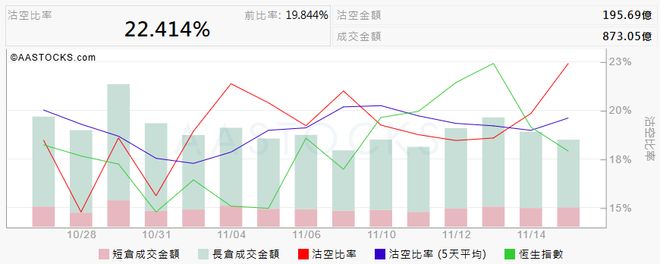
Core Viewpoint - The Hong Kong stock market has experienced a significant increase in short-selling activity, with the Hang Seng Index's short-selling ratio rising from 14.78% on October 28 to 22.41% on November 17, indicating heightened bearish sentiment among investors [1][7]. Group 1: Short-Selling Trends - Tencent's short-selling ratio increased from 11.49% on October 28 to 13.98% on November 17, with the number of shares short-sold reaching 362,840 on November 14, the highest since October 30 [3][7]. - Alibaba's short-selling ratio surged from 9.95% to 29.79%, with short-sold shares rising from 78,100 to 338,900 [5][7]. - Other companies such as Horizon Robotics, Lenovo Group, and SenseTime also saw significant increases in short-selling volumes, with Horizon Robotics' short-selling volume increasing by 56.95 million shares, a rise of 688.63% [8][9][10]. Group 2: Market Conditions - The surge in short-selling activity is attributed to external pressures, including foreign capital outflows and tightening local liquidity, as the Hong Kong market is sensitive to global liquidity changes [11]. - Despite a net inflow of 105 billion HKD from southbound funds from August to October, foreign capital outflows through Hang Seng Index ETFs and futures amounted to approximately 131 billion HKD, indicating a liquidity crunch [11]. - The overall earnings expectations for the Hong Kong market have weakened, with analysts downgrading ratings for major internet and consumer service stocks, leading to a systemic downward adjustment in earnings forecasts for the Hang Seng Index [12]. Group 3: Future Outlook - The short-term performance of the Hong Kong stock market will be influenced by uncertainties in U.S. Federal Reserve monetary policy and the trend of domestic economic recovery [14]. - Analysts suggest that unless technology stocks exceed performance expectations, market pressures may increase, highlighting the need for a balanced investment strategy focusing on both growth and dividend-paying sectors [13][14].