中美利差

Search documents
债市由逆风变顺风,继续看多:11月债市投资策略
Hua Yuan Zheng Quan· 2025-11-04 06:38
Group 1 - The core view of the report indicates a shift in the bond market from headwinds to tailwinds, with a continued bullish outlook for November [1] - In 2025, the bond market is expected to rely heavily on increased allocations from bank proprietary trading, with a total bond market balance increasing by 16.4 trillion yuan in the first three quarters [2] - Government bonds accounted for a significant portion of this increase, with an increment of 11.4 trillion yuan, while financial bonds increased by 3.0 trillion yuan [2] Group 2 - The report highlights that the growth rate of bond investments by banks has significantly increased, with a year-on-year growth of 21.1% for the four major banks and 17.5% for smaller banks as of September [2] - The report notes that the demand for credit remains weak, leading banks to focus on bond investments as a primary driver for asset scale expansion [2] - The report anticipates that conditions for a further reduction in policy interest rates may be in place, supported by a decline in the cost of interest-bearing liabilities for banks [2] Group 3 - Non-bank institutions are reported to have low bond positions and shorter durations, with a potential increase in bond market sentiment as the central bank resumes government bond trading [2] - The report suggests that there is potential for significant allocation of credit bonds by wealth management products, estimating a potential increase of several trillion yuan [2] - The report predicts that the 10-year government bond yield may return to around 1.65% by the end of the year, with a bullish outlook for the bond market continuing into November [2][3]
【财经分析】美联储“裱糊”困境引发无序震荡 美债市场年末不确定性或增长
Sou Hu Cai Jing· 2025-11-03 07:10
Core Viewpoint - The U.S. Treasury market is at a crossroads of monetary policy shifts and fiscal sustainability, with increasing complexity due to diverging views within the Federal Reserve and rising uncertainty in economic data [1][2]. Group 1: Monetary Policy Divergence - The Federal Reserve lowered the federal funds rate target range by 25 basis points to 3.75% to 4.00%, marking the second rate cut of the year, and announced the end of quantitative tightening (QT) on December 1 [1]. - There is a notable split within the Federal Reserve, with some members advocating for larger rate cuts while others prefer to maintain current rates, reflecting a lack of consensus [2]. - Inflation remains a significant concern, with September inflation reaching its highest level since January, driven by rising prices of essential goods [2]. Group 2: Economic and Fiscal Challenges - The U.S. federal debt has surpassed $35 trillion, with the debt-to-GDP ratio reaching 143%, a historical high, raising concerns about fiscal sustainability [6]. - The ongoing government shutdown has complicated data collection, including employment statistics, which adds to the uncertainty surrounding economic indicators [2][3]. - The impact of tariffs is contributing to rising consumer prices, with estimates suggesting that consumers bear 50% to 70% of the total tariff costs [3]. Group 3: Market Volatility and Investor Behavior - The probability of a rate cut in December has decreased from 90% to approximately 70%, indicating heightened uncertainty in market expectations [6]. - Investors are adjusting their strategies in response to the volatility in the Treasury market, with suggestions to shift towards longer-duration bonds to mitigate exposure to short-term policy fluctuations [8]. - The upcoming presidential election in November is expected to increase market volatility, with historical data indicating a 10-15% higher volatility in election years compared to non-election years [7].

好消息!2025年11月房贷利率将迎大幅下调,降息已成定局
Sou Hu Cai Jing· 2025-10-30 17:42
Group 1 - The core viewpoint of the articles indicates that a new round of mortgage interest rate cuts is expected to occur in November 2025, potentially more significant than previous reductions [3][9][11] - In May 2023, the People's Bank of China lowered the LPR to 3.5%, and the first home loan rate dropped to 2.6%, resulting in reduced monthly payments for borrowers [3][5] - The financial regulatory authority has indicated plans to accelerate the introduction of financing systems compatible with new real estate development models, with a significant increase in approved loans for real estate projects [3][5] Group 2 - The current economic complexity, including weak domestic demand indicators, is driving the need for mortgage rate cuts [5][9] - Predictions suggest that the LPR may be lowered by 10-30 basis points by the end of 2025, which would further reduce borrowing costs for homebuyers [3][9] - The anticipated reduction in mortgage rates is expected to lower the cost of home purchases significantly, with potential monthly payment reductions of 600-900 yuan for a 1 million yuan loan [9][11] Group 3 - The external environment, particularly the U.S. Federal Reserve's shift to a rate-cutting cycle, has eased constraints on domestic monetary policy, facilitating potential mortgage rate reductions [7][9] - The expected mortgage rate cuts are likely to stimulate the real estate market, benefiting both first-time buyers and those looking to upgrade their homes [9][11] - The collaboration between public and commercial loan rates is projected to save homebuyers over 20 billion yuan annually, with further savings anticipated from upcoming rate cuts [9][11] Group 4 - The reduction in mortgage rates is expected to alleviate financial pressure on real estate companies and stimulate demand for development loans [11][13] - The overall economic impact of lower mortgage rates could enhance consumer spending in related sectors such as home appliances and renovations [11][13] - Despite strong expectations for rate cuts, the current mortgage rates are already at a policy floor, indicating limited room for further reductions [11][13]

2025年9月银行间外汇市场运行报告
Sou Hu Cai Jing· 2025-10-29 06:57
Group 1 - The interbank foreign exchange market showed stable trading with a slight month-on-month increase in daily average trading volume, reaching $192.26 billion, although it experienced a year-on-year decline of 4.4% [2] - The daily average trading volume for the RMB foreign exchange market was $143.50 billion, down 7.7% year-on-year but up 5.5% month-on-month, primarily due to a decrease in spot volatility leading to subdued spot trading [2] Group 2 - The US dollar index rebounded after hitting a year-low of 96.22, influenced by a hawkish tone from the Federal Reserve despite a 25 basis point rate cut [3] - By the end of September, the dollar index closed at 97.7750, remaining stable compared to the previous month [3] Group 3 - The RMB exchange rate reached a new high for the year at 7.1019 before slightly retreating, closing at 7.1186 at the end of the month, reflecting a 0.17% appreciation for the month [4] - The CFETS RMB index against a basket of currencies reported an appreciation of 0.21% compared to the previous month [4] Group 4 - The domestic foreign exchange differential shifted from positive to negative, with an average daily differential of -4 basis points for the month, indicating a stronger selling pressure in the first half of the month [5] - The maximum differential recorded was -97 basis points on the 26th, marking the largest differential for the month [5] Group 5 - The implied volatility of RMB foreign exchange options continued to decline, with the 1-month ATM implied volatility dropping to 2.3%, the lowest since August 2024 [6] - The overall market sentiment regarding the RMB exchange rate has warmed, contributing to the decrease in volatility [6] Group 6 - The trading volume of RMB foreign exchange swaps was active, with a daily average of $93.20 billion, up 8.9% month-on-month, driven mainly by state-owned banks [7] - The 1-year swap points reached a new high in two and a half years at -1322 basis points, reflecting a significant increase of 261 basis points from the previous month [7][8] Group 7 - The US dollar liquidity remained loose, with the SOFR rate fluctuating around 4.40% before rising to a year-high of 4.51% mid-month, then declining to 4.14% after the Fed's rate cut [9][10] - The domestic dollar borrowing rates decreased following the Fed's rate cut, with the overnight borrowing rate stabilizing at 4.06% by the end of the month [9][10]

放水时刻又要来?这个时间点可能要降息
Sou Hu Cai Jing· 2025-10-28 14:05
Group 1: Monetary Policy and Economic Outlook - The expectation of a domestic interest rate cut has been reignited, with a potential cut by the end of the year, especially after the Federal Reserve's anticipated 0.25% rate cut, which would bring the total cuts for the year to 0.5% [1] - The widening interest rate differential between China and the U.S. following the Fed's rate cut may reduce depreciation pressure on the RMB, providing motivation for domestic rate cuts [1] - There is a possibility of further weakening in the macroeconomic environment in Q4, as consumer spending is expected to decline due to the cessation of subsidies in the home appliance and automotive sectors [3] Group 2: Consumer Sector Performance - Many consumer stocks have reported disappointing earnings in Q3, indicating weak consumer demand, with notable examples including Guibao Pet Products and Zhongju High-Tech [3] - Kweichow Moutai's wholesale price has dropped below 1700 yuan, reflecting challenges in the liquor sector, which is facing performance tests in the coming days [3] - The net profit of Kuozi Jiao (a liquor company) for the first three quarters of 2025 was 740 million yuan, down 43% year-on-year, with Q3 net profit plummeting 93% [5] Group 3: Specific Company Performance - Sanqi Interactive Entertainment reported a net profit of 2.3 billion yuan for the first three quarters of 2025, up 24% year-on-year, with Q3 net profit increasing by 49%, despite a 6.6% decline in revenue [6] - The significant profit growth for Sanqi Interactive was attributed to a reduction in sales expenses, which decreased by 1.5 billion yuan compared to the previous year [6] - The performance of liquor stocks is under scrutiny, with Kweichow Moutai and Wuliangye both experiencing declines in revenue and profit margins, indicating a challenging market environment [6]

宏观深度报告:人民币汇率再审视
Ping An Securities· 2025-10-27 10:11
Group 1: RMB Exchange Rate Trends - Since August 25, 2025, the RMB has experienced a smooth appreciation trend, ending a previous three-week narrow fluctuation[6] - The RMB exchange rate is expected to remain above 7 for the year, with significant appreciation dependent on the stability of the Chinese economy and high-quality development[3] - The RMB has a considerable "rebound" potential, contingent on the pace of the decline in the US-China interest rate differential[7] Group 2: Market Influences - Recent adjustments in the RMB central parity rate are primarily driven by a weakening US dollar, aligning with normal pricing mechanisms[17] - The RMB's relative weakness against the US dollar reflects the impact of the second round of US-China trade disputes, with a maximum depreciation of 9.2% noted[9] - The RMB's exchange rate is closely related to the US-China interest rate differential, with a significant correlation observed since 2022[14] Group 3: Capital Flow Dynamics - Positive changes in cross-border capital flows are noted, including a sustained high trade surplus and a slowdown in China's outward direct investment[43] - The average monthly trade surplus in foreign exchange payments increased from $33.9 billion to $70.7 billion, indicating a doubling effect[27] - The shift from "currency hoarding" to "currency settlement" among foreign trade enterprises has catalyzed RMB appreciation, with the critical threshold around 7[30] Group 4: Risk Factors - Risks include the potential underperformance of growth stabilization policies, deterioration in US-China trade negotiations, and unexpected resilience in the US economy[2] - The RMB's appreciation may face challenges if the market's expectations for its stability do not solidify, particularly around the 7 mark[41]
人民币汇率升至年内新高后小幅回调
Jin Rong Shi Bao· 2025-10-22 02:38
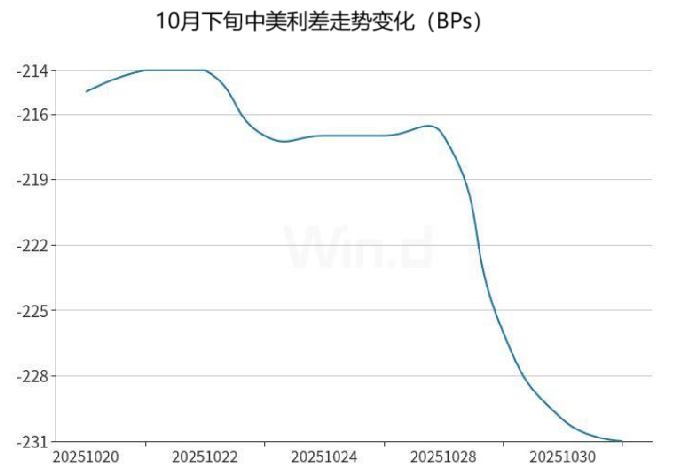
Core Insights - The interbank foreign exchange market in China showed a mixed performance in September, with the US employment data falling short of expectations and the Federal Reserve lowering interest rates by 25 basis points, leading to a rebound in the US dollar index [1][6] - The Chinese yuan reached a new high for the year in September, but experienced slight fluctuations towards the end of the month [2][3] - The offshore yuan weakened against the onshore yuan, resulting in a shift from a positive to a negative exchange rate differential [3] Exchange Rate Performance - The yuan appreciated to a high of 7.1019 against the US dollar in early September, driven by a weaker dollar index and positive sentiment from US-China trade talks [2] - By the end of September, the yuan was trading at 7.1186, reflecting a monthly appreciation of 0.17% [2] - The CFETS index for the yuan against a basket of currencies rose by 0.21% to 96.77 [2] Exchange Rate Differential - The exchange rate differential between onshore and offshore yuan shifted from positive to negative, with the average differential for the month being -4 basis points [3] - The maximum differential recorded was -97 basis points on September 26 [3] Foreign Exchange Options Market - The trading volume for yuan foreign exchange options was stable, with an average daily transaction of 63.18 billion USD, up 8.37% month-on-month [4] - Implied volatility for yuan options continued to decline, with the 1-month ATM implied volatility dropping to 2.3%, the lowest since August 2024 [4] Swap Market Activity - The yuan foreign exchange swap market saw active trading, with an average daily volume of 931.95 billion USD, an increase of 8.90% month-on-month [5] - Short to medium-term transactions dominated, accounting for nearly 70% of the trading volume [5] Interest Rate Differentials - The interest rate differential between Chinese and US bonds fluctuated, with the 10-year US Treasury yield dropping to a year-low of 4.01% before rebounding to around 4.2% [6] - The 10-year US-China bond yield spread ended the month at -230 basis points, an increase of 9 basis points from the previous month [6] - The 1-year swap points rose significantly, reaching -1322 basis points, the highest in nearly two and a half years [6]
LPR为何持续按兵不动,宁王业绩超预期,带来啥影响?
Sou Hu Cai Jing· 2025-10-21 00:44
Group 1: Monetary Policy and LPR - The People's Bank of China (PBOC) has kept the Loan Prime Rate (LPR) unchanged at 3% for 1-year and 3.5% for over 5 years for five consecutive months [1] - The stability in LPR is attributed to several factors, including the historical low net interest margin of commercial banks, lack of tight funding conditions, and the need to avoid widening the interest rate differential with the US [1][2] - The PBOC's approach to LPR adjustments is strategic, focusing on actual market demand rather than blindly lowering rates to stimulate financing [2] Group 2: Company Performance - CATL reported a net profit of 18.55 billion yuan for Q3 2025, a year-on-year increase of 41.21%, with a total net profit of 49 billion yuan for the first three quarters, up 36.2% [4] - The performance of CATL is seen as exceeding expectations, providing support for its stock price despite concerns about high valuations [4] - CATL's growth rate remains robust, suggesting strong operational performance akin to that of a younger company, contributing to its stock price doubling since its Hong Kong listing [4] Group 3: Consumer Electronics - iPhone 17 standard version sales have surged, nearly doubling those of the iPhone 16, attributed to improved specifications without a price increase [4] - The strong sales reflect the market's positive response to Apple's ecosystem and product quality, reinforcing confidence in Apple's future growth and its supply chain [5]
LPR已连续4个月持平 10月会变吗?
财联社· 2025-10-18 07:55
Core Viewpoint - The expectation is that the LPR (Loan Prime Rate) will remain unchanged in October, as various analysts believe there is no urgent need for a reduction given the current economic conditions and credit data [1][5][6]. Group 1: LPR Stability - Analysts predict that both the one-year and five-year LPR will hold steady in October due to stable policy interest rates and positive credit data [1][2]. - The current low levels of corporate and personal loan rates suggest that lowering the LPR is not a priority at this time [3][6]. - The pressure on bank interest margins and the need to meet year-end credit targets are factors contributing to the expectation of no change in the LPR [5][6]. Group 2: Future Rate Adjustments - Some analysts anticipate a potential reduction of 10 to 30 basis points in the LPR by the end of the year, particularly if external economic pressures, such as U.S. tariff policies, continue to impact global trade [4][10]. - The possibility of a rate cut is also supported by the need to stimulate credit demand and stabilize the real estate market [10][11]. - The recent actions of the People's Bank of China, including significant reverse repurchase operations, indicate a cautious approach to interest rate adjustments, aiming to avoid excessive pressure on bank margins [6][8]. Group 3: External Influences - The recent 25 basis point rate cut by the Federal Reserve is seen as a factor that could influence future LPR adjustments, although its immediate impact is limited [7][8]. - Analysts note that the domestic banking sector's pressure on interest margins may necessitate a prior reduction in deposit rates before any LPR cuts can effectively lower loan rates [8][10]. - The overall economic environment, including inflation levels and credit demand, will play a crucial role in determining the timing and extent of any future LPR adjustments [9][11].

美联储吵翻了!黄金跌金融涨,降息快慢,影响你房贷、股票、菜价
Sou Hu Cai Jing· 2025-10-13 11:12
Core Viewpoint - The ongoing debate around interest rate cuts in the U.S. is creating uncertainty in global markets, with traders expecting two more cuts this year while Federal Reserve officials express concerns about persistent inflation [1][15]. Group 1: Interest Rate Dynamics - The Federal Reserve lowered interest rates to 4.25%-4.5% at the end of last year, but this followed a period of rates above 5% for two years, leading to significant capital inflows into the U.S. [3]. - The expectation of slower interest rate cuts by the Federal Reserve could lead to renewed capital outflows from emerging markets, as higher U.S. interest rates attract funds [3][5]. Group 2: Impact on Domestic Economy - The high U.S. interest rates limit the Chinese central bank's ability to lower domestic interest rates, affecting mortgage rates and housing market stimulation efforts [5]. - A strong U.S. dollar puts pressure on the Chinese yuan, leading to increased costs for imported goods, which could contribute to domestic inflation [8]. Group 3: Market Reactions - The anticipation of interest rate changes has led to volatility in various sectors, with gold prices dropping significantly in response to reduced rate cut expectations [10]. - The financial sector benefits from a high-interest environment, with U.S. financial stocks performing well while other sectors, like technology, face challenges [10]. Group 4: External Trade Considerations - The U.S. unemployment rate is projected to rise, which may reduce consumer spending and impact export orders from China, particularly in manufacturing hubs like the Yangtze River Delta [11]. - The upcoming Federal Reserve meetings are closely monitored by businesses involved in foreign trade, as decisions made can significantly affect their operations [13]. Group 5: Investment Strategies - Investors are advised to focus on long-term strategies, such as selecting undervalued stocks with high dividends or investing in broad market indices, rather than reacting to short-term fluctuations driven by Federal Reserve communications [13][15].