
全球经济增长

Search documents
思博瑞资管:全球经济将持续增长 未来一年挑战与机遇并存
Zhi Tong Cai Jing· 2026-01-08 09:05
Group 1 - The core viewpoint is that despite challenges in the coming year, opportunities are expected, with a strong belief in continued global economic growth [1] - The U.S. economy is projected to grow at a rate of 2% to 3% due to the effects of interest rate cuts by 2026, supported by low mortgage rates and stable real income [1] - Outside the U.S., economic growth is expected to slightly improve due to a stable job market and improved tariff conditions, with Germany and China implementing significant development plans and stimulus measures [1] Group 2 - U.S. inflation is expected to stabilize by 2026, but reaching the Federal Reserve's 2% target may take longer due to the need for service prices and wages to weaken further [2] - The inflation situation in most countries outside the U.S. has reached targets, allowing central banks to implement more stimulus measures, with Eurozone inflation expected to drop below 2% [2] - The Federal Reserve's interest rate decisions will be data-driven, with potential fewer rate cuts in 2026 due to strong economic growth, necessitating a careful balance between supporting employment and stabilizing prices [2] Group 3 - Geopolitical risks are expected to remain high in 2026, with ongoing conflicts such as the Russia-Ukraine situation and U.S.-China strategic competition impacting global trade flows [3] - The U.S. has relied more on fiscal policy than monetary policy for economic support since the COVID-19 pandemic, which may lead to long-term inflation pressures and increased financing difficulties for the government [3] - The independence of central banks is crucial, as any signals weakening inflation targets in pursuit of higher growth could heighten investor uncertainty and increase risk premiums [3]
专访联合国经社事务部助理秘书长Navid Hanif:中国将是推进可持续发展的关键力量
2 1 Shi Ji Jing Ji Bao Dao· 2026-01-07 03:36
Core Insights - Global economic growth is becoming increasingly "expensive," particularly for developing economies facing debt pressures, tightening financing, and rising external uncertainties [1] - The UN indicates that these pressures have structural characteristics, with global growth levels remaining below pre-pandemic trends [1] - The focus is shifting from achieving higher growth rates to assessing the capacity for future resource investment [1] Economic Growth Factors - The global economy is recovering, but the pace is slow and uneven, with a projected growth rate of 2.5% for 2026, significantly below the pre-pandemic level of 3.2% [2] - Key factors impacting economic growth include: - Debt issues, with many developing countries allocating over 10% of fiscal revenue to debt servicing, limiting investment in sustainable development [2] - Trade tensions, which could escalate with new tariffs, posing risks to economic growth [2] - Youth unemployment, a significant challenge for many countries [2] - Climate shocks, which disrupt food supply and infrastructure, increasing fiscal burdens for recovery [2] Sustainable Development Financing - There is an annual investment gap of approximately $4 trillion to achieve sustainable development goals, which is manageable within the global GDP of over $100 trillion [3] - The "Seville Commitment" emphasizes three action areas for sustainable financing: - Mobilizing both domestic and international investments, including concessional financing from multilateral development banks [3] - Urgent resolution of debt crises, with specific measures proposed under the G20 framework [4] - Reforming the international financial architecture to ensure timely emergency financing during crises [4] Sovereign Debt Restructuring - The current debt situation is severe for developing countries, with calls for coordinated, long-term solutions rather than temporary fixes [5] - The G20 framework for debt relief has seen slow progress, with specific recommendations to expedite debt restructuring and ensure equitable responsibility among creditors [5][6] Investment in Human Capital and Productivity - Investment in human capital is crucial for future prosperity, emphasizing education, skills training, and job creation [7] - Productivity growth in developing countries has significantly declined, necessitating structural transformation towards higher value-added manufacturing and services [7] - Investment in renewable energy and health is highlighted as essential for enhancing productivity and creating jobs [7] Global Cooperation and Multilateral Mechanisms - Despite global fragmentation, shared challenges necessitate collective solutions, particularly in areas like poverty alleviation and climate change [8] - The UN's role is to support member states in achieving sustainable development goals through collaboration [9] - China's potential role in advancing global development agendas is recognized, particularly through initiatives that align with sustainable development goals [10]
年末全球贸易答卷:有望首破35万亿美元,AI引领与风险并存
第一财经· 2025-12-25 13:25
作者 | 第一财经 潘寅茹 行至年末,全球贸易交出了怎样的答卷? 2025.12. 25 本文字数:2488,阅读时长大约4分钟 12月以来,多个国际组织与国际金融机构在最新发布的报告中总结了今年全球贸易与经济的发展状况,并 就2026年的发展趋势作出了研判。 联合国贸发会议(UNCTAD)在年终题为《贸易、金融与全球经济重塑》的报告中提到,尽管受到地缘政 治紧张局势、贸易成本上升、全球需求不平衡等因素影响,今年全球贸易仍有望首次突破35万亿美元,与 去年相比增幅约为2.2万亿美元,增速约为7%。其中,货物贸易与服务贸易分别预计增长约1.5万亿美元和 7500亿美元,较2024年增幅分别为6.3%和8.8%。 同时,世界银行(WB)、国际货币基金组织(IMF)等在年末报告的展望中均表示,当前全球经济正处于 关键转折点,贸易与金融体系失衡、政策波动及气候危机等多重因素相互交织,给全球发展带来严峻挑 战,需要各国加强政策协调与合作,共同应对全球性挑战,推动经济朝着更加稳定、可持续的方向发展。 人工智能引领全球贸易 美国特朗普政府的关税政策无疑是今年贸易领域的焦点之一。上述报告均认为,正是由于美国政府关税政 策的反 ...

中信证券发布2026年投资全景图
Ge Long Hui A P P· 2025-12-23 06:25
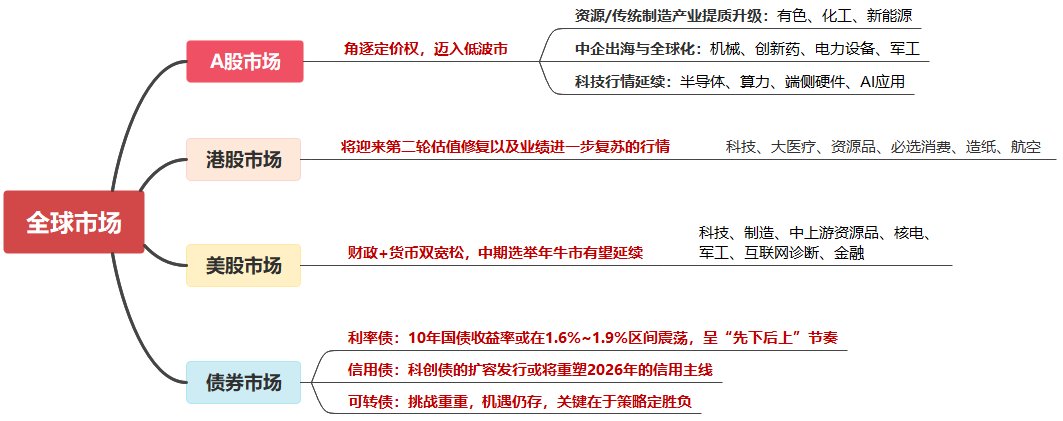
Group 1 - The core viewpoint is that China's macroeconomic outlook for 2026 indicates a mild recovery under structural differentiation, with economic growth expected to be lower initially and higher later, resilient exports, and gradually recovering investments, while consumer goods face short-term pressure [1] - The A-share market is expected to be driven by a broader range of companies with global revenue exposure, suggesting that the fundamentals of A-shares should be viewed in the context of global market demand [1] - The period following the signing of the China-US agreement until the US midterm elections is anticipated to be a stable phase for the China-US relationship, presenting a golden opportunity for bullish equity market strategies [1] Group 2 - In the global market, a softer and clearer growth trend is expected in 2026, with the US economy projected to grow moderately, Eurozone domestic demand likely to recover, and Japan's performance expected to be lukewarm, supported by fiscal expansion [1] - The US stock market is anticipated to continue its bull market in 2026 due to midterm elections, policy easing, ample liquidity, and favorable fundamentals, although caution is advised regarding high interest rate risks and potential policy lags [2] - The Hong Kong stock market is expected to experience a second round of valuation recovery and further earnings revival in 2026, benefiting from internal "15th Five-Year Plan" catalysts and external fiscal and monetary easing from major economies [2] Group 3 - In the bond market, the 10-year government bond yield is expected to fluctuate between 1.6% and 1.9% in 2026, following a "down then up" pattern [2] - The expansion of sci-tech bonds is likely to reshape the credit landscape in 2026, while convertible bonds face challenges but still present opportunities [2]

高盛预测:2026年全球经济将稳健增长 但就业市场仍显低迷
智通财经网· 2025-12-22 03:53
Group 1: Economic Outlook - Goldman Sachs projects global GDP growth to be 2.8% in 2026, surpassing the market consensus of 2.5% [1] - The U.S. economy is expected to outperform other major developed economies, with a GDP growth forecast of 2.6% in 2026, driven by reduced tariff drag, tax cuts, and a more accommodative financial environment [1] - China's GDP growth is anticipated to be 4.8% in 2026, exceeding market expectations, supported by strong export performance despite weak domestic demand [1] - The Eurozone's economic outlook is less favorable, with a projected GDP growth of 1.3%, although fiscal stimulus in Germany and stable growth in Spain may mitigate some structural challenges [1] Group 2: Labor Market and Inflation - Despite stable overall output growth, improvements in the labor market may lag behind economic expansion, particularly in the U.S., where rising productivity increases the economic growth threshold needed for job creation [1] - Goldman Sachs expects inflation to decline more rapidly in 2026, with core inflation rates in the U.S. and the U.K. dropping from around 3% to near 2% by the end of 2026, aided by factors such as easing tariff impacts and slowing wage growth [2] - The Federal Reserve is projected to cut interest rates by 50 basis points next year, bringing the federal funds rate to a range of 3.0% to 3.25% [2] - The macroeconomic outlook is seen as supportive for stock markets and many emerging market assets, although high valuations, particularly in AI-related sectors, and a weak labor market may increase market volatility [2]

欧佩克预计2026年市场将保持供需平衡
Shang Wu Bu Wang Zhan· 2025-12-19 15:49
Core Viewpoint - OPEC's latest monthly report indicates that the global oil market supply and demand will be largely balanced by 2026, maintaining overall stability in the market [1] Supply and Demand - OPEC+ forecasts an average crude oil demand of 43 million barrels per day in 2026, consistent with last month's prediction and close to current production levels [1] - In November, OPEC+ crude oil production was approximately 43.06 million barrels per day, showing a slight increase following the implementation of the latest production agreement [1] Demand Growth - Global oil demand is expected to grow by 1.3 million barrels per day in 2025 and 1.4 million barrels per day in 2026, primarily driven by non-OECD countries, particularly in Asia, the Middle East, and Africa [1] - This demand growth will partially offset the impact of slowing growth in developed economies [1] Macroeconomic Outlook - OPEC anticipates continued robust global economic growth, with projected growth rates of 3.1% for both 2025 and 2026 [1] - Strong consumption momentum, a relatively stable trade environment, and supportive fiscal and monetary policies from major economies will underpin energy demand [1]
高盛:料明年全球经济增长2.8% 预期美联储减息50个基点
智通财经网· 2025-12-19 08:57
Economic Growth Outlook - Goldman Sachs forecasts global economic growth to be robust at 2.8% in 2026, surpassing market expectations of 2.5% [1] - The U.S. economy is expected to grow by 2.6%, driven by reduced tariff drag, tax cuts, and a more accommodative financial environment [1] - China's economy is projected to maintain resilience with a growth rate of 4.8%, as strong export performance offsets weak domestic demand [1] - The Eurozone's economic growth is predicted to be 1.3% next year, supported by fiscal stimulus in Germany and strong growth in Spain [1] Labor Market and Inflation - The labor market outlook is less optimistic, as accelerated productivity increases the GDP growth threshold needed to create jobs, particularly evident in the U.S. where unemployment is rising despite steady GDP growth [1] - Inflation is expected to decline to near target levels by the end of 2026 across most economies, with core inflation in the U.S. and the UK projected to slow from around 3% to near 2% [1] - Factors contributing to lower inflation include reduced tariff pass-through, easing administrative prices, and slowing wage and housing inflation, alongside falling oil prices and increased Chinese commodity supply [1] Interest Rate Expectations - The U.S. Federal Reserve is anticipated to cut interest rates by 50 basis points to a range of 3% to 3.25%, with dovish risks present [2] - The UK and many emerging markets are also expected to reduce interest rates, with the UK potentially cutting by 75 basis points [2] - The Eurozone is expected to maintain current interest rates, and the market's expectations for rate hikes in Canada and Australia are disagreed upon by Goldman Sachs [2] Asset Market Outlook - Goldman Sachs holds a positive view on equities and many emerging market assets, believing that cyclical factors will dominate the market, outweighing valuation concerns [2] - However, there may be increased volatility due to tensions between these two factors, with market focus shifting to the trend of re-leveraging potentially leading to underperformance in credit [2] - Key risks include a fragile labor market potentially triggering recession fears and stock markets questioning the value of AI-related revenues [2] - The dollar is expected to gradually weaken unless stronger U.S. growth leads to a reassessment of rate cut expectations, with declines likely concentrated in currencies sensitive to the economic cycle [2]
野村全球宏观经济展望:预计2026年全球经济将强劲增长
野村集团· 2025-12-19 04:02
Core Viewpoint - The report anticipates that the investment boom driven by artificial intelligence, along with more supportive monetary and fiscal policies, will continue to propel strong global economic growth in 2026 [5] Global Economic Outlook - The global economy is expected to show resilience despite trade-related disruptions and policy uncertainties, with a stable and accelerating growth pattern anticipated for 2026 [6] - Fiscal constraints will be a significant theme in 2026, with concerns over inflation and financial repression if budget deficits are not controlled [6] Major Economies Macroeconomic Outlook United States - The U.S. economy is projected to maintain resilience, leading growth among developed markets with a real GDP growth of 2.4% [8] - Labor market conditions are expected to improve, with the unemployment rate dropping to 4.0% by year-end [8] - The Federal Reserve is anticipated to lower interest rates twice in June and September 2026 [8] Europe - The Eurozone is expected to enter a more constructive phase, with fiscal policy becoming a core issue and economic growth accelerating, particularly in the second half of 2026 [9] - The European Central Bank is likely to maintain deposit rates at 2.00% as inflation remains near target levels [9] China - China's GDP growth is forecasted to slow to 4.3%, with a drop to 4.1% in the first half of 2026, followed by a rebound to 4.5% in the second half due to policy stimulus [10] - The central economic work conference has continued a stance of "moderate easing" in monetary policy [10] Japan - Japan's economy is expected to continue its recovery, with core inflation projected to fall below 2% in the first quarter of 2026 [11] - The Bank of Japan may extend the pause on interest rate hikes for an additional year [11] Other Asian Countries - Strong AI demand and the supercycle of storage chips are expected to lead to differentiated economic growth across various countries in Asia [12] - Countries like South Korea, Singapore, Malaysia, and India may see GDP growth exceeding market expectations, while Thailand and the Philippines may underperform [12]

宣昌能出席二十国集团财政和央行副手会
Jin Rong Shi Bao· 2025-12-19 01:27
Core Viewpoint - The G20 meeting in Washington D.C. focused on enhancing the role of financial channels and macro policy coordination to promote global economic growth, with China emphasizing its support for multilateralism and the need for domestic policy adjustments in deficit countries [1][2]. Group 1: G20 Meeting Highlights - The G20 meeting took place on December 15-16, with discussions on the 2026 financial channel work arrangements and key topics [1]. - Chinese Vice Governor of the People's Bank of China, Xuan Changneng, represented China and highlighted the importance of multilateralism and macro policy coordination [1]. Group 2: China's Position and Proposals - China supports modernizing regulations to improve the business environment while maintaining essential financial regulatory standards like Basel III [1]. - The country is actively implementing the G20 Cross-Border Payment Roadmap to enhance cross-border payment efficiency and reduce transaction costs, adhering to international anti-money laundering standards [1]. - China plans to deepen reforms and expand high-level opening-up, focusing on domestic demand and building a strong domestic market to unleash service consumption potential [1]. Group 3: Monetary Policy and Economic Outlook - The People's Bank of China will continue to implement a moderately accommodative monetary policy to create a favorable monetary and financial environment for stable economic growth and high-quality development [1].
中国副财长出席G20财政和央行副手会议
Zhong Guo Xin Wen Wang· 2025-12-17 08:43
中国副财长出席G20财政和央行副手会议 中新社北京12月17日电 2026年二十国集团(G20)主席国美国在华盛顿举行其接任主席国后的首次G20财 政和央行副手会议。会议围绕2026年G20财金渠道工作安排以及G20财金渠道重点议题和工作计划进行 了讨论。中国财政部副部长廖岷出席会议并发言。 据中国财政部17日公布的新闻稿,廖岷表示,当前全球经济增长动能不足,各方应更好发挥G20财金渠 道作用,加强宏观政策协调,共同营造开放、包容、非歧视的国际经济合作环境。中方坚定支持多边主 义,期待与各方共同努力推进2026年G20财金渠道合作进程,为促进全球经济强劲、可持续、平衡、包 容性增长贡献力量。中方呼吁遵循市场化原则,多渠道动员资源帮助更多债务国改善债务可持续性并提 高可持续发展能力。 廖岷重点宣介了"十五五"规划建议内容和中央经济工作会议精神,介绍了中方在推动高质量发展、加快 绿色转型和数字化、推进高水平对外开放等方面的实践经验以及坚持内需主导、建设强大国内市场、健 全社保体系等相关政策。 会前和会议期间,廖岷同美国、德国、英国、法国、意大利、俄罗斯、沙特、欧盟、巴西、新加坡、荷 兰等G20成员及嘉宾国代表以及 ...