
再通胀

Search documents
2025 年全球股市涨跌榜:赢家与输家盘点,2026年走势展望
Xin Lang Cai Jing· 2025-12-31 09:31
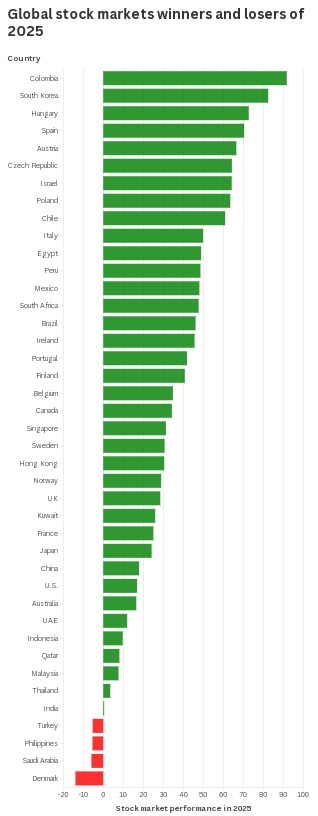
Group 1: Global Market Overview - The Morgan Stanley Capital International All Country World Index (MSCI ACWI) increased by over 21% in 2025, reaching a historical high of 1024 points on December 26 [1][14] - European stock markets surged, led by the banking sector, but a valuation reassessment in 2026 may limit further upside [1][14] - The performance of Asian stock markets varied significantly, influenced by policy support and demand for artificial intelligence [1][14] Group 2: Emerging Markets Performance - Colombia's stock market topped the global performance charts with an increase of over 91% in 2025, contrasting sharply with Denmark, which saw a decline [5][16] - Emerging markets dominated the top performance rankings, with Latin America being a key highlight, as Colombia, Chile, Peru, Mexico, and Brazil all recorded gains exceeding 45% [6][19] - Analysts attribute Colombia's stock market surge to low valuation bases, concentrated index sectors, and improved investor sentiment [6][19] Group 3: Colombia's Market Dynamics - The Colombian stock market's rise is driven by three factors: low initial valuations, concentrated index sectors, and a recovery in investor sentiment [6][19] - The financial sector holds a significant weight in the Morgan Stanley Capital International Colombia Index, particularly the largest bank, amplifying market gains [6][19] - Political expectations, particularly regarding the presidency of Gustavo Petro, have contributed to a more optimistic market outlook [6][19] Group 4: Denmark's Market Challenges - Denmark's stock market underperformed due to high concentration in a single stock, Novo Nordisk, which accounts for approximately 40% of the index [8][21] - The stock price of Novo Nordisk fell nearly 48% during the year, significantly impacting the overall index performance [8][21] Group 5: European Market Insights - Other European markets, such as Hungary, Spain, Austria, and the Czech Republic, recorded impressive gains, benefiting from economic recovery and declining inflation [9][22] - The Stoxx 600 European Banks Index rose approximately 65% in 2025, highlighting the benefits for countries with high banking sector weights [9][23] Group 6: Asian Market Trends - The South Korean stock market surged by about 80%, driven by strong performances from technology leaders like Samsung Electronics and SK Hynix [11][24] - The outlook for Asian markets in 2026 will depend on policy flexibility, currency trends, and sustainable demand for artificial intelligence [11][24] Group 7: U.S. Market Performance - The U.S. stock market saw a moderate increase of 16% in 2025, with major indices like the S&P 500 and Nasdaq reaching new historical highs [12][25] - Despite concerns over potential AI bubbles, strong earnings growth driven by AI and resilient consumer demand were key factors supporting the market [12][25]

【专题报告】从历史经验看年末铂钯行情
Xin Lang Cai Jing· 2025-12-30 08:58
Group 1 - In 2025, precious metals experienced a significant price surge driven by macroeconomic and geopolitical events, supply-demand mismatches, and market sentiment, surpassing most initial expectations [2][21] - Platinum prices rose dramatically from $1,664 per ounce at the beginning of December to a peak of $2,478.5 per ounce, marking a nearly 50% increase [2][21] - Palladium prices followed platinum's trend, increasing from a low of $1,422.5 per ounce to $1,959.7 per ounce, with a volatility of approximately 37.6% [2][21] Group 2 - The current macroeconomic landscape is reminiscent of the 1970s oil crisis, with nations competing for core resources and geopolitical conflicts driving up commodity prices [8][27] - The demand for platinum and palladium is influenced by their applications in hydrogen energy and other renewable sectors, similar to the historical significance of oil [9][28] - Supply constraints due to geopolitical tensions and infrastructure limitations in producing countries have led to a structural shortage in the platinum market since 2023 [11][34] Group 3 - According to WPIC, platinum supply is expected to decline by 2% in 2025 to 222 tons, primarily due to reduced output from South Africa, Russia, and Zimbabwe [11][31] - Global demand for platinum is projected to decrease by 5% to 243 tons in 2025, with industrial demand particularly affected by tariffs and rising raw material costs [11][31] - For palladium, supply is forecasted to decrease by 3.4% to 272.6 tons in 2025, with demand also declining by 2.1% to 273.1 tons, resulting in a slight deficit [12][35] Group 4 - The outlook for 2026 suggests a potential balance in the platinum market, with supply expected to increase by 4% to 230 tons, while demand may decrease by 6% [11][34] - The palladium market may still face supply shortages, but the gap is expected to be smaller due to increased recycling and a slowdown in automotive demand [12][36] - The overall recovery in platinum group metals prices is improving the outlook for mining companies, with potential for increased production and profitability [13][33]

新能源及有色金属日报:去库持续现货升贴水坚挺-20251230
Hua Tai Qi Huo· 2025-12-30 05:05
Report Industry Investment Rating - The unilateral strategy is cautiously bullish, and the arbitrage strategy is neutral [6] Core View - Social inventory continues to decline, spot premium performs well, and the premium in East China has increased significantly. The domestic zinc smelting loss has expanded, and the supply pressure has decreased. The fundamental data is still bullish, and the current zinc valuation is low. There is optimism about future consumption, the expectation of interest rate cuts remains unchanged, and re - inflation has not yet been reflected [5] Summary by Relevant Catalogs Important Data - **Spot**: The LME zinc spot premium is -$28.26 per ton. The SMM Shanghai zinc spot price is 23,440 yuan per ton, with a premium of 130 yuan per ton; the SMM Guangdong zinc spot price is 23,380 yuan per ton, with a premium of -5 yuan per ton; the Tianjin zinc spot price is 23,340 yuan per ton, with a premium of 0 yuan per ton [2] - **Futures**: On December 29, 2025, the SHFE zinc main contract opened at 23,105 yuan per ton and closed at 23,255 yuan per ton. The trading volume was 242,907 lots, and the open interest was 93,687 lots. The highest price was 23,470 yuan per ton, and the lowest was 23,000 yuan per ton [3] - **Inventory**: As of December 29, 2025, the total inventory of SMM seven - region zinc ingots was 111,900 tons, a decrease of 2,800 tons from the previous period. The LME zinc inventory was 106,550 tons, a decrease of 325 tons from the previous trading day [4] Market Analysis - Social inventory is declining, and the spot premium is strong, especially in East China. Downstream buyers are purchasing on a need - to - basis due to high prices, and market trading is sluggish. The import window for zinc ore has opened, and the enthusiasm for zinc ore procurement has decreased. The zinc ingot export window is closed. The comprehensive smelting loss of domestic smelters has expanded, and supply pressure has decreased [5] Strategy - **Unilateral**: Cautiously bullish [6] - **Arbitrage**: Neutral [6]
2026年宏观经济展望:开局之年,周期向何处去
Chengtong Securities· 2025-12-29 11:42
External Environment - The US economy is expected to remain in an expansion phase in 2026, with a growth rate around 2.5%, exceeding its potential growth rate[2] - Inflation is a key concern for US voters, and trade relations with China are expected to stabilize temporarily before mid-term elections[2] - The Federal Reserve may lower interest rates once but could also raise rates depending on economic conditions[12] China Policy - China's macro policy will focus on quality and efficiency, avoiding large-scale stimulus while leaving room for future risks[3] - The broad fiscal deficit is projected to expand slightly to around 12.5 trillion yuan, with a deficit rate of 8.5%-9%[3] - Interest rates are expected to decrease by approximately 20 basis points, with reserve requirement ratios lowered by 25-50 basis points[3] China Economic Scenarios - **Optimistic Scenario**: Stable US-China trade relations lead to a GDP growth of over 5% and nominal growth above 4%[4] - **Neutral Scenario**: GDP growth is projected at 4.5%-5% with nominal growth around 4%, driven by a net export contribution of 1% to GDP[4] - **Cautious Scenario**: GDP growth may drop to around 4% with nominal growth at 3%, as net export contribution declines to 0.5%[4] Risks - Potential risks include lower-than-expected fiscal and monetary policy effectiveness, challenges in stabilizing the real estate market, and increased geopolitical tensions[4]
“斩杀线”下的美国:年薪百万的中产,也怕一次意外
创业邦· 2025-12-27 10:33
Core Viewpoint - The concept of "killing line" has emerged in discussions about the precarious financial situation of many Americans, particularly the middle class, who face severe economic pressures that can lead to financial ruin and homelessness [5][8][30]. Group 1: Economic Conditions - The poverty line for a family of four in the U.S. is set at an annual income of $32,150, but a more realistic figure to maintain basic living standards is approximately $136,500, or about 960,000 RMB [11][12]. - A quarter of American households are living paycheck to paycheck, spending nearly all their income on essential expenses [14]. - 37% of Americans cannot cover an unexpected expense of $400, indicating widespread financial vulnerability [15]. Group 2: Homelessness Crisis - The total number of homeless individuals in the U.S. surged by 18% in 2024 compared to the previous year [19]. - Young people under 25 accounted for 27% of the homeless population, with their numbers increasing by 29% [20]. - The number of homeless children rose by 33%, with at least 148,000 minors living in shelters or on the streets [21]. Group 3: K-shaped Economic Recovery - The U.S. economy is experiencing a "K-shaped" recovery, where the wealthy benefit disproportionately from economic growth, primarily driven by technology and capital returns, while the lower-income groups face stagnation [30][33]. - The contribution of AI-related investments to GDP growth reached 1.57 percentage points in the first half of 2025, surpassing that of private consumption [31]. - The manufacturing sector's value added fell below 10% for the first time in 2024, highlighting a shift away from traditional economic drivers [32]. Group 4: Structural Issues - The labor market is characterized by a "double weakness" in supply and demand, with rising unemployment and job instability for low-income workers due to technological advancements [35]. - The average commercial electricity price in the U.S. has increased by about 30% since 2019, contributing to higher living costs for families [36]. - Economic policies have disproportionately benefited the wealthiest, with the lowest income households potentially losing around $1,600 annually due to tax reforms [38]. Group 5: Policy Challenges - Policymakers face the challenge of balancing capital market prosperity with rising living costs for voters, which could lead to significant economic risks if not managed properly [39]. - The ongoing low-interest-rate environment primarily benefits asset markets, offering limited relief to ordinary families struggling with debt [39]. - The structural imbalance in the economy has led to a situation where a single financial shock can trigger a cascade of negative outcomes for vulnerable households [40].

解构美国系列第十六篇:特朗普如何激活美国地产:现实与挑战
EBSCN· 2025-12-27 08:28
Market Overview - The U.S. real estate market remains in a "weak supply and demand" state despite the Federal Reserve's significant interest rate cuts of 175 basis points (bps) from September 2024 to August 2025, with new and existing home sales projected to decline in 2025 compared to 2024 levels[2][12]. - The mortgage interest rate remains high, averaging over 6%, significantly above the existing mortgage rate average of approximately 4.3%, limiting the effectiveness of the Fed's rate cuts on the housing market[3][45]. Supply and Demand Dynamics - Demand is hindered by high home prices and affordability crises, leading to a decrease in home buying and mortgage demand, with 2025 new home sales expected to be below 2024 levels[2][12]. - The existing home market faces tight inventory due to the "lock-in effect," where homeowners with low fixed-rate mortgages are reluctant to sell, exacerbating supply shortages[21][45]. Future Projections - The anticipated "Trump housing reform" in 2026 aims to lower mortgage costs, activate supply markets, and further reduce interest rates, but significant legislative and judicial constraints may limit its effectiveness[4][50]. - A mortgage rate around 5% is estimated to be a critical threshold for initiating a recovery in the U.S. real estate cycle, with corresponding 10-year Treasury yields expected to be in the range of 3.2%-3.3%[5][50]. Risks and Challenges - The ongoing impact of tariffs on construction materials is expected to further increase housing costs, complicating supply issues and potentially reducing new housing starts by approximately 450,000 units over the next five years[39][40]. - The current housing supply shortage is estimated at around 2.8 million units, with projections indicating it may take up to 10 years to address this gap under current conditions[21][24].
“斩杀线”下的美国:年薪百万的中产,也怕一次意外
Feng Huang Wang Cai Jing· 2025-12-26 13:09
"斩杀线"这词最近在网上火出圈了,源头其实是一群在美多年的华人和留学生,他们靠着直播聊天,分享了不少自己在美国的亲身见闻。 有人是做慈善的契机,有人是搞学术研究的需要,总之都实实在在接触到了美国的底层人群,也亲眼目睹了太多美国中产一朝破产后,生活一落千丈的狼 狈惨状。 后来网友们又搬运了一大堆美国中产的吐槽和哭诉,让"斩杀线"对应的那些现实情况,变得越来越具体、越来越扎心。 其实"斩杀线"本来是游戏里的词,意思很简单,就是BOSS的血量降到某个临界值以下,玩家一套连招就能直接把它秒杀。 可放到美国社会里,直接成了普通人的生存红线。 只要你的财务状况、信用评分跌破那个阈值,就会被一连串麻烦连环打击,从正常生活滑向困境,想翻身都难。 01 谁都可能踩到的"生存红线" 根据美国官方划定的四口之家贫困线,是年收入3.215万美元[1]。 但这套标准是1963年那会儿,按食品支出算出来的,早就跟不上现在的物价了,根本反映不了现在房租、医疗费、育儿费有多贵。 投资者迈克尔·格林算过一笔账,现在一个美国四口之家,想维持最基本的生活,有地方住、生病能看上病、孩子有人管,年收入至少得13.65万美元,差 不多合人民币96万元[ ...

【公募基金】外部担忧缓解,延续震荡格局——公募基金权益指数跟踪周报(2025.12.15-2025.12.19)
华宝财富魔方· 2025-12-22 09:04
Core Viewpoint - The article discusses the current state of the equity market, highlighting a mixed performance with a focus on domestic demand expansion and structural differentiation in market trends [2][11][13]. Group 1: Market Overview - The equity market experienced high volatility, with the Shanghai Composite Index rising by 0.03% and the CSI 300 Index falling by 0.28% during the week of December 15-19, 2025 [2][11]. - The average daily trading volume across the market was 17,465 billion, showing a decrease compared to the previous week [11]. - The financial and consumer sectors performed relatively well, while growth sectors lagged behind [11][13]. Group 2: Domestic Demand Expansion - A significant emphasis was placed on expanding domestic demand, as highlighted by President Xi Jinping's article in "Qiushi" magazine, which elevated the strategy to a national level [13]. - Continuous policy support is expected to stimulate consumption, optimize new policy implementations, and address unreasonable restrictions in the consumption sector [13]. - The potential introduction of national subsidy policies post-New Year is anticipated to further boost consumption [13]. Group 3: Hong Kong Market Dynamics - The Hang Seng Index fell by 1.10%, and the Hang Seng Tech Index dropped by 2.82%, with most sectors experiencing a pullback due to concerns over rising U.S. Treasury yields and potential interest rate hikes by the Bank of Japan [14]. - Short-term pressures on the Hong Kong market are expected to persist, but there remains a valuation advantage for Hong Kong stocks if short-term factors dissipate [14]. Group 4: Fund Performance Tracking - The Active Equity Fund Selection Index rose by 0.09% last week, achieving a cumulative excess return of 16.68% since inception [4]. - The Value Equity Fund Selection Index increased by 1.02%, with a cumulative excess return of 3.56% since inception [5]. - The Growth Equity Fund Selection Index fell by 1.02%, but has recorded a cumulative excess return of 13.05% since inception [6].

南华期货2026年国债年度展望:供需再平衡温和再通胀
Nan Hua Qi Huo· 2025-12-22 01:53
Report Industry Investment Rating No relevant content provided. Core Viewpoints - The core framework for interest rate bond pricing remains the attitude of monetary policy, market expectations (liquidity), and fundamental expectations [2][92]. - The market has a highly consistent confidence and expectation in re - inflation, but the specific height of recovery depends on the improvement of demand [2][92]. - Next year, external demand is unlikely to continue to provide "above - expected" growth, and the actual growth rate will offset the contribution of re - inflation to the nominal growth rate to some extent [2][92]. - The bond market is facing two major risks: marginal improvement in inflation and supply - demand mismatch at the ultra - long end. The supply - demand mismatch of ultra - long - term government bonds will become more obvious [2][92]. - Monetary policy will maintain a supportive stance, and the central bank's increase in tools such as bond - buying may bring phased market opportunities [2][92]. - Next year, interest rates will generally continue the low - level shock market, and the yield of 10 - year treasury bonds may fluctuate between 1.7% - 2% [3][93]. - It is recommended to increase timing and attention to market data to play for band trading opportunities. Before the cycle indicator indicates that the interest rate will break away from the low level, each approach to the upper limit of the range will be a suitable allocation opportunity [3][93]. - In terms of arbitrage strategies, considering the inevitable rise of inflation and the necessity of maintaining monetary easing under the current fundamentals, steepening the 30 - 2 yield curve is the most certain choice [3][93]. Summary by Directory 1. Market Priced by Marginal Increment - **Spring Festival - end of March**: There was a resonance between tightened funds and risk appetite, and policy expectations were significantly revised [6]. - **Second Quarter**: Geopolitical disturbances led to the early implementation of easing policies [6]. - **Third Quarter**: Market sentiment reversed [6]. - **End of October - End of the Year**: The restart of bond - buying triggered new policy games [6]. 2. Interest Rate Decomposition: Correctly View "Re - inflation" - **Price Trend Improvement**: CPI and PPI showed certain trends of improvement, with PPI having a more obvious bottom - up trend [26]. - **Consistent Direction, Diverse Optimism Levels** - Do not over - estimate the effectiveness of anti - involution policies [6]. - The rise in commodity prices is structurally obvious, with price increases concentrated in some industries [6]. - Demand determines the height of the rebound. The recovery height of CPI and PPI depends on demand improvement, with CPI expected to be between 0 - 1% and PPI between - 1% - 1% [6][40]. 3. Interest Rate Decomposition: The Elasticity of Real Interest Rates Still Lies in Domestic Demand - **Economic Growth: Expected Difference Abroad, Elasticity at Home**: In 2025, GDP showed certain growth characteristics, and the expected difference in economic growth mainly comes from external factors, while the elasticity lies in domestic demand [46]. - **Exports: Maintaining Stability, Difficult to Have Expected Differences** - Geopolitical visibility has increased, and the global cycle is improving, but external demand is unlikely to exceed expectations [54]. - The proportion of exports is at a historical high, and the export situation of some countries such as South Korea shows a downward trend in the central level [54][61]. - **Domestic Demand: Policy Support, Emphasizing Both Quantity and Structure** - **Policy Emphasizes Quantity and Quality, "Price" over "Quantity"**: The Central Economic Work Conference at the end of the year emphasized high - quality development and structural adjustment. In the context of continuing the dual - loose monetary and fiscal policies, the increase in policy intensity in 2026 is likely to be weaker than in 2025 [69][70]. - **Still Facing Downward Pressure in the Short Term**: Domestic demand, especially consumption and investment, still faces certain downward pressure, and the non - government sector's financing is continuously sluggish and the leverage ratio is still high [72][75]. 4. How to Understand Monetary Policy? - **Supportive Policy Stance Remains Consistent**: Although the use of traditional aggregate tools such as reserve requirement ratio cuts and interest rate cuts has converged this year, the improvement of the policy tool system has reduced the necessity of continuous use of aggregate policies, and the overall capital cost is low. As long as there is pressure on the demand side, there is no need to doubt the central bank's policy stance [79]. - **The Necessity of Interest Rate Cuts is Decreasing, but the "Threshold" to Become a Market Catalyst is also Decreasing**: There are concerns that the supply pressure of ultra - long bonds will be too large next year. Bond - buying by the central bank corresponds to the release of long - term liquidity, and if the central bank extends the bond - buying period, it means further improvement in the expectation of monetary easing [91]. 5. Summary and Outlook - Re - emphasize the core framework for interest rate bond pricing, the situation of re - inflation and external demand, and the risks faced by the bond market [92]. - Forecast the trend of interest rates next year, and give suggestions on trading and arbitrage strategies [93].
国内库存去库趋势不改
Hua Tai Qi Huo· 2025-12-19 02:08
Report Summary 1. Report Industry Investment Rating - Not provided in the content 2. Core View of the Report - Domestic inventory de - stocking trend remains unchanged. Short - term consumption resilience limits the depth of zinc price correction, and there is a possibility of re - inflation in the long - term under the interest rate cut cycle [1][5] 3. Summary by Relevant Catalogs Important Data - **Spot**: LME zinc spot premium is -$21.57 per ton. SMM Shanghai zinc spot price is 23,130 yuan/ton, up 110 yuan/ton from the previous trading day, with a premium of 110 yuan/ton; SMM Guangdong zinc spot price is 23,020 yuan/ton, up 90 yuan/ton, with a premium of - 15 yuan/ton; Tianjin zinc spot price is 23,030 yuan/ton, up 90 yuan/ton, with a premium of 10 yuan/ton [2] - **Futures**: On December 18, 2025, the main SHFE zinc contract opened at 23,000 yuan/ton, closed at 23,030 yuan/ton, up 120 yuan/ton from the previous trading day. The trading volume was 92,275 lots, and the open interest was 52,902 lots. The highest price was 23,105 yuan/ton, and the lowest was 22,965 yuan/ton [3] - **Inventory**: As of December 18, 2025, the total inventory of zinc ingots in seven regions monitored by SMM was 122,200 tons, a decrease of 3,500 tons from the previous period. LME zinc inventory was 99,400 tons, an increase of 1,700 tons from the previous trading day [4] Market Analysis - Downstream rigid - demand procurement continues to repair the spot premium. Domestic consumption shows resilience, and social inventory is declining. Overseas inventory has increased sharply, and the premium has turned into a discount. The export window for Chinese zinc ingots has closed, but the concentrated delivery is not expected to last, and the absolute inventory level is still low. The TC of zinc mines continues to decline. High - altitude areas in China have started to reduce production, resulting in a decrease in domestic ore supply. However, smelters' procurement demand and enthusiasm remain high, and the TC of zinc mines is expected to decline slightly. The comprehensive smelting losses of smelters have expanded, and the supply in December may still be lower than expected, with a significant decrease in supply pressure compared to the previous period [5] Strategy - **Single - side**: Cautiously bullish - **Arbitrage**: Inter - period positive spread arbitrage [6]