
汇率波动

Search documents
韩国央行行长罕见量化加息幅度 称稳汇率或需加息200–300基点
Xin Hua Cai Jing· 2026-01-15 05:04
新华财经北京1月15日电韩国央行行长李昌镛15日就货币政策与外汇市场形势发表系列讲话,明确指 出:若试图通过政策利率手段稳定外汇市场,"利率必须上调约200至300个基点",即从当前2.50%升至 4.5%–5.5%区间。 针对房地产市场,李昌镛重申:"不认为仅靠更高的利率就能平息房价上涨",暗示需依赖财政与监管等 非货币政策工具应对楼市风险。 在外汇干预方面,李昌镛透露,国民年金公团(NPS)近期已配合外汇当局开展对冲操作以稳定市场, 并感谢福利部协同合作。但他亦警告,散户投资者海外股票购买再度增加,叠加"韩国有很多人愿意借 出美元,但很少有人愿意出售"的结构性问题,加剧了本币贬值压力。 此外,李昌镛表示,若外汇市场持续不稳定,"韩国央行不会同意每年向美国流出200亿美元的投资资 金",并称政府将于当日稍晚就美韩贸易协议及外汇市场发布联合声明。他呼吁采取"临时措施与长期解 决方案并重"的策略应对汇率波动,并强调"有必要改变市场对韩元将进一步贬值的预期"。 (文章来源:新华财经) 李昌镛的此番表态凸显韩元持续贬值对货币政策构成的潜在压力。 李昌镛强调,近期韩元兑美元汇率一度跌至1470,虽"远未反映韩国经济基 ...
商品集体回调,原油跌3%,白银暴跌7%
Hua Er Jie Jian Wen· 2026-01-15 03:29
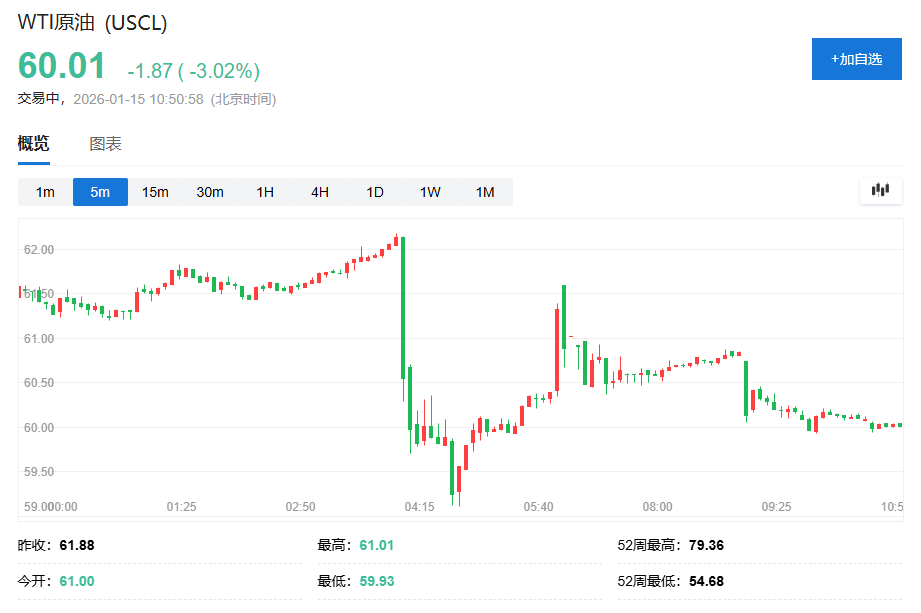
特朗普称将"观望"伊朗局势发展,避险情绪消退打压原油价格,贵金属价格也从历史高位回落。 据央视新闻,当地时间1月14日下午,美国总统特朗普在白宫谈及伊朗局势时表示,"我们要先观望局势发展"。他同时指出美国政府收到了"来自伊朗非 常积极的声明"。WTI原油下挫、较高点跌超3%。 贵金属市场同样剧烈波动。白银价格一度暴跌7.3%,成为当日表现最差的大宗商品之一。特朗普推迟对关键矿产进口征收新关税的决定,导致金、 银、铂、钯等贵金属集体回调。 外汇市场方面,韩元周四在亚洲交易时段小幅走低,此前一日因美国财政部长贝森特提及该货币"过度下跌"而大幅反弹。贝森特的言论为韩元提供了罕 见的口头支持,当前该货币正滑向2009年以来最弱水平。 Wells Fargo驻纽约策略师Brendan McKenna表示: 贝森特的评论能在短期内支撑韩元,但如果市场认为基本面和政治形势仍在恶化,市场影响力可能更大。 韩国央行周四维持基准利率不变,符合市场普遍预期,韩元兑美元下跌0.2%。 货币: ICE美元指数反弹0.02%,报99.13。 日元方面同样受到关注。贝森特周四与日本财务大臣片山皋月通话,指出"过度汇率波动本质上是不可取的" ...

日元兑人民币汇率跌至4.48历史新低
Sou Hu Cai Jing· 2026-01-15 00:38
Exchange Rate Status and Market Reaction - The Japanese yen reached a historic low against the Chinese yuan at 4.48 on December 19, 2025, marking the lowest level on record; the yen also fell below 157 against the US dollar, despite a 25 basis point interest rate hike by the Bank of Japan, which failed to reverse the downward trend [1][2] Core Drivers of the Downward Trend - The conflict between monetary policies is evident as the Japanese government introduced a fiscal stimulus plan exceeding 21 trillion yen, raising debt concerns with a national debt-to-GDP ratio of 264%, while the central bank only made a minor interest rate increase; Prime Minister Fumio Kishida publicly opposed aggressive rate hikes, leading to a collapse in market confidence [3] - The widening interest rate differential between Japan and the US, with the US 10-year Treasury yield remaining above 4%, has driven continued selling of the yen through arbitrage trading [3] Economic and Social Impact - Input-driven inflation is eroding purchasing power, with rice prices soaring by 90% since the beginning of the year, and beef prices increasing by 150%-200% over the past 12 years, forcing consumers to cut back on food spending [6] - For every 1 yen depreciation, Japanese households face an annual increase in expenses of 6,000 yen, negating the benefits for exporting companies [7] - Small and medium-sized enterprises are facing survival crises due to skyrocketing import costs, with manufacturing profit growth declining by 2.1%, and tourism revenue sharply decreasing, further worsening the employment market [8] Intervention Challenges and Global Risks - The policy toolbox is nearing exhaustion, as government debt stands at 235% of GDP; if interest rates rise to 0.75%, annual debt servicing costs could surge by 8 trillion yen, potentially triggering a sovereign debt crisis [10] - Foreign exchange intervention is limited, with nearly half of the foreign reserves committed to US investments, leaving insufficient funds available; interventions in 2024 cost 5 trillion yen but only provided temporary stabilization [10] - There is a risk of a global financial chain reaction if approximately 20 trillion yen in arbitrage funds return en masse, which could impact liquidity in emerging markets and lead to competitive currency devaluations [10] - If the yen falls below the 160 mark, Japan may be forced to utilize foreign reserves for intervention, although the US has clearly opposed unilateral actions; without coordinated rate cuts from the Federal Reserve or G7 support, the yen could plunge towards 180:1 against the dollar [10]
贝森特会见日本财务大臣,敦促采取“稳健”政策应对汇率波动
Xin Lang Cai Jing· 2026-01-15 00:29
Group 1 - The U.S. Treasury Secretary emphasized the need for robust monetary policy during a meeting with Japan's Finance Minister, highlighting concerns over excessive currency fluctuations [1][3] - The Japanese yen recently fell to its lowest point in 18 months, prompting market speculation about potential government intervention to stabilize the currency [1][3] - Following the meeting, the yen rebounded, with a 0.43% increase against the dollar, reaching 158.46 yen per dollar after previously hitting a low of 159.45 yen [1][3] Group 2 - The Bank of Japan raised interest rates from 0.5% to 0.75% in December, citing progress towards achieving a 2% inflation target [2][4] - Critics argue that the slow pace of interest rate hikes contributes to the weakness of the yen, which benefits exports but raises living costs due to increased import prices [5]
安琪酵母:汇率波动不会对公司运营构成重大影响
Zheng Quan Ri Bao· 2026-01-14 13:41
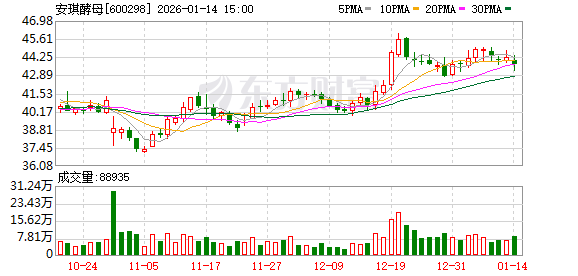
(文章来源:证券日报) 证券日报网1月14日讯 ,安琪酵母在接受调研者提问时表示,为规避汇率波动的风险,公司会加强国际 贸易和汇率政策的研究,合理制定贸易条款和结算方式;同时,采取多种措施来减少外汇风险敞口。整 体来说,汇率波动不会对公司运营构成重大影响。 ...

大华银行上调越南2026年GDP增速预期至7.5%
Shang Wu Bu Wang Zhan· 2026-01-14 10:18
Group 1 - The core viewpoint of the report is that Singapore's UOB has raised Vietnam's GDP growth forecast for 2026 from 7.0% to 7.5% due to strong economic performance [1] - Vietnam's economy continued to show robust growth in Q4 2025, with actual GDP growing by 8.46% year-on-year, surpassing both the previous quarter's growth of 8.25% and market expectations, marking the highest quarterly growth since 2009, excluding pandemic-related anomalies [1] - Exports and manufacturing are identified as the main drivers of economic growth, with Q4 2025 exports achieving a 19% year-on-year increase and an annual export growth rate of 17%, demonstrating strong export competitiveness [1] - The manufacturing sector also saw a significant increase, with a year-on-year growth of 11.3% in Q4, contributing to an overall manufacturing value-added growth rate of 10.5% for the year [1] Group 2 - The report warns of potential risks to Vietnam's future economic growth, including uncertainties in external demand due to its highly open economy, where exports account for 83% of GDP, and the ongoing uncertainty of U.S. trade policies [2] - Inflationary pressures are highlighted, with an average Consumer Price Index (CPI) increase of 3.2% in 2025, driven mainly by rising service prices, particularly in healthcare and education [2] - The Vietnamese dong depreciated by 3.1% against the U.S. dollar, leading to imported inflation pressures [2] - The report indicates that the State Bank of Vietnam is expected to maintain the refinancing rate at 4.5% throughout 2026 to ensure macroeconomic stability and manage inflation expectations [2]

日经指数首破54000点!大选预期引爆“高市交易”,日元贬至159关口
智通财经网· 2026-01-14 01:35
Group 1 - Japanese stock market reached a historical peak, with the Nikkei 225 index rising 1% to surpass the 54,000 mark for the first time, continuing a strong performance from the previous day with a gain of over 3% [1] - The Topix index also showed an upward trend, increasing by 0.73% to close at 3,624.99 points [1] - The Japanese yen fell below the critical level of 159 against the US dollar, marking the lowest point since the currency intervention by Japanese authorities in July 2024 [1] Group 2 - US stock markets experienced a decline, with all three major indices falling as the market digested the volatility caused by recent policy proposals from former President Trump [1] - Despite JPMorgan's latest earnings report exceeding expectations, its stock faced selling pressure [1] - The S&P 500 index decreased by 0.19%, the Dow Jones Industrial Average fell by 0.8%, and the Nasdaq Composite also dropped by 0.1% [1] Group 3 - Other major Asian markets generally followed the Wall Street trend, with the South Korean Composite Index slightly up, while the tech-heavy Kosdaq index fell by 0.37% [1] - The Australian S&P/ASX 200 index closed flat, maintaining a volatile pattern [1] - Hang Seng Index futures closed at 26,920 points, up 71.53 points from the previous day's actual closing price of 26,848.47 points [1]
国际金融市场早知道:1月14日
Zhong Guo Jin Rong Xin Xi Wang· 2026-01-14 00:56
Global Economic Outlook - The World Bank has raised its global economic growth forecast for 2026 to 2.6%, an increase of 0.2 percentage points. The U.S. is expected to grow by 2.2%, while the Eurozone and Japan are projected to slow to 0.9% and 0.8%, respectively [1][8] U.S. Economic Policy and Market Reactions - Former President Trump has called for the Federal Reserve to lower interest rates as the economy improves, denying any plans for another government shutdown and indicating upcoming policies aimed at reducing the cost of living [7][8] - Trump has accused Fed Chair Powell of overspending by billions, labeling him as "incompetent or corrupt," and has indicated plans to nominate a new Fed chair soon. This has drawn support for Powell from former Treasury Secretaries and central bank leaders, who criticized political interference in central bank independence [8] U.S. Fiscal Situation - The U.S. Treasury reported a record budget deficit of $145 billion for December 2025, the highest for that month historically. The deficit for the fiscal year 2026 so far stands at $602 billion, down from $711 billion in the same period last year [8] Labor Market and Inflation - The New York Fed President Williams stated that the current U.S. economic conditions are "quite favorable," with no signs of rapid deterioration in the labor market, and expects stabilization and gradual improvement this year. He noted that monetary policy is close to neutral, with no strong pressure for rate cuts or hikes in the short term [2][8] - The U.S. Consumer Price Index (CPI) for December 2025 rose by 2.7% year-on-year, with core CPI increasing by 2.6%, both unchanged from previous values. Due to prior government shutdowns, the data's reference value is limited, and the market anticipates a 95% probability that the Fed will maintain interest rates in January [8] Market Dynamics - The Dow Jones Industrial Average fell by 0.8% to 49,191.99 points, the S&P 500 decreased by 0.19% to 6,963.74 points, and the Nasdaq Composite dropped by 0.1% to 23,709.87 points [3][9] - COMEX gold futures declined by 0.44% to $4,594.40 per ounce, while COMEX silver futures rose by 2.08% to $86.86 per ounce [4][10] - U.S. oil futures increased by 2.69% to $61.1 per barrel, and Brent crude rose by 2.43% to $65.42 per barrel [5][11]
韩元连续九日走软 创下2008年以来最长连跌纪录
智通财经网· 2026-01-13 05:52
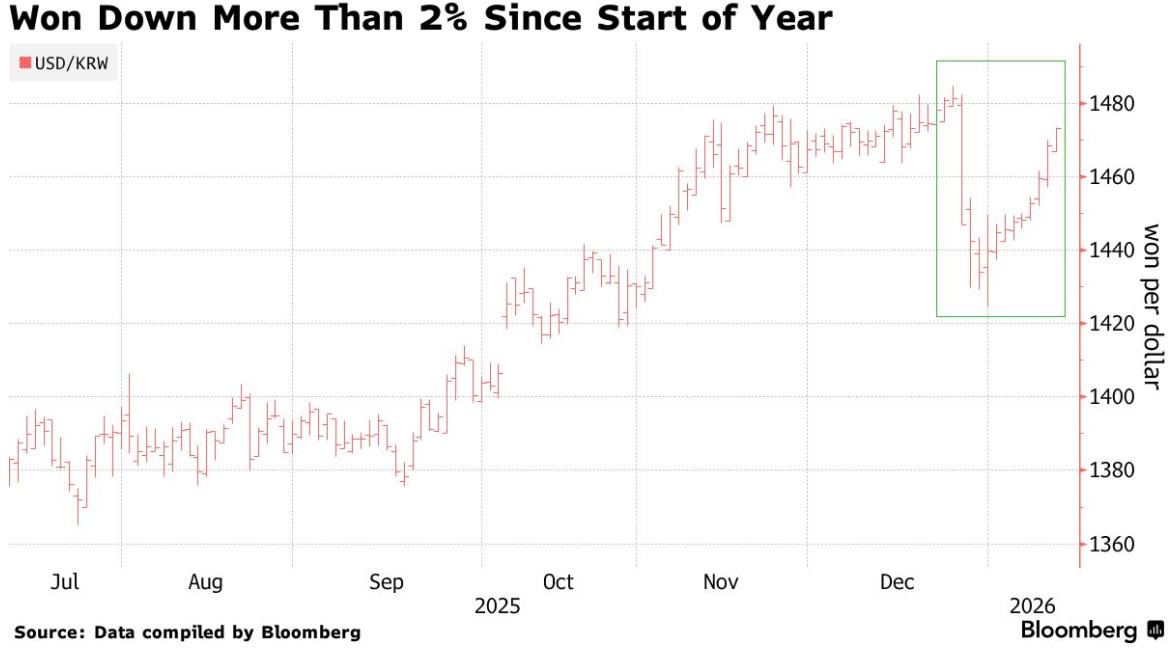
Core Viewpoint - The South Korean won has experienced its longest consecutive decline against the US dollar since 2008, with local investors shifting funds overseas amid unfavorable market conditions [1] Group 1: Currency Performance - The won fell by 0.4% to 1,473.40 won per dollar, marking a decline of over 2% from approximately 1,440 won at the end of last year [1] - This decline represents the longest losing streak for the won, continuing for nine consecutive trading days [1] Group 2: Market Sentiment - Efforts by authorities to stabilize the exchange rate have not changed market sentiment, which remains pressured by external factors and ongoing supply-demand imbalances [1] - The strong performance of the US dollar, supported by geopolitical tensions in Latin America and the Middle East, has erased gains made by the won since the end of 2025 [1] Group 3: Investment Trends - There is a robust demand for overseas assets among domestic investors, while foreign investors continue to net sell South Korean stocks [1]
家电业务承压汇兑收益下滑,德昌股份2025年净利润同比预降超50%
Ju Chao Zi Xun· 2026-01-12 03:11
Core Viewpoint - The company forecasts a significant decline in net profit for the year 2025, with a decrease of over 50% compared to the previous year, primarily due to changes in the home appliance business environment and exchange rate fluctuations [2][3] Financial Performance Summary - The projected net profit for 2025 is estimated to be between 160 million yuan and 200 million yuan, a decrease of 210.83 million yuan to 250.83 million yuan from the previous year's net profit of 410.83 million yuan, representing a year-on-year decline of 51% to 61% [2] - The expected net profit attributable to the parent company after deducting non-recurring gains and losses is estimated to be between 145.36 million yuan and 185.36 million yuan, down from 393.25 million yuan in the previous year, indicating a decline of 53% to 63% [2] Business Segment Analysis - The automotive parts business continues to grow rapidly, while the home appliance segment faces multiple pressures, including international trade policy impacts and intensified industry competition leading to declining product prices [3] - New production capacity has been put into operation but is still in the ramp-up phase, resulting in increased amortization costs year-on-year, which negatively affects the gross margin of the home appliance business [3] - The company anticipates an exchange loss of approximately 18 million yuan for 2025, a decrease of about 60 million yuan compared to the previous year, further impacting overall performance [3]

