
生柴政策

Search documents
国泰君安期货研究周报:农产品-20250928
Guo Tai Jun An Qi Huo· 2025-09-28 10:57
Group 1: Report Overview - The report is the Guotai Junan Futures Research Weekly Report - Agricultural Products dated September 28, 2025, covering multiple agricultural product futures including palm oil, soybean oil, soybean meal, soybean, corn, sugar, cotton, and live pigs [1][2] Group 2: Investment Ratings - No investment ratings for the industries are provided in the report Group 3: Core Views Palm Oil - The supply - driven price increase is difficult to continue. The European demand support may not end soon, but the demand side is hard to provide further stimulation. The combined inventory of Indonesia and Malaysia may accumulate until October and then slowly decline. There may be hidden inventories in Indonesia until the end of the year, and the price may fluctuate until the end of the year [6][8] Soybean Oil - The policy of US soybean oil may be postponed to next year. Before the policy is implemented, it will mainly fluctuate in the range of 50 - 56 cents/pound. Domestic soybean oil has no independent driving force and will mainly follow the trend of the oil and fat sector [9] Soybean Meal and Soybean - It is expected that the prices of soybean meal and soybean futures will fluctuate. It is necessary to avoid risks during the National Day holiday. For soybean meal, pay attention to trade events and fundamental data; for soybean, the market expects policy support [20][25] Corn - The corn market shows a pattern of near - strong and far - weak. The price may rebound in the short term but is expected to decline after the National Day. It is advisable to short at high prices [33][37] Sugar - The sugar market has a weak basis. Internationally, it will mainly be in low - level consolidation; domestically, the basis is bearish [59][61] Cotton - It is expected that the cost of new cotton will continue to dominate the futures price trend. Before the National Day, the Zhengzhou cotton futures will maintain a weak and volatile trend, and after the holiday, it will be mainly determined by the new cotton cost [86][102] Group 4: Summary by Commodity Palm Oil - **Last Week**: After Argentina announced zero - tariff exports of oil and meal, the palm oil 01 contract fell 1.11% last week [5] - **This Week**: European demand support continues, but the demand side lacks stimulation. The combined inventory of Indonesia and Malaysia may accumulate until October. The price may fluctuate until the end of the year [6][8] Soybean Oil - **Last Week**: After Argentina announced zero - tariff exports of oil and meal, the soybean oil 01 contract fell 2.09% last week [5] - **This Week**: The policy of US soybean oil may be postponed. Before the policy is implemented, it will mainly fluctuate in the range of 50 - 56 cents/pound. Domestic soybean oil has no independent driving force [9] Soybean Meal and Soybean - **Last Week**: The price of US soybeans was weak. The domestic soybean meal price was weak, and the soybean price was strong. The net sales of US soybeans decreased week - on - week, and the excellent - good rate decreased [20] - **This Week**: It is expected that the prices of soybean meal and soybean futures will fluctuate. For soybean meal, avoid trade event risks; for soybean, the market expects policy support [25] Corn - **Market Review**: The spot price of corn rebounded last week. The futures price first fell and then rose. The basis remained flat [33][34] - **Market Outlook**: CBOT corn fell, wheat prices rose, corn starch inventory decreased. The price may rebound in the short term but is expected to decline after the National Day [34][37] Sugar - **This Week's Market Review**: Internationally, the price of New York raw sugar rose, and the net long position of funds decreased significantly. Domestically, the spot price of sugar in Guangxi decreased, and the basis of the main contract decreased significantly [59][60] - **Next Week's Market Outlook**: Internationally, it will be in low - level consolidation; domestically, the basis is bearish [61] Cotton - **Market Data**: ICE cotton was weak, and domestic cotton futures continued to decline [86][89] - **Fundamentals**: Internationally, the export sales data of US cotton was poor, and the situation in other countries varied. Domestically, the new cotton was expected to be abundant, and the cost was uncertain. The downstream situation was average [90][97] - **Operation Suggestion**: ICE cotton may maintain low - level consolidation. Before the National Day, Zhengzhou cotton futures will be weakly volatile, and after the holiday, the price will be mainly determined by the new cotton cost [102]
商品日报(9月24日):玻璃午后大幅拉涨 原油系全线走高
Xin Hua Cai Jing· 2025-09-24 11:59
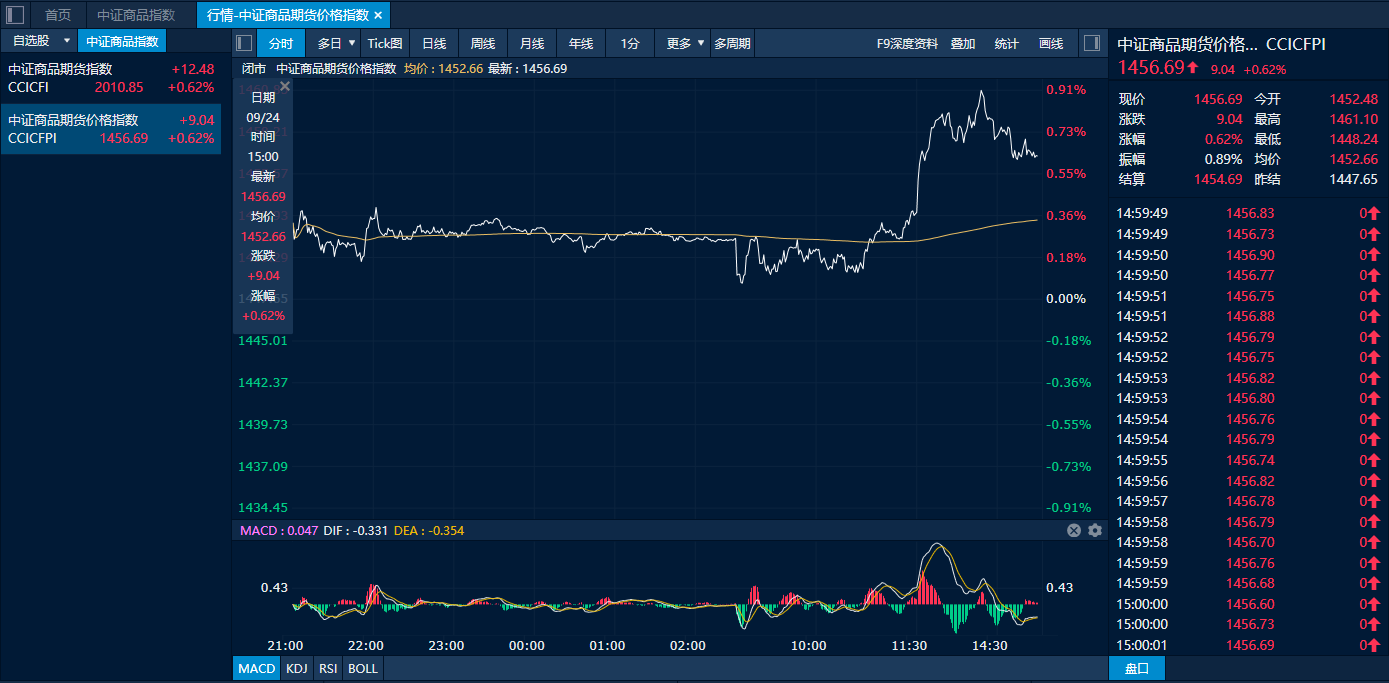
Group 1: Market Overview - The domestic commodity futures market on September 24 saw more gains than losses, with the glass main contract rising over 4% and fuel oil main contract increasing over 3% [1][2] - The China Securities Commodity Futures Price Index closed at 1456.69 points, up 9.04 points or 0.62% from the previous trading day [1] Group 2: Glass Industry Insights - The glass main contract experienced a significant increase, with a peak rise of nearly 8% during the trading session, ultimately closing with a 4.74% gain [2] - Market sentiment was driven by rumors of a meeting among glass enterprises and the issuance of a growth stabilization plan for the building materials industry by multiple government departments [2] - Despite the positive sentiment, the glass industry is still at the bottom of the real estate cycle, with weak demand and a need for capacity reduction to address oversupply [2] Group 3: Oil Market Dynamics - Domestic oil-related products rose across the board, with SC crude oil and fuel oil main contracts recording gains of over 1% and 3%, respectively [3] - Concerns over global supply tightening were heightened by recent drone attacks on Russian refineries and potential diesel export bans by the Russian government [3] - Short-term price trends for fuel oil are expected to remain strong due to cost support and recovering demand, although a potential decline in purchasing sentiment is anticipated post-holiday [3] Group 4: Other Commodity Movements - The shipping European line saw a rise, with the main contract increasing over 2% after peaking at over 6% during the session [4] - Oilseed and oil products remained weak, with the main contracts for soybean meal and oil experiencing slight declines, while palm oil showed a small increase due to tightening supply expectations [5][6] - Palm oil prices may rise by approximately 15% as the seasonal high production cycle ends, and potential shortages could arise if Indonesia implements specific policies [6]

阿根廷关税政策变化,油粕遭遇重创
Zhong Xin Qi Huo· 2025-09-24 07:21
1. Report Industry Investment Ratings Overall Industry Outlook - The report does not provide a comprehensive investment rating for the entire agricultural industry. However, it offers individual outlooks for various agricultural products: - **Protein Meal (Soybean Meal and Rapeseed Meal)**: Oscillating weakly [2][6] - **Corn and Starch**: Oscillating [8] - **Pigs**: Oscillating weakly [9] - **Natural Rubber (RSS3 and TSR20)**: Oscillating [10][12] - **Synthetic Rubber**: Oscillating [13] - **Cotton**: Oscillating weakly in the medium - term, with short - term attention to support levels [14] - **Sugar**: Oscillating weakly in both the short and long term [15] - **Pulp**: Oscillating [16] - **Offset Printing Paper**: Consider interval operations between 4100 - 4400 [17] - **Logs**: Oscillating around 800 in the short term [19] 2. Core Views of the Report - The report analyzes multiple agricultural products. The main influencing factors include international policies (such as Argentina's cancellation of export tariffs), weather conditions, supply - demand relationships, and market sentiment. For example, Argentina's cancellation of soybean and other grain export tariffs impacts the global and domestic markets of related products, and weather conditions affect crop yields and harvest schedules [1][6][8]. 3. Summary by Related Catalogs 3.1. Protein Meal - **Logic**: Argentina's cancellation of soybean export tariffs leads to a decrease in export prices and an expected increase in export volume, which is bearish for the domestic and international soybean markets. Domestically, the opening of import profit for Argentine soybeans, soybean meal, and soybean oil is expected to increase imports, causing short - term pressure on the domestic market. In the long run, domestic soybean meal supply may increase in Q4 2025, and the supply gap may disappear in Q1 2026. On the demand side, the consumption of soybean meal may increase steadily, while rapeseed meal follows the trend of soybean meal [1][6]. - **Outlook**: Both soybean meal and rapeseed meal are expected to oscillate weakly. It is recommended to take profits on previous long positions and then wait and see [2][6]. 3.2. Corn and Starch - **Logic**: The price of domestic corn shows regional differentiation. In the short term, there is pressure from the concentrated listing of new grain, and Argentina's cancellation of corn export tariffs also affects market sentiment. In the long term, the price is not pessimistic under the scenario of tightening carry - over inventory, presenting a short - term bearish and long - term bullish pattern [8]. - **Outlook**: Oscillating. Pay attention to short - selling opportunities on rebounds and reverse spread opportunities [8]. 3.3. Pigs - **Logic**: In the short term, the supply of pigs is abundant, and the cost of breeding is expected to decrease due to Argentina's policy. In the long term, if the "anti - involution" policy continues to be implemented, the supply pressure in 2026 will gradually weaken [9]. - **Outlook**: Oscillating weakly. The price is expected to face supply pressure after the National Day, and attention can be paid to reverse spread strategies [9]. 3.4. Natural Rubber - **Logic**: Rubber prices are relatively resistant to decline due to favorable fundamentals, showing a pattern of strong spot prices, inventory reduction, and narrowing basis. However, due to poor commodity sentiment, it is difficult to rise independently. In the short term, attention should be paid to the supply increase in the production area and the inventory reduction rate, as well as the downstream procurement willingness [12]. - **Outlook**: Oscillating strongly in the short term. Consider short - term long positions on pullbacks in September [12]. 3.5. Synthetic Rubber - **Logic**: The BR futures contract oscillates within a range. The overall commodity trend is weak, but natural rubber is relatively strong, supporting the BR futures. The fundamentals and price operation logic have not changed significantly recently. The price is expected to continue to oscillate between 11300 - 12300 [13]. - **Outlook**: Oscillating within a range in the short term [13]. 3.6. Cotton - **Logic**: The expected increase in Xinjiang's cotton production in the new year leads to the market trading the expected supply surplus in advance, causing the cotton price to decline. The current inventory is tight, and the demand has improved seasonally, but the sustainability of the peak - season demand is questionable. The market shows a pattern of tight near - term and loose far - term supply [14]. - **Outlook**: Oscillating weakly in the medium term. In the short term, pay attention to the support at 13500 yuan/ton [14]. 3.7. Sugar - **Logic**: Zhengzhou sugar prices continue to decline, breaking through the 5500 yuan/ton level. Macroeconomically, the market has digested the Fed's interest - rate cut. Fundamentally, the international trade flow is loose, and domestic consumption and imports are not favorable. In the long term, the global sugar supply is expected to be abundant in the 25/26 crushing season [15]. - **Outlook**: Oscillating weakly in both the short and long term [15]. 3.8. Pulp - **Logic**: Pulp futures oscillate at a low level, with differences between near - term and far - term contracts. The market has both positive and negative factors, but the impact is not strong. The fundamentals are still bearish, but the futures price has already factored in the negative news, and the price of bleached northern softwood kraft pulp has stabilized [16]. - **Outlook**: Oscillating. It is recommended to wait and see [16]. 3.9. Offset Printing Paper - **Logic**: The futures price oscillates narrowly around 4200 yuan. The short - term fundamentals have limited changes, with sufficient supply and no obvious contradiction between supply and demand. Attention should be paid to new driving factors such as publishing tenders [17]. - **Outlook**: Consider interval operations between 4100 - 4400 [17]. 3.10. Logs - **Logic**: The log futures price oscillates narrowly. The fundamentals have marginally improved, but there is no strong upward driving force. From the perspective of delivery, it has a bearish impact on the futures price [19]. - **Outlook**: Oscillating around 800 in the short term [19].
棕榈油主力下破9000元/吨 短期偏弱调整行情依旧
Jin Tou Wang· 2025-09-23 06:10
Core Viewpoint - Palm oil futures have significantly declined, with the main contract reported at 8964.00 CNY/ton, reflecting a drop of 3.88% [1] Group 1: Market Data - The Southern Peninsula Palm Oil Millers Association (SPPOMA) reported a 6.57% month-on-month decrease in Malaysian palm oil yield for the period of September 1-20, 2025, along with a 0.25% decrease in extraction rate and a 7.89% reduction in production [2] - As of September 19, domestic palm oil commercial inventory stands at 600,000 tons, showing a week-on-week decrease of 50,000 tons, a month-on-month increase of 30,000 tons, and a year-on-year increase of 130,000 tons [2] - The Malaysian Palm Oil Council (MPOC) indicated that the price of crude palm oil is expected to fluctuate between 4200 to 4500 MYR per ton in the short term, supported by a robust global vegetable oil market and supply uncertainties [2] Group 2: Institutional Perspectives - Zhonghui Futures suggests that the biodiesel policies in Indonesia and Malaysia are favorable for palm oil market consumption expectations, with buying demand noted in mid-September. The fundamental outlook remains bullish, but caution is advised due to frequent changes in U.S. biodiesel policies that may negatively impact palm oil adjustments [3] - Dae Yu Futures notes that oilseed prices are stabilizing, with a relaxed domestic fundamental environment and stable oilseed supply. The USDA's high production expectations for South America in 2024/25 and neutral Malaysian palm oil inventory are highlighted, along with improved demand due to Indonesia's B40 policy promoting domestic consumption [3]
油脂周报:油脂仍处于磨底阶段,继续关注政策端变化-20250922
Yin He Qi Huo· 2025-09-22 03:12
Group 1: Report Industry Investment Rating - Not provided in the content Group 2: Core Viewpoints of the Report - The recent core events and market review show that the yield and production of Malaysian palm oil decreased in the first 15 days of September, India's port inventory continued to accumulate in August, and the overall price of oils and fats was affected by multiple factors. Short - term oil and fat prices lack obvious drivers but have strong support below. Oils and fats are in the bottom - grinding stage, and it is advisable to consider buying on dips in batches after a pullback [4][5][25] - For palm oil, it is expected that the production in September may decline, exports may increase slightly, and the stable spot price in the producing areas supports the price. For soybean oil, it is affected by the expected US biodiesel policy, and China often exports soybean oil to India. Also, it is necessary to pay attention to whether US soybeans can be imported. Rapeseed oil in China continues to reduce inventory marginally, which supports its price [5][25] Group 3: Summary According to the Directory Part 1: Weekly Core Points Analysis and Strategy Recommendation International Market - **Malaysian Palm Oil**: SPPOMA data shows that from September 1 - 15, the yield per unit area of Malaysian palm oil decreased by 6.94% month - on - month, the oil extraction rate decreased by 0.21% month - on - month, and the production decreased by 8.05% month - on - month, with the decline increasing compared to the first 10 days. ITS data shows that from September 1 - 20, exports increased by 8.7% month - on - month to 1.01 million tons. Malaysia raised the reference price of crude palm oil in October to 4,268.68 ringgit per ton, with an export tax rate of 10%, which supports the price at the cost end [8] - **India's Oil Market**: As of August, India's edible oil imports in the 2024/25 fiscal year reached 12.38 million tons, a year - on - year decrease of 8%. Palm oil imports decreased by 19%, soybean oil imports reached a record high of 3.89 million tons, a year - on - year increase of 43%, and sunflower oil imports decreased by 25% year - on - year. In August, the port inventory continued to accumulate to 970,000 tons, with palm oil inventory increasing from 450,000 to 540,000 tons, and sunflower oil and soybean oil inventory decreasing to about 210,000 tons. India's edible oil import profit is not good recently, and the procurement has slowed down [14] Domestic Market - **Palm Oil**: As of September 12, 2025, the commercial inventory of palm oil in key national regions was 641,500 tons, a week - on - week increase of 22,200 tons or 3.58%. The spot trading volume decreased significantly, the basis was stable and slightly weak, and the import profit gap widened. In the short term, palm oil lacks obvious drivers and maintains a volatile trend. It is recommended to consider buying on dips in batches [17] - **Soybean Oil**: As of September 12, 2025, the commercial inventory of soybean oil in key national regions was 1.2512 million tons, a week - on - week decrease of 100 tons or 0.01%. The basis was stable. Affected by the expected US biodiesel policy, soybean oil prices rose and then corrected. In the future, as the arrival of domestic soybeans decreases, soybean oil inventory may gradually decline. It is recommended to consider buying on dips in batches [20] - **Rapeseed Oil**: As of September 12, 2025, the coastal rapeseed oil inventory was 614,000 tons, a week - on - week decrease of 29,100 tons or 3.3%. The inventory continued to decline marginally, the basis was stable and increasing, and the monthly spread increased significantly. The fundamental situation of domestic rapeseed oil has not changed much, and it is necessary to pay attention to rapeseed and rapeseed oil purchases and policy changes [23] Strategy Recommendation - **Unilateral Strategy**: In the short term, the oil and fat market lacks obvious drivers and is in the bottom - grinding stage. It is advisable to consider buying on dips in batches after a pullback [27] - **Arbitrage Strategy**: Wait and see [27] - **Option Strategy**: Wait and see [27] Part 2: Weekly Data Tracking - Multiple data charts are provided, including the monthly production, export, and inventory of Malaysian palm oil; the supply and demand of Indonesian palm oil; the international soybean oil market; India's oil and fat supply and demand; domestic rapeseed oil, soybean oil, and palm oil import profits; domestic oil and fat supply and demand; domestic oil and fat spot basis; and domestic oil and fat commercial inventory [31][37][39]
棕榈油周报:菜油表现强势,棕榈油震荡调整-20250922
Tong Guan Jin Yuan Qi Huo· 2025-09-22 01:22
1. Report Industry Investment Rating - No relevant content found 2. Core Views of the Report - Last week, BMD Malaysian palm oil's main continuous contract fell 21 to close at 4,424 ringgit/ton, a decline of 0.47%; palm oil's 01 contract rose 20 to close at 9,316 yuan/ton, an increase of 0.22%; soybean oil's 01 contract rose 6 to close at 8,328 yuan/ton, an increase of 0.07%; rapeseed oil's 01 contract rose 211 to close at 10,068 yuan/ton, an increase of 2.14%; CBOT US soybean oil's main continuous contract fell 1.53 to close at 50.59 cents/pound, a decline of 2.94%; ICE rapeseed's active contract fell 18.6 to close at 618.7 Canadian dollars/ton, a decline of 2.92% [4]. - Palm oil fluctuated within the week, first rising then falling. India's strong imports in August and heavy rainfall in Malaysian production areas, which affected production and led to a weakening of Malaysian palm oil production on a month - on - month basis, limited the price decline. However, the uncertainty of the US biodiesel policy and the decline of US soybean oil dragged down the palm oil trend. Rapeseed oil was strong due to expected low supply in the context of China - Canada trade and continued inventory reduction in China [4][7]. - The Fed cut interest rates by 25 basis points last week. The dollar index fluctuated at a low level, and oil prices weakened. In terms of fundamentals, heavy rainfall in Malaysian production areas affected production and logistics, and the output of Malaysian palm oil in the first half of September decreased on a month - on - month basis, limiting price declines. But the uncertainty of the US biodiesel policy dragged down US soybean oil. Palm oil is expected to fluctuate in the short term [4][10]. 3. Summary by Directory 3.1 Market Data - CBOT soybean oil's main continuous contract fell from 52.12 cents/pound to 50.59 cents/pound, a decline of 2.94%; BMD Malaysian palm oil's main continuous contract fell from 4,445 ringgit/ton to 4,424 ringgit/ton, a decline of 0.47%; palm oil's 01 contract rose from 9,296 yuan/ton to 9,316 yuan/ton, an increase of 0.22%; soybean oil's 01 contract rose from 8,322 yuan/ton to 8,328 yuan/ton, an increase of 0.07%; rapeseed oil's 01 contract rose from 9,857 yuan/ton to 10,068 yuan/ton, an increase of 2.14%. Spot prices also showed different trends [5]. 3.2 Market Analysis and Outlook - Palm oil fluctuated within the week, with India's strong imports and production problems in Malaysia limiting price declines, while the US biodiesel policy uncertainty and the decline of US soybean oil dragging it down. Rapeseed oil was strong due to supply concerns [7]. - From September 1 - 15, 2025, Malaysian palm oil's yield, oil extraction rate, and output decreased on a month - on - month basis. Different institutions' data on Malaysian palm oil exports from September 1 - 15 showed mixed trends. India's palm oil imports in August reached a high level, and the total import of edible vegetable oil also increased [8][9]. - As of September 12, 2025, the inventory of three major oils in key regions in China increased slightly compared to last week and significantly compared to the same period last year. As of September 19, the weekly average daily trading volume of soybean oil increased, while that of palm oil decreased [9][10]. 3.3 Industry News - Heavy rainfall in Sabah, Malaysia, caused floods and the cancellation of a state - level celebration. Edible oil prices, including palm oil, are expected to be firm in 2025, and the supply - demand gap will continue in 2026 [11]. 3.4 Related Charts - The report provides multiple charts showing the trends of palm oil, soybean oil, and rapeseed oil in futures and spot markets, as well as the production, inventory, and export data of Malaysia and Indonesia's palm oil, and the commercial inventory of three major oils in China [12][13][14]
美豆周度报告-20250921
Guo Tai Jun An Qi Huo· 2025-09-21 07:32
1. Report Industry Investment Rating - There is no information provided regarding the report industry investment rating. 2. Core Viewpoints of the Report - The overall view is that with a bumper harvest in South America, there is no basis for a bull market; cost support reduces the probability of a sharp decline, and the market is generally oscillating with a slight upward trend, ranging from 950 - 1150 cents per bushel [5]. - Negative factors include that the communique of the recent China - US presidential call indicates that China will not purchase US soybeans before November, the weather in the main US soybean - producing areas is favorable with high yield prospects, and the expected increase in Brazil's planting area in the 2025/26 season is 1.8% [5]. - Positive factors are that policies such as the biodiesel policy and the expectation of improved China - US relations support prices, the US soybean balance sheet is in a tight balance, and La Nina weather may delay Brazil's soybean planting [5]. 3. Summary by Related Catalogs Market Price - This week, US soybean prices oscillated and closed lower. The China - US presidential call did not mention agricultural product procurement, and it is expected that China will be absent from the US soybean export market before the APEC meeting in November. The US soybean harvest progress has accelerated. Next week, attention should be paid to the follow - up progress of China - US negotiations, the weather conditions in the main production areas of the US and Brazil, and the progress of the biodiesel policy [8][10]. - This week, US soybean meal prices declined. The market expected that improved China - US relations would bring better export prospects for US agricultural products, but the presidential call did not mention agricultural product procurement [11][12]. - This week, US soybean oil prices oscillated lower. The draft opinion on the biodiesel exemption policy has changed, adding options that worry the market about demand prospects [15]. - As of September 12, the spot price of soybeans at US Gulf ports was $10.99 per bushel; the purchase price at farms (Iowa) was $9.73 per bushel, slightly down; as of September 18, the spot price of soybeans in south - western Iowa was $9.775 per bushel; on September 18, the spot price in Mato Grosso, Brazil, slightly decreased to 120.32 reais per bag; as of September 18, the spot price at Brazilian ports slightly decreased to 139.81 reais per bag [17][19][23][25]. Supply Factors - The drought situation in US soybean - producing areas has worsened, with a drought rate of 58% this week compared to 47% last week. In the next two weeks, the temperature in US producing areas will be warmer with no early frost threat, and there will be more precipitation in the main US soybean - producing areas. Most of the Brazilian producing areas have slightly less precipitation, the southern region is relatively humid, and the Brazilian rainy season is expected to return at the end of the month. Precipitation in Argentine soybean - producing areas is normal to high, and sowing is expected to start in October. As of September 12, the good - to - excellent rate of US soybeans was 63%, down from 64% last week and the same as the same period last year [28][30][32][34][36][39]. Demand Factors - As of September 12, the US soybean crushing profit was $3.14 per bushel, up from $3.08 last week. The weekly US soybean export volume was 837,100 tons, up from 640,000 tons last week; the weekly export inspection and quarantine volume was 804,300 tons, up from 467,600 tons last week; the net sales for this year were 923,000 tons, down from 1,389,400 tons last week; the sales for the next year were 2,200 tons, down from 1,074,000 tons last week; the quantity shipped to China last week was 0 tons [42][44][46][48][50][52]. Other Factors - The latest ENSO (NINO3.4 anomaly index) value is - 0.905, entering the La Nina range. The soybean planting costs in Brazil and the US have decreased. As of September 16, the net long position of soybeans in CFTC was 14,400 lots, compared with a net short position of 4,100 lots last week; the net long position of soybean oil was 35,000 lots, up from 17,500 lots last week; the net short position of soybean meal was 59,400 lots, compared with a net short position of 56,700 lots last week [55][57][63][65][67].
板块品种多下跌
Zhong Xin Qi Huo· 2025-09-19 02:27
1. Report Industry Investment Ratings - Oils and Fats: Oscillating [5] - Protein Meal: Oscillating [6] - Corn and Starch: Oscillating Weakly [7] - Live Pigs: Oscillating [9] - Natural Rubber: Oscillating [10] - Synthetic Rubber: Oscillating [13] - Cotton: Oscillating Strongly [14] - Sugar: Oscillating [16] - Pulp: Oscillating [17] - Offset Paper: Oscillating [18] - Logs: Oscillating [20] 2. Report's Core View - Most agricultural products showed a downward trend on September 19, 2025. Different varieties are affected by various factors such as policies, weather, supply - demand relationships, and macro - economic conditions. The market trends of different products vary, including oscillations, oscillations with an upward or downward bias [1]. 3. Summaries According to Related Catalogs 3.1 Market Trends of Different Varieties - **Oils and Fats**: Concerns about the US biodiesel policy are rising, increasing the downward pressure on oil prices. The market is affected by factors such as US soybean conditions, palm oil production in Malaysia and Indonesia, and the inventory situation in China. It is expected to oscillate [5]. - **Protein Meal**: After the Fed's interest rate cut, the double - meal followed the market decline. Internationally, factors such as US soybean conditions, South American sowing progress, and CFTC positions affect the market. Domestically, there are issues of inventory accumulation and demand changes. It is expected to oscillate [6]. - **Corn and Starch**: The support at 2150 is strong, and the short - term market may fluctuate. The current price is stable with a slight downward trend, and the supply and demand situation is affected by new grain listing and other factors. It is expected to oscillate weakly [7][8]. - **Live Pigs**: Before the festival, inventory is continuously reduced, and the supply and demand of live pigs are loose. In the short term, supply is abundant, and in the long term, the impact of capacity - reduction policies needs to be observed. It is expected to oscillate [9]. - **Natural Rubber**: Due to negative sentiment, the rubber price dropped significantly. However, the fundamentals are still relatively strong in the short term. It is recommended to consider short - term long positions during the callback in September, and the short - term trend is expected to oscillate strongly [10][12]. - **Synthetic Rubber**: The weakening of natural rubber dragged down synthetic rubber. The price is in the range of 11300 - 12300, and it is expected to oscillate in the short term [13][14]. - **Cotton**: After the interest rate cut expectation was fulfilled, Zhengzhou cotton declined under the bearish commodity atmosphere. In the short term, the callback space is limited, and the downward pressure will increase after the large - scale listing of new cotton. It is expected to oscillate strongly [14]. - **Sugar**: Due to the overall bearish commodity atmosphere, the sugar price declined. In the long term, the new season's supply is expected to be loose, and the price is expected to oscillate weakly; in the short term, it will oscillate downward to find support [16]. - **Pulp**: There is no obvious driving force for a breakthrough, and it maintains an oscillating trend. The current supply - demand situation is affected by factors such as the effectiveness of price increases in the US dollar market and seasonal demand. It is expected to oscillate [17]. - **Offset Paper**: The trading volume is low, and it runs in a narrow - range oscillation. The short - term supply - demand contradiction is not obvious, and it is recommended to operate in the range of 4000 - 4500. It is expected to oscillate [18]. - **Logs**: With the adjustment of commodities, logs oscillate weakly. The current market is in a game between weak reality and peak - season expectations. It is expected that the price may stop falling and stabilize in September [20]. 3.2 Commodity Index Information - On September 18, 2025, the comprehensive index, commodity 20 index, and industrial product index of the commodity index all declined, with declines of 0.94%, 1.04%, and 1.06% respectively. The agricultural product index declined by 0.42% on that day, with a 5 - day decline of 1.16%, a 1 - month decline of 2.06%, and a year - to - date increase of 0.24% [178][180].
中辉期货豆粕日报-20250917
Zhong Hui Qi Huo· 2025-09-17 03:40
1. Report Industry Investment Ratings - No specific industry - wide investment ratings are provided in the report. 2. Core Views of the Report - **Short - term Decline**: For soybean meal and rapeseed meal, the short - term outlook is bearish. Soybean meal is affected by the increase in US soybean production and inventory, and rapeseed meal is influenced by trade policies and high inventory [1]. - **Short - term Consolidation**: Palm oil and soybean oil are expected to consolidate in the short term. Palm oil has positive consumption expectations due to biodiesel policies and purchase demand, while soybean oil faces pressure from the approaching US soybean harvest and high domestic inventory [1]. - **Oscillating with a Bullish Bias**: Rapeseed oil is likely to oscillate with a bullish bias, supported by the China - Canada trade dispute and dual - festival demand, but limited by the resumption of China - Australia trade [1]. - **Cautious Bullish**: Cotton is cautiously bullish. Although the supply is under pressure from the increasing output in the US and other Northern Hemisphere countries, the short - term bottom of the domestic market is supported by tight supply before new cotton listing and a lower inventory - to - sales ratio [1]. - **Cautious Bearish**: Jujube is cautiously bearish. There is pressure after the new jujube harvest considering the production forecast and carry - over inventory, but there may be large price fluctuations before November [1]. - **Cautious Bullish**: Live pigs are cautiously bullish. The spot and near - term contracts may have limited further decline, and the price may rise as the peak season approaches and the far - term capacity is reduced [1]. 3. Summary by Variety Soybean Meal - **Market Situation**: As of September 12, 2025, national port soybean inventory was 968.6 million tons, up 2.5 million tons week - on - week; 125 oil mills' soybean inventory was 733.2 million tons, 1.5 million tons more than last week. The futures price of the main contract was 3041 yuan/ton, down 1 yuan from the previous day, and the national average spot price was 3067.14 yuan/ton, up 6.85 yuan [2][3]. - **Outlook**: The short - term is bearish but the decline space is limited due to approaching the spot price and Sino - US trade issues [1]. Rapeseed Meal - **Market Situation**: As of September 12, coastal area main oil mills' rapeseed inventory was 7.4 million tons, down 2.7 million tons week - on - week; rapeseed meal inventory was 1.75 million tons, down 0.05 million tons. The futures price of the main contract was 2518 yuan/ton, up 14 yuan from the previous day, and the national average spot price was 2684.21 yuan/ton, up 18.95 yuan [5][7]. - **Outlook**: The short - term is bearish, and its trend mainly follows soybean meal. Attention should be paid to the results of China - Canada meetings [1]. Palm Oil - **Market Situation**: As of September 12, 2025, the national key area palm oil commercial inventory was 64.15 million tons, up 2.22 million tons week - on - week. The futures price of the main contract was 9482 yuan/ton, up 60 yuan from the previous day, and the national average price was 9508 yuan/ton, up 110 yuan [8][9]. - **Outlook**: The fundamental outlook is bullish. The idea is to go long when the price is low, and attention should be paid to Malaysia's palm oil export situation this month [1]. Cotton - **Market Situation**: The main contract CF2601 of Zhengzhou cotton rose 0.07% to 13895 yuan/ton, and the domestic spot price rose 0.29% to 15300 yuan/ton. The ICE cotton main contract rose 1.24% to 67.67 cents/pound. The national cotton commercial inventory dropped to 127 million tons, lower than the same period by 46.11 million tons [10][11]. - **Outlook**: It is expected to oscillate in the short term. Before new cotton listing, it is advisable to conduct range operations and pay attention to the opportunity of going long at a low price for far - month contracts [1]. Jujube - **Market Situation**: The main contract CJ2601 of jujube fell 0.55% to 10805 yuan/ton. The inventory of 36 sample enterprises was 9321 tons, down 89 tons week - on - week, higher than the same period by 4593 tons [14][15]. - **Outlook**: There is pressure after new jujube harvest. In the short term, the concern about quality issues is alleviated, but there may be large price fluctuations before November. It is recommended to sell high during price fluctuations [1]. Live Pig - **Market Situation**: The main contract Lh2511 of live pig fell 0.87% to 13160 yuan/ton, and the domestic live pig spot price rose 0.30% to 13340 yuan/ton. The national sample enterprise live pig存栏量 was 3782.4 million tons, up 19.08 million tons month - on - month, and the出栏量 was 1117.72 million heads, up 26.04 million heads month - on - month [16][17]. - **Outlook**: The spot and near - term contracts have limited further decline space. The price may rise as the peak season approaches and far - term capacity is reduced. It is not recommended to short further for near - month contracts, and attention can be paid to going long for 07 and future 09 contracts [1].
基本面展望偏多 棕榈油期货盘面表现偏强
Jin Tou Wang· 2025-09-16 07:08
Core Viewpoint - Palm oil futures showed a strong performance, with the main contract rising by 1.22% to 9484.00 yuan/ton as of the report date [1] Market Inventory and Trade Data - As of September 12, 2025, the commercial inventory of palm oil in key regions reached 641,500 tons, an increase of 22,200 tons from the previous week, representing a growth of 3.58%. Year-on-year, this is an increase of 128,000 tons from 513,500 tons, marking a 24.92% rise [2] - On September 15, the trading volume of 24-degree palm oil at national ports was 200 tons, a decrease of 85.71% compared to the previous trading day [2] - According to shipping survey agency ITS, Malaysia's palm oil export volume from September 1 to 15 was 742,648 tons, an increase of 2.6% compared to 724,191 tons in the same period last month [2] Institutional Perspectives - Zhonghui Futures indicated that the biodiesel policies in Indonesia and Malaysia are favorable for palm oil market consumption expectations, with buying demand from China and India. The fundamental outlook remains bullish, suggesting a buy-on-dips strategy [3] - Jinxin Futures noted that the recent cumulative increase in the oilseed market has been significant, and with rising inventory pressure and lack of demand, the market's momentum for further gains is diminishing, leading to increased profit-taking pressure. A bearish outlook is suggested [3]