
AI投资

Search documents
港股收评:恒生指数大涨2.58%,创4年多新高,有色金属、石油、半导体板块领涨
Jin Rong Jie· 2026-01-28 08:32
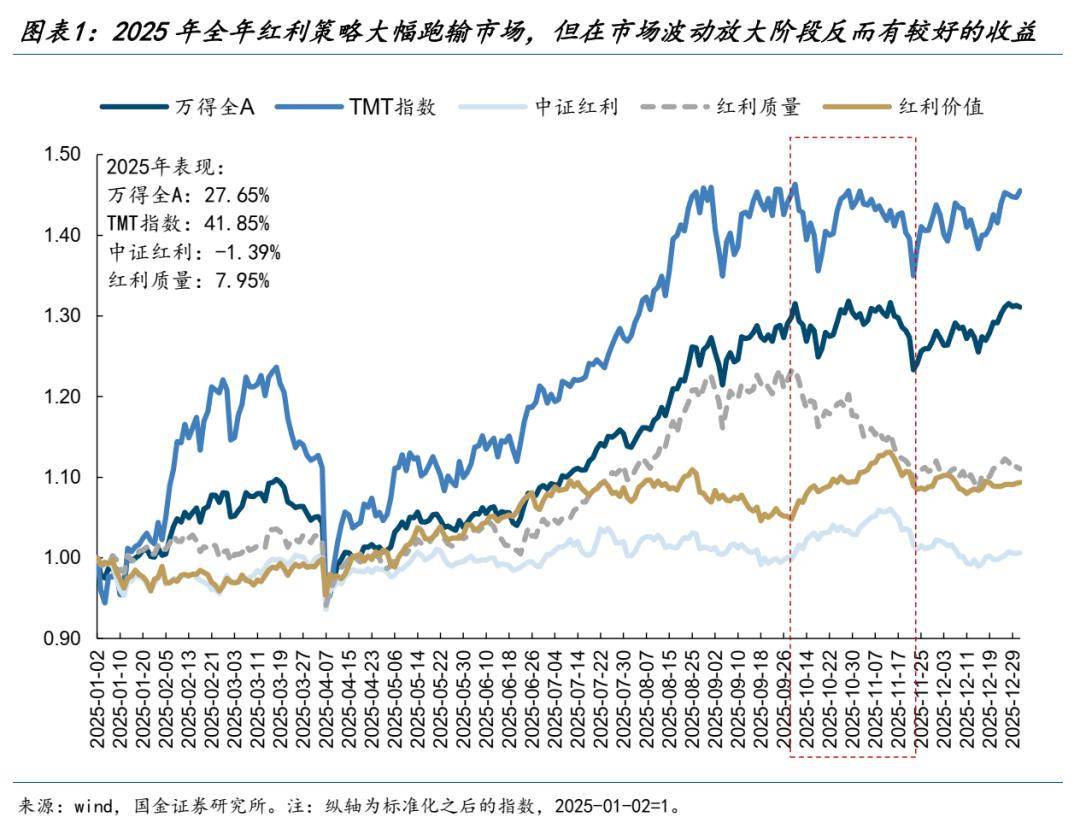
1月28日,恒生指数走势强劲,盘中创4年多新高,截至港股收盘,恒生指数涨2.58%,报27826.91点, 创4年多新高,恒生科技指数涨2.53%,报5900.16点,有色金属、石油、半导体板块领涨。中国石化油 服涨约15%,赤峰黄金涨约11%,山东黄金涨约9%,中铝国际涨约8%,泡泡玛特涨约7%。鸣鸣很忙上 市首日收涨69.06%。 半导体板块上涨,华虹半导体涨超7%,中芯国际涨超3%。继存储芯片大幅涨价后,已有模拟芯片公司 开始对部分产品进行涨价。公开资料显示,从2025年底起,德州仪器、ADI等国际模拟公司开始对部分 产品陆续启动涨价,涨价品类对应的下游应用领域主要为AI服务器、汽车电子等。值得一提的是,德 州仪器最新给出的强劲展望,凸显模拟芯片订单回升。 券商观点: 国金策略:跨市场比较来看,港股红利依旧具备性价比 国金策略认为在AI投资宏观风险较低、降息周期下全球制造业景气度向上的背景下,会有更多行业的 景气度出现改善,投资者可能还是会更加关注增长率而非股息率。因此在红利策略内部,行业选择上可 以更多地向基本面要弹性。跨市场比较来看,港股红利依旧具备性价比,但对于个人投资者而言考虑到 红利税之后可能 ...
国金策略:跨市场比较来看,港股红利依旧具备性价比
Sou Hu Cai Jing· 2026-01-28 05:23
【报告导读】在AI投资宏观风险较低、降息周期下全球制造业景气度向上的背景下,会有更多行业的景气度出现改善,投资者可能还是会更加关注增长 率而非股息率。因此在红利策略内部,行业选择上可以更多地向基本面要弹性。跨市场比较来看,港股红利依旧具备性价比,但对于个人投资者而言考虑 到红利税之后可能就没那么明显。 Summary 摘要 1一问红利:2026年是否会有超额? 2025年红利策略大幅跑输市场,最核心的原因在于市场找到了新的能够突破宏观趋势的成长性:以AI产业投资为代表,以及景气度也开始逐步扩散到与 AI强相关的"泛AI"领域。所以市场的定价驱动力从2022年至2024年上半年的股息率d逐步开始重新转向增长率g。展望2026年,红利策略是否会有相较于全 A的超额收益,核心判断还是在于市场是否依旧以基本面的边际变化作为核心驱动力?基于我们年度策略《世界的中国》对于2026年的基本面展望,在AI 投资宏观风险较低、降息周期下全球制造业景气度向上的背景下,2026年中国的企业盈利修复可能是股票市场的核心驱动力,会有更多的行业景气度出现 改善。在这种宏观背景下,我们认为投资者可能还是会更加关注基本面的边际变化(增长率) ...

向阳而行,潮起“兴”程 | 兴银基金2026投资策略会全景投视
Sou Hu Cai Jing· 2026-01-28 02:41
Core Insights - The 2026 investment outlook presented by Xingyin Fund highlights a landscape of opportunities and challenges, emphasizing a structural differentiation that nurtures long-term value [1] Equity Market - The equity market in 2026 is characterized by both opportunities and challenges, with global high volatility and domestic transitions between old and new driving forces [2] - Key investment themes include the extension of AI investments from TMT to broader sectors like power equipment, non-ferrous metals, and intelligent driving, alongside emerging areas like commercial aerospace [2] - The consumer healthcare sector has reached an attractive valuation after a prolonged adjustment, and Hong Kong stocks may see valuation recovery amid expectations of U.S. Federal Reserve rate cuts [2] - Investment principles emphasized include maintaining a "cyclical mindset, competitive advantage, safety margin, and priority on odds" to identify high-cost performance assets in a complex market [2] Consumer Sector - The consumer sector has entered a new era characterized by "total pressure and deep structural differentiation," driven by new demographics and demands [3] - Key trends are defined by three consumer groups: Generation Z, the elderly, and the new middle class, leading to three main investment lines: the experience economy focused on "emotional value," growth in "health and aging," and the integration of "AI and consumption" [3] - The previous consumer cycle has ended, with future leading companies emerging from current structural waves [3] Technology Investment - Technology development continues to evolve around three core directions: enhancing efficiency, improving life quality, and ensuring safety [4] - AI remains a central driving force for 2026, but investors are encouraged to identify truly capable companies beyond AI, focusing on areas like nuclear fusion, photolithography, brain-machine interfaces, quantum technology, and commercial aerospace [4] - Genuine investment opportunities lie with companies that address fundamental human needs and achieve key technological breakthroughs [4] Fixed Income Market - The fixed income market outlook for 2026 is optimistic, contrasting with the "weak operation and structural differentiation" of 2025 [5] - Market pricing has returned to rationality, with excessive rate cut expectations being digested, and a positive shift in supply-demand dynamics is anticipated [5] - Credit bonds are highlighted as a favored direction for 2026, supported by a trend of shrinking supply in urban investment bonds and the expansion of credit bond ETFs [5] - A strategic framework of "credit bonds as a shield and interest rate bonds as a spear" is recommended, focusing on mid-to-high-grade credit bonds for stable yields while leveraging interest rate bonds for trading opportunities [5] Overall Market Perspective - The 2026 market will unfold amidst complexity and structural opportunities, necessitating a return to fundamentals and in-depth research to identify and seize long-term value opportunities [6] - Xingyin Fund's strategy meeting showcased its investment philosophy based on deep research, diversified layouts, and rational responses to market dynamics, aiming to explore and capture opportunities in the evolving market landscape [6]

2026年AI投资新浪潮:电力基建破局和医疗健康蓝海双赛道布局
Jiang Nan Shi Bao· 2026-01-27 08:38
Group 1: AI Investment Trends - The core narrative of AI investment in 2026 is shifting from a broad approach to a more focused strategy, emphasizing key beneficiaries in infrastructure, companies with pricing power, and industries benefiting from productivity improvements [1][3] - New Horizon Global Advisory highlights that AI technology is no longer benefiting all sectors equally, with opportunities concentrated in specific areas such as infrastructure and healthcare [1][3] Group 2: Power Supply as a Bottleneck - Elon Musk emphasizes that the decisive factor in the AI race is power supply capability rather than just algorithms or chip performance, predicting that China's power generation could reach three times that of the U.S. by 2026 [2] - The energy consumption of generative AI services is significantly higher than traditional services, with estimates suggesting that by 2027, generative AI could consume between 85 to 134 terawatt-hours (TWh) of energy, equivalent to the annual electricity needs of countries like the Netherlands or Argentina [2] Group 3: Healthcare Sector Transformation - AI is becoming a core catalyst for structural changes in the healthcare industry, with applications in drug development, diagnostics, and cost control expected to drive significant transformations [5][6] - The Chinese government is actively promoting AI applications in healthcare, with guidelines issued to accelerate AI's role in drug development and medical diagnostics [6] Group 4: Market Dynamics and Opportunities - Major industry players are increasingly focusing on AI applications in healthcare, with companies like Ant Group and OpenAI launching AI health-related products [7] - The healthcare sector is witnessing improved fundamentals, with rising profit expectations and a resurgence in mergers and acquisitions, indicating a robust market environment [7] Group 5: Regulatory and Market Challenges - The commercialization of AI in healthcare is highly dependent on policy support and regulatory frameworks, with uncertainties surrounding business models and market demand potentially impacting revenue growth [8] - Despite the challenges, the AI investment landscape is evolving, moving towards a more pragmatic exploration of specific sectors like healthcare, which are expected to yield significant returns [8]
A股策略专题:2026年红利策略三问
SINOLINK SECURITIES· 2026-01-27 08:24
Group 1: Dividend Strategy Outlook for 2026 - The dividend strategy in 2025 significantly underperformed the market, primarily due to the emergence of new growth sectors like AI, which shifted market focus from dividend yield (d) to growth rate (g) from 2022 to mid-2024[2] - For 2026, the core judgment on whether dividend strategies can achieve excess returns hinges on whether the market continues to prioritize marginal changes in fundamentals[2] - With a low macro risk environment for AI investments and a recovery in corporate earnings expected, the focus may remain on growth rates rather than dividend yields, making excess returns from dividend strategies unlikely[2] Group 2: A-Shares vs. Hong Kong Stocks - Since April 2024, Hong Kong's low-volatility dividend index has outperformed A-shares by 49%, driven mainly by the industrial, financial, and energy sectors[3] - Despite the higher dividend yield of Hong Kong stocks, the PE valuation levels are now comparable to A-shares, indicating limited room for further convergence[3] - The relative performance of Hong Kong stocks is attributed more to stock selection rather than industry allocation, with financials, energy, and industrials contributing the most to excess returns[3] Group 3: Constructing the 2026 Dividend Portfolio - The 2026 dividend strategy should focus on sectors benefiting from AI investment, manufacturing recovery, and domestic consumption recovery, with traditional manufacturing and resource sectors expected to have the broadest benefits[3] - A scoring system combining payout ratios and stability with profitability metrics (ROE) is proposed to optimize sector allocation for dividends[3] - Recommended sectors for increased allocation include insurance, textile manufacturing, and logistics, while sectors with high potential but lower success rates, like banks and construction, should be considered for long-term investment[3]
A股策略专题20260127:2026 年红利策略三问
SINOLINK SECURITIES· 2026-01-27 07:17
一问红利:2026 年是否会有超额? 2025 年红利策略大幅跑输市场,最核心的原因在于市场找到了新的能够突破宏观趋势的成长性:以 AI 产业投资为代 表,以及景气度也开始逐步扩散到与 AI 强相关的"泛 AI"领域。所以市场的定价驱动力从 2022 年至 2024 年上半年 的股息率 d 逐步开始重新转向增长率 g。展望 2026 年,红利策略是否会有相较于全 A 的超额收益,核心判断还是在于 市场是否依旧以基本面的边际变化作为核心驱动力?基于我们年度策略《世界的中国》对于 2026 年的基本面展望, 在 AI 投资宏观风险较低、降息周期下全球制造业景气度向上的背景下,2026 年中国的企业盈利修复可能是股票市场 的核心驱动力,会有更多的行业景气度出现改善。在这种宏观背景下,我们认为投资者可能还是会更加关注基本面的 边际变化(增长率)而非股息率。所以 2026 年红利策略似乎很难获取超额收益。但这并不意味着红利策略不重要, 因为它依旧是很多投资者构建投资组合的压舱石和降低组合波动的重要工具:一方面,A 股权益资产内部红利资产的 估值水平最低,波动率也相对较低;另一方面,与主要城市二手住宅租金回报、10 年期 ...
综合晨报-20260126
Guo Tou Qi Huo· 2026-01-26 06:19
Group 1: Oil and Related Products - The US Treasury imposed new sanctions on Iran, increasing concerns about Middle East crude supply disruptions. The Tengiz oil field's extended shutdown and US cold wave also affected the market. Despite a recent price rebound, the high inventory pressure in Q1 2026 may limit the price increase [2]. - Low - sulfur fuel oil followed crude oil in a callback due to the end of cold - wave speculation and EIA's unexpected inventory build - up. High - sulfur fuel oil remained strong, supported by geopolitical tensions and the strengthening of Asian spot spreads [22]. - Kpler data shows sufficient Venezuelan crude arrivals in January, but a significant reduction in shipments since January may lead to supply shortages in February and subsequent months. Cost support and weak terminal demand suggest a short - term bullish but volatile outlook for asphalt [23]. Group 2: Precious Metals - Geopolitical risks have raised the price center of precious metals. However, after gold and silver broke through key price levels, there may be short - term fluctuations due to profit - taking and overbought technical indicators. It is advisable to wait for a stable period before re - entering the market [3]. Group 3: Base Metals - Copper prices were pushed up by the trading sentiment of precious metals and a weak US dollar. Supply - side factors such as strikes in Chilean small mines and roadblocks affecting large mines are being monitored [4]. - Aluminum prices rebounded on Friday. Geopolitical factors caused market sentiment to fluctuate. The price is expected to oscillate at a high level, and attention should be paid to the price direction of gold and silver after breaking through key levels [5]. - Zinc prices are expected to oscillate between 24,000 - 25,000 yuan/ton in the short term. There is an opportunity for short - selling at the 25,000 yuan/ton level due to the expected supply surplus [8]. - Lead prices are expected to oscillate between 17,000 - 17,800 yuan/ton. The production of recycled lead is restricted by high costs and low prices, and environmental protection policies may affect future production [9]. - Nickel prices rose significantly with active trading. However, there is a risk of negative feedback from downstream due to high prices. Short - term sentiment is positive, and a long - position strategy is recommended [10]. - Tin prices continued to rise, driven by investment funds and the expected long - term demand from AI - related investments [11]. Group 4: Industrial Metals and Alloys - Cast aluminum alloy prices follow the trend of Shanghai aluminum. The market is inactive, and the supply surplus is difficult to change. The price difference with Shanghai aluminum is weaker than in previous years [6]. - Alumina production capacity is still high, and the supply surplus persists. With falling ore prices, the cost has decreased, but the price is under pressure, and the upside of the futures price is limited [7]. - Industrial silicon's supply is expected to be affected if major enterprises cut production. Demand is weakening, and inventory is increasing. The price is expected to be strong in the short term, and attention should be paid to whether it can break through the 9,000 yuan/ton level [14]. Group 5: Steel and Iron - related Products - Steel prices rebounded slightly. Rebar demand decreased slightly, production increased, and inventory accumulated again. Hot - rolled coil demand and production both decreased slightly, and inventory continued to decline [15]. - Iron ore prices oscillated last week. Global shipments decreased seasonally but remained high year - on - year. Domestic port inventory increased significantly. Demand is weak, but there is still an expectation of winter stockpiling [16]. - Coke prices rebounded. The first price increase was postponed, production decreased slightly, and inventory increased slightly. The market is expected to oscillate in a range [17]. - Coking coal prices rebounded slightly. Production increased slightly, inventory increased, and winter stockpiling demand continued. The price is expected to oscillate in a range [18]. - Manganese ore prices increased slightly. There are structural problems in port inventory. Silicon - manganese production decreased slightly, and inventory decreased slightly. A short - selling strategy on price rebounds is recommended [19]. - Silicon - iron prices increased slightly. Affected by policies, the price is relatively strong. Supply decreased significantly, inventory decreased slightly. A short - selling strategy on price rebounds is recommended [20]. Group 6: Chemical Products - Polycrystalline silicon's overseas orders increased, but the spot trading is weak. The futures price may face pressure in the future, waiting for the official guidance from the exchange [13]. - Urea prices were stable over the weekend. Downstream demand increased, and production enterprises continued to reduce inventory. The price is expected to oscillate strongly in the medium - to - long term [24]. - Methanol prices fluctuated due to geopolitical factors. Overseas production is low, and domestic port inventory is high. However, the expected reduction in imports in Q1 provides support, and the short - term price is expected to be strong [25]. - Pure benzene's upward momentum weakened. Supply decreased, demand increased slightly, and inventory in East China ports decreased significantly. The short - term price is expected to oscillate strongly, and slow inventory reduction is expected in the long term [26]. - Styrene prices increased significantly, but downstream resistance to high prices may limit the upside. Supply - demand competition may intensify [27]. - Propylene supply has no obvious pressure, and downstream demand is weak. Polyethylene supply will increase, and demand is weakening. Polypropylene supply pressure is not large, but demand is weak [28]. - PVC prices are strong. Factory inventory decreased, but social inventory increased. There is a possibility of capacity reduction and increased exports this year. Caustic soda prices are oscillating, with high inventory and high production. The profit of chlor - alkali integration may continue to be compressed [29]. - PX and PTA prices increased. There is a risk of inventory accumulation around the Spring Festival. In Q2, there may be opportunities for long - positions in PX processing margins and positive spreads, subject to downstream demand [30]. - Ethylene glycol production decreased slightly, and polyester load is expected to decline. There is an expectation of inventory accumulation around the Spring Festival. In Q2, supply - demand conditions may improve, but the long - term price is under pressure [31]. - Short - fiber production is high, and inventory is low. Downstream orders are weak, but sales increased due to raw material price increases. Bottle - chip production decreased, and processing margins improved slightly. Long - term capacity pressure remains [32]. Group 7: Building Materials - Glass inventory increased slightly, and there is a risk of further accumulation during the downstream holiday season. Production is currently unprofitable, and the price may fluctuate with the macro - environment. Attention should be paid to future capacity changes [33]. - Soda ash inventory decreased slightly but remains under pressure. Some enterprises cut production. The short - term price is expected to follow the macro - trend, and a short - selling strategy on price rebounds is recommended in the long term [34]. Group 8: Agricultural Products - Soybean meal prices oscillated. South American soybean harvest is affected by weather, and Chinese soybean purchases are progressing. Attention should be paid to the Brazilian harvest and potential imports from Canada [35]. - Palm oil and soybean oil prices are strong. US biomass diesel policies are favorable, and the supply - demand situation in Indonesia and Malaysia needs to be monitored [36]. - Rapeseed and rapeseed oil prices are expected to oscillate at the bottom. Rapeseed supply in Canada is sufficient but exports are weak. The supply of rapeseed oil may be slightly tighter than that of rapeseed meal [37]. - Domestic soybean prices rebounded from a low level. Attention should be paid to policy and spot market guidance [38]. - Corn prices are relatively strong due to reduced available supply and pre - holiday restocking demand. Future price trends depend on the sales progress in Northeast China and auction results [39]. - Pig prices are expected to be strong before the Spring Festival but weak after the holiday. The industry still needs to reduce production capacity, but the current price recovery may slow down this process [40]. - Egg prices are strong due to pre - festival stocking and reduced supply. In the long - term, the fundamental situation is improving, and a long - position strategy on price dips is recommended [41]. - Cotton prices are oscillating. US cotton exports increased significantly. Domestic cotton inventory is high, but demand is stable. The impact of the reduction in Xinjiang's planting area is uncertain [42]. - Sugar prices are oscillating. Indian sugar production is progressing rapidly, while Thai production is slow. In China, the focus is on the expected difference in production. The short - term price faces pressure [43]. - Apple prices are oscillating. Cold - storage sales increased for the Spring Festival, but poor fruit quality and high prices may affect inventory reduction [44]. - Wood prices are at a low level. Supply is expected to decrease, demand has increased slightly, and low inventory provides some support. Temporarily hold off on trading [45]. - Pulp prices are oscillating. Downstream demand is weak, and inventory has been increasing for three consecutive weeks. Paper mills' purchases are mainly for immediate needs. Temporarily hold off on trading [46]. Group 9: Financial Products - A - share indexes rose, and futures contracts showed different trends. The market is concerned about the continuity of US dollar liquidity repair and the impact of the Greenland conflict on risk appetite. A - shares are expected to shift from rapid upward movement to a strong - oscillating trend [47]. - Bond prices were strong last week. In the short - term, the yield of medium - to - long - term bonds is likely to oscillate, and the short - term yield may continue to decline due to loose liquidity. There are opportunities for steepening the yield curve and flattening the ultra - steep spread [48]. Group 10: Shipping - The container shipping index (European line) oscillated last week. The "weak reality" logic suppressed the price, while CMA CGM's suspension of resuming flights provided short - term support. The market is expected to be weak - oscillating in the future, and the key factors for near - term and far - term contracts are different [21].
1月26日国际晨讯丨现货黄金首次突破5000美元/盎司 美联储即将举行2026年首次议息会议
Sou Hu Cai Jing· 2026-01-26 00:47
Market Review - The Nikkei 225 index opened at 53023.28 points, down 1.53% [1] - The Korean Composite Index opened at 4997.54 points, up 0.1% [1] - Spot gold surpassed $5000 per ounce for the first time, increasing by approximately 1% [1] - Spot silver also reached a new high, rising over 2% to a maximum of $106.541 per ounce [1] - On January 23, the US major stock indices closed mixed, with the Dow Jones down 0.58% at 49098.71 points, the S&P 500 up 0.03% at 6915.61 points, and the Nasdaq up 0.28% at 23501.24 points [1] - For the week, the Dow Jones fell 0.52%, the S&P 500 dropped 0.35%, and the Nasdaq decreased by 0.06% [1] - In Europe, major stock indices closed mixed, with the DAX up 0.18% at 24900.71 points, the CAC40 down 0.07% at 8143.05 points, and the FTSE 100 down 0.07% at 10143.44 points [1] - For the week, the DAX fell 1.57%, the CAC40 dropped 1.4%, and the FTSE 100 decreased by 0.9% [1] Upcoming Events - The Federal Reserve is set to hold its first monetary policy meeting of 2026 on January 29, with expectations that it will maintain current rates [2] - Market focus for Tesla's earnings report has shifted from financial data to advancements in Full Self-Driving (FSD) systems, humanoid robots, and Robotaxi technology [2] - Microsoft and Meta will address whether companies are beginning to benefit from AI investments [2] Institutional Insights - Goldman Sachs has raised its 2026 gold price forecast to $5400 per ounce from a previous estimate of $4900 per ounce, citing diversification in private investment as a key factor for gold's upward movement [3] Company News - Nvidia's founder Jensen Huang visited the company's new office in Shanghai, engaging with employees and addressing their concerns [4] - Tesla CEO Elon Musk announced that the FSD system requiring driver supervision is expected to be approved in China as early as next month, aligning closely with its approval timeline in Europe [4] - Amazon plans a second round of layoffs as part of a larger plan to cut approximately 30,000 jobs, with the latest round expected to be similar in scale to the 14,000 white-collar positions cut in October 2025 [4]





中国银行:2026中国银行个人金融全球资产配置白皮书
Sou Hu Cai Jing· 2026-01-24 08:01
Core Viewpoint - The report outlines the global asset allocation strategy for personal finance by Bank of China, predicting a slow recovery in the global economy in 2026, with a focus on the performance of various asset classes amid changing monetary policies and economic conditions. Economic Overview - In 2025, global economic growth is expected to slow down with inflation receding, leading G10 countries (excluding Japan) into a rate-cutting cycle. The Federal Reserve's continued rate cuts are anticipated to push the US dollar index down, resulting in strong global asset performance, particularly in gold and silver, while oil is expected to be the only asset with negative returns. The Chinese asset market is entering a phase of value reassessment, with a slow bull market forming and the RMB expected to appreciate against the USD [1][8]. - For 2026, the global economy may continue its weak recovery, with uncertainties remaining. China's economy is projected to stabilize and grow between 4.7% and 5.0% due to supportive macro policies. The US is expected to see reduced policy uncertainty, while the Eurozone's economic fundamentals remain robust, and the UK economy shows resilience [1][8][10]. Equity Market - The internationalization and value reassessment of Chinese assets are ongoing, with the A-share market expected to solidify its slow bull market and potentially evolve into a long bull market. Hong Kong stocks are positioned to benefit from global liquidity inflows as a core hub for RMB asset allocation. The US stock market is expected to rise but may underperform compared to non-US markets, while European and Japanese markets are anticipated to see moderate gains [1][9][12]. Bond Market - The bond market is influenced by the Federal Reserve's rate cuts and balance sheet expansion, leading to a downward shift in US Treasury yields. The UK bond market shows high allocation value, while German bonds are expected to perform slightly weaker. In China, the 10-year government bond yield is projected to fluctuate between 1.6% and 1.9% [2][10][11]. Foreign Exchange Market - The trend of "de-dollarization" is expected to continue, with the US dollar's central tendency likely to decline. Non-US currencies are showing mixed performance, with the Euro and Malaysian Ringgit slightly stronger, while the Japanese Yen, British Pound, Australian Dollar, and Indonesian Rupiah are in the middle range. The RMB is expected to fluctuate within a stable range against the USD and may depreciate slightly against other major non-US currencies [2][10][20]. Commodity Market - The long-term upward trend for gold remains solid, with expectations for new historical highs in 2026, albeit with increased volatility. Silver is also expected to trend upwards due to multiple support factors. The demand dynamics for copper and aluminum are being reshaped by AI developments, while oil is expected to remain in a supply surplus situation. Prices for polyester and industrial silicon are anticipated to recover due to supportive policies, and lithium carbonate is expected to see price fluctuations based on supply and demand changes [2][11][12]. Asset Allocation Strategy - The recommended global asset allocation order for 2026 is precious metals, non-ferrous metals, equities, and bonds. Gold and silver are expected to outperform copper and aluminum, while non-US equities are projected to outperform US stocks. In the bond sector, US Treasuries are favored over Chinese bonds, and oil is suggested for lower allocation [3][11][12].


美联储政策突传转向 沪金警示回调风险
Jin Tou Wang· 2026-01-22 06:05
Group 1 - Gold futures are currently trading around 1074.22, with a slight decline of 0.09%, reaching a high of 1099.62 and a low of 1074.00 [1] - The short-term outlook for gold futures appears bearish [1] Group 2 - A Reuters survey indicates that most economists expect the Federal Reserve to maintain the benchmark interest rate at 3.50%-3.75% this quarter, reversing previous expectations of a rate cut before March [3] - The strong growth outlook for the U.S. economy and persistent inflation above the 2% target are the main reasons supporting this judgment [3] - 58% of economists surveyed expect no change in rates this quarter, with a consensus that the January FOMC meeting will result in no action [3] - Concerns about political interference are rising, with Trump criticizing Powell for not cutting rates effectively and potential criminal investigations into Powell's actions [3] Group 3 - The survey has raised the U.S. GDP growth forecast for this year to 2.3%, up from 2% last month, with an average of 2% expected by 2028 [4] - The chief economist at Oxford Economics is more optimistic, predicting a growth rate of 2.8% due to AI investments and tax cuts contributing 0.6 percentage points [4] - Inflation, as measured by PCE, is expected to remain above the 2% target this year and through 2028, with an average unemployment rate of 4.5% [4] Group 4 - As of January 22, 2026, the main gold futures contract has surpassed 1100 yuan/gram, creating a historical high and showing a high-level oscillation [5] - Technical indicators suggest a bullish trend in the short term, but caution is advised due to the RSI nearing the overbought zone [5] - Support is noted at 1090 yuan/gram, while resistance is observed at 1120 yuan/gram, with geopolitical tensions and global central bank gold purchases supporting the long-term trend [5]