AI科技

Search documents
AI科技+沃什提名=强美元还是“黄金坑”?
Sou Hu Cai Jing· 2026-02-03 08:52
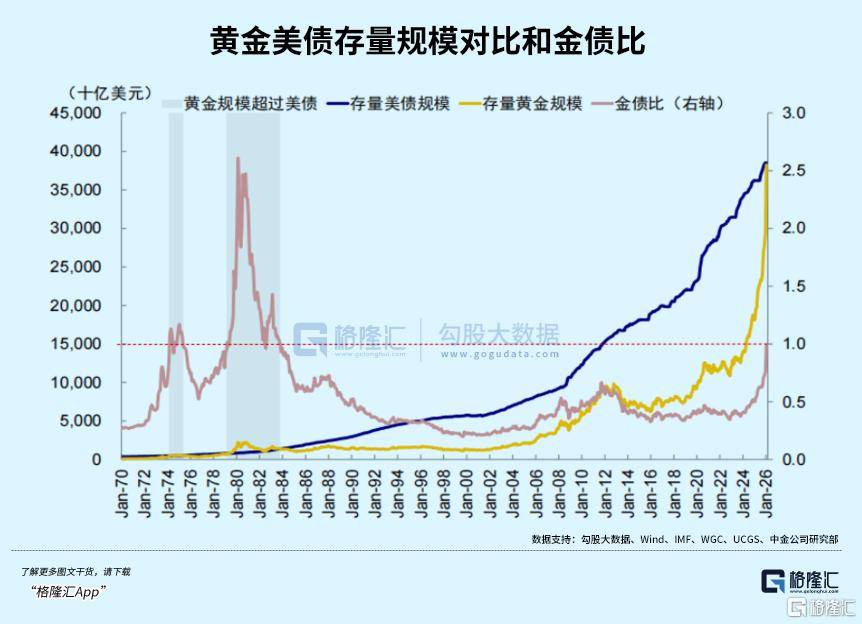
最近的市场跟"坐过山车"似的:黄金冲到5500美元/盎司历史高位,转头一天跌9%创40年最大跌幅;美元指数上周跌至近4年新 低,又因"沃什提名"反弹。 01 背后更关键的是美元信用在松动。当前全球黄金总价值(38.2万亿美元)快赶上美债规模(38.5万亿美元),这是80年代以来 头一回。以前美元是老大,美债是硬通货,现在黄金能跟它平起平坐,说明大家对美元没那么信了——就像以前都认一家银行 的存单,现在大家开始把钱换成黄金藏着,信号再明确不过了。 02 再聊AI科技:或成美元走强"新引擎",对黄金有两面性 不少粉丝朋友在问我们:新美联储主席沃什的提名+炒得火热的AI科技,到底会让美元变强,还是给黄金挖个抄底"坑"?今天 给大家拆解一下背后的影响逻辑和机会判断。 先看大环境:全球旧秩序回不去,美国自己一堆麻烦 现在的全球格局很直白:以前一起搭伙做生意,现在各算各的账。特朗普上台后把"美国优先"和"极限施压"贯彻到底,对盟友 加关税、逼乌克兰让渡矿产权益,甚至想"买"格陵兰岛,欧盟、加拿大直接反制,这就是逆全球化的真实样子。 杀敌一千自损八百,美国经济也跟着遭殃。最近生产端通胀(PPI)超预期,企业生产的东西还是贵 ...

黄金、白银暴跌前夕,但斌警示风险!旗下研究员却赚了十几亿?(附最新持仓)
私募排排网· 2026-02-03 07:00
Core Viewpoint - The international precious metals market recently experienced significant volatility, with gold futures dropping over 11% and silver futures plummeting by 31.37%, marking the worst single-day performance since March 1980. This decline followed a bullish trend in precious metals, prompting warnings from prominent investors about potential risks [2]. Group 1: Market Analysis - On January 28, a notable private equity figure, Dan Bin, warned of a potential market correction following a surge in prices, referencing historical data where gold and silver experienced drastic declines after reaching peak prices in 1980 and 2011, respectively [2]. - Dan Bin has been heavily invested in U.S. AI technology stocks and has shown little interest in gold stocks, leading to skepticism about his warnings regarding gold. He clarified that his lack of investment in gold does not influence his perspective [3]. Group 2: Performance Metrics - Dan Bin's management of 77 private equity products has yielded an average return of ***% for 2025, with a three-year average return of ***%, placing him at the top among private equity founders in the last three years [4]. - The latest disclosures of Dan Bin's fund, Dongfang Gangwan, revealed a total holding of 10 U.S. stocks valued at approximately $1.316 billion, equivalent to over 9.1 billion RMB, with Google surpassing Nvidia as the largest holding [5][6].



多重利空导致A股下跌,需耐心等待市场企稳
British Securities· 2026-02-03 01:44
Market Overview - The A-share market is experiencing a downturn due to multiple negative factors, with a notable decline in trading volume and a cautious sentiment among investors as the Spring Festival approaches [2][9] - On the previous Monday, all three major indices fell over 1%, with the precious metals and non-ferrous metals sectors leading the decline, while sectors like ultra-high voltage and liquor showed resilience [5][6] Key Drivers of Market Movement - The recent drop in the market can be traced back to significant fluctuations in the international precious metals market, which affected the commodity market and subsequently impacted related A-share sectors [2][9] - The appointment of a new Federal Reserve Chairman has led to a reassessment of global liquidity policies, tightening market liquidity further due to increased margin requirements on futures contracts [2][9] Sector Performance - Consumer stocks, particularly in the liquor sector, have shown activity as the government emphasizes domestic demand, with policies aimed at stimulating consumption since 2025 [7] - The ultra-high voltage sector has seen gains, driven by the increasing demand for high-power, stable electricity supply in the context of the global AI computing infrastructure boom [8] Investment Strategy - Investors are advised to remain patient and wait for market sentiment to stabilize, liquidity to improve, and clear positive fundamentals to emerge before increasing their investment positions [3][9] - The report highlights three key investment directions in the consumer sector: structural opportunities aligned with demographic trends, service consumption upgrades, and safety-focused investments in agriculture and related sectors [7]
A股港股波动加大,机构热评:震荡中酝酿新机会
Sou Hu Cai Jing· 2026-02-03 01:32
Group 1 - A-shares experienced significant volatility, with the Shanghai Composite Index dropping by 2.48% on the first trading day of February 2026, marking the largest single-day decline since April 2025 [1] - Some funds shifted from cyclical and technology sectors to defensive sectors such as agriculture and consumer goods, while the overall strategy remains focused on AI technology and cyclical sectors [1][2] Group 2 - The decline in the A-share market is attributed to multiple factors, including overseas liquidity expectations due to the nomination of Kevin Warsh as Fed Chair, which raised concerns about tightening financial conditions [2] - The commodity market's high volatility, particularly in gold and silver prices, also contributed to the market downturn [2] - The approach of the Chinese New Year holiday has led to increased market caution and observation [2] Group 3 - According to Shenwan Hongyuan, the current market issues are primarily due to overtrading of trend assets, and the weak dollar cycle is not ending but rather shifting in logic [3] - The long-term logic of "cyclical Alpha, supply constraints + new economic demand + strategic resource security + weak dollar" remains intact [3][4] Group 4 - Shenwan Hongyuan suggests that a prolonged period of market fluctuation is expected before a new upward trend emerges, with a focus on AI applications and the chemical sector [4] - The AI industry continues to progress, with potential gradual transition towards application, while the cyclical Alpha recovery has not yet reached extreme values [4] Group 5 - Guotai Junan believes that after the market decline, there is potential for stabilization and a recovery in the upward trend before the Chinese New Year, maintaining a positive outlook on the Chinese stock market [5] - The focus is shifting towards domestic demand, which is expected to enhance the economic outlook and asset returns [5] Group 6 - Emerging technologies are seen as a main investment theme, with recommendations for sectors such as internet, media, computing, and robotics [6] - The expansion of domestic demand is identified as a key growth driver, with recommendations for food and beverage, consumer services, and aviation sectors [6] - The financial sector is viewed as a stabilizing force, benefiting from the growth in wealth management demand, with recommendations for insurance, brokerage, and banking [6] Group 7 - Suggested ETFs for investment include: - AI applications/emerging technology: Hang Seng Internet ETF (513330.SH), Media ETF (516190.SH) - Domestic demand: Food and Beverage ETF (515170.SH) - Financial sector: Hong Kong Stock Connect Financial ETF (513190.SH) - Broad market: CSI 300 ETF (510330.SH) [7]
2026:一定重视“4个再均衡”
Hua Er Jie Jian Wen· 2026-02-03 00:27
Core Viewpoint - The transition towards "new and old coexisting" for institutional investors is occurring, indicating a shift from "new surpassing old" in 2025 to a balanced allocation in 2026, emphasizing the need to invest in both AI technology and cyclical sectors like manufacturing and commodities [1][3]. Group 1: Technology Sector Rebalancing - The essence of the "new" is the downward movement of AI technology, transitioning towards the fourth stage of supply-demand gaps, with upstream gaps in copper, storage, and power equipment, and downstream gaps in AI applications and components [1][3]. - The internal rebalancing within technology indicates a need to avoid simplistic trading strategies based on risk preferences [3]. Group 2: Export and Overseas Business Rebalancing - The "old" aspect reflects a shift in exports and overseas business towards the midstream, with traditional industries stabilizing and growing profits as they move from downstream manufacturing to midstream sectors like engineering machinery, wind power, chemicals, and industrial metals [1][3]. - The rebalancing in overseas business highlights the increasing profitability and growth potential of midstream manufacturing compared to downstream exports [3][24]. Group 3: Resource Pricing Rebalancing - In 2026, resource pricing may not align with the assumption of a consistently weak dollar, suggesting a potential for a stronger dollar, emphasizing the return to commodity attributes and a decline in financial attributes [1][4]. - The focus on resource pricing indicates that commodities driven by supply-demand fundamentals are more likely to see price increases, making them attractive for continued investment [4][24]. Group 4: Institutional Investor Trends - Observations from Q4 2025 indicate a clear consensus among institutional investors on AI technology, overseas equipment, and globally priced resources as key investment areas, with these sectors showing significant gains in the A-share market [2][5]. - The increase in FOF products and the rise of passive funds reflect a strong demand for stable, income-generating investment products, while active funds are experiencing a decline [5][41]. Group 5: Sector-Specific Insights - In Q4 2025, institutional investors increased their holdings in sectors such as non-ferrous metals, communication, basic chemicals, non-bank financials, and machinery, while reducing exposure in pharmaceuticals, computing, electronics, media, and renewable energy [5][6]. - The allocation towards AI technology is showing divergence, with a decrease in holdings for sectors with weaker earnings visibility, while sectors with strong earnings, like CPO, are seeing increased investment [6][10].
国投策略:2026年AI新科技要配,但顺周期这些“老东西”也要明显增配
Sou Hu Cai Jing· 2026-02-02 12:23
Core Conclusion - The institutional investors are shifting towards a "rebalancing" strategy for 2026, transitioning from "new triumphs over old" in 2025 to a "dance of new and old" in 2026. This indicates a need to allocate to both AI technologies and traditional cyclical sectors like manufacturing and commodities, marking a significant rebalancing trend [1][2]. Group 1: Rebalancing Trends - The rebalancing involves a focus on AI technology moving downstream, addressing supply-demand gaps in the fourth stage, with upstream gaps in copper, storage, and power equipment, and downstream gaps in AI applications and components [1][2]. - Traditional industries are stabilizing and growing profits from overseas operations, transitioning from downstream manufacturing to upstream sectors such as engineering machinery, wind power, chemicals, and industrial metals [3][4]. - The pricing of resource commodities in 2026 may not align with a consistently weak dollar assumption, suggesting a potential for stronger dollar conditions and a return to commodity fundamentals, making certain resource commodities more attractive for investment [3][4]. Group 2: Institutional Investment Insights - By Q4 2025, institutional investors showed a clear consensus on allocating to AI technology, overseas equipment, and globally priced resource commodities, which were the leading sectors in the A-share market prior to the Spring Festival [1][2]. - The share of technology and overseas sectors in A-share profits (excluding finance) is expected to approach 40% by 2025, indicating a significant shift towards high-end technology and manufacturing or export-oriented sectors [1][2]. - Observations from Q4 2025 indicate a notable increase in FOF products and a rise in demand for stable income-generating products, reflecting a strong interest in diversified asset allocation [4][5]. Group 3: Sector Performance and Changes - In Q4 2025, the top sectors for institutional investment included non-ferrous metals, communication, basic chemicals, non-bank financials, and machinery, while sectors like pharmaceuticals, computing, electronics, and media saw reductions in investment [5][6]. - The TMT sector's allocation has decreased to 37.95% due to mixed performance in earnings, with a notable increase in positions in high-performing areas like optical modules, while sectors with weaker earnings like integrated circuits and computing equipment saw reductions [6][7]. - The investment in resource commodities, particularly in non-ferrous and chemical sectors, has increased significantly, indicating a bullish outlook on these commodities due to expected price increases [6][7].
黄金白银,能抄底了吗?
Sou Hu Cai Jing· 2026-02-02 11:54
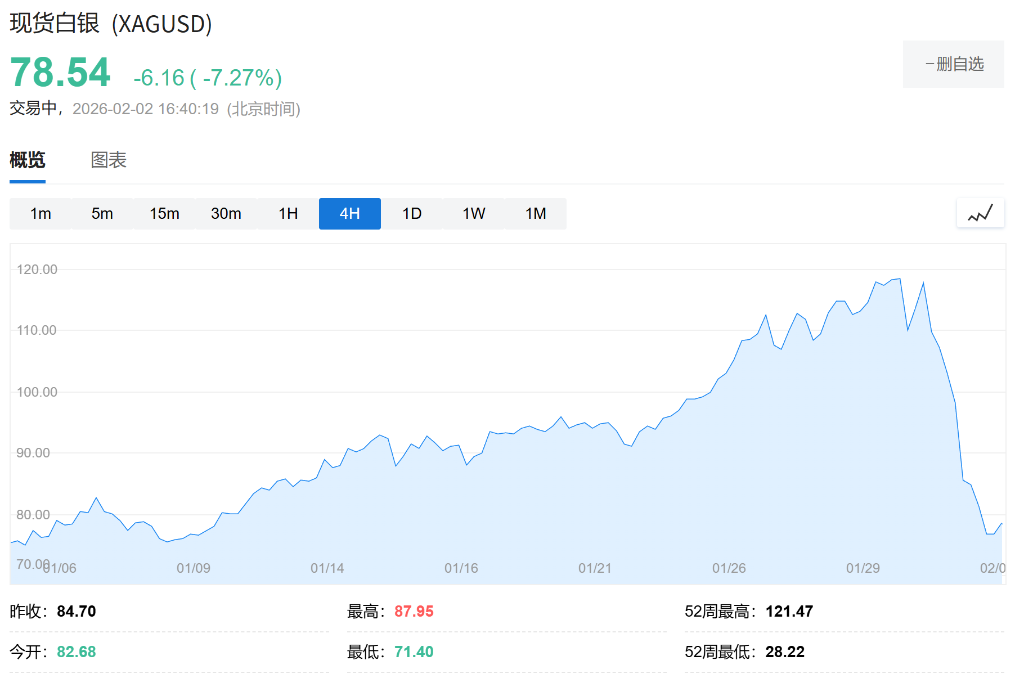
周一的贵金属市场延续周五下跌趋势,现货黄金一度跌到4400美元关口。 现在的局面非常清晰:资金获利了结,杠杆资金正在被强制出清。 现货白银也一度跌到71美元附近。 多家研究机构认为,尽管长期的地缘博弈和债务逻辑未变,但短期内,不要试图在雪崩时伸手去接"带血的筹码"。此时的下跌是市场在测试新任美联储主 席的底线,也是对前期疯狂投机情绪的暴力修正。 金银暴跌:不仅是沃什,更是去杠杆的连锁反应 本次暴跌并非单一因素所致,而是政策预期、交易拥挤度与交易所干预的共振。 1. 导火索:沃什获提名,鹰派预期升温。 华泰证券与天风证券均指出,特朗普提名凯文·沃什(Kevin Warsh)为新任美联储主席是直接触发剂。沃什被视为"鹰派",其核心主张包括"降息+缩表"。 天风证券补充,沃什曾在2006-2011年任职期间以"通胀鹰派"著称,市场担忧其上任后美联储独立性危机降温,导致美元反弹,流动性收紧预期压制了贵 金属。 2. 机制性杀跌:交易所联手"降温"。 华泰证券与财通证券强调了交易所干预的影响。CME(芝商所)和上期所几乎同时提高保证金比例。CME在1月底连续两次上调黄金和白银保证金,其中 白银从11%上调至15%;上期 ...

【招银研究|资本市场快评】如何看待A股大跌——短期震荡消化不改中期趋势
招商银行研究· 2026-02-02 11:46
Core Viewpoint - The recent decline in the A-share market is primarily driven by external liquidity shocks and internal capital withdrawal, with a significant impact from the hawkish stance of the new Federal Reserve chairman [2]. Group 1: Market Decline Reasons - The core trigger for the market drop is the hawkish expectation of the Federal Reserve's balance sheet reduction, leading to a global liquidity repricing [2]. - The A-share market, which has been largely liquidity-driven since the bull market began on September 24, 2024, is particularly sensitive to changes in policy expectations [2]. - Domestic factors, including reduced leverage by exchanges and significant ETF redemptions, have further suppressed market sentiment, with a record net redemption of 780 billion yuan in January [2]. Group 2: A-share Market Outlook - The current pricing of the A-share market reflects a certain bias against the Federal Reserve's hawkish stance, with expectations that the new chairman will balance interest rate cuts with the realities of dollar liquidity [3]. - As the market approaches a reasonable valuation, regulatory goals for cooling the market will likely be achieved, leading to a potential shift towards more positive policy [3]. - Historical patterns suggest a strong likelihood of a spring rally between the Lunar New Year and the Two Sessions, with a historical probability of around 90% for market gains during this period [3]. - Defensive attributes are expected from undervalued domestic assets during periods of external volatility, as evidenced by the resilience of banking and food and beverage sectors [3]. - Following stabilization of market sentiment, there is potential for continued investment in AI technology and overseas manufacturing, alongside increased allocation to high-dividend sectors like banking and consumer goods to enhance portfolio resilience [3].


黄金白银,能抄底了吗?
华尔街见闻· 2026-02-02 10:13
周一的贵金属市场延续周五下跌趋势,现货黄金一度跌到4400美元关口。 现货白银也一度跌到71美元附近。 现在的局面非常清晰: 资金获利了结,杠杆资金正在被强制出清。 多家研究机构认为,尽管长期的地缘博弈和债务逻辑未变, 但短期内,不要试图在雪崩时伸手去接"带血的筹码"。 此时的下跌是市场在测试新任美联储主席 的底线,也是对前期疯狂投机情绪的暴力修正。 金银暴跌:不仅是沃什,更是去杠杆的连锁反应 本次暴跌并非单一因素所致,而是政策预期、交易拥挤度与交易所干预的共振。 1. 导火索:沃什获提名,鹰派预期升温。 华泰证券与天风证券均指出,特朗普提名凯文·沃什(Kevin Warsh)为新任美联储主席是直接触发剂。沃什被视为"鹰派",其核心主张包括"降息+缩表"。 天风证券补充,沃什曾在2006-2011年任职期间以"通胀鹰派"著称,市场担忧其上任后美联储独立性危机降温,导致美元反弹,流动性收紧预期压制了贵金属。 2. 机制性杀跌:交易所联手"降温"。 华泰证券与财通证券强调了交易所干预的影响。CME(芝商所)和上期所几乎同时提高保证金比例。CME在1月底连续两次上调黄金和白银保证金,其中白银 从11%上调至15%; ...

金银“史诗级巨震”之后,可以抄底了吗?
Hua Er Jie Jian Wen· 2026-02-02 09:06
Core Viewpoint - The precious metals market continues to decline, with silver dropping 7% and gold falling 4.7%, breaching the $4500 mark, indicating a significant market correction driven by profit-taking and forced liquidation of leveraged positions [1][4]. Group 1: Market Dynamics - The recent drop in precious metals is attributed to multiple factors, including policy expectations, trading congestion, and exchange interventions [5]. - The nomination of Kevin Warsh as the new Federal Reserve Chairman has heightened hawkish expectations, leading to a stronger dollar and tighter liquidity, which negatively impacts precious metals [5][10]. - Exchanges like CME and SHFE have raised margin requirements, contributing to the market's downward pressure [5][7]. Group 2: Speculative Positioning - Prior to the crash, silver was one of the most crowded long positions globally, with extreme speculative positioning indicated by a 14-day RSI for gold exceeding 90, marking a historic high [7]. - The volatility index for silver reached 111, the highest on record, suggesting a precarious market environment where any reversal in sentiment could lead to severe deleveraging [7][10]. Group 3: Macro Influences - Concerns over profitability in AI tech stocks, such as those reported by Microsoft and Tesla, have led to a risk-off sentiment in the U.S. stock market, prompting some investors to liquidate precious metals to maintain liquidity [10]. Group 4: Future Outlook - Despite the short-term turmoil, institutions believe the long-term bullish logic for precious metals remains intact, supported by ongoing demand from central banks and concerns over U.S. debt sustainability [11][13]. - The market is expected to experience a period of wide fluctuations, with cautious buying sentiment prevailing in the near term [13][14]. Group 5: Investment Timing - Investors are advised to be patient and wait for volatility to decrease before entering the market, with specific indicators such as implied volatility dropping below 20% being suggested as potential entry points [16]. - Historical data indicates that gold typically sees an average pullback of about 8% over approximately 18 days after reaching a peak, providing a reference for potential timing [16]. - There is a warning regarding the risk of price discrepancies between spot and futures markets, particularly for silver, which may still have room for further declines [16].