
M2增速

Search documents
7月金融数据出炉,社会融资规模增速保持较高水平
Sou Hu Cai Jing· 2025-08-13 12:39
Group 1 - In July, M2 growth accelerated to 8.8%, with a balance of 329.94 trillion yuan, indicating a 0.5 percentage point increase from the previous month and a 2.5 percentage point increase year-on-year [1] - The balance of RMB loans reached 268.51 trillion yuan, growing by 6.9% year-on-year, while the balance of foreign currency loans was 272.48 trillion yuan, with a year-on-year growth of 6.7% [1] - The total social financing stock was 431.26 trillion yuan, reflecting a year-on-year growth of 9.0%, with an incremental increase of 1.13 trillion yuan, which is 361.3 billion yuan more than the previous year [1] Group 2 - The increase in M2 and M1 growth rates suggests strong financial support for the real economy, despite external environment fluctuations and real estate market adjustments affecting financing demand [2] - Current loan interest rates are at historical lows, and the banking system has ample liquidity to meet market financing needs, with loan growth rates around 7.0%, significantly higher than nominal GDP growth [5] - The monetary policy is expected to maintain a supportive stance in the second half of the year, focusing on reducing financing costs and increasing credit accessibility to stimulate domestic demand [5]


前7月社融破23万亿元,信贷“小月”数据波动原因何在?
Di Yi Cai Jing· 2025-08-13 09:18
Core Viewpoint - The fluctuations in July's credit data are attributed to seasonal factors, policy adjustments, and structural optimization, with a notable focus on the impact of local government bond replacements on loan growth [1][2][4]. Monetary Data Overview - As of the end of July 2025, the broad money supply (M2) reached 329.94 trillion yuan, growing by 8.8% year-on-year, which is 0.5 percentage points higher than the previous month and 2.5 percentage points higher than the same period last year [2]. - The narrow money supply (M1) stood at 111.06 trillion yuan, with a year-on-year growth of 5.6%, up by 1 percentage point from the previous month [2]. - The total social financing stock was 431.26 trillion yuan at the end of July, reflecting a year-on-year increase of 9.0%, which is 0.1 percentage points higher than the previous month and 0.8 percentage points higher than the same period last year [2]. Credit Growth Analysis - The increase in social financing for the first seven months of 2025 reached 23.99 trillion yuan, which is 5.12 trillion yuan more than the same period last year [3]. - The loan balance at the end of July was 268.51 trillion yuan, with a year-on-year growth of 6.9%, indicating strong support for the real economy [6][8]. - The growth rate of loans, after adjusting for the impact of local government bond replacements, is close to 8%, which remains a robust level [5]. Structural Optimization of Credit - The structure of credit has been continuously optimized, with significant growth in inclusive small and micro loans, which reached 35.05 trillion yuan, growing by 11.8% year-on-year [8]. - Medium to long-term loans for the manufacturing sector amounted to 14.79 trillion yuan, reflecting a year-on-year increase of 8.5%, both of which are higher than the overall loan growth rate [8]. Policy Coordination - The macroeconomic policy has been more proactive, with a focus on coordinating monetary and fiscal policies to support economic recovery [9][10]. - The issuance of government bonds has accelerated, with a total of 13.3 trillion yuan issued in the first half of the year, including 7.89 trillion yuan in national bonds, which is a 36% increase year-on-year [9]. - The government department's leverage ratio has increased by 9 percentage points to 65.3%, while the leverage ratios of non-financial enterprises and households have remained relatively stable [10].
【银行】7月金融数据前瞻:社融向上、贷款向下——流动性观察第115期(王一峰/赵晨阳)
光大证券研究· 2025-08-10 00:03
Core Viewpoint - The article discusses the seasonal increase in loan issuance in June, but highlights the ongoing pressure from insufficient demand, leading to a weaker credit growth outlook for July [6][7]. Group 1: Loan Issuance and Credit Growth - In June, new loans totaled 3.1 trillion yuan, a year-on-year decrease of 670 billion yuan, indicating a relative weakness in credit growth after the initial surge at the beginning of the year [6]. - For July, it is anticipated that new RMB loans will be less than 100 billion yuan, with a year-on-year decrease of 200 billion yuan, resulting in a growth rate around 7% [6][7]. - The loan issuance pattern is expected to follow a "front low, back high" trend, with significant pressure on negative growth in early July due to the expiration of concentrated loans from June [6]. Group 2: Corporate and Retail Credit Dynamics - On the corporate side, short-term loans are expected to experience seasonal negative growth, while the demand for medium and long-term loans is declining due to ongoing economic pressures [7]. - The manufacturing sector is facing increased operational pressures, leading to a seasonal decline in financing demand, as indicated by the PMI remaining below the "expansion line" for four consecutive months [7]. - Retail credit growth remains weak, with low willingness among residents to increase leverage, particularly in mortgage loans, which are expected to show negative growth due to seasonal declines in the real estate market [7]. Group 3: Social Financing and Monetary Supply - It is projected that new social financing in July will be between 1 to 1.2 trillion yuan, with a year-on-year increase of approximately 300 to 500 billion yuan, maintaining a growth rate around 9% [8]. - The government bond issuance is expected to be the main driver of social financing growth [8]. - M1 growth is expected to remain stable around 4.5%, while M2 growth may slightly decline to approximately 8.1%, reflecting seasonal shifts in deposits [9][10].

股指周报:中美谈判在即,股指本周刷新年内高点-20250725
Zhe Shang Qi Huo· 2025-07-25 11:33
Report Industry Investment Rating No relevant content provided. Core Viewpoints of the Report - A-share index has a clear bottom line, and the trading volume in the two markets has increased, driving the index to fluctuate upwards. The "anti-involution" policy has led to a full recovery of theme stocks. The 1.2 trillion hydropower project in the Yarlung Zangbo River has directly promoted the entire infrastructure industry chain such as water conservancy and building materials to strengthen. The market shows the characteristic of "blue-chip stocks setting the stage, and theme stocks performing". Futures index should be intervened after a pullback [3]. - Although the international situation is complex, the current market expectations are sufficient, and the disturbances caused by Sino-US and Iran-Israel issues are limited. The US has lifted the restrictions on H20 chips. The external influence is mainly the Fed's interest rate decision. A rate cut is beneficial for the appreciation of the RMB, the return of foreign capital, and the inflow of new incremental funds, which may start as early as September. Currently, policies to stabilize the capital market are positive, the bottom line of the stock index is clear, and new technologies and new consumption are promoting the economic expectation to stabilize and recover. After the risk-free interest rate drops to a low level, the entry of medium and long-term funds and residents into the market will enter a new cycle. A breakthrough must be accompanied by an increase in trading volume. This week, the trading volume in the two markets exceeded 1.5 trillion (MA5), and the index still has upward momentum [4]. Summary by Relevant Catalogs Market Performance - This week, domestic stock indices continued to strengthen. As of July 24, 2025, the Shanghai Composite Index closed at 3605.73, up 2.02% for the week and 7.58% year-to-date; the Shenzhen Component Index closed at 11193.06, up 2.56% for the week and 7.47% year-to-date; the ChiNext Index closed at 2345.37, up 3.00% for the week and 9.51% year-to-date; the Science and Technology Innovation 50 Index closed at 1032.84, up 2.51% for the week and 9.51% year-to-date; the SSE 50 Index closed at 2812.44, up 1.73% for the week and 4.76% year-to-date; the CSI 300 Index closed at 4149.04, up 2.23% for the week and 5.44% year-to-date; the CSI 500 Index closed at 6293.60, up 3.18% for the week and 9.92% year-to-date; the CSI 1000 Index closed at 6701.12, up 2.27% for the week and 12.48% year-to-date [13]. - Among the global indices, the Nasdaq Composite Index rose 0.78%, the S&P 500 Index rose 1.00%, and the Biotechnology Index rose 3.68%. In terms of industries, most of the 31 first-level Shenwan industry indices rose this week. Sectors such as building materials, coal, steel, and non-ferrous metals rose significantly, while a few sectors such as banks and communications fell [16]. Liquidity - In June, the total social financing exceeded expectations, and the growth rate reached a new high, rising to 4.6% (a month-on-month increase of 2.3 pct), the highest growth rate since 2023, indicating a significant improvement in corporate liquidity [14][15]. - The capital interest rate (the 7-day reverse repurchase rate of deposit-taking financial institutions in the interbank market, DR007) remained at a low level. In May, the net MLF injection was 37.5 billion yuan. The yield of the 10-year treasury bond was around 1.65%. In June, the total social financing rebounded strongly, mainly driven by policies, and the endogenous driving force still needs to be consolidated. The new social financing was 4.20 trillion yuan, an increase of 900.8 billion yuan year-on-year, and the stock growth rate rose to 8.9% (a month-on-month increase of 0.2 pct), reaching a new high this year. Government bonds increased by 507.2 billion yuan year-on-year (contributing 58% of the social financing increment), reflecting an accelerated pace of fiscal efforts, with special bonds and special-purpose bonds advancing simultaneously. New RMB loans were 2.24 trillion yuan, an increase of 110 billion yuan year-on-year, and short-term corporate loans became the main driving force. The growth rate of M2 rebounded, and M1 improved significantly. In June, the year-on-year growth rate of M2 was 8.3% (a month-on-month increase of 0.4 pct), mainly driven by the low-base effect (deposit diversion caused by manual interest compensation supervision in the same period in 2024) and an increase in corporate deposits [17]. Trading Data and Sentiment - This week, the trading volume increased, and the stock index continued to fluctuate strongly. The number of new accounts opened in January was 1.57 million, in February was 2.83 million, in March was 3.06 million, in April dropped to 1.92 million, in May continued to drop to 1.555 million, and in June slightly increased to 1.6464 million. On July 23, the Shanghai Composite Index reached 3600 points during intraday trading, the second-highest point since October 2024. The trading volume in the two markets (MA5) exceeded 1.5 trillion, and the index showed strong momentum, with prominent structural market conditions [26]. Index Valuation - As of July 24, 2025, the latest PE of the Shanghai Composite Index was 15.64, with a percentile of 73.34; the latest PE of the entire market was 20.81, with a percentile of 78.73. Among the major stock indices, the valuation percentiles were in the order of CSI 1000 > CSI 500 > CSI 300 > SSE 50. Note: The starting time of the valuation percentile is January 1, 2009 [34]. Index Industry Weights (as of June 30, 2025) - In the SSE 50 Index, the weights of banks, non-bank finance, and food and beverage were relatively high, at 21.34%, 11.18%, and 8.31% respectively. The electronics industry became the fourth-largest weighted industry [43]. - In the CSI 300 Index, the weights were relatively dispersed, and the top three weighted industries were banks, non-bank finance, and electronics [43]. - In the CSI 500 Index, the top three weighted industries were electronics, pharmaceutical biology, and non-bank finance [48]. - In the CSI 1000 Index, the top three weighted industries were electronics, pharmaceutical biology, and computers [48].
2025年6月金融数据点评:6月金融数据偏强,信贷结构改善
Dong Fang Jin Cheng· 2025-07-21 08:55
Group 1: Financial Data Overview - In June 2025, new RMB loans amounted to 2.24 trillion, an increase of 110 billion year-on-year[4] - The total social financing scale in June was 4.20 trillion, up 900.8 billion year-on-year[10] - The broad money supply (M2) grew by 8.3% year-on-year, an increase of 0.4 percentage points from the previous month[4] Group 2: Credit and Financing Trends - June saw a significant recovery in new loans, primarily due to a low base from the previous year and the effects of recent financial support measures[6] - Cumulatively, new loans in the first half of the year totaled 12.92 trillion, a decrease of 350 billion year-on-year, largely influenced by local government debt replacement[9] - The structure of credit improved, with short-term loans for enterprises increasing by 490 billion in June, indicating rising short-term financing needs[8] Group 3: Government and Policy Impact - Government bond financing was a major driver of social financing growth, with an increase of 503.2 billion year-on-year in June[12] - The financial support measures implemented in May are gradually showing positive effects, contributing to the increase in both new loans and social financing[5] - The central bank is expected to continue implementing a moderately loose monetary policy, with potential further interest rate cuts and reserve requirement ratio reductions in the second half of the year[16]
金融数据超预期修复——6月金融数据点评
Sou Hu Cai Jing· 2025-07-19 03:06
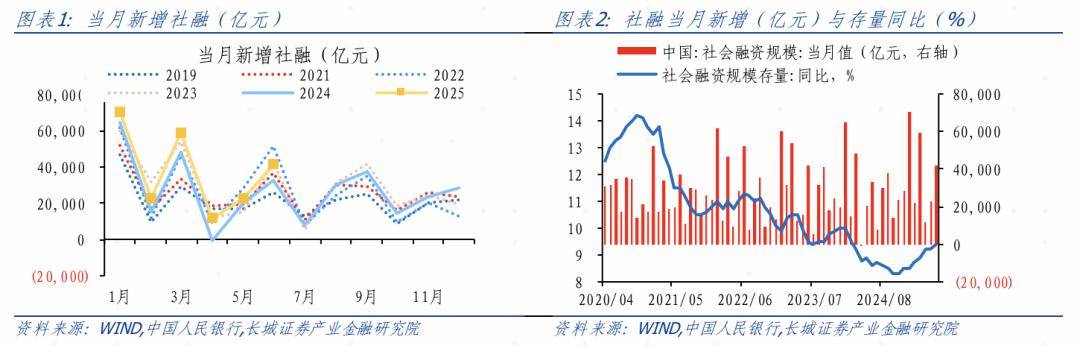
Core Viewpoint - The financial data for June indicates a significant increase in M1 and M2 growth rates, reflecting heightened liquidity and economic activity, primarily driven by government financing and seasonal factors, while consumer confidence remains cautious [1][2][3]. Group 1: Monetary Data - In June, the new social financing scale reached 4.2 trillion yuan, an increase of 900 billion yuan year-on-year, with a year-on-year growth rate of 8.9% for the social financing stock, up from 8.7% [1][2]. - M1 growth accelerated from 2.3% in May to 4.6% in June, while M2 increased from 7.9% to 8.3%, indicating improved liquidity and economic activity [1][3]. - The M2-M1 gap narrowed to 3.7% from 5.6% in the previous month, suggesting a more optimistic market outlook and enhanced production and consumption investment intentions [1][3]. Group 2: Financing Data - Government bond issuance remains robust, with net financing of 1.3548 trillion yuan in June, a year-on-year increase of 507.2 billion yuan, contributing to a total issuance of 7.66 trillion yuan in the first half of the year, which is 65% of the annual target [2][4]. - Corporate loan demand showed signs of recovery, with new corporate loans in June totaling 1.77 trillion yuan, an increase of 140 billion yuan year-on-year, indicating a strong seasonal performance [4][5]. - Resident loans increased moderately, with short-term loans rising due to seasonal consumption patterns, but overall performance remains weak compared to historical averages [5].
A 股风格转换的历史复盘与回测分析
Yin He Zheng Quan· 2025-07-16 11:54
Historical Review of Size and Style Rotation - From 2008 to 2010, small-cap stocks outperformed due to significant economic stimulus and abundant liquidity, with small-cap stocks being more sensitive to funding[6] - Between 2011 and 2013, large-cap stocks gained favor as economic growth pressures increased, highlighting their defensive attributes[8] - The period from 2013 to 2015 saw a resurgence of small-cap stocks driven by the rise of new industries and increased M&A activity, with leverage funds entering the market[9] - From 2016 to 2021, large-cap stocks dominated as supply-side reforms improved profitability for leading companies, while M&A activity cooled[10] - In the 2021 to 2023 period, small-cap stocks regained strength due to changes in funding structure and the rise of new industries like AI[12] Growth vs. Value Style Rotation - From 2011 to 2014, value stocks outperformed as the economy shifted from stimulus-driven growth to self-sustained growth, with GDP growth declining[15] - In 2015, growth stocks saw a rebound due to the rise of the internet and new industries, despite ongoing economic pressures[19] - The period from July 2016 to October 2018 favored value stocks as traditional industries improved amid tightening liquidity[21] - From November 2018 to July 2021, growth stocks outperformed due to the rise of new industries and favorable liquidity conditions[23] - From August 2021 to August 2024, value stocks are expected to dominate due to tightening global liquidity and geopolitical uncertainties[25] Key Indicators and Future Outlook - The historical analysis indicates that size and style rotations are influenced by fundamental factors, liquidity, valuation, and policy[27] - The correct prediction rate for small-cap outperformance since 2005 is 69%, while for growth vs. value since 2011 is 77%[2] - In the first half of 2025, small-cap stocks outperformed with a 7.54% increase in the CSI 1000 index compared to a 1.37% increase in the CSI 300 index[2] - The outlook for the second half of 2025 suggests a potential shift towards large-cap stocks due to institutional investor preferences and external uncertainties[2]
固定收益点评:下半年社融增速或承压
GOLDEN SUN SECURITIES· 2025-07-15 06:57
Report Industry Investment Rating There is no information provided regarding the report industry investment rating. Core Viewpoints - The growth rate of social financing may face pressure in the second half of the year. If there is no additional budget, government bonds will shift from year - on - year increase in the first half to year - on - year decrease in the second half, and non - government bond social financing has been weak due to high real interest rates [2][3][20]. - The low - base effect supports the continued significant rebound of M1 growth rate, and the rebound of social financing growth rate drives the rebound of M2 growth rate. Attention should be paid to the subsequent changes in fiscal deposits [3][4]. - The current stock market rise requires a low - interest - rate environment, and the impact on the bond market from capital flow is limited. The bond market has limited adjustment space, and it is a better allocation opportunity after adjustment. It is expected that bond yields will decline again, and a long - duration position and a dumbbell - shaped allocation are recommended [5][21]. Summary by Related Content Credit Situation - In June, new credit was 2.24 trillion yuan, a year - on - year increase of 110 billion yuan. Corporate short - term credit demand increased, while the improvement of household credit demand was still limited. Corporate medium - and long - term loans and short - term loans increased year - on - year, and bill financing decreased year - on - year. Household medium - and long - term and short - term loans also increased year - on - year, but high - frequency data showed weak real - estate sales [1][8]. Social Financing Situation - In June, new social financing was 4.1993 trillion yuan, a year - on - year increase of 0.9008 trillion yuan, and the year - on - year growth rate of social financing stock was 8.9%, 0.2 percentage points higher than the previous month. Government bonds were still the main support item. However, if there is no additional budget, subsequent bond supply will decrease year - on - year, and social financing growth rate may decline [2][13]. - In the first half of this year, the increase in social financing mainly came from government bonds. The annual budget increment of government bonds is 13.86 trillion yuan. After deducting the issued part in the first half, the net financing scale in the second half is expected to be about 6.1 trillion yuan, compared with about 8 trillion yuan in the same period last year [3][20]. M1 and M2 Situation - In June, the new - caliber M1 increased by 4.6% year - on - year, a rebound of 2.3 percentage points from May, mainly due to the low - base effect last year [3][15]. - In June, M2 increased by 8.3% year - on - year, a rebound of 0.4 percentage points from the previous month. The increase in social financing growth rate promoted the rebound of M2 growth rate. With the slowdown of government bond issuance in the second half, fiscal deposits may decrease year - on - year, increasing the capital supply in the market [4][18]. Stock and Bond Market Situation - The recent rise in the stock market is mainly driven by valuation recovery and requires a low - interest - rate environment. The impact of the stock market on the bond market's capital is limited. The bond market has limited adjustment space, and it is expected that bond yields will decline again. A long - duration position and a dumbbell - shaped allocation are recommended, with the 10 - year Treasury bond yield expected to fall to 1.4% - 1.5% [5][21].
上半年信贷结构进一步优化
Shang Hai Zheng Quan Bao· 2025-07-14 18:29
Group 1 - Government bonds are the main driver of social financing growth, with a cumulative increase of 22.83 trillion yuan in the first half of 2025, which is 4.74 trillion yuan more than the same period last year [1] - Net financing of government bonds reached 7.66 trillion yuan, an increase of 4.32 trillion yuan year-on-year, while domestic stock financing for non-financial enterprises was 170.7 billion yuan, up 49.3 billion yuan year-on-year [1] - The issuance of government bonds has significantly increased compared to last year, with the issuance pace in the first half of the year being about 10 to 15 percentage points faster than the same period last year [1] Group 2 - The M2 money supply grew by 8.3% year-on-year as of the end of June, an increase of 0.4 percentage points from the previous month, largely influenced by a low base effect from last year [1] - The low base effect from last year, where M2 growth was only 6.2%, is expected to gradually diminish, leading to a reasonable growth rate for financial totals in the second half of the year [2] - The financial sector is expected to continue providing strong support for the real economy, with reasonable growth in loans and targeted support for key areas such as technology innovation, consumption, green finance, and inclusive finance [2]
上半年金融数据出炉!社融规模增量近23万亿元,M2增速8.3%
Sou Hu Cai Jing· 2025-07-14 14:09
Core Viewpoint - The People's Bank of China (PBOC) reported that in June 2025, new loans and social financing both exceeded market expectations, indicating a positive trend in credit growth and monetary policy effectiveness [1][2]. Group 1: Credit Growth - In June 2025, new RMB loans amounted to 2.24 trillion yuan, an increase of 1.1 billion yuan year-on-year [1]. - The total social financing scale in June reached 4.1993 trillion yuan, up by 900.8 billion yuan year-on-year [1]. - The balance of RMB loans at the end of June was 268.56 trillion yuan, reflecting a year-on-year growth of 7.1% [2]. Group 2: Monetary Policy and Economic Support - The PBOC has implemented a moderately loose monetary policy, utilizing various tools to support high-quality development of the real economy [2]. - The increase in credit is attributed to the PBOC's actions, including interest rate cuts and liquidity injections, which have improved financing conditions for businesses and households [3][4]. - The government bond issuance peak has also contributed to the rise in social financing data [1]. Group 3: Loan Structure and Sector Focus - The first half of 2025 saw a total loan increase of 12.92 trillion yuan, with significant allocations to manufacturing and infrastructure sectors [4]. - Corporate medium- and long-term loans increased by 400 billion yuan in June, ending a four-month decline [5]. - The demand for medium- and long-term loans is supported by various factors, including financial support measures and ongoing infrastructure investments [5]. Group 4: Social Financing and Government Bonds - The total social financing increment for the first half of 2025 was 22.83 trillion yuan, an increase of 4.74 trillion yuan year-on-year [6][7]. - Government bond financing was a major contributor to the increase, with a year-on-year rise of 4.32 trillion yuan [7]. - In June, new social financing reached 4.20 trillion yuan, reflecting a seasonal increase and a year-on-year growth of 9008 billion yuan [7]. Group 5: Future Outlook - Experts anticipate that the PBOC may continue to implement interest rate cuts and reserve requirement ratio reductions in the second half of 2025 [9][10]. - The growth of M2 money supply is expected to support the financing needs of enterprises and households, with a year-on-year increase of 8.3% [9]. - The ongoing adjustments in monetary policy are aimed at enhancing domestic demand and mitigating external economic pressures [10].