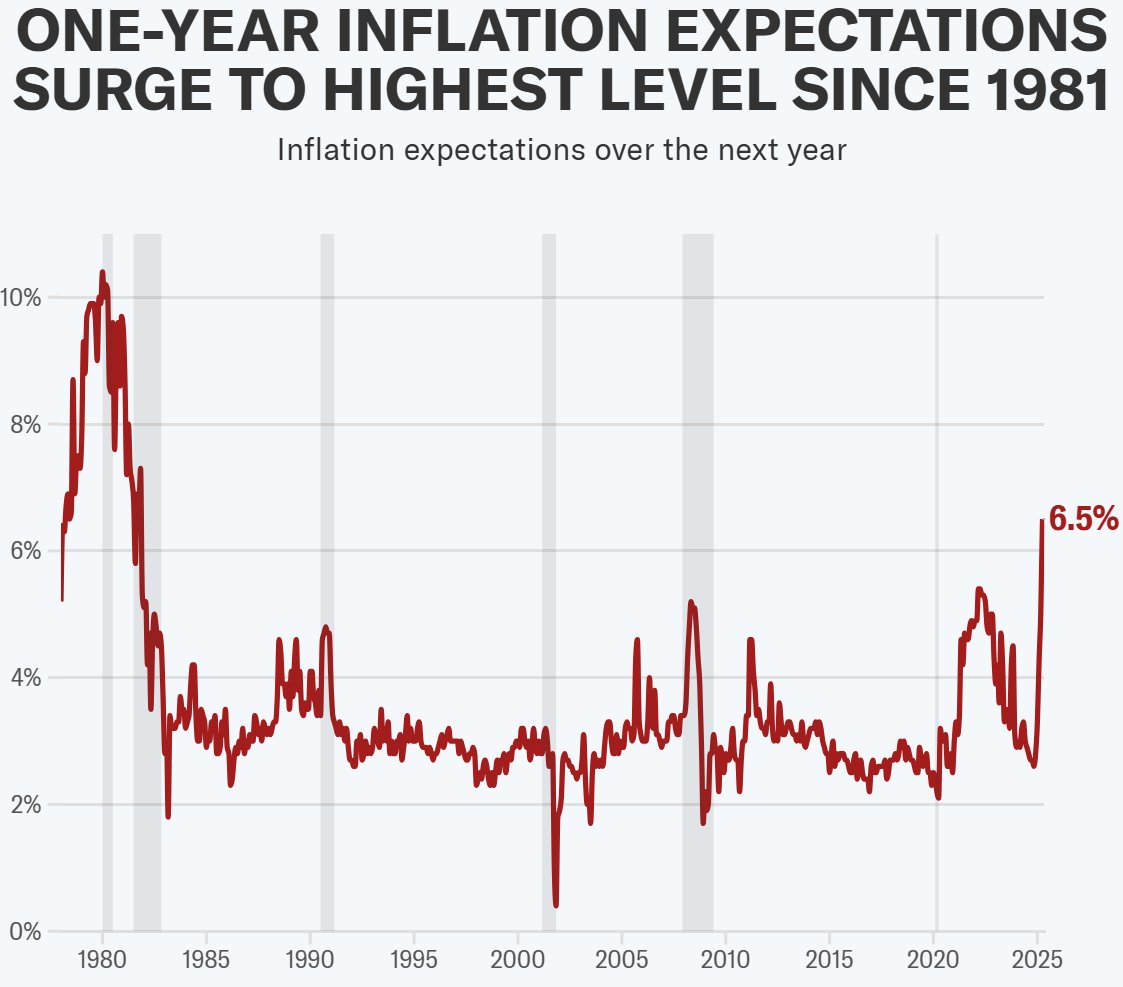
滞胀

Search documents
美联储按兵不动,黄金市场避险需求减弱
Sou Hu Cai Jing· 2025-05-12 12:14
从中长期来看,黄金在当前全球经济环境中的配置价值显得尤为重要。首先,关税争端的持续性预计将 加大市场的不确定性,且美国面临滞胀的风险未消。第二,全球央行出于对抗美元信用风险的考虑,持 续增持黄金,这一趋势将为未来黄金投资提供支撑。第三,市场对美联储在2025年前进行2-3次降息的 预期,意味着黄金作为不生息资产的吸引力将继续上升。 (转自:ETF炼金师) 在过去一周,黄金市场经历了一系列波动,伦敦现货黄金价格在周末收于3,326美元/盎司,较前一周上 涨2.6%,最高曾触及至3500美元。与此相比,国内AU9999黄金的价格为786元/克,周环比小幅上升 0.7%。与此同时,十年期美债利率上升4个基点,达到4.37%。 近期金价波动的主要因素是市场避险情绪的变化和资金的获利回吐。由于特朗普政府对电影及医药行业 的关税言论,市场在周初出现避险情绪回暖,黄金价格一度重返3400美元以上。然而,随着美国与英国 达成双边贸易协议,市场情绪开始缓和,投资者逐渐选择高位获利了结,导致金价在之后有所回落。人 民币计价的AU9999黄金在触及830元后也下跌至786元附近。 在5月的联邦公开市场委员会(FOMC)会议上,美联 ...
分析师:5.12通胀预期压力升温,晚间黄金行情走势分析
Sou Hu Cai Jing· 2025-05-12 10:33
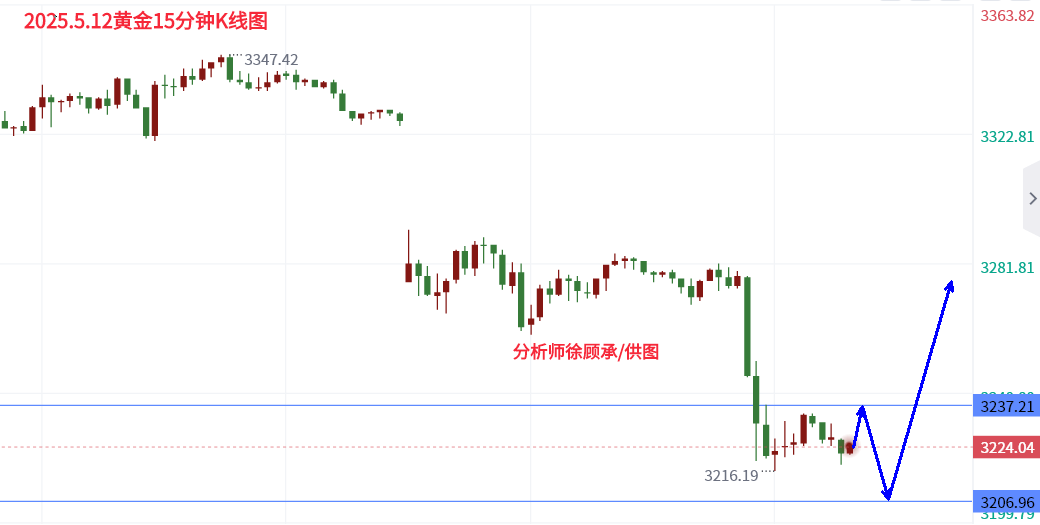
操作策略1:建议反弹3236附近空,损8美金,目标看15-20点。 明日将公布通胀相关数据。市场预计4月CPI或初现价格上涨迹象,核心CPI环比升0.3%符合预期,本周晚些时候公布的核心PPI或走势相似,这表明 美联储关注的核心PCE指标仍面临一定压力,但尚不足以引发其高度警觉。若通胀超预期,受关税效应提前影响,美元走势或较复杂,当前鹰派重 定价空间有限,通胀过热甚至可能加剧滞胀担忧,短期内利空美元。 黄金市场近期波动显著,周五收盘价定格于3326点位,而周一早盘跳空低开至3275,形成明显缺口。随后金价在3292至3260区间内震荡整理,早盘 时段延续回落态势,午间虽有所反弹,但整体力度偏弱。至欧盘前,金价从3282强势下挫至3216,期间虽有反弹,却未能突破3236。当前金价在 3220附近胶着,晚间走势尤为关键。上方阻力位于3236-3240区间,下方支撑则在3206-3200一线。整体趋势偏弱,若3200关口失守,或将进一步测 试3180。操作上徐老师建议回调做多为主,反弹高空为辅。 操作策略2:建议回调3207附近多,损8美金,目标看15-20点。 本文由徐老师分析团队策划编辑,以上文章由徐老师本人 ...

研究所晨会观点精萃-20250512
Dong Hai Qi Huo· 2025-05-12 05:50
Report Industry Investment Rating No relevant content provided. Core Viewpoints of the Report - The substantial progress of the China-US trade talks has boosted the overall global risk appetite, and the domestic risk appetite is also expected to be favorably affected in the short term. For assets, the stock index is expected to rebound with short - term cautious long positions; government bonds are expected to oscillate at a high level with cautious long positions. In the commodity sector, black metals are expected to be weakly oscillating, non - ferrous metals, energy - chemicals, and precious metals are expected to oscillate, and all are under cautious observation [3]. - The demand for steel is expected to be weak, and the prices of steel futures and spot have widened their decline. The prices of ferrous alloys are expected to oscillate within a range. The prices of energy - chemical products have rebounded slightly due to the China - US trade talks, but there are still long - term downward pressures. Non - ferrous metals are expected to oscillate, and the short - term trends are affected by the China - US talks and other factors [6][9][13]. Summary by Directory Macroeconomic and Financial - **Macro**: Overseas, the China - US trade talks ended positively, and details will be announced on Monday. Domestically, China's exports in April exceeded expectations, and the China - US high - level talks in Switzerland achieved substantial progress. The stock index is expected to rebound with short - term cautious long positions; government bonds are expected to oscillate at a high level with cautious long positions. In the commodity sector, black metals are weakly oscillating, non - ferrous metals, energy - chemicals, and precious metals are oscillating, all under cautious observation [3]. - **Stock Index**: Affected by sectors such as semiconductor chips, artificial intelligence, and software development, the domestic stock market declined slightly. The China - US talks and loose monetary policies are expected to boost domestic risk appetite, and short - term cautious long positions are recommended [3]. - **Precious Metals**: The precious metals market oscillated last week. Economic data shows resilience, and the market is re - pricing the Fed's policy path. Gold may be under short - term pressure but has long - term support. Silver is under short - term observation [4][5]. Black Metals - **Steel**: The domestic steel futures and spot markets were weak last Friday. In May, it enters the off - season for steel demand. The apparent consumption of 5 major steel products decreased, and inventory started to rise. The supply also decreased slightly. Short - term bearish sentiment is recommended [6]. - **Iron Ore**: The futures and spot prices of iron ore continued to be weak. Steel demand has weakened, and although the iron - water output is still high, it is not supported by demand. The supply is expected to increase in the later period, and short - term bearish sentiment is recommended [6]. - **Ferroalloys (Silicon Manganese/Silicon Iron)**: The price of silicon manganese rebounded slightly, and that of silicon iron declined. The demand for ferroalloys is weakening. The short - term price of ferroalloys is expected to oscillate within a range [7][8]. Energy - Chemicals - **Crude Oil**: The China - US talks and domestic policy stimuli have improved the macro - sentiment, and oil prices have rebounded. However, the long - term downward path has been established, and the oil price will be under pressure in the later period but will continue to have high volatility in the short term [9]. - **Asphalt**: The absolute price of asphalt has rebounded due to the progress of the trade agreement. The inventory removal has stagnated, the supply is low, and the demand has been slightly boosted. It will continue to fluctuate with crude oil in the short term [9]. - **PX**: PX has many self - maintenance periods and follows the polyester chain to rise. It will continue to be in short supply in the later period and will maintain a relatively strong oscillating pattern in the short term [9]. - **PTA**: The downstream demand for PTA exists in the short term, but there are limitations to its long - term upward space. It is expected to oscillate strongly in the short term [10]. - **Ethylene Glycol**: The supply of ethylene glycol is high, and the inventory removal is postponed. It will continue to oscillate [10]. - **Short - Fiber**: The downstream processing profit of short - fiber is decreasing, and there is a risk of a decline in the high - operating rate. It will maintain a high - level range oscillation [10]. - **Methanol**: The inventory of methanol has increased, and the supply pressure is prominent. It is expected to oscillate weakly in the short term and has downward pressure in the long term [11]. - **PP**: The supply pressure of PP has been relieved, but the demand is weak, and the fundamentals are under pressure [11]. - **LLDPE**: The downstream of LLDPE is basically stable, and the supply has increased slightly. It is expected to oscillate weakly before the holiday and requires cautious observation [13]. Non - Ferrous Metals - **Copper**: The China - US talks may boost the market sentiment in the short term. The copper price is expected to oscillate in the short term, and opportunities for short positions can be sought in the medium term [13]. - **Aluminum**: The trade agreement between the US and the UK has a short - term positive impact on the market sentiment. The aluminum price rebound is approaching the end. Short - term long positions should be gradually liquidated, and short - position opportunities can be sought after the situation becomes clear [13]. - **Tin**: The supply of tin is expected to increase, and the demand is about to enter the off - season. The tin price is expected to oscillate in the short term, affected by the China - US talks, the resumption of production in Wa State, and the weakening demand [14].
黄金突然直线跳水!金饰价格一夜跌了14元
21世纪经济报道· 2025-05-12 04:12
Core Viewpoint - The article discusses the recent significant decline in gold prices, highlighting both short-term risks and long-term investment potential in the gold market [1][4]. Price Movements - On May 12, gold prices experienced a substantial drop, with COMEX gold futures falling below $3,270 per ounce. Domestic gold jewelry prices also decreased, with brands like Chow Sang Sang and Chow Tai Fook marking their gold prices at 1,007 CNY and 1,008 CNY per gram, respectively, down 14 CNY from the previous day [1][2]. Market Analysis - Various gold-related ETFs have also seen declines, with the Huaxia Gold ETF dropping by 2.02% and the Gold Stock ETF falling by 1.54%. Key holdings such as Zhaojin Mining and Chow Tai Fook have also seen their stock prices decrease [3]. - Analysts from Guoxin Futures predict that gold prices may continue to fluctuate in the short term, with potential support around $3,250 per ounce. They suggest that geopolitical tensions or weak economic data could trigger a rebound [4][6]. Long-term Outlook - Despite short-term adjustments, the long-term investment value of gold remains widely recognized. Analysts from CITIC Futures maintain a bullish long-term outlook, citing a clear trend of slowing U.S. economic growth and ongoing trade tensions as factors that could support gold prices [6][8]. - Goldman Sachs forecasts that gold prices could rise to $3,700 per ounce by the end of 2025 and further to $4,000 per ounce by mid-2026, driven by structural demand from central banks and investors [8]. Conclusion - The article emphasizes the importance of monitoring economic indicators and geopolitical developments, as these factors will significantly influence gold price movements in both the short and long term [4][6][8].
加拿大失业率继续攀升 美元/加元仍有上行空间
Jin Tou Wang· 2025-05-12 03:50
Group 1 - The Canadian labor market data shows a faster-than-expected increase in the unemployment rate to 6.9%, impacting the USD/CAD exchange rate [1] - The USD/CAD pair is attempting to maintain its position around 1.3940, supported by progress in US-China trade negotiations held in Switzerland [1] - US Treasury Secretary Scott Bansen described the two-day talks with Chinese officials in Geneva as productive, with expectations for more details to be released [1] Group 2 - Despite ongoing recession concerns, recent data suggests that the US economy is more likely to experience a slowdown rather than a full contraction, with no signs of accelerating inflation [1] - The Federal Reserve officials have expressed concerns about potential stagflation, with warnings from President Michael Barr about tariff increases disrupting supply chains [1] - Technical indicators such as MACD and CCI suggest short-term momentum accumulation for the USD/CAD exchange rate, although there may be a risk of a pullback due to the CCI entering the overbought territory [2]
全球市场观察系列:关税博弈下的港股与美股
Soochow Securities· 2025-05-12 02:32
Group 1 - The report highlights the increasing macroeconomic uncertainty, with the Federal Reserve signaling a "wait and see" approach, indicating a cautious stance towards inflation and employment data, while trade policy remains a critical variable [2][3] - The U.S. and U.K. have reached a preliminary trade agreement, reducing tariffs on U.K. car imports to a maximum of 10%, which reflects a potential baseline for future negotiations [2] - The report expresses a cautiously optimistic view on the Hong Kong stock market, noting a strong rebound due to new financial policies, but acknowledges ongoing external risks and market volatility [3][5] Group 2 - The U.S. stock market is expected to experience volatility, with the S&P 500 showing signs of pressure despite recovering from previous declines, influenced by trade negotiations and potential earnings pressures [5][6] - The report indicates that the Hong Kong stock market's rebound requires additional capital inflows and sustained policy support, with current inflows primarily from the southbound channel [3][18] - The report notes that global stock and bond ETFs have seen accelerated net inflows, particularly into European markets, while U.S. markets continue to experience net outflows [6][25]
特朗普关税重锤未落,日本经济已陷“技术性衰退”悬崖
智通财经网· 2025-05-12 02:20
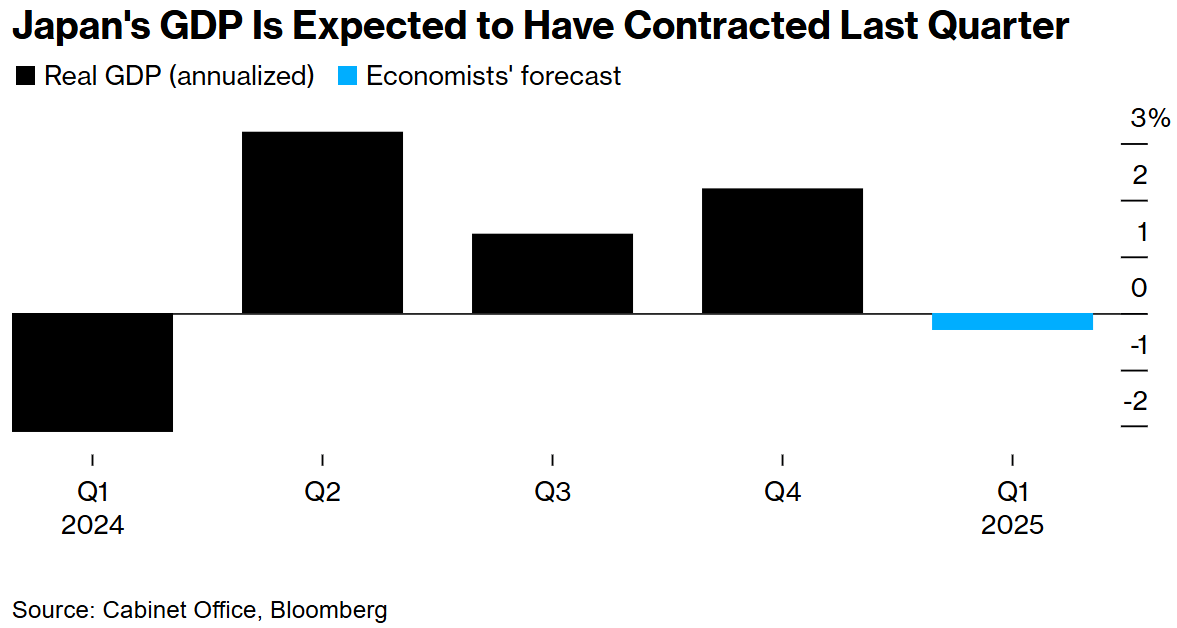
Economic Outlook - Japan's economy is projected to contract in the first quarter of this year, with economists forecasting a 0.3% annualized decline in GDP adjusted for inflation, marking the first quarterly negative growth in a year [1][4] - The economic contraction raises concerns over the Bank of Japan's policy normalization process and Prime Minister Kishida's prospects ahead of the summer elections [1][5] Contributing Factors - Multiple factors are contributing to the expected GDP decline, including a surprising drop in imports last quarter, which diminished the net export boost, and continued weak consumer spending amid high inflation [5] - Analysts suggest that Japan currently lacks growth drivers, with a significant possibility of consecutive quarters of contraction [5] Trade Negotiations and Policy Implications - The deadlock in US-Japan trade negotiations exacerbates the pressure on policymakers, as any signs of economic weakness could complicate efforts to reach an agreement [7] - The recent data may reinforce the Bank of Japan's cautious stance, with the policy committee delaying the timeline for achieving stable inflation targets by a year and halving growth expectations for the current fiscal year [7][8] Corporate Earnings and Economic Sentiment - Major Japanese corporations are beginning to lower profit forecasts due to tariff impacts, with Toyota predicting a profit decline of about one-third for the current fiscal year [8] - Concerns are growing regarding the sustainability of Japan's "inflation-wage" cycle, as real wages have been declining due to rising living costs, leading to subdued consumer spending [9] Political and Economic Risks - Japan is experiencing a domestic version of stagflation, with insufficient consumer spending to support a moderate recovery [10] - The weak GDP data could trigger a new round of political maneuvering for economic stimulus plans ahead of the summer elections, especially as Prime Minister Kishida's approval ratings have dropped to their lowest since taking office [10]
摩根士丹利:黄金-风险偏好与风险规避
摩根· 2025-05-12 01:48
Investment Rating - The report indicates a stable price range for gold between $3,200 and $3,500 per ounce, with a focus on ETF inflows as a key driver for future price movements [1][4]. Core Insights - Gold prices have stabilized after a rapid increase, primarily driven by strong ETF inflows, but recent outflows indicate competition from other asset classes [1][5]. - The first quarter of 2025 saw a 1% year-on-year increase in physical gold demand, driven entirely by investment demand, particularly from ETFs, which added 227 tons [2][4]. - Central bank demand decreased by 21% year-on-year, while jewelry demand fell by 19%, highlighting a shift in market dynamics [1][22][31]. Summary by Sections ETF Inflows and Demand - The report highlights that ETF inflows have reached their highest level since Q1 2022, with North America and Asia seeing significant contributions, particularly from China [4][15]. - Despite strong inflows earlier in the year, there have been 11 out of the last 13 trading days with outflows, indicating a shift in investor preference towards equities [5][39]. Physical Demand Trends - The first quarter of 2025 recorded a total gold demand of 1,206 tons, the highest for a first quarter since 2016, primarily due to strong ETF inflows [2][4]. - Demand for gold bars and coins increased by 3% year-on-year, reaching 325 tons, with notable contributions from China and Europe [15][18]. Central Bank and Jewelry Demand - Central bank gold purchases fell by 21% year-on-year, with Poland being the largest buyer, while China’s purchases slowed down significantly [22][31]. - Jewelry demand has weakened considerably, particularly in China and India, with declines of 32% and 25% respectively, attributed to high prices affecting consumer purchasing power [31][32]. Macroeconomic Factors - The report suggests that macroeconomic factors have less influence on gold prices compared to physical demand trends, with a potential 'stagflation' scenario providing a favorable environment for gold [35][36]. - The relationship between gold prices and real yields has weakened, indicating that uncertainty and physical demand are now the primary drivers [37][38].
黄金与美股:危机信号与市场逻辑的深层重构
Sou Hu Cai Jing· 2025-05-12 01:31
Core Viewpoint - The divergence between gold and U.S. stocks since 2025 reflects profound changes in the global economic order, with gold acting as a safe haven amid geopolitical tensions and economic uncertainties [1][2]. Group 1: Gold Market Dynamics - Gold prices experienced significant volatility, breaking through $3,500 per ounce, followed by a 7% correction in May, before rebounding to $3,380, indicating intense market competition [1]. - The ongoing geopolitical risks, including the escalation of the Middle East situation and the prolonged Russia-Ukraine conflict, alongside the imposition of a 145% tariff on China by the Trump administration, are reshaping global supply chains and enhancing gold's appeal as a traditional safe-haven asset [1]. - Central banks globally have been net buyers of gold for 18 consecutive months, with Q1 2025 purchases reaching 243.7 tons, and China's gold reserves increasing to 2,292 tons, supporting the long-term bullish outlook for gold amid a trend of "de-dollarization" [2]. Group 2: U.S. Stock Market Challenges - The U.S. stock market has faced a reversal from optimism to panic, with the Dow Jones and S&P 500 indices showing slight declines, and tech stocks like Tesla experiencing a 44% drop year-to-date, amid rising recession fears [6]. - Trump's tariff policies have led to increased import costs, pressuring corporate profits, with economists warning of a potential 4% decline in U.S. GDP in 2025, which could push the economy into a technical recession [8]. - The Federal Reserve's decision to maintain interest rates in May, despite persistent inflation, has created uncertainty in the market, with a 20% expectation for rate cuts in June, leading to rising bond yields and capital outflows from U.S. stocks [9][10]. Group 3: Investment Strategies and Market Trends - Historical data indicates that during periods of market volatility, such as a 10% increase in the S&P 500 volatility index (VIX), gold prices tend to rise by an average of 1.5%, highlighting gold's role as a hedge against market fluctuations [12]. - In April, U.S. stocks saw an outflow of $8.9 billion, while European and Japanese stocks attracted inflows of $3.4 billion and $4.4 billion, respectively, indicating a shift in investor sentiment towards diversifying away from U.S. assets [14]. - The divergence in monetary policy between the U.S. and China, with the latter releasing 1 trillion yuan in liquidity through reserve requirement cuts, has further complicated capital flows, leading to a decoupling of gold and U.S. stock market movements [16]. Group 4: Future Outlook - Despite short-term technical adjustments, the long-term bullish foundation for gold remains intact, supported by central bank purchases, weakening dollar credit, and inflation risks, with Goldman Sachs predicting gold prices could reach $3,700 by the end of 2025 [18]. - The structural risks in the U.S. stock market are increasing, particularly for high-valuation tech stocks, while defensive sectors like consumer goods and pharmaceuticals are becoming more attractive for investment [18]. - The weakening of dollar hegemony is prompting a shift in global asset allocation strategies, encouraging investors to build diversified portfolios that include gold and inflation-hedged assets [20].
解放日关税后美国首波“硬数据”来袭 通胀警报将再次拉响?
智通财经网· 2025-05-11 23:37
智通财经APP获悉,上周股市小幅收跌,此前美联储主席鲍威尔重申了央行对利率政策的观望态度,而特朗普总统公布了美国和英国之间的贸易协议。 由于贸易波动影响了股票走势,三大主要股指上周均以下跌收盘。标准普尔500指数下跌约0.5%,道琼斯工业平均指数下跌约0.2%,纳斯达克综合指数下跌 约0.3%。 未来一周将带来通胀的最新数据,周二将公布消费者价格指数(CPI),周四将公布生产者价格指数(PPI)。零售销售数据将反映美国消费者的健康状况。投资 者还将关注与英国达成的有限双边协议后贸易协定的进展。 中国作为美国的第三大贸易伙伴,也是关注的焦点。包括财政部长贝森特在内的美国官员上周末在日内瓦与中国官员会晤,旨在缓和紧张局势并达成初步共 识。上周五,特朗普总统提出将中国关税削减至80%的想法。这一提议可能会促使中国方面采取降低关税的回应措施。 上周,美联储的政策制定者投票决定维持利率不变,理由是需更多数据和时间来理解关税的影响,而这些关税政策仍在变化中。 央行官员承认,贸易政策的变化增加了美国经济的风险。 鲍威尔在新闻发布会上表示:"我的直觉告诉我,经济路径的不确定性极高,下行风险已经增加。" "解放日"后的通胀 本 ...