反内卷

Search documents
26年经济有何期待?——12月经济数据解读
陈兴宏观研究· 2026-01-19 09:50
Economic Overview - The national economy achieved a GDP growth of 5% for the year, successfully meeting the target [2][11] - Exports continued to support growth, benefiting from reduced trade disruptions post the China-US Kuala Lumpur Agreement, with strong growth in the electronic and high-tech product sectors [2] - Investment saw a further decline, with all three major investment categories experiencing downward trends, particularly in manufacturing and real estate [2][4] Industrial Production - Industrial production showed signs of recovery, with the industrial added value for December increasing by 5.2% year-on-year [3] - The mining, manufacturing, and electricity sectors reported growth rates of 5.4%, 5.7%, and 0.8% respectively [3] - Exports contributed positively to industrial production, with a year-on-year increase in export delivery value of 3.2% [3] Investment Trends - Fixed asset investment saw a year-on-year decline of 15.1%, with private investment dropping by 17.2% [4] - Real estate investment experienced a significant decline of 35.8%, while manufacturing investment fell by 10.5% [4] - Infrastructure investment also faced challenges, with traditional and new standards showing declines of 15.9% and 12.2% respectively [4] Consumer Behavior - Retail sales growth slowed to 0.9% in December, marking a new low since 2023, influenced by the real estate cycle and consumer debt [7] - Service consumption showed resilience, with a year-on-year growth rate of 5.5%, supported by policy initiatives [7] - Essential consumer goods saw a decline in growth, while discretionary goods showed a narrowing decline [7] Real Estate Market - Real estate sales area saw a year-on-year decline of 15.6%, although the rate of decline improved compared to November [8] - New construction area decreased by 19.4%, while the completion area also faced a decline [8] - Housing prices continued to drop across various city tiers, with both new and second-hand residential prices decreasing [8] Employment and Economic Stability - The urban unemployment rate remained stable at 5.1%, consistent with previous months [11] - Overall, the economy is facing challenges from external uncertainties and ongoing structural adjustments, with a focus on expanding consumption as a key growth strategy for 2026 [11]


——12月经济数据解读:2026年经济有何期待?
Huafu Securities· 2026-01-19 09:06
Economic Performance - In December, the national GDP growth for the year reached 5%, successfully meeting the target[10] - The fixed asset investment in December saw a year-on-year decline of 15.1%, an increase of 3.1 percentage points from the previous month[4] - The manufacturing investment dropped by 10.5%, while real estate investment fell by 35.8%[4] Consumption Trends - Retail sales growth in December decreased by 0.4 percentage points to 0.9%, marking the lowest level since 2023[19] - Service retail sales continued to rise, with a cumulative year-on-year growth of 5.5%, indicating strong resilience in service consumption[19] - The average growth rate of essential consumer goods increased to 3.2%, while discretionary goods saw a decline of 4.4%[22] Industrial Production - The industrial added value in December grew by 5.2% year-on-year, with significant contributions from equipment manufacturing and high-tech industries[11] - The mining, manufacturing, and electricity sectors reported growth rates of 5.4%, 5.7%, and 0.8% respectively[11] Real Estate Market - The sales area of real estate in December experienced a year-on-year decline of 15.6%, although this was an improvement from November[25] - Housing prices continued to decline, with both new and second-hand residential prices showing a widening year-on-year drop[10] Employment and Future Outlook - The urban unemployment rate remained stable at 5.1%, consistent with the previous month and year[26] - The report emphasizes that expanding consumption is crucial for stabilizing growth in 2026, with "new infrastructure" and "energy infrastructure" as potential short-term strategies[26]
换购住房退税政策延续,商业用房下调首付比例:建筑材料
Huafu Securities· 2026-01-19 08:47
Investment Rating - The industry rating is "Outperform the Market" [8][66] Core Insights - The report highlights the continuation of housing tax refund policies and a reduction in the down payment ratio for commercial properties, which are expected to support the real estate market [3][13] - The report anticipates a turning point in the building materials capacity cycle due to supply-side reforms and a recovery in home buying willingness driven by lower interest rates and supportive policies [6][13] - The report notes that the real estate market is gradually stabilizing, with an increasing probability of recovery in post-cycle demand for building materials [6][13] Summary by Sections Investment Highlights - The Ministry of Finance, State Administration of Taxation, and Ministry of Housing and Urban-Rural Development have announced the extension of tax refund policies for homeowners [3] - The central bank has adjusted the minimum down payment ratio for commercial housing loans to no less than 30% [3] - Various cities are implementing measures to promote stable development in the real estate market, including urban renewal projects and government subsidies for home purchases [3][13] Market Data - As of January 16, 2026, the national average price of bulk P.O 42.5 cement is 335.5 CNY/ton, showing a 0.9% decrease from the previous week and a 16.0% decrease year-on-year [4][14] - The national average price of glass (5.00mm) is 1097.1 CNY/ton, reflecting a 0.4% increase from the previous week but a 16.9% decrease year-on-year [4][22] Sector Review - The Shanghai Composite Index fell by 0.45%, while the Shenzhen Composite Index rose by 1%. The building materials index decreased by 0.67% [5][51] - Sub-sectors such as refractory materials and fiberglass manufacturing showed positive growth, while cement and glass manufacturing experienced declines [5][51] Investment Recommendations - The report suggests focusing on three main lines of investment: high-quality companies benefiting from stock renovations, undervalued stocks with long-term alpha attributes, and leading cyclical building materials companies showing signs of bottoming out [6]
2025年经济增长数据点评:5.0%后的新序章
Guolian Minsheng Securities· 2026-01-19 08:23
Economic Growth Overview - In 2025, China's GDP reached 14,018.79 billion yuan, growing by 5.0% year-on-year[5] - Quarterly GDP growth rates were 5.4% in Q1, 5.2% in Q2, 4.8% in Q3, and 4.5% in Q4, with Q4 showing a 1.2% quarter-on-quarter increase[5] Industrial Performance - Industrial capacity utilization has been improving since Q2 2025, particularly in coal mining, electrical machinery, and automotive sectors[3] - December 2025 industrial production growth accelerated to 5.2% year-on-year, up from 4.8% in November[5] Investment and Consumption Trends - Investment and consumption growth slowed in December 2025, with investment showing a decline of -10.6% year-on-year[5] - However, high-frequency data indicates early signs of stabilization in investment, supported by new policy financial tools and increased special bond issuance[5] Export and Government Consumption - Exports are expected to be a key support for economic growth in Q1 2026, with net exports showing improvement[5] - Government consumption is also anticipated to play a significant role in boosting the economy, with recent policy measures aimed at promoting consumption[5] Real Estate Sector - Real estate investment saw a further decline to -17.2% year-on-year in December 2025, reflecting high base effects from the previous year[8] - Despite the current downturn, a gradual recovery in real estate investment is expected as the high base effect diminishes[8] Risks and Future Outlook - Potential risks include policy measures falling short of expectations and unexpected changes in domestic economic conditions[8] - The first quarter of 2026 is anticipated to show a recovery in infrastructure investment, supported by a higher proportion of special bonds directed towards infrastructure projects[7]
招期新能源ESG工业硅多晶硅周报(2026年1月12日-2026年1月16日):工业硅上下游均有减产扰动,多晶硅关注反垄断后续回应-20260119
Zhao Shang Qi Huo· 2026-01-19 08:06
Report Overview - Report Title: Industrial Silicon and Polysilicon Weekly Report (January 12 - January 16, 2026) [1] - Report Date: January 18, 2026 [2] - Researcher: Shi Enbing [2] 1. Report Industry Investment Rating No relevant content provided. 2. Core Views Industrial Silicon - The market is expected to oscillate. Supply-side: The number of open furnaces decreased by 7 this week, mainly from Sichuan. Social and warehouse inventories increased slightly. Demand-side: Both the polysilicon and organic silicon industries are promoting anti-involution. Polysilicon production in January is expected to decline to 100,000 tons. The organic silicon industry is supporting prices, with weekly production continuously decreasing slightly. The aluminum alloy开工率remains stable. The market is expected to oscillate between 8400 - 9200 yuan, and short positions can be considered at high prices [3]. Polysilicon - The market is expected to oscillate. The National Energy Administration commented on the "anti-involution" in the photovoltaic industry. For mature sectors such as silicon materials and wafers, backward production capacity should be eliminated. For the component sector, sales below cost should be rectified. The spot market is in a wait-and-see state this week. Supply-side: Weekly production decreased by over 10%, and industry inventory increased slightly. Demand-side: Wafer production in January remains stable, while cell and component production decreased by over 10% month-on-month. The cancellation of photovoltaic export tax rebates on the 9th supports component exports during the window period, and demand is expected to remain stable in the off-season. After the "anti-monopoly" event, the market has fully priced in the negative news, and the near-term balance sheet has shifted from loose to tight supply-demand balance. Next week, attention should be paid to the emotional impact of the follow-up feedback from industry associations [4]. 3. Summary by Catalogue 01 Futures Data - **Industrial Silicon**: The main contract price oscillated between 8605 - 8755 yuan/ton. The spread between the first and fourth contracts was 65. The trading volume decreased by 8100 lots to 371,900 lots. The capital inflow decreased by 70 million yuan to 3.233 billion yuan. The warehousing receipts increased to 56,415 tons [3]. - **Polysilicon**: The main contract 2605 oscillated widely between 48,670 - 50,200 yuan. The warehousing receipts increased by 390 tons to 13,680 tons. The capital inflow decreased by 735 million yuan to 3.797 billion yuan [4]. 02 Industrial Silicon - **Price**: The spot price remained stable. Xinjiang Tongyang 553 was reported at 8700 yuan/ton, Kunming 421 at 10,000 yuan/ton, and Sichuan 421 at 9800 yuan/ton [3]. - **Valuation**: The electricity price in the southwest region has gradually recovered after switching to the dry-season electricity price. The production costs in Xinjiang, Yunnan, and Sichuan are estimated to be 8487.5 yuan/ton, 9720 yuan/ton, and 9600 yuan/ton respectively, with profits of 312.5 yuan/ton, -380 yuan/ton, and -400 yuan/ton respectively [3]. - **Supply**: This week's production was 78,420 tons, a decrease of 1860 tons (-2.3%) from last week. The number of open furnaces decreased by 7, with an overall furnace opening rate of 27.76%. Xinjiang's production increased by 43.94% year-on-year, Sichuan's decreased by 24.73%, and Yunnan's decreased by 7.96% [3]. - **Inventory**: Social inventory increased by 3000 tons to 555,000 tons. The Guangzhou Futures Exchange's warehousing receipts increased by 1975 tons to 56,415 tons [3]. - **Demand**: - **Polysilicon**: Production this week was 22,030 tons, a decrease of 13.3% week-on-week. The industry's total inventory was approximately 316,800 tons, an increase of 1.6% week-on-week [3]. - **Organic Silicon**: The average price of DMC remained unchanged at 13,850 yuan/ton (+1.8%). The prices of industrial chain products increased by 250 - 350 yuan. DMC production decreased by 400 tons to 43,600 tons, a decrease of 0.9% week-on-week. Weekly inventory decreased by 1300 tons, a decrease of 2.9% [3]. - **Aluminum Alloy**: The average price of ADC12 was 23,900 yuan/ton, an increase of 200 yuan week-on-week; the average price of A356 was 24,300 yuan/ton, with the price rising first and then falling. The regenerative 开工率this week was 58%. In December, passenger car production decreased by 4.2% year-on-year, and new energy vehicle production increased by 18.5% year-on-year in November [3]. - **Export**: Industrial silicon exports in November showed a year-on-year improvement, with a year-on-year increase of 3.7% and a month-on-month increase of 21.8% [3]. 03 Polysilicon - **Price**: This week, the prices of silicon materials and wafers remained stable, while the price of cell sheets increased slightly by 4% [3][4]. - **Valuation**: The production costs in Inner Mongolia, Sichuan, Qinghai, and Xinjiang are 42,465 yuan/ton, 39,540 yuan/ton, 45,415 yuan/ton, and 43,963 yuan/ton respectively, with profits of 17,135 yuan/ton, 20,460 yuan/ton, 14,585 yuan/ton, and 14,370 yuan/ton respectively [4]. - **Supply**: This week's production was 22,030 tons, a decrease of 13.3% week-on-week. Production in January is expected to decline to 100,000 tons month-on-month [4]. - **Inventory**: The industry's total inventory increased by 5000 tons to approximately 316,800 tons, an increase of 1.6% week-on-week [4]. - **Silicon Wafers**: The price of N-type wafers remained stable this week. In December, wafer inventory increased by 18.92% month-on-month and 17.4% year-on-year. Wafer production in January is planned to be 45.2 GW, a decrease of 2% year-on-year and an increase of 3% month-on-month [4]. - **Cell Sheets**: The price of cell sheets increased slightly by 4% this week. Cell production in January is planned to be 39.36 GW, a decrease of 18.3% year-on-year and 15.8% month-on-month [4]. - **Components**: The price of components increased slightly by 3 - 5% this week. The latest weekly inventory was 30.4 GW, an increase of 1.33% week-on-week. Production in January is planned to be 32.47 GW, a decrease of 19% month-on-month and 17% year-on-year. Component exports in November were 20.09 GW, an increase of 22.92% year-on-year and 3.6% month-on-month. In November 2025, new photovoltaic installations were 22.02 GW, a decrease of 11.9% year-on-year and an increase of 74.8% month-on-month. The year-end installation intensity slightly exceeded expectations, and the annual total is expected to exceed 300 GW. The latest average winning bid price for photovoltaic components was 0.71 yuan/watt, with a winning bid procurement capacity of only 0.2 GW [4]. 04 Organic Silicon, Aluminum Alloy, and Export - **Organic Silicon (DMC)**: The price increased to 13,850 yuan/ton (+1.8%) this week. Weekly production decreased by 0.9% week-on-week, and inventory decreased by 2.9% week-on-week. The gross profit margin was 13.73% [3][53][55]. - **Aluminum Alloy**: The prices of ADC12 and A356 oscillated within a range this week. The regenerative aluminum alloy 开工率this week was 58%. In December, passenger car production decreased by 4.2% year-on-year [3][59][61]. - **Export**: Industrial silicon exports in November decreased by 3.7% year-on-year and increased by 21.78% month-on-month [3][65].
受益于“反内卷”与涨价方向,石化ETF(159731)迎布局良机,近8日合计“吸金”2.69亿元
Mei Ri Jing Ji Xin Wen· 2026-01-19 07:09
Group 1 - The core viewpoint of the article highlights the upward trend of the Petrochemical ETF (159731), which has seen a 2.84% increase as of 13:22 on January 19, with leading stocks such as Haohua Technology, Luxi Chemical, and Hengli Petrochemical driving the gains [1] - The Petrochemical ETF has experienced a continuous net inflow of funds for eight consecutive trading days, totaling 269 million yuan, with its latest share count reaching 549 million and total scale hitting 522 million yuan, both marking new highs since its inception [1] - Huaxi Securities maintains that the slow bull trend in A-shares remains unchanged, with a focus on sectors expected to show high growth or improved prosperity during the dense disclosure period of annual performance forecasts in late January [1] Group 2 - The article suggests focusing on the expansion of technology industry trends, including AI computing power, AI applications, robotics, and Hong Kong internet sectors [1] - It also highlights sectors benefiting from "anti-involution" and price increases, such as chemicals and non-ferrous metals [1] - The anticipated high growth sectors for the 2025 annual performance forecasts include electronics, machinery equipment, and pharmaceuticals [1] Group 3 - The Petrochemical ETF (159731) and its linked funds (017855/017856) closely track the CSI Petrochemical Industry Index, with the basic chemical industry accounting for 59.23% and the oil and petrochemical industry for 32.60% of the index [1] - The article notes that the restructuring of supply and demand patterns and the upgrading of industry attributes are accelerating the pace of industrial cycle recovery [1]
国际油价小幅上涨,丁二烯、环氧丙烷价格上涨
Zhong Guo Neng Yuan Wang· 2026-01-19 06:53
Core Viewpoint - The report highlights the current trends in the chemical industry, focusing on price movements, supply and demand dynamics, and investment opportunities in undervalued leading companies amid a backdrop of geopolitical tensions and changing market conditions [1][4][8]. Industry Dynamics - In the week of January 12-18, 49 out of 100 tracked chemical products saw price increases, while 20 experienced declines, and 31 remained stable. The average monthly price of 49% of products rose compared to the previous month [3]. - The average price of WTI crude oil futures increased by 0.54% to $59.44 per barrel, while Brent crude oil futures rose by 0.66% to $63.76 per barrel during the same week [4]. - As of January 9, U.S. crude oil production averaged 13.753 million barrels per day, a decrease of 58,000 barrels from the previous week but an increase of 272,000 barrels year-on-year. Total U.S. oil demand was 21.009 million barrels per day, up by 178,200 barrels from the previous week [4]. Price Movements - The price of butadiene rose by 4.04% to 9,663 yuan per ton as of January 18, with a month-on-month increase of 25.98% but a year-on-year decrease of 20.8%. The production of butadiene was 109,300 tons, down 2.85% from the previous week [5]. - Epoxy propane prices increased by 8.84% to 8,620 yuan per ton, with a year-on-year rise of 9.88%. The market operating rate was 65.38%, reflecting a 1.51% increase from the previous week [6][7]. Investment Recommendations - As of January 18, the price-to-earnings ratio (TTM) for the SW basic chemical sector is 14.68, at the 59.64% historical percentile, while the price-to-book ratio is 1.54, at the 40.20% historical percentile. The SW oil and petrochemical sector has a TTM P/E ratio of 13.44, at the 39.81% historical percentile [8]. - Investment suggestions include focusing on undervalued leading companies, the impact of "anti-involution" on supply in related sub-industries, and the growing importance of self-sufficiency in electronic materials and certain new energy materials amid rising prices [2][8]. - Recommended stocks include Wanhua Chemical, Hualu Hengsheng, and others, with a focus on sectors like semiconductor materials, OLED materials, and new energy materials [8][9].





建材ETF(159745)涨超1%,水泥行业在“反内卷”背景下易涨难跌
Mei Ri Jing Ji Xin Wen· 2026-01-19 06:39
Group 1 - The cement industry is expected to experience price increases under the backdrop of "anti-involution," with a significant capacity reduction anticipated for the first time in history by 2025 [1] - By the end of 2025, over 280 clinker production lines will be replaced, resulting in an annual capacity reduction of 150 million tons [1] - From January 1, 2026, major enterprises will fully implement production based on approved capacity, which, along with normalized staggered production, will curb regional "involution" competition [1] Group 2 - The cement production volume is expected to decline due to a downturn in real estate and a decrease in infrastructure growth, leading to overall low price fluctuations [1] - The widening price gap between cement and coal is expected to improve profitability [1] - Significant infrastructure projects and urban renewal are anticipated to support demand in 2026, alongside continued optimization of supply under the "dual carbon" policy [1] Group 3 - The building materials ETF (159745) tracks the construction materials index (931009), reflecting the overall performance of listed companies in the building materials industry, including cement, glass, and new building materials [1] - The index focuses on companies with high market share and good growth prospects, showcasing the diversity and growth potential of the building materials industry [1]
ETF盘中资讯|氟化工龙头涨停,化工板块午后继续猛攻!机构:供需双底确立,2026年或迎“戴维斯双击”
Sou Hu Cai Jing· 2026-01-19 06:33
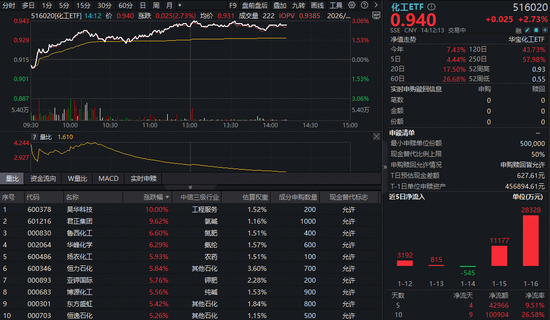
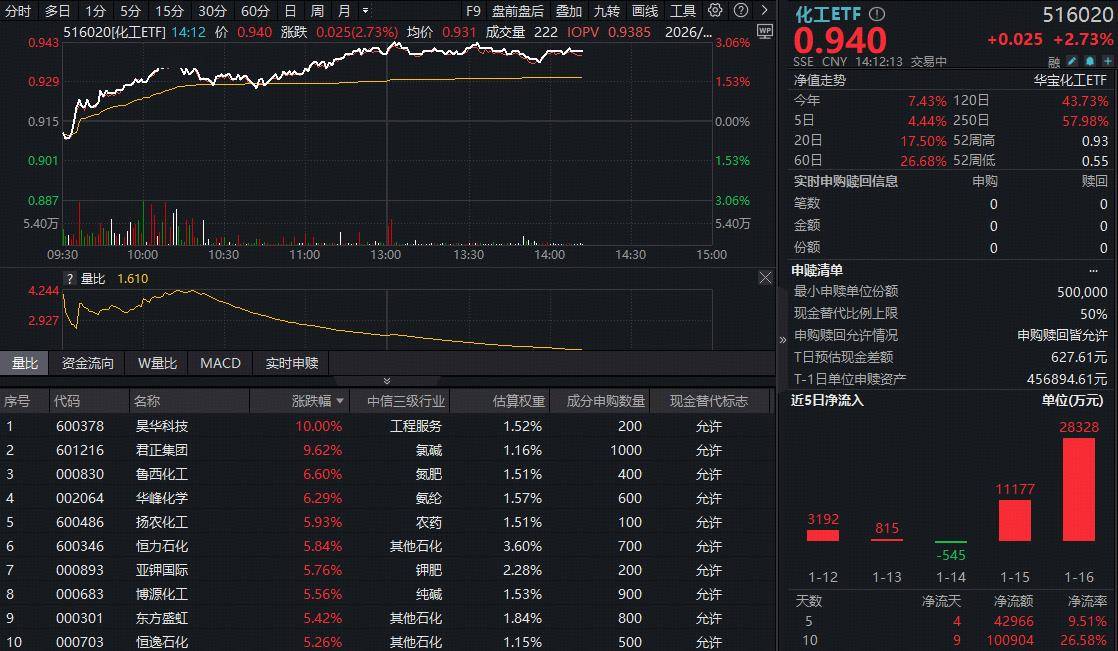
Group 1 - The chemical sector continues to show strength, with the Chemical ETF (516020) experiencing a price increase of 2.73% as of the latest update [1][2] - Key stocks in the sector include Haohua Technology, which reached the daily limit, and Junzheng Group, which surged over 9%, along with other notable gains from companies like Luxi Chemical and Huafeng Chemical [1][2] - Since 2025, the Chemical ETF has shown a cumulative increase of 47.53%, significantly outperforming major indices such as the Shanghai Composite Index (22.38%) and the CSI 300 Index (20.25%) [1][3] Group 2 - The chemical industry has seen negative growth in capital expenditure since 2024, but the "anti-involution" trend and the clearing of outdated overseas capacities are expected to lead to a contraction in supply [4] - The "14th Five-Year Plan" emphasizes expanding domestic demand, which is anticipated to drive growth in chemical product demand, especially with the onset of a U.S. interest rate cut cycle [4] - A potential turning point for the chemical industry is expected in 2026, with a shift from valuation recovery to earnings growth, referred to as the "Davis Double Play" [4] Group 3 - The Chemical ETF (516020) tracks the CSI Sub-Industry Chemical Theme Index, with nearly 50% of its holdings concentrated in large-cap leading stocks, including Wanhua Chemical and Salt Lake Co., allowing investors to capitalize on strong investment opportunities [5] - The ETF also includes exposure to various sub-sectors such as phosphate and nitrogen fertilizers, fluorochemicals, and others, providing a comprehensive investment approach within the chemical sector [5] - The fund does not charge a sales service fee, with specific subscription and redemption fee structures outlined for investors [5][6]


氟化工龙头涨停,化工板块午后继续猛攻!机构:供需双底确立,2026年或迎“戴维斯双击”
Xin Lang Cai Jing· 2026-01-19 06:24
Group 1 - The chemical sector continues to show strength, with the Chemical ETF (516020) experiencing a price increase of 2.73% as of the latest update [1][8] - Key stocks in the sector include Haohua Technology, which reached the daily limit, and Junzheng Group, which surged over 9%, along with other notable gains from companies like Luxi Chemical and Huafeng Chemical [1][8] - Since 2025, the Chemical ETF has shown a cumulative increase of 47.53%, significantly outperforming major indices such as the Shanghai Composite Index (22.38%) and the CSI 300 Index (20.25%) [10][11] Group 2 - The chemical industry has faced negative growth in capital expenditure since 2024, but the "anti-involution" trend and the accelerated elimination of outdated overseas capacity are expected to lead to a contraction in supply [12] - The "14th Five-Year Plan" emphasizes expanding domestic demand, which is anticipated to drive growth in chemical product demand, especially with the onset of a U.S. interest rate cut cycle [12] - The chemical industry may experience a cyclical turning point in 2026, transitioning from valuation recovery to earnings growth, referred to as the "Davis Double Play" [12] Group 3 - The Chemical ETF (516020) tracks the CSI Sub-Industry Chemical Theme Index, with nearly 50% of its holdings concentrated in large-cap leading stocks, including Wanhua Chemical and Salt Lake Co., allowing investors to capitalize on strong investment opportunities [13] - The ETF also diversifies its holdings across key sectors such as phosphate and nitrogen fertilizers, fluorine chemicals, and other leading stocks in the chemical sector [13] - Investors can also access the Chemical ETF through linked funds, which have specific subscription and redemption fee structures [5][14]