
利率下行

Search documents
首次,有银行停售5年期定存
财联社· 2025-11-06 06:22
Core Viewpoint - The cancellation of the five-year fixed deposit product by the Tongyu County Mengyin Village Bank marks a significant shift in the banking industry, potentially indicating expectations of declining interest rates and pressure on interest margins [1][3]. Summary by Sections Cancellation of Five-Year Fixed Deposit - The Tongyu County Mengyin Village Bank announced the cancellation of its five-year fixed deposit product effective November 5, 2025, making it the first bank to do so in the industry [1][3]. - The bank adjusted its deposit rates, lowering the one-year rate from 1.50% to 1.45%, the two-year rate from 1.60% to 1.55%, and the three-year rate from 1.95% to 1.85% [3][4]. Industry Context - Several other small and medium-sized banks have recently lowered their deposit rates, with some reductions reaching up to 80 basis points, yet they continue to offer five-year fixed deposit products [5]. - The cancellation of the five-year product is unprecedented, as banks typically opt to withdraw three-year or five-year large deposits instead [5][6]. Comparison with Larger Banks - Major banks such as Industrial and Commercial Bank of China and China Merchants Bank still offer five-year fixed deposit products, with rates of 1.55% and 1.30% respectively [6][7]. - The differing strategies among banks regarding fixed deposit offerings may be influenced by their unique liability situations and the need to balance deposit scales under interest margin pressures [7].


利息快跌没了,保险公司用ABS锁定收益
和讯· 2025-11-04 10:15
Group 1 - The core viewpoint of the article is that insurance companies are increasingly turning to insurance asset-backed securities (ABS) as a new direction for investment, particularly in a declining interest rate environment, with expectations for significant growth in this area over the next few years [2][5][10] - The scale of insurance ABS has surged, with 15 insurance asset management institutions registering 66 asset-backed plans in the first three quarters of this year, representing a year-on-year growth of 25.1% [3][4][10] - The shift from a "registration system" to a "registration system" for insurance asset-backed plans in September 2021 has led to rapid growth in this sector, maintaining over 50% year-on-year growth from 2020 to 2023 [4][10] Group 2 - Insurance companies favor ABS due to their need for long-term, stable returns to meet future liabilities, especially as bond market yields decline and equity market volatility increases [5][6] - ABS typically consists of long-term projects with low liquidity, such as infrastructure and high-quality debt, providing stable cash flows that align well with the long-term nature of insurance funds [5][6] - The current yield spread of ABS products is relatively high, with different types of ABS showing an overall credit yield spread exceeding 30 basis points, making them attractive to low-risk investors like insurance funds [5][6] Group 3 - ABS provides stable and predictable cash flow returns, which can match the duration needs of life insurance liabilities, making it an ideal investment for insurance companies [6][7] - The policy environment is supportive of ABS, with recent initiatives encouraging banks and insurance institutions to increase their investment in asset-backed plans [7][8] - The types of underlying assets for ABS registered in recent years include consumer finance, small and micro loans, supply chain assets, and restructuring debts, all of which align with national strategic support areas [8] Group 4 - ABS can generate significant returns for investors, as the performance of insurance ABS is closely linked to the investment returns of insurance companies, which directly affect policyholder dividends and account yields [9][10] - If insurance companies can achieve returns above 5% through ABS, they can better meet their commitments to policyholders and potentially offer higher dividends [9][10] - The potential for individual investors to participate in ABS is currently limited, but as some insurance asset management institutions expand their roles, opportunities for trading ABS and REITs may increase in the future [9][10] Group 5 - The expectation is that ABS will transition from a "supplementary allocation" to a "core strategy" for insurance funds, with a projected increase in the proportion of ABS in alternative investments from 12% to 25% over the next three years [10][11] - Key factors for this transition include the quality of underlying assets, the channels for trading ABS, and the valuation methods used, which could enhance investor confidence and liquidity [10][11] - If these factors are realized, ABS could become a new foundational investment for insurance funds during the ongoing interest rate decline [11]

四季度以来房企融资成本持续下探
Zheng Quan Ri Bao· 2025-10-23 19:09
Group 1 - Real estate companies are actively financing in Q4, with financing costs continuing to decline, with rates dropping to around 2%, and some companies seeing rates in the "1s" [1] - Major real estate firms are issuing bonds for debt repayment and project construction, with China Overseas Land & Investment announcing a bond issuance of 30 billion yuan for projects in multiple cities [1] - China Merchants Shekou Industrial Zone Holdings announced a bond issuance of up to 40 billion yuan with a fixed interest rate of 1.90% [1] Group 2 - Local state-owned enterprises are also increasing their financing efforts, with Beijing Energy Investment completing a non-public bond issuance of up to 3 billion yuan at a rate of 2.04% [2] - The real estate sector saw a total bond financing amount of 561 billion yuan in September, a year-on-year increase of 31.0%, with credit bonds making up 57.4% of this total [2] - The average interest rate for real estate bonds in September was 2.68%, a decrease of 0.38 percentage points year-on-year, with credit bonds averaging 2.36% [3] Group 3 - The decline in financing costs is attributed to policy support for reasonable financing in real estate and a general decrease in market interest rates, leading to increased market confidence [3] - The financing environment for real estate is showing signs of marginal improvement, with expectations of continued support from policies and active credit tools [3] - Lower financing rates will provide greater opportunities for companies to replace high-cost debt and extend debt maturity, aiding in the stabilization of their balance sheets [3]




2025年,利率下行后,这5种资产将越来越值钱了
Sou Hu Cai Jing· 2025-10-21 04:40
Core Insights - The global trend of declining interest rates since 2025 has made traditional bank deposits less attractive, with one-year fixed deposit rates around 2%, failing to keep up with an average inflation rate of approximately 3% [1] - This environment presents an opportunity for asset reallocation, focusing on assets that can outperform interest rates, hedge against inflation, and have long-term growth potential [1] Investment Opportunities - The demand for electric vehicles (EVs) has surged, indicating a growing opportunity in the technology sector, particularly in areas like chips, new materials, and AI [3][4] - Investing in technology-themed funds allows individuals to indirectly benefit from industry growth without the need to directly purchase high-priced stocks [3] - Real estate investment remains viable, particularly in core urban areas with strong demand and infrastructure, while ordinary residential properties in less populated areas may struggle to appreciate [4][5] Asset Classes - Gold has proven to be a reliable asset for value preservation, with a reported price increase of over 30% since 2021, making it a suitable hedge against economic fluctuations [5] - Digital assets like Bitcoin carry higher risks and are recommended for only a small portion of an individual's investment portfolio [5] - Regular investment in mutual funds, particularly those focused on technology and consumer sectors, has shown stable returns, averaging around 8% over five years [7] Skills and Knowledge Investment - Investing in personal skills and knowledge is highlighted as a non-depreciating asset, with examples of individuals enhancing their income through skill acquisition in high-demand areas like video editing and data analysis [8] - The recommendation includes allocating a portion of assets to skill development, which can lead to increased income and job security [8] Suggested Asset Allocation - A proposed asset allocation strategy includes 35% in quality funds, 30% in core city real estate, 15% in gold, 10% in technology stocks, and 10% in skills investment, aiming for stable growth and enhanced personal capabilities [8]

如何看待30年国债补涨行情的延续性?
Southwest Securities· 2025-10-20 04:15
1. Report Industry Investment Rating No industry investment rating information is provided in the report. 2. Core Views of the Report - Since October, the bond market has shown a divergence in the term structure. The ultra - long - term interest rate varieties had a lagged increase in the first week of October but a concentrated catch - up in the second week, with the market style shifting from "spreading yield spread" to "compressing yield spread" [2][6]. - The catch - up of ultra - long bonds has pushed the spread between new and old bonds to compress, and the liquidity premium may determine the subsequent compression space. The spread between new and old bonds mainly depends on the "tax valuation anchor" and "liquidity premium", and the latter may play a more important role in the future [2][11][12]. - The deep - seated reason for the strong catch - up of ultra - long bonds last week is that the yield spread between ultra - long interest rates and other term interest rates has shown cost - effectiveness, attracting both allocation and trading desks [2][15]. - The bond market may see a downward space in the fourth quarter, but the rhythm may vary at different time points. In late October, it may enter a volatile period, and from November to December, it will be determined by the game between macro - fundamentals and policy expectations, with two scenarios presented [2][3][20]. - In terms of investment strategy, it is recommended to position the portfolio duration in the medium - to - long range, select high - quality coupon assets as the bottom position, and pay attention to trading opportunities in medium - duration varieties such as secondary perpetual bonds [3][103]. 3. Summary by Relevant Catalogs 3.1 How to View the Sustainability of the 30 - year Treasury Bond Catch - up Market - **Market Performance in October**: In the first week of October, the 10 - year Treasury bond outperformed the 30 - year Treasury bond in both the spot and futures markets. In the second week, the ultra - long - end assets took over, with the 30 - year Treasury bond yield accelerating downward and the catch - up momentum of ultra - long bonds being released [2][6]. - **New and Old Bond Spread**: The catch - up of ultra - long bonds drove the spread between new and old 30 - year special Treasury bonds (2500002 and 2500006) to compress. As of October 17, the spread had narrowed by 3.05BP. The subsequent spread trend may depend more on the liquidity premium [11][12]. - **Reason for Catch - up**: The yield spread between 30 - year and other - term Treasury bonds has reached a high level, attracting both allocation and trading desks. The trading desks, mainly represented by brokers and funds, played a leading role in the catch - up market [15][17]. - **Market Outlook**: The bond market may have a downward space in the fourth quarter. In late October, it may enter a volatile period due to important events. From November to December, two scenarios are presented based on the development of Sino - US economic and trade relations [2][3][20]. 3.2 Important Matters - **Central Bank's Reverse Repurchase**: In October, the central bank carried out 6000 billion yuan of 6 - month term buy - out reverse repurchase operations, with a net injection of 4000 billion yuan for 3 - month and 6 - month term buy - out reverse repurchases [27]. - **CPI and PPI Data**: In September, CPI decreased by 0.3% year - on - year and increased by 0.1% month - on - month; PPI decreased by 2.3% year - on - year, with the decline narrowing by 0.6 percentage points, and was flat month - on - month [29]. - **Credit Data**: From January to September 2025, the cumulative increase in social financing scale was 30.09 trillion yuan, 4.42 trillion yuan more than the same period last year. RMB loans increased by 14.75 trillion yuan [32]. - **Sino - US Tariff Tension**: On October 14, the US Treasury Secretary said that the 100% tariff on China "may not happen" and the communication channels between the two countries have reopened [33]. 3.3 Money Market - **Open Market Operations and Fund Rates**: From October 13 to 17, the central bank's 7 - day reverse repurchase operations had a net injection of - 3479 billion yuan. The bank - to - bank liquidity remained loose, and the policy rate of 7 - day open - market reverse repurchase was 1.40%. As of October 17, R001, R007, DR001, and DR007 changed compared with October 11, and the interest rate centers also changed slightly [37][41]. - **Certificate of Deposit Rates and Repurchase Transactions**: In the primary market, the net financing of inter - bank certificates of deposit (NCDs) last week was 2246.60 billion yuan, and the annual issuance scale as of the 42nd week of 2025 had reached 26.88 trillion yuan. The issuance interest rates of NCDs decreased compared with the previous week. In the secondary market, the yields of NCDs of all terms showed an upward trend [43][49][52]. 3.4 Bond Market - **Primary Market**: In the second week of October, the net supply of interest - rate bonds weakened, with a net financing of 218.71 billion yuan. The issuance of ultra - long - term special Treasury bonds in 2025 ended last week. As of October 17, the cumulative net financing of national bonds in 2025 was about 5.40 trillion yuan, and that of local bonds was about 6.15 trillion yuan. The issuance scale of special refinancing bonds as of last week was 2.01 trillion yuan [55][56][63]. - **Secondary Market**: Sino - US economic and trade games led to a weakening of the equity market, and interest rates showed a downward trend, with the long - end and ultra - long - end performing better. The 10 - 1 - year term spread further compressed. The average daily turnover rates of the 10 - year Treasury bond active bond (250011) and the 10 - year CDB bond active bond (250215) increased, and the liquidity premium between the 10 - year Treasury bond active bond and the secondary - active bond decreased to 5.20BP [55][66][70]. 3.5 Institutional Behavior Tracking - **Leveraged Trading**: Last week, the leveraged trading scale returned to a high level with the relatively loose capital, with an average of about 8.04 trillion yuan. The 20 - day moving average of the daily trading volume of inter - bank pledged repurchase was 6.72 trillion yuan, a decrease of about 0.15 trillion yuan compared with the previous week [86]. - **Cash Bond Market Transactions**: State - owned banks increased their holdings of bonds, mainly focusing on Treasury bonds within 5 years and policy - financial bonds between 5 - 10 years. Rural commercial banks reduced their buying and showed a net - selling profit - taking operation. Brokers and funds, as important trading desks, increased their holdings of Treasury bonds of all terms and 5 - 10 - year policy - financial bonds. Insurance companies increased their holdings of local bonds over 10 years [78][90]. 3.6 High - Frequency Data Tracking - **Futures and Commodity Prices**: Last week, the settlement prices of rebar futures decreased by 1.69% week - on - week, wire rod futures increased by 6.55%, cathode copper futures decreased by 2.09%, the cement price index decreased by 0.22%, and the Nanhua Glass Index decreased by 9.28%. The CCFI index decreased by 4.11%, and the BDI index increased by 5.68% [98]. - **Food and Crude Oil Prices**: The wholesale price of pork decreased by 4.35% week - on - week, and the wholesale price of vegetables increased by 3.89%. The settlement prices of Brent crude oil futures and WTI crude oil futures decreased by 2.66% and 2.44% respectively [98]. - **Exchange Rate**: The central parity rate of the US dollar against the RMB last week was 7.09 [101]. 3.7 Market Outlook - **Market Trend**: The bond market may see a downward space in the fourth quarter, but the rhythm may vary at different time points. In late October, it may enter a volatile period, and from November to December, it will be determined by the game between macro - fundamentals and policy expectations, with two scenarios presented [2][3][20]. - **Investment Strategy**: It is recommended to position the portfolio duration in the medium - to - long range, select high - quality coupon assets as the bottom position, and pay attention to trading opportunities in medium - duration varieties such as secondary perpetual bonds [3][103].
风格切换当下,周期有哪些看点?
2025-10-19 15:58
Summary of Key Points from Conference Call Records Industry Overview Power Generation Industry - The thermal power industry benefits from a significant decrease in coal costs, with Q3 performance continuing the recovery trend. The expected bottom for coal prices provides confidence for electricity price negotiations, and the anticipated increase in capacity prices improves the industry's business model. However, attention is needed on the potential impact of coal supply and demand changes on costs [1][4][7]. - The hydropower sector experienced significant fluctuations in Q3 due to the flood season, but the unexpected autumn floods may lead to an upward adjustment of the annual power generation target. Key players like the Yangtze River Basin, Sichuan Investment, and Huaneng Hydropower show strong competitiveness [1][5]. - Nuclear power has a confirmed long-term growth potential, with a peak in new unit commissioning expected in 2027. The acceleration of new unit approvals and the macroeconomic backdrop of declining interest rates enhance its influence, although market-oriented trading may exert short-term pressure on performance [1][6]. Construction and Building Materials - Silver Dragon Co. benefits from an increased proportion of high-strength product usage and overseas business expansion, with Q3 performance expected to maintain high growth rates. Emerging businesses in aerospace steel wire products show strong competitiveness [1][8]. - Three Trees reported growth in revenue and net profit in Q3, driven by demand for existing and second-hand housing, and accelerated development of high-margin retail formats. The trend of domestic substitution is evident [1][8]. - Rabbit Baby's stock price increase is attributed to sector rotation and its low valuation with high dividend characteristics. Q3 revenue growth is expected to turn positive, with investment income enhancing performance and maintaining a high dividend yield [1][9]. - Huanxin Cement's mid-year performance saw a significant increase, with domestic and international cement business net profit per ton rising. The acquisition of Nigerian cement assets enhances performance, supported by supply-side reform logic [2][10]. Market Trends and Insights Market Sentiment and Style Changes - Recent changes in market sentiment and style have positively impacted the public utility sector, with the utility index rising nearly 3% since October, outperforming the Shanghai Composite Index by about 3% [3]. Real Estate Market Dynamics - During the National Day holiday, the real estate market showed signs of recovery, with first-tier cities experiencing slight growth and third-tier cities seeing a 20% year-on-year increase. However, second-hand housing transactions showed a significant decline [11]. - High-frequency data indicates a doubling of new housing supply in core cities from August, with a 30%-40% year-on-year increase. This suggests a positive outlook for future sales driven by optimistic expectations [12]. Future Policy Expectations - The fourth quarter is expected to maintain a loose policy tone, with ongoing implementation of real estate storage and urban renewal policies. There is also an increasing expectation of interest rate cuts, creating a favorable environment for the real estate sector [15]. Investment Recommendations - Investors are advised to focus on pure development companies, particularly smaller and mid-sized real estate firms that may experience valuation recovery or fundamental-driven trading opportunities due to improving policy expectations and fundamentals [16].
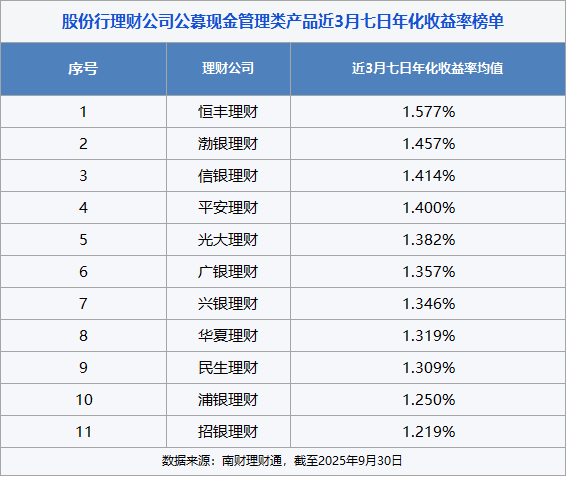
利率下行期的领跑者,恒丰理财三季度现管产品收益居股份行之首
2 1 Shi Ji Jing Ji Bao Dao· 2025-10-17 08:47
Core Insights - The article highlights the performance of cash management products in the Chinese market, particularly focusing on the strong performance of Hengfeng Wealth Management's products amidst a declining interest rate environment [1][4]. Group 1: Market Overview - As of September 2025, there are 6,550 RMB public cash management products in the market, with 81.9% of them yielding annualized returns between 1% and 1.5% [1]. - The average seven-day annualized yield for cash management products from joint-stock banks in Q3 2025 is 1.366% [1]. Group 2: Company Performance - Hengfeng Wealth Management's cash management products achieved an impressive average seven-day annualized yield of 1.577% in Q3 2025, ranking first among joint-stock banks [2]. - The "New Hengmeng Wallet" series from Hengfeng Wealth Management consists of 13 products, with a total scale of approximately 18.121 billion RMB as of September 2025 [2]. Group 3: Asset Allocation Strategy - The New Hengmeng Wallet series focuses on high liquidity and low-risk assets, primarily investing in large bank certificates of deposit and high-rated credit bonds [3]. - As of Q3 2025, large bank certificates of deposit account for 44.48% of the product mix, while high-rated credit bonds (AAA-rated) make up 22.32% [3]. Group 4: Product Development and Strategy - Hengfeng Wealth Management has developed a diverse product system that caters to different risk preferences and investment needs, establishing a competitive advantage [3]. - The investment strategy includes a stable foundation of fixed-income assets while selectively incorporating equity assets to enhance returns [3].
九月金融数据怎么看
CMS· 2025-10-16 03:01
Group 1: Financial Data Overview - In September, the new social financing (社融) amounted to 3.5 trillion RMB, with a growth rate of 8.7%, slightly down from the previous value of 8.8%[3] - New RMB loans totaled 1.29 trillion RMB, reflecting a growth rate of 6.6%, down from 6.8% previously[3] - M2 growth rate was 8.4%, a decrease from 8.8% in the prior month, while M1 growth rate increased to 7.2% from 6%[3] Group 2: Structural Insights - The decline in social financing was primarily influenced by credit and government bonds, with "non-standard" financing and direct corporate financing contributing positively[3] - New corporate loans were approximately 1.6 trillion RMB, down by about 3.7 billion RMB year-on-year, while government bonds decreased by 3.5 billion RMB[3] - The increase in "non-standard" financing was about 3.6 billion RMB, up by approximately 1.87 billion RMB year-on-year[3] Group 3: Deposit and Monetary Supply Trends - New RMB deposits reached 2.2 trillion RMB, down by 1.53 trillion RMB year-on-year, with household deposits increasing by 760 billion RMB[3] - The broad money supply (M2) growth rate declined by 0.4 percentage points compared to the previous month, indicating a continued trend of capital activation[3] - The M1-M2 spread continues to widen, suggesting ongoing liquidity in the market[3] Group 4: Market Outlook and Risks - The current trend indicates a shift towards a favorable environment for interest rate declines, supported by a loose monetary policy from the central bank[3] - Risks include potential unexpected declines in the overseas economy and macroeconomic policies exceeding expectations[5]
固收:利率下行空间分析及机会挖掘
2025-10-14 14:44
Summary of Key Points from Conference Call Records Industry Overview - The records primarily discuss the bond market dynamics in the context of current economic conditions, particularly focusing on interest rates and trade tensions affecting the market [1][2][3]. Core Insights and Arguments - The bond market is currently experiencing a general upward trend, but the profit-making effect is not significant due to inflation expectations and the performance of the equity market [1][2]. - A monetary policy easing or unexpected events, such as escalated trade tensions or domestic economic weakness, are necessary to break the current stagnation in profit-making [1][2]. - The market has minimal implied expectations for easing, and any rate cuts could help lower interest rates further. The 10-year government bond yield is currently around 1.75%, with potential to drop to 1.6% only with supportive easing measures [1][2][3]. - The fourth quarter is expected to have a more relaxed tone compared to the third quarter, with a model indicating a bullish outlook starting from October 10, with an 85% success rate [3]. - The funding environment post-National Day is expected to remain comfortable, with a 7-day funding level around 1.4% and low government issuance, leading to a higher probability of maintaining a loose funding level [4]. Important but Overlooked Content - The value of certificates of deposit (CDs) is highlighted, with a recommendation to focus on 6-month CDs over 1-year CDs for better returns, while 1-year CDs are suggested for those looking to extend duration [4]. - The bond market's strategy needs to consider the historical context of trade tensions, as past increases in tariffs led to rapid declines in bond yields, but the current situation may differ due to various influencing factors [2][5]. - The spread between 30-year local government bonds and 30-year government bonds is approximately 18 basis points, indicating strong allocation value for local government bonds [2][6]. - The records suggest a flexible investment strategy, recommending a barbell approach for potential gains while maintaining a bullet strategy for fixed positions in credit bonds [8]. - The liquidity of the 10-year government bonds is noted, with specific recommendations to observe the impact of new redemption fee regulations on trading strategies [9][10]. Investment Recommendations - Investors are advised to focus on local government bonds, particularly from regions like Zhejiang and Hunan, due to their favorable yield spreads and absolute returns [6][7]. - The records suggest monitoring the 5-7 year government bonds for better value and potential investment opportunities in the context of changing market conditions [14]. - The 50-year government bonds are considered to have investment value, but their attractiveness is limited by the performance of 30-year bonds, which currently dominate the market [13]. This summary encapsulates the key points from the conference call records, providing insights into the bond market's current state, strategic recommendations, and potential investment opportunities.
假期前后债市转暖 避险需求促利率下行
Jing Ji Guan Cha Bao· 2025-10-14 01:43
Core Viewpoint - The bond market has shown signs of recovery before and after the holiday, driven by increased risk aversion leading to a decline in interest rates [1] Group 1: Market Performance - During the six working days from September 28 to September 30 and October 9 to October 11, bond market sentiment improved, with yields declining for several consecutive days [1] - The 10-year government bond yield fell by over 5 basis points, with the most significant drops occurring on September 30 and October 11 [1] Group 2: Influencing Factors - The decline in yields on September 30 was influenced by rumors of the central bank restarting government bond trading [1] - On October 11, the market's risk aversion was significantly boosted by renewed threats from the U.S. to impose additional tariffs [1] Group 3: Future Outlook - Analysts suggest that the bond market will continue to face various disturbances from the equity market and policy changes in the short term [1] - The adjustment phase that has persisted since July has lasted for three months, and while the downward trend has slowed, further catalysts are needed to break the current oscillation pattern in interest rates [1]