
生物柴油政策

Search documents
紫金天风期货油油油
Zi Jin Tian Feng Qi Huo· 2025-12-12 12:08
1. Report Industry Investment Rating No information provided. 2. Core Viewpoints of the Report - In the 25/26 period, most oils are expected to increase in production. However, in 2025, the production and consumption growth rates of major biodiesel - producing countries globally slowed down, and the demand growth rates of various raw materials declined, except for palm oil, which maintained a relatively high growth rate. The market is still waiting for the US to announce the compliance obligation volumes for 2026 and 2027 and Indonesia's biodiesel policy. The low price of US crude oil limits the imagination space for biodiesel demand, unless the government is willing to provide substantial subsidies [207]. - Due to previous improvements in rainfall and fertilizers, as well as an increase in labor, Malaysia's production exceeded expectations this year, and Indonesia also had a significant increase in production, resulting in a divergence between expectations and reality. Although the replanting rate of oil palms is at a low level, it has improved compared to the low point in early 2020, but it started to decline in December 2021. After 2021, the use of fertilizer raw materials in Malaysia and Indonesia decreased rapidly, and considering the lagged impact of weather, the production performance in the next few months may not be as good as before [207]. - Currently, the soybean crushing profit in Argentina is relatively low, and the global new - crop sunflower oil production is lower than expected. Palm oil has cost - effectiveness, but Brazil has not decided whether to implement the B16 biodiesel policy at the beginning of 2026. Under the overall expectation of a bumper harvest in South America, the price of far - month South American soybean oil is low [207]. - Different from the downward adjustment of global sunflower seed and sunflower oil production, the global rapeseed production is gradually increasing. As Australian and Canadian rapeseed purchases are restricted, short - selling rapeseed in the domestic market may not be smooth. The impact is more likely to be indirectly transmitted to the domestic market through rapeseed oil and rapeseed meal from Dubai and Russia. However, opportunities to narrow the price spread at high levels should be noted [207]. - Before there is stronger positive news for biodiesel, the price advantage will still support the palm oil price. But if there is no speculation on the supply side and no expectation of inventory reduction, the price rebound will be limited [207]. 3. Summary by Relevant Catalogs 3.1 Market Review - **Price Movements**: The prices of domestic three major oils and US crude oil fluctuated in 2025. There were several rounds of price drops and rebounds. Drops were mainly due to factors such as the delay in Indonesia's biodiesel policy, unclear US biodiesel policy, increased South American soybean production, higher - than - expected imports of rapeseed oil and rapeseed, and official clarifications on non - restriction of palm oil exports. Rebounds were caused by factors like floods in palm oil - producing areas, rebounds in US and Brazilian soybean premiums, insufficient near - month imports of soybeans, expected pre - Ramadan purchases in India, and rumors of Indonesia's palm oil export ban [4]. 3.2 25/26 Global Oilseeds Situation - **Production and Export**: The total global oilseed production in the 25/26 period was gradually adjusted downward, with significant decreases in soybean and sunflower seed production, but significant increases in rapeseed and cottonseed production. The total export volume changed little, with significant increases in soybean and sunflower seed exports and a decrease in rapeseed exports [5]. - **Consumption and Stock - to - Use Ratio**: Global oilseed crushing was slightly adjusted downward, with a significant increase in rapeseed crushing but decreases in soybean and sunflower seed crushing. The stock - to - use ratio of rapeseed increased significantly, while those of soybeans and sunflowers decreased slightly [12][17]. 3.3 25/26 Global Oils Situation - **Production and Export**: The total global oil production in the 25/26 period was adjusted slightly. Rapeseed oil production was increased significantly, while soybean oil and sunflower oil production were decreased significantly. Rapeseed oil exports increased significantly, palm oil exports changed little, and soybean oil and sunflower oil exports decreased significantly [19]. - **Consumption**: The total global oil consumption decreased slightly. The consumption of soybean oil and rapeseed oil increased significantly, while that of sunflower oil decreased significantly [21]. - **Stock - to - Use Ratio**: The stock - to - use ratios of different oils showed different trends [30]. 3.4 Rapeseed Situation - **International Rapeseed Price and Spread**: The price of Canadian rapeseed was weak [32]. - **Canadian Rapeseed**: In the 25/26 period, Canadian rapeseed production increased by 789,000 tons. Exports were expected to increase by nearly 400,000 tons, and the ending inventory would rise from 1.597 million tons to 2.5 million tons. The export was slow, domestic consumption was high, and the commercial inventory was close to that of the previous year [38][40][42][45]. - **EU Rapeseed**: In the EU's November agricultural crop announcement for the 24/25 period, the rapeseed yield was adjusted upward to 3.34 tons per hectare, the planting area remained unchanged, and the production was adjusted upward to 2.0206 million tons. Rapeseed imports were high, exports increased, and the monthly crushing volume decreased [51][53][55][57]. - **Other Regions**: Australian new - crop rapeseed production was increased, Ukrainian rapeseed exports decreased, and Russian rapeseed production increased [61][66][71]. 3.5 Palm Oil Situation - **Malaysia**: In October, Malaysia's palm oil production increased more than expected, with a 11.02% month - on - month increase to 2.04 million tons. The export situation was complex, with a decrease in exports to India during the festival. As of the end of November, the inventory was expected to continue to increase [92][96][102]. - **Indonesia**: In September, Indonesia's palm oil production decreased significantly, and exports decreased due to the increase in export tariffs. The inventory remained basically stable at the end of September [121][128]. 3.6 Soybean Oil Situation - **North and South America**: The export of soybean oil in North and South America slowed down. Argentina's soybean oil export slowed, and Brazil's soybean oil export also decreased [132][134][141]. 3.7 Sunflower Oil Situation - **European Sunflower Seeds**: The production of European sunflower seeds was adjusted downward [151]. - **Ukraine**: Ukraine's sunflower oil exports were at a low level, with a decrease in exports to India and an increase in exports to the EU [158]. - **Other Regions**: Russia's sunflower oil export slowed, and Argentina's sunflower oil exports to India increased. The total sunflower seed production of four countries (Argentina, Ukraine, Russia, and the EU) increased [160][163][170]. 3.8 Biodiesel Situation - **Indonesia**: The distribution of biodiesel in Indonesia was slow, and as of November 10, the biodiesel distribution volume reached 12.25 billion liters, while the annual target was 15.6 billion liters [172][173]. - **EU**: The EU's imports of Malaysian POME, UCO, and UCOME increased, and the import of UCO was at a high level. The export of UCOME to the US decreased significantly, and the import of Chinese UCO remained at a high level [174][177][179][181][183]. - **US**: The proportion of soybean oil in US biodiesel feedstock generally rebounded, but the biodiesel production was lower than that of the previous year [185][187]. - **Brazil**: The consumption of soybean oil in Brazilian biodiesel was at a high level, and the growth rate of biodiesel raw material consumption slowed down in 2025 [195][197].
油脂产业周报:油脂区间震荡为主,等待报告指引-20251209
Nan Hua Qi Huo· 2025-12-09 10:58
Report's Investment Rating for the Industry There is no information provided regarding the report's investment rating for the industry. Core Views of the Report - The short - term weak reality suppresses the upward momentum of the oil and fat market, with the market in a wide - range oscillation, waiting for the final US energy policy and further news on Indonesia's B50 [1][2]. - The future trading of the oil and fat market will focus on the final determination of US biofuel obligations, the supply - demand balance game in palm oil - producing areas, the arrival schedule of US soybeans, and the progress of China - Canada relations [11]. Summary by Directory 1. Core Contradictions and Strategy Recommendations 1.1 Core Contradictions - The core contradiction in the oil and fat market lies in the game between inventory pressure and demand growth in palm oil - producing areas, the uncertainty of the US biodiesel policy, the potential tight supply of rapeseed due to China - Canada relations, and the overall sufficient supply of the three major domestic oils and fats [1]. 1.2 Trading - Type Strategy Recommendations - **Trend Judgment**: Short - term wide - range oscillation adjustment, with a possible upward shift in the price center in the medium term. - **Price Ranges**: P2601 oscillates between 8200 - 8900 yuan/ton, Y2601 between 8000 - 8400 yuan/ton, and OI between 9200 - 10000 yuan/ton. - **Technical Analysis**: For single - side short - term trading, consider a rebound in palm oil; for arbitrage, observe the weakening trend of the rapeseed - palm and soybean - palm spreads [18]. 1.3 Industry Customer Operation Recommendations - **Price Range Forecast**: The price range for soybean oil is 8000 - 8500 yuan/ton, rapeseed oil 9300 - 10300 yuan/ton, and palm oil 8200 - 8700 yuan/ton [21][23]. - **Strategies**: Adopt a short - term weak - oscillation view for the basis strategy; for the calendar - spread strategy, with high uncertainty in Indonesia's B50 policy next year, holders of the P1 - 5 reverse spread can take profits [22]. 1.4 Basic Data Overview - Provides detailed information on the daily prices, price changes, and spreads of palm oil, soybean oil, and rapeseed oil in both the futures and spot markets [24][25]. 2. This Week's Important Information and Next Week's Events to Watch 2.1 This Week's Important Information - **Positive Information**: Indonesia's palm oil rectification is accelerating, which may disrupt production efficiency [26]. - **Negative Information**: Malaysia's palm oil inventory in November is expected to reach a six - year high; domestic palm oil and soybean oil inventories are increasing, and the soybean crushing volume is high [27]. - **Spot Transaction Information**: Recent oil and fat transactions have remained stable, with an increase in rapeseed oil transactions and a slight decline in soybean oil and palm oil transactions [28]. 2.2 Next Week's Important Events to Watch - Monitor domestic high - frequency weekly inventory data, Malaysia's high - frequency palm oil production and export data, the progress of the US small refinery exemption redistribution decision, and the progress of China - Canada trade negotiations [35]. 3. Market Interpretation 3.1 Price - Volume and Capital Interpretation - **Domestic Market**: The oil and fat market rebounded this week, but lacks upward momentum. Capital trends vary among palm oil, soybean oil, and rapeseed oil, with different positions and sentiment [31]. - **Basis Structure**: The basis of the main oil and fat contracts continued to bottom out this week, remaining weak due to high inventory and average demand [33]. - **Calendar - Spread Structure**: The oil and fat market shows differentiation, with the soybean oil and rapeseed oil in a Back structure that has become shallower; the palm oil 1 - 5 spread has repaired upward, indicating lower expectations for the producing areas next year [34]. - **Spread Structure**: The soybean - palm, rapeseed - soybean, and rapeseed - palm spreads all declined slightly this week, with rapeseed oil weakening and palm oil rebounding slightly [61]. - **Foreign Market**: The foreign market was weakly oscillating this week, with palm oil and soybean oil under pressure due to a lack of positive factors [65]. 4. Valuation and Profit Analysis 4.1 Upstream and Downstream Profit Tracking in the Industry Chain - The POGO and BOHO spreads rebounded slightly this week, but the cost of soybean oil - based biodiesel remained at a multi - year low [68]. 4.2 Import and Export Profit Tracking - As a net importer of palm oil, China's import profit has changed slightly, with few new purchases due to the negative basis [70]. 5. Supply - Demand and Inventory Projections 5.1 Supply - Demand Balance Sheet Projections in Producing Areas - Malaysia's palm oil production in November is expected to decline slightly, but the inventory is expected to reach a six - and - a - half - year high, with supply pressure still existing [72]. 5.2 Supply - Side and Projections - Palm oil: Low procurement willingness due to the negative basis, and limited domestic purchases are expected during the off - season [75]. - Soybean oil: The arrival of raw materials will decline in December, and the supply pressure will gradually ease [75]. - Rapeseed oil: The inventory will continue to decline, and supply may be tight if China - Canada relations do not improve [75]. 5.3 Demand - Side and Projections - The short - term inventory of the three major oils and fats is relatively high, and the downstream demand is weak. The overall terminal demand for oils and fats may remain stable and weak [77].
宽幅震荡,关注生柴及天气利多兑现情况:油脂年报
Chang Jiang Qi Huo· 2025-12-08 05:25
2025-12-08 产业服务总部 饲料养殖中心 全球植物油:供应端,USDA11 月预估 25/26 年度全球植物油增产放慢,其中 菜油增产幅度最大而棕油增产最小。需求端,各国生物柴油政策发力,在增强油脂 国内消费的同时缩紧了油脂出口,不过总需求依然同比增长。需求增幅大于供应增 幅,25/26 年度全球植物油期末库存及库销比均同比下降,供需继续收紧,对植物油 价格有支撑。后续全球油脂市场的不确定性将主要集中于南美大豆/印尼棕油产量和 各国生物柴油政策上,可能造成价格剧烈波动:一是 25/26 年度美豆及南美豆因为 天气炒作,印尼棕油因为种植园强征等原因导致产量下降,收紧供应。二是美国和 印尼利多植物油生柴需求的生柴政策能否成功落地。 长江期货股份有限公司交易咨询 业务资格:鄂证监期货字[2014]1 号 研究员 棕油:供应端,目前市场对 2026 年东南亚棕油产量预估较为乐观,印尼两国均 同比增产。需求端,印度人口增长带来的刚性需求与印尼 B40 计划支撑,2025 年 产地棕油出口及国内消费有望维持强劲。供需双强下,25/26 年度印马库存预计都 同比下滑,马来库存历史中位,印尼库存则是更紧张的历史低位。 ...
东南亚洪水引发减产担忧 棕榈油企稳反弹
Qi Huo Ri Bao Wang· 2025-12-04 00:55
关注美国生物柴油政策 近期,市场担忧洪水影响马来西亚及印尼棕榈油产量,美国环保局澄清2026年及2027年生物柴油合规义务量 下降的传闻,棕榈油价格出现反弹。在印度2026年斋月前,棕榈油仍然具有价格优势。尽管需求端支撑棕榈 油价格反弹,但是持续上涨还需要生物柴油及减产周期表现配合。 上半年,机构预估今年马来西亚棕榈油产量为1950万吨,略高于2024年的1934万吨。然而,从6月开始,马来 西亚棕榈油产量持续维持较高增速,进入减产周期的10月也保持增长,市场预估今年马来西亚棕榈油产量有 望突破2000万吨。另外,马来西亚棕榈油局(MPOB)10月报告显示,马来西亚棕榈油累库超预期。进入11 月,马来西亚棕榈油出口降幅不断扩大,印度和中国等国采购放缓。印尼能矿部公布的数据显示,截至11月 初,年内印尼生物柴油累计分销量为122.5亿升,而2025年全年目标为156亿升,如果保持当前分销速度,全年 目标将难以完成。 9月,印尼棕榈油产量环比下降22.45%,至429.8万吨,受9月工作日天数少的因素影响;1—9月,累计产量同 比增加440万吨。9月,印尼上调出口关税接近80美元/吨,导致当月棕榈油出口量环比下降 ...

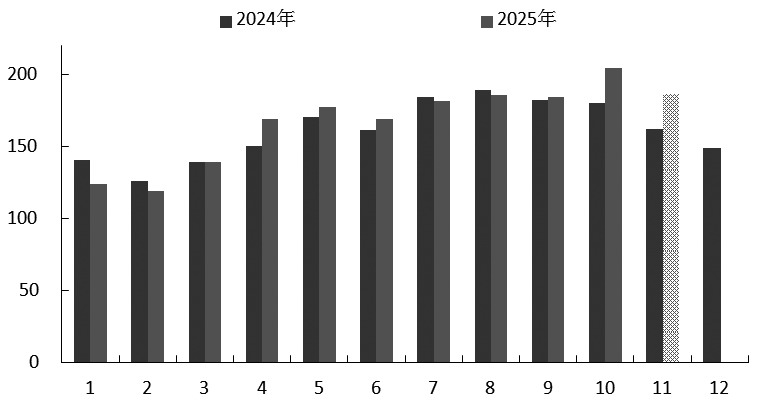
棕榈油期货:震荡偏强
Ning Zheng Qi Huo· 2025-12-01 09:02
Report Industry Investment Rating - The investment rating for the palm oil futures industry is "Oscillating with a Bullish Bias" [1] Core View of the Report - Last week, palm oil futures prices rebounded after hitting bottom. Due to frequent disturbances in US biodiesel policies and approaching the contract roll - over period, the market fluctuated greatly. Malaysian palm oil exports declined significantly month - on - month, and there was a high probability of inventory build - up in November, which pressured near - term futures prices. However, the import profit margin was in a deeper inversion, and there were no new ship purchases. The rapid decline in the futures price led to the repair of the soybean - palm oil price spread, which significantly boosted demand. Subsequently, the production growth rate of palm oil in Malaysia decreased sharply, and the market expected to enter a production - reduction cycle. As a result, the futures price rose significantly. In the short term, as the open interest of the 01 contract decreases rapidly, the inversion of the 1 - 5 price spread may be further repaired, and palm oil is expected to oscillate with a bullish bias. The operation suggestion is to go long at low prices [1] Summary by Related Catalogs Market Review and Outlook - Last week, palm oil futures prices rebounded after hitting bottom. At the beginning of the week, US biodiesel policies caused frequent disturbances, and during the contract roll - over period, the market fluctuated greatly. The Dalian palm oil futures price repeatedly broke previous lows, leading the decline in the oil and fat sector. The fundamental situation in the producing areas remained weak, with a significant month - on - month decline in Malaysian palm oil exports and a high probability of inventory build - up in November, which pressured near - term futures prices to break below the 4000 ringgit/ton mark. In China, there was a continuous large influx of palm oil, and inventories continued to increase. However, the import profit margin was in a deeper inversion, and there were no new ship purchases. The rapid decline in the futures price led to the repair of the soybean - palm oil price spread, which significantly boosted demand. The domestic spot basis rose rapidly, and traders and oil mills were strongly inclined to support prices. Later, the production data released by MPOA and SPPOMA showed a significant decline in the production growth rate. Considering the rainy season and frequent floods in the producing areas, the market expected to enter a production - reduction cycle. Additionally, the European Parliament supported a one - year postponement of the implementation of the "EU Zero - Deforestation Act", which caused the futures price to rise significantly. In the short term, as the open interest of the 01 contract decreases rapidly, the inversion of the 1 - 5 price spread may be further repaired, and palm oil is expected to oscillate with a bullish bias. The operation suggestion is to go long at low prices [1] Factors to Watch - Factors to watch include Malaysian palm oil production and export data, the repair of the soybean - palm oil price spread, and biodiesel policies [2] Palm Oil Ship - Date Quotations and Import Profit Calculations | Ship Date (24 - degree) | South China (CNF) | Forward Exchange Rate | Import Cost | Futures Price | Profit Against Futures | | --- | --- | --- | --- | --- | --- | | January | 1050 | 7.0494 | 8874 | 8644 | - 230 | | February | 1053 | 7.0356 | 8882 | 8644 | - 238 | | March | 1056 | 7.0266 | 8896 | 8644 | - 252 | [3] This Week's Fundamental Data Weekly Changes - The report mainly analyzes the palm oil market from aspects such as the spot - futures market, supply, demand, and cost - profit [4] Spot - Futures Market Review - The report presents a graph of the basis of the main contract, but no specific data analysis is provided [6] Supply Situation Analysis - The report presents graphs of palm oil ship - purchase quantity statistics, expected palm oil arrival volume, and Malaysian palm oil production, but no specific data analysis is provided [9][10][13] Demand Situation Analysis - The report presents graphs of China's total palm oil liquid import quantity and Malaysian palm oil export quantity, but no specific data analysis is provided [14][17] Cost - Profit Analysis - The report presents a graph of the daily profit against futures for the December palm oil ship - date, but no specific data analysis is provided [21]
宝城期货豆类油脂早报(2025年12月1日)-20251201
Bao Cheng Qi Huo· 2025-12-01 01:58
Report Summary 1. Report Industry Investment Rating No relevant content provided. 2. Report's Core View - The soybean meal market is under pressure from high domestic inventory and weak demand, with limited upside potential, while cost support and concerns about future supply limit the downside, resulting in a continued short - term pattern of strong overseas and weak domestic markets [5]. - The palm oil market is currently dominated by Indonesia's tax game in the short - term, with a "weak reality" and "strong expectation" scenario, and the price is expected to be oscillating strongly in the short - term [7]. 3. Summary by Variety Soybean Meal (M) - **Time - frame Views**: Short - term: oscillating; Medium - term: oscillating; Intraday: oscillating weakly; Reference view: oscillating weakly [5][6]. - **Core Logic**: The domestic spot market has a loose supply - demand situation, with high oil refinery operating rates. Downstream feed enterprises are cautious in purchasing due to breeding losses, and their inventories are sufficient, mainly replenishing on a just - in - time basis. This leads to a negative basis. The high inventory and weak demand in the domestic industry chain limit the rebound space, while cost support and concerns about future supply limit the decline space [5]. Palm Oil (P) - **Time - frame Views**: Short - term: oscillating strongly; Medium - term: oscillating; Intraday: oscillating strongly; Reference view: oscillating strongly [6][7]. - **Core Logic**: The palm oil market is dominated by Indonesia's tax game in the short - term. Delayed shipments have changed inventory and trade flows. The market is looking forward to whether Indonesia will continue to promote or increase the mandatory biodiesel blending ratio. If the policy is implemented, it will boost Indonesia's industrial consumption of palm oil, reduce export volume, and support prices [7]. Other Relevant Information - For varieties with night trading sessions, the starting price is the night - session closing price; for those without, it is the previous day's closing price. The ending price is the day - session closing price for calculating the price change [2]. - A decline of more than 1% is considered weak, a decline between 0 - 1% is oscillating weakly, a rise between 0 - 1% is oscillating strongly, and a rise of more than 1% is strong. Oscillating strongly/weakly only applies to intraday views [3]. - Short - term refers to within a week, and medium - term refers to two weeks to one month, based on the previous day's night - session closing price [6].
美豆周度报告-20251130
Guo Tai Jun An Qi Huo· 2025-11-30 11:58
美豆周度报告 Guotai Junan Futures all rights reserved, please do not reprint 观点与逻辑 Special report on Guotai Junan Futures 01 美豆多空因素与观点 | 总体观点 | | --- | | 南美丰产,没有牛市基础;需求有望好转,下方空间有限,总体震荡偏强,区间1000-1200美分/蒲式耳 | | 利空因素 | | 1、中国购买美豆后,特朗普政府对生柴添加政策的支持力度可能减弱 | | 2、巴西雨季回归,降水改善,播种进入收尾阶段 | | 3、巴西2025/26年度种植面积预计增加 | | 利多因素 | | 1、预计本年度中国购买美豆量1200万吨,未来三年每年2500万吨以上 | | 2、阿根廷播种速度低于预期 | | 3、拉尼娜天气可能导致南美大豆减产 | Special report on Guotai Junan Futures 资料来源:同花顺,国泰君安期货研究 国泰君安期货研究所 农产品组 谢义钦 投资咨询从业资格号:Z0017082 Special report on Guotai Juna ...
农产品组行业研究报告:气候、地缘、生柴,迷雾中寻找新方向
Hua Tai Qi Huo· 2025-11-30 08:52
Report Industry Investment Rating - The investment rating is neutral [8] Core Viewpoints of the Report - In 2025, the core contradiction in the global oil market is focused on the good production in major producing countries and the uncertainty of biodiesel industry policies and trade policies. In the palm oil sector, Indonesia's production in 2025 is expected to increase by 10% year-on-year, and Malaysia's annual production remains stable, with an unexpectedly high inventory in October. For soybean oil, although the global soybean production has a phased decline due to the US, the increase in South American soybean production ensures a bumper global soybean harvest. Rapeseed oil supply is also basically good, with the EU's rapeseed production increase contributing 54.7% of the global increment. China's anti - dumping deposit policy on Canadian rapeseed has significantly reduced China's rapeseed import scale. On the demand side, biodiesel policies show great fluctuations, and Indonesia's B50 expectation, as well as the US biodiesel blending targets and subsidy policies, have a great impact on the demand side [4][96] - The prices of the three major domestic oils show a significant differentiation trend, and the difference in supply - demand patterns and policy regulation directions are the core influencing variables. Rapeseed oil prices show a characteristic of oscillating upward with a rising bottom. The policy of imposing anti - dumping deposits on Canadian rapeseed in August has broken the previous supply - demand balance, leading to a sharp decline in domestic rapeseed inventory and a drop in the oil mill operating rate. Although the inventory was high in the first half of the year, the expectation of supply contraction has become the core pricing logic. Soybean oil prices oscillate between cost support and inventory suppression. After April, the concentrated arrival of South American soybeans has led to high crushing volume and a rise in inventory, and the weakening of the double - festival stocking demand has caused a price correction. The soybean gap in the third and fourth quarters may have less impact than expected. Palm oil prices show a downward oscillating trend. The increase in production in major producing countries and the surge in domestic imports have brought double supply pressure, increasing the domestic inventory. Only the implementation of Indonesia's B40 policy has provided phased support, but the uncertainty of the future B50 policy still poses great price risks [4][5][97] - Future research on the oil market should focus on three core factors. On the supply side, it is necessary to track the weather changes during the sowing period of South American soybeans, the entry of major palm oil producing countries into the seasonal production - reduction cycle, the implementation progress and funding guarantee of Indonesia's B50 biodiesel policy, and the changes in China - Canada trade policies and the export scale of Australian rapeseed to China. On the demand side, it is necessary to focus on the recovery of domestic catering consumption and the boost of the US biodiesel industry's profit improvement on soybean oil consumption. In terms of inventory, the high inventory pressure of soybean oil needs to be digested through the expansion of the export market and the recovery of terminal consumption, the inventory accumulation pressure of palm oil may gradually ease with the arrival of the seasonal production - reduction period in producing areas, and the low - inventory pattern of rapeseed oil is difficult to change fundamentally in the short term [4][6][98] Summary According to the Directory 2025 Review of the Three Major Oils' Market Conditions - From January to October 2025, the prices of the three major domestic vegetable oils fluctuated greatly and showed significant differentiation. Rapeseed oil prices oscillated upward, with the spot average price in October rising 10.5% compared to January. Soybean oil prices slightly fluctuated between cost and inventory, with the average price in October rising only 2.28% compared to January. Palm oil prices oscillated downward, with the average price in October falling 6.47% compared to January [12] - From January to March, the three major oils were in the initial game stage. Rapeseed oil was balanced between high carry - over inventory and Spring Festival stocking demand. Soybean oil oscillated at the bottom, supported by low soybean arrivals and low crushing volume. Palm oil oscillated downward under policy negatives and production - reduction support [14][16] - From April to July, the market differentiation of the three major oils intensified. Rapeseed oil oscillated at a high level, restricted by high inventory and slow catering recovery. Soybean oil prices fell under the pressure of abundant supply. Palm oil prices continued to decline due to increased production in major producing countries [16][18] - From August to October, policy variables became the key to break the market balance. Rapeseed oil prices rose unilaterally after the anti - dumping deposit policy on Canadian rapeseed. Soybean oil prices first rose due to cost - push and then adjusted due to high inventory. Palm oil prices first rebounded and then fell back, affected by Indonesia's biodiesel policy and the increase in inventory [18] Global Oil Supply Analysis Global Palm Oil Supply - Indonesia and Malaysia account for over 80% of global palm oil production, and their supply - demand patterns dominate the global market. In 2025, Indonesia entered the seasonal production - increase period in March. From June to August, its monthly average production increased by over 30%. The increase in exports and domestic industrial consumption due to biodiesel policies effectively digested the supply pressure. GAPKI estimates that Indonesia's palm oil production will increase by about 10% this year and about 5% next year, but the weather in 2026 may be a variable [20][23] - Malaysia's annual palm oil production fluctuated seasonally, with the total output from January to October increasing slightly by 1.77% year - on - year. Due to the aging of oil palm trees and limited new planting areas, its production growth was restricted. From June to October, exports were lower than expected due to competition from Indonesia, leading to an increase in inventory. In October, the inventory was 30.72% higher than the same period last year [26][27] Global Soybean Supply - Global soybean production increased from 316,072 thousand tons in the 2015/16 season to 427,136 thousand tons in the 2024/25 season, but decreased by 1.3% in the 2025/26 season, mainly due to a 2.3% reduction in harvested area, while the yield per unit area increased by 0.7% [30] - In the US, although the planting area decreased, the yield per unit area was at a high level, and the total output reached 115 million tons. In South America, Brazil's soybean planting progress in the 2025/26 season is smooth, and overseas institutions have a high - yield expectation, with estimates generally in the range of 175 - 180 million tons. Argentina may reduce the soybean planting area, and the estimated output is in the range of 48 - 50 million tons [31][34] - In the 2025/26 season, global soybean ending inventory decreased slightly by 1.1%, and the stock - to - use ratio decreased from 20.6% to 20.0%. The US soybean stock - to - use ratio also decreased, and the ending inventory decreased by 8.5% compared to the 2024/25 season [37] Global Rapeseed Oil Supply - From 2015/16 to 2024/25, global rapeseed supply showed a fluctuating upward trend, and in 2025/26, the total output increased by 7.3% year - on - year. The EU's rapeseed production increase contributed 54.7% of the global increment [44] - In Canada, the yield per unit area in 2025/26 recovered to a high level in the past five years, and the total output increased by 4.0% year - on - year, accounting for 21.7% of the global total output. In the EU, the rapeseed output in 2025/26 increased by 19.3% year - on - year, driven by the improvement of yield per unit area and the expansion of harvested area [48][49] Global Oil Demand Analysis Global Biodiesel Production Trend - Globally, biodiesel production increased continuously from 2021 to 2024 but is expected to decline in 2025. Traditional production areas such as the EU and the US are showing a slowdown or decline in growth, while some countries in Southeast Asia and South America, such as Indonesia and Brazil, are the main driving forces for growth [54][55] US Biodiesel Situation - In the first three quarters of 2025, the profit of the US biodiesel industry was poor, and production decreased significantly. In order to relieve the supply pressure, US soybean oil prices decreased to gain export competitiveness. However, since October, the profit of the biodiesel industry has improved significantly. The US Environmental Protection Agency has adjusted the renewable fuel obligation targets for 2026 and 2027, and future implementation needs to be monitored [58][60][65] Indian Oil Consumption - In the 2024/25 season, India's total oil imports decreased slightly by 0.32% year - on - year, but palm oil imports decreased by 16.82% due to price increases and tariff adjustments. From January to May, India mainly consumed inventory, and from June to September, imports increased significantly as inventory reached a low level. India's oil consumption growth supports the global oil market, and its palm oil consumption and inventory are important factors affecting palm oil prices [66][67][69] Domestic Oil Supply - Demand Analysis Imports - From January to September 2025, China's soybean imports increased by 5.29% year - on - year. The direct import of soybean oil was relatively small, with a 5.12% increase year - on - year. Rapeseed imports decreased by 42.19% year - on - year, while rapeseed oil imports increased by 18.13% year - on - year. Palm oil imports decreased by 19.21% year - on - year, mainly due to the production pattern in major producing countries and the inverted price difference between soybean oil and palm oil [72][74][82] Consumption - As of the 45th week of 2025, China's soybean crushing increased by 5.24% year - on - year. Rapeseed crushing decreased by 47.7% year - on - year, mainly due to policy and supply constraints. Palm oil consumption showed obvious seasonal fluctuations, with overall weak demand and slow inventory digestion [83][86][89] Inventory - As of the 45th week of 2025, China's soybean oil commercial inventory increased by 4.84% year - on - year, reaching a peak due to high crushing volume and weak consumption in summer. Rapeseed oil inventory decreased significantly after the anti - dumping policy on Canadian rapeseed. Palm oil inventory first decreased due to supply shortages and then increased due to increased production in major producing countries and weak demand [90][94] Market Outlook - The core contradictions in the 2025 global oil market remain, and the prices of the three major domestic oils will continue to be affected by supply - demand patterns and policies in the future. Future research should focus on supply - side factors such as weather, biodiesel policies, and trade policies, as well as demand - side factors such as domestic catering consumption and US biodiesel industry profits [96][98]
三大油脂周度报告-20251128
Xin Ji Yuan Qi Huo· 2025-11-28 12:39
1. Report Industry Investment Rating - No relevant information provided. 2. Core Viewpoints of the Report - In the short - term, palm oil is expected to be strong due to concerns about production cuts caused by floods in Southeast Asia; rapeseed oil will fluctuate as Australian rapeseeds are arriving but need time for customs clearance and pressing; soybean oil will have narrow - range fluctuations due to ample supply and lack of driving forces [28]. - In the medium - to - long - term, palm oil prices are expected to stabilize and rebound after bottom - hunting, considering the upcoming seasonal production cut in the producing areas and the long - term support of Indonesia's biodiesel policy; the trend of rapeseed oil prices depends on China - Canada trade relations; the soybean - palm oil price spread has been repaired, and the cost center of soybean oil is expected to rise [29]. 3. Summary by Related Catalogs 3.1 Domestic Three Major Oils Spot Price Trends - From November 21 to 28, 2025, the futures closing price of palm oil (P2601) rose from 8550 to 8626, a weekly increase of 0.89%; the spot price fell from 8532 to 8518, a weekly decrease of 0.16% [4]. - The futures closing price of rapeseed oil (OI2601) dropped from 9816 to 9757, a weekly decrease of 0.60%; the spot price decreased from 10167 to 10145, a weekly decrease of 0.21% [4]. - The futures closing price of soybean oil (Y2601) increased from 8190 to 8244, a weekly increase of 0.66%; the spot price rose from 8392 to 8412, a weekly increase of 0.24% [4]. 3.2 Three Major Oils Basis Changes - As of November 27, 2025, the basis of soybean oil, rapeseed oil, and palm oil was 188 yuan/ton (a decrease of 10 yuan/ton from the previous week), 373 yuan/ton (an increase of 12 yuan/ton from the previous week), and - 10 yuan/ton (a decrease of 40 yuan/ton from the previous week) respectively [7]. - As of November 28, 2025, the YP spread was - 382 yuan/ton (a decrease of 22 yuan/ton from the previous week) [7]. 3.3 Domestic Three Major Oils Inventory Trends - As of November 21, 2025, the rapeseed oil inventory in coastal areas was 2.45 million tons (an increase of 0.37 million tons from the previous week); the commercial inventory of palm oil mills was 66.71 million tons (an increase of 1.39 million tons from the previous week); the inventory of soybean oil in national oil mills was 117.99 million tons (an increase of 3.14 million tons from the previous week); the total inventory of the three major oils was 187.15 million tons (an increase of 4.9 million tons from the previous week) [10]. 3.4 Supply - side of Palm Oil - As of November 28, 2025, the import cost of 24 - degree palm oil was 8884 yuan/ton (an increase of 71 yuan/ton from the previous week) [13]. - As of November 28, 2025, the gross profit of 24 - degree palm oil against the market was - 224 yuan/ton (a decrease of 145 yuan/ton from the previous week) [13]. - SPPOMA data showed that the year - on - year increase in Malaysian palm oil production from November 1 - 25, 2025, narrowed to 5.49% [13]. 3.5 Supply - side of Soybean Oil - As of November 21, 2025, the soybean inventory in national ports was 942.50 million tons (a decrease of 50.1 million tons from the previous week), the soybean inventory in major national oil mills was 714.99 million tons (a decrease of 32.72 million tons from the previous week), and the oil mill operating rate was 59% (a decrease of 3% from the previous week) [16]. - As of November 28, 2025, the soybean crushing profit was - 533.20 yuan/ton (an increase of 40.15 yuan/ton from the previous week) [16]. 3.6 Supply - side of Rapeseed Oil - As of November 21, 2025, the total rapeseed inventory in oil mills was 0.1 million tons (a decrease of 0.15 million tons from the previous week) [19]. - As of November 28, 2025, the import rapeseed crushing profit was - 2414.40 yuan/ton (an increase of 39.2 yuan/ton from the previous week) [19]. 3.7 Demand - side - On November 27, 2025, the trading volume of palm oil in major oil mills was 3700 tons, the trading volume of first - grade soybean oil was 6300 tons, and the POGO spread was 375.99 US dollars/ton (an increase of 30.75 US dollars/ton from the previous week) [25]. - The predicted annual total consumption of rapeseed oil is 805 million tons [25]. 3.8 Fundamental Analysis of Three Major Oils - Policy: The Trump administration is considering extending the restrictions on imported raw materials and imported biodiesel. The US restructuring of the Energy Bureau and the abolition of renewable energy - related departments have limited the boost to the US biofuel policy. The market is concerned about the progress of China - Canada trade relations [26]. - Foreign factors: For US soybeans, the November USDA supply - demand report lowered the 2025/26 soybean yield per acre by 0.5 bushels to 53 bushels per acre, and the soybean production was also lowered to 4.253 billion bushels, lower than market expectations. Exports were unexpectedly lowered by 0.5 billion bushels, about 136 million tons. Since Tuesday, China has purchased at least 10 ships of US soybeans. Since late October, China has purchased about 3.5 million tons of US soybeans, about 30% of the 12 - million - ton purchase target [26]. For palm oil, SPPOMA data showed that the Malaysian palm oil production from November 1 - 25, 2025, increased by 5.49% compared with the same period last month. AmSpecAgri data showed that the export volume of Malaysian palm oil products from November 1 - 25, 2025, decreased by 16.4% compared with the previous month. The increase in production and decline in exports increased the expectation of inventory accumulation in Malaysia. Recent floods in Southeast Asia have raised concerns about the impact on Malaysian palm oil production [26]. - Import and crushing: The oil mill operating rate decreased by 3% from the previous week, and the soybean inventory decreased. The rapeseed inventory in oil mills was 0.1 million tons, a decrease of 0.15 million tons from the previous week [26]. - Inventory: As of November 14, 2025, the rapeseed oil inventory in coastal areas increased to 2.45 million tons; the commercial inventory of palm oil mills increased to 66.71 million tons; the inventory of soybean oil in national oil mills increased to 117.99 million tons [26]. - Spot: This week, the spot prices of oils showed mixed trends. The spot price of palm oil decreased by 0.16%, the spot price of rapeseed oil decreased by 0.21%, and the spot price of soybean oil increased by 0.24% [26].
《农产品》日报-20251127
Guang Fa Qi Huo· 2025-11-27 01:22
| 油脂产业期现日报 | | | | | | | | --- | --- | --- | --- | --- | --- | --- | | 2025年11月27日 | 投资咨询业务资格:证监许可 [2011] 1292号 | | | | 王法庭 | Z0019938 | | 更油 | | | | | | | | | | | 11月26日 | 11月25日 | 旅跌 | 旅跌幅 | | 现价 | | 江苏一级 | 8460 | 8510 | -20 | -0.59% | | 期价 | | Y2601 | 8150 | 8144 | 6 | 0.07% | | 墓差 | | Y2601 | 310 | 366 | -56 | -15.30% | | 现货墓差报价 | | 江苏1月 | 01+280 | 01+280 | 0 | : | | 仓单 | | | 22029 | 24625 | -2596 | -10.54% | | 棕櫚油 | | | | | | | | | | | 11月26日 | 11月25日 | 涨跌 | 涨跌幅 | | 现价 | | 广东24度 | 8290 | 8370 | -80 | - ...