
K型分化

Search documents
金鹰基金:春季躁动布局正当时 聚焦科技+制造主线
Xin Lang Cai Jing· 2025-12-22 02:47
Group 1: Market Overview - The A-share market experienced a fluctuating recovery pattern last week, with a divergence in index performance, characterized by a stronger Shanghai market compared to Shenzhen [7] - Under the expectation of "expanding domestic demand" policies and high dividend defensive attributes, consumption and non-bank financial sectors became the leading gainers, while previously active AI applications and hardware saw a pullback [7] - The average daily trading volume in the A-share market decreased to 1.76 trillion yuan, indicating a decline in market activity [7] Group 2: Economic Indicators - November consumption showed a significant slowdown due to high base effects and policy exhaustion, while fixed asset investment continued to decline, and the real estate market remained sluggish [7] - External demand was noted as a rare bright spot, but there are expectations for monetary stimulus and fiscal pre-positioning to improve domestic economic conditions in early next year [7] Group 3: Global Economic Context - The Bank of Japan's interest rate hike has led to a moderate recovery in market risk appetite, while the U.S. non-farm employment rate is expected to rise, and CPI is projected to be below market expectations [8] - Despite these indicators, the Federal Reserve is unlikely to take further directional actions in the short term, with expectations that it will not lower interest rates in January [8] Group 4: Industry Focus - The focus is shifting towards technology and manufacturing sectors, with a potential bottoming out of the recent global tech pullback [9] - Key factors for the future strength of the tech sector include improvements in large model capabilities and advancements in AI commercialization [9] - The manufacturing sector is expected to benefit from fiscal and monetary easing, with a focus on export-oriented manufacturing and real estate chains related to emerging markets [9]
美股消费最艰难的时刻过去了吗
Sou Hu Cai Jing· 2025-12-19 14:12
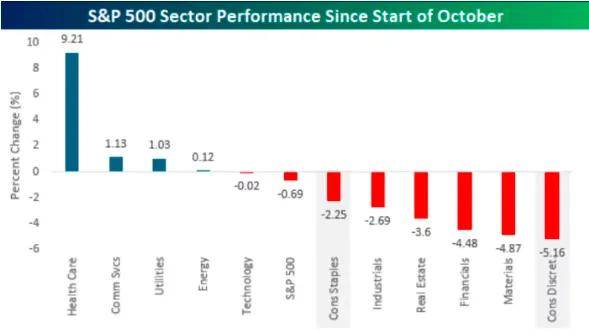
Core Viewpoint - The consumer sector in both US and A-shares is facing significant challenges, with most gains in the stock market concentrated in AI-related companies, leaving ordinary consumers with limited benefits. This has led to a decline in middle-class spending power and consumer sentiment [1][4]. Group 1: Market Performance - Many consumer stocks have underperformed the market this year, marking a rare occurrence where historically strong consumer stocks have lagged for two consecutive years [2]. - The recent downturn began in June 2024, erasing the long-term valuation premiums of many consumer stocks, with price-to-earnings (PE) ratios around 10 times becoming common [3]. - Lululemon's Q3 earnings report showed low growth but slightly exceeded guidance expectations, indicating a potential stabilization after facing layoffs and tariffs. The company's stock surged by 10% in a single day, marking the first significant outperformance of non-essential consumer stocks against the broader market in a year [3]. Group 2: Consumer Sentiment and Spending - The reduction of the middle class and ongoing layoffs are expected to reach a turning point, with the wealth effect from the stock market likely to eventually benefit all social strata [4]. - The consumer confidence index in the US has recently hit a record low, approaching the pandemic lows of 2022, indicating that the current period is particularly challenging for consumers [9]. - The K-shaped recovery is evident, with non-essential consumer goods, such as dining and sportswear, performing poorly, while grocery retailers like Walmart and Costco maintain better stock performance due to their lower-priced offerings [9][10]. Group 3: Company-Specific Insights - Lululemon's Q3 report revealed a 2% decline in revenue from the US market, offset by over 40% growth in China, highlighting the reliance on international markets for performance [11]. - Other companies in the sportswear sector, such as Adidas and Puma, also reported declining revenues in the US, emphasizing the challenges faced domestically [11]. - The performance of companies like Chipotle Mexican Grill (CMG) reflects the struggles of mid-tier consumer brands, with Q3 same-store sales declining and Q4 guidance lowered, indicating a bleak outlook for the US middle-class consumer market [14]. Group 4: Future Outlook - The worst times for US consumer stocks may be behind, with potential for recovery as PE ratios stabilize and market conditions improve [4][26]. - The upcoming 2026 World Cup in the US is expected to provide a marginal improvement for local consumer sectors, particularly in sports and leisure [25]. - Companies with significant overseas revenue are likely to recover faster from domestic challenges, with brands in cosmetics and sportswear expected to outperform those in the restaurant sector [26].

穿越周期,重塑价值:2025中国酒业深度调整与未来展望
Sou Hu Cai Jing· 2025-12-18 03:17
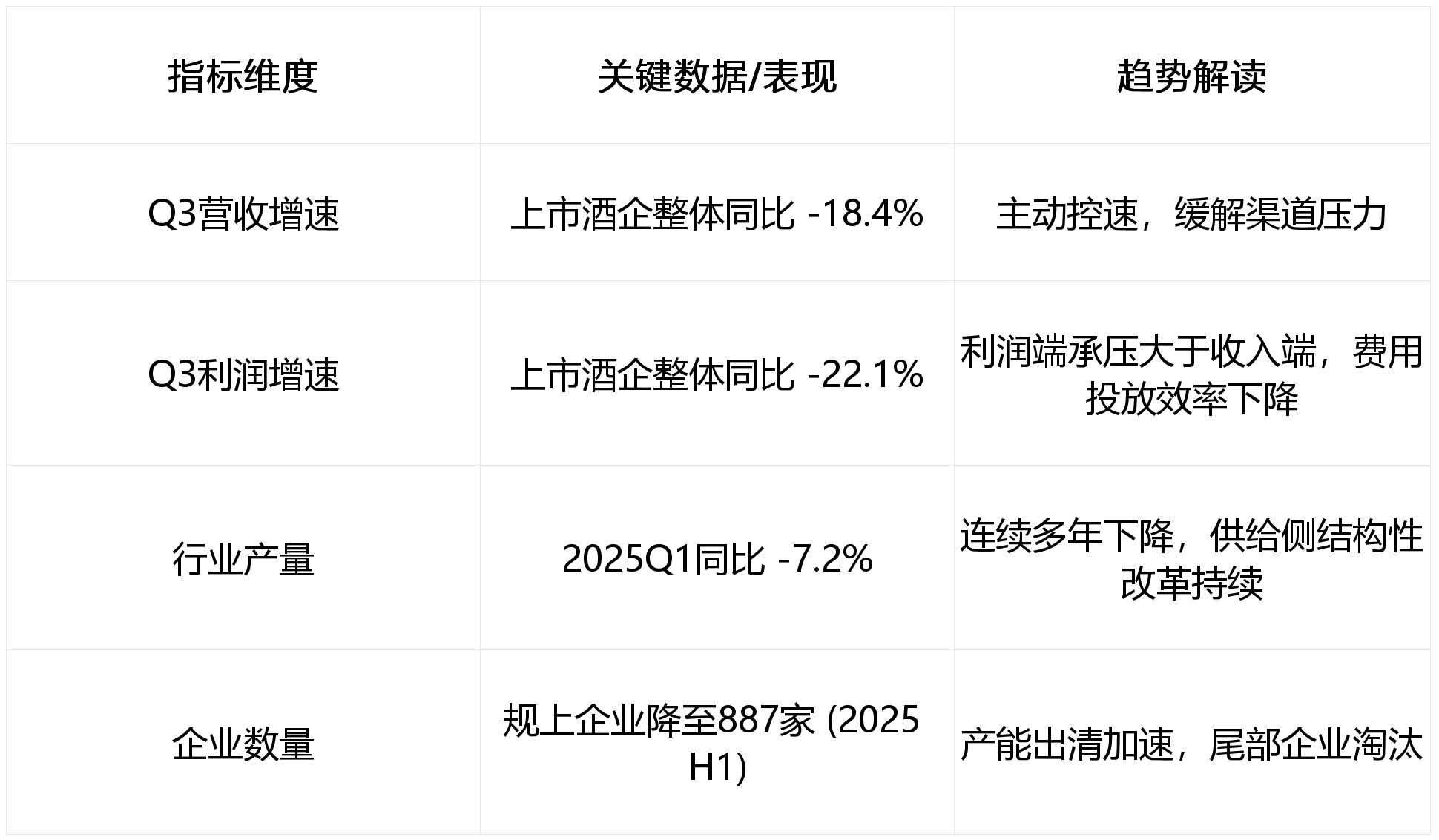
Core Viewpoint - The Chinese liquor industry is entering a deep adjustment phase in 2025, characterized by unprecedented changes and restructuring due to complex macroeconomic conditions and shifts in consumer demand [1] Group 1: Changes in Cycle - 2025 marks a watershed year for the Chinese liquor industry, transitioning from "incremental expansion" to "stock game" amid a prolonged adjustment phase [2] - The industry is experiencing a "triple overlap" of macroeconomic cycles, industrial structure cycles, and generational consumption changes [2] - In Q3 2025, listed liquor companies reported an 18.4% year-on-year decline in revenue and a 22.1% drop in net profit, largely due to companies' proactive measures to ease channel financial pressures [3] - The liquor industry's production volume decreased by 7.2% year-on-year in Q1 2025, indicating a potential eighth consecutive year of decline [4] - The number of large-scale enterprises in the industry has sharply decreased from 1,593 in 2017 to 887 in the first half of 2025, highlighting the accelerated exit of smaller firms lacking competitive advantages [4] Group 2: Changes in Structure - The competition landscape is showing extreme differentiation, with the concentration of the industry increasing significantly [6] - The market share of the top six liquor companies (CR6) in terms of production, revenue, and profit reached 14%, 46%, and 62% respectively in 2023, with further growth expected by 2025 [7] - High-end price segments (above 1,000 yuan) remain stable, while the mid-range (300-800 yuan) is under pressure from weak business consumption, and the low-end (100-300 yuan) is gaining traction due to a return to rational consumption [8] Group 3: Changes in Demand - The industry is shifting from a "channel-driven" model to a "consumer-driven" approach, necessitating comprehensive product and marketing innovations [10] - Traditional consumption scenarios are declining, with a rise in "self-drinking," "small gatherings," and "banquet" scenarios, emphasizing quality and cost-effectiveness over mere status [10] - The younger generation is reshaping the market, favoring lower-alcohol beverages and mixed drinks, prompting major brands to innovate and engage with this demographic [11] - The consensus among liquor companies is to prioritize "de-stocking" and "promotions" over mere performance growth, utilizing digital tools for more effective marketing [11] Group 4: Future Outlook - The industry is expected to transition to a new phase of "high-quality development," with growth rates stabilizing at single digits or even negative in some years [13] - Policy impacts are dual-faceted, with anti-corruption measures limiting high-end liquor demand while economic stimulus policies may boost overall consumption [14] - Internationalization is becoming essential for leading liquor companies, with exports maintaining growth and a shift from product export to brand establishment in overseas markets [15] - The industry is at a critical juncture, where only resilient companies that embrace change will thrive in the new landscape [16]




【招银研究|海外宏观】如期降息,启动扩表——美联储议息会议点评(2025年12月)
招商银行研究· 2025-12-11 10:04
Core Viewpoint - The Federal Reserve has lowered the benchmark interest rate by 25 basis points to a target range of 3.50-3.75%, indicating a shift towards a more dovish stance amid internal divisions within the committee [1][5][6]. Economic Outlook - The Fed expresses confidence in a "Goldilocks" scenario where high growth and stable inflation are expected to occur simultaneously, with the 2026 GDP growth forecast raised by 0.5 percentage points to 2.3% and PCE inflation forecast lowered by 0.2 percentage points to 2.4% [3][4]. - Concerns about employment risks are prioritized over inflation risks, with indications that the labor market is cooling down [3][4]. Policy Decisions - The Fed's decision to cut rates reflects increasing internal divisions, with 6 out of 19 committee members opposing the rate cut, suggesting a potential pause in future cuts [5][6]. - The initiation of a reserve management-type balance sheet expansion (RMP) aims to maintain liquidity, with an initial expansion rate of $40 billion per month [5][6]. Forward Guidance - The Fed may implement 2-4 additional rate cuts in 2026, totaling 50-100 basis points, with a potential slowing of the rate cut pace to one cut every two meetings [6][7]. - The Fed's balance sheet expansion will align with nominal GDP growth, with a mid-term expansion rate expected to be between $200-300 million per month [6][7]. Market Reactions - Market expectations for future rate cuts have shifted from 70 basis points to 53 basis points, with U.S. Treasury yields declining across the board [7][8]. - The stock market remains supported by the Fed's rate cuts, although concerns about high valuations and potential AI bubbles may lead to increased volatility [8][9]. Currency and Commodity Outlook - The dollar index has weakened, and the RMB is expected to appreciate moderately due to the ongoing rate cut cycle [9][10]. - Gold prices are anticipated to remain in a bullish trend, influenced by the Fed's rate cuts and ongoing geopolitical uncertainties [10].

美股逼近历史高点,这份迟到的PCE报告,藏着年末行情密码?
Sou Hu Cai Jing· 2025-12-10 10:49
Core Viewpoint - The delayed release of the September PCE data has created significant tension in the U.S. stock market, with investors anxiously awaiting its implications for interest rate decisions by the Federal Reserve [2][20]. Market Sentiment - The market is currently experiencing a surge in optimism, driven by expectations of a potential interest rate cut by the Federal Reserve, leading to a notable decline in the U.S. dollar index and positive movements in Asian and European stock futures [4][6]. - This surge is characterized by a "fear of missing out" (FOMO) among investors, prompting them to buy stocks in anticipation of year-end gains, despite underlying economic uncertainties [6][16]. Economic Indicators - The core PCE index, which is a key inflation measure for the Federal Reserve, has shown a year-over-year increase of 2.7% as of August, remaining above the 2% target for 55 consecutive months. The upcoming September data is critical for future monetary policy [8][20]. - Recent economic indicators, such as ADP employment data and consumer confidence indices, have shown signs of weakness, raising concerns about a potential economic recession [9][10]. Consumer Behavior - Despite negative sentiment reflected in soft data, retail performance has been strong, indicating a divergence in consumer spending patterns. Lower-income consumers are gravitating towards discount stores, while higher-income consumers continue to purchase luxury goods [12][20]. Federal Reserve's Dilemma - The Federal Reserve faces a challenging decision: whether to cut interest rates to support employment while managing persistent inflation. Historical precedents suggest that missteps in such situations can lead to significant economic consequences [14][18]. - The market's current optimism may be overly exuberant, with potential risks if the PCE data does not align with expectations, which could lead to a reassessment of the Fed's monetary policy [16][18]. Upcoming PCE Data Impact - The market's focus is on the upcoming PCE data, with specific thresholds for core month-over-month increases determining the Fed's next steps. A rise of 0.2% would likely support a rate cut, while higher figures could disrupt current market expectations [18][20].

美国经济的K型分化现象:环球市场动态2025年12月10日
citic securities· 2025-12-10 03:52
环球市场动态 A 股周二涨跌不一,英伟达链支撑 大市;港股表现低迷,恒指国指双 双刷新月内新低;欧股小幅收低, 市场等待美联储议息;美股震荡走 势,市场观望情绪浓厚。 外 汇 / 商 品 受成品油走软拖累,周二国际油价 下跌 1%,连续第二天回落;交易员 押注美联储降息且白银供应趋紧, 现货白银首次突破 60 美元,再创 历史新高。 固 定 收 益 周二美国国债下跌,收益率曲线走 平。10 月职位空缺高于预期。十年 期美债拍卖相对平稳。亚洲债市交 投平淡。法国议会通过 2026 年社 保预算。今天将有 12 月议息决议 公布。 产品及投资方案部 注:bp/bps=基点;pt/pts=百分点 中信证券财富管理 (香港) 免责声明请参考封底 2025 年 12 月 10 日 美 国 经 济 的 K 型 分 化 现 象 股 票 ▪ 美国今年假日季的消费需求尽显韧性,但伴随着 "穷者愈发拮据、富者扩张消费" 的 K 型分化现象。我们发现 美国居民部门的收支两端都存在加剧购买力分化的因素,低收入者近年来面临的涨价压力更大,且其薪资增速 在过去一年的放缓比高收入者更明显,人工智能浪潮催生的企业行为变化和风险管理式降息周期 ...
美国经济被AI泡沫绑架,七巨头掌控命脉,一旦崩盘美国必遭毁灭!
Sou Hu Cai Jing· 2025-12-09 10:14
美国经济的繁荣,本质上是一场少数人的盛宴,其核心支柱是两大相互绑定的泡沫,股市泡沫与AI泡沫。 截至2025年10月,"巴菲特指标"已突破219%,美国上市公司总市值达到经济总量的两倍多,远超2007年金融危机前的105%和2000年互联网泡沫时的138%, 创下历史最高纪录。 这种泡沫的受益者高度集中:最富有的10%人群持有全美国近90%的股票,而底层50%人口仅持有1%。 财富的极度集中直接体现在消费端,《华尔街日报》数据显示,这10%的富人贡献了49.7%的全国消费支出,占GDP的三分之一,成为经济增长的主要推 手。 美国股市屡创新高、GDP保持增长,看似一副经济强劲的模样,但为何超过一半的美国民众却感受不到繁荣,反而深陷生活压力? 这种表面光鲜与民生困境的巨大反差,背后藏着怎样的结构性危机?所谓的经济增长,究竟是真实复苏还是泡沫堆砌的幻觉? 更危险的是市场集中度空前提升,"七大科技巨头"仅占美国上市公司总数的0.12%,却贡献了30.35%的总市值,2025年前9个月其市值增长占股市总增长的 52.37%。 扩展到"十大巨头"后,更是占据了标准普尔500指数38%的市值,少数企业的涨跌直接决定了全国经 ...

黄付生:八大硬科技引领产业重构,新一轮牛市与商品超级周期共振
2 1 Shi Ji Jing Ji Bao Dao· 2025-12-09 08:01
Group 1: Economic and Industrial Trends - The core of the "14th Five-Year Plan" focuses on building a modern industrial system, emphasizing the reconstruction of high-tech industries over the next decade, particularly in areas like artificial intelligence, aerospace, and biomedicine [4][5] - The real estate market is undergoing a significant cleanup, returning to reasonable levels, with new construction and sales dropping to levels seen a decade ago, indicating a shift towards quality and sustainability in development [6][7] - The service consumption sector is identified as a key area for domestic demand growth, with current service consumption accounting for only 46.1% of household spending, significantly lower than the nearly 70% in the U.S., suggesting substantial room for expansion [7] Group 2: External Environment and Market Dynamics - The external environment is experiencing profound adjustments, with U.S.-China tech competition entering a new phase characterized by "ecological competition," which is more systematic and long-term [2][8] - The domestic industry is showing a "K-shaped" differentiation, where high-tech exports are growing while traditional labor-intensive products are declining, reflecting a structural shift in profitability among listed companies [8][9] - The trend of technology companies expanding overseas is becoming a significant growth engine, particularly in sectors like media, communications, and computing, highlighting a disparity between macroeconomic data and social sentiment [9] Group 3: Corporate Profitability and Market Outlook - Corporate profitability is showing signs of recovery, with A-share non-financial companies' revenue turning positive and net profit growth improving, indicating a shift towards asset-liability repair after a prolonged period of risk aversion [11][12] - The capital market is expected to transition from valuation-driven to performance-driven growth, with a structural bull market forming due to improving profitability and favorable internal and external conditions [12] - A potential super cycle for commodities is anticipated, with current commodity prices at historically low levels compared to U.S. equities, suggesting a forthcoming significant and sustained increase in prices [12]
陷入“决策僵局”中的美联储
Western Securities· 2025-12-07 06:34
Monetary Policy Outlook - The market is pricing in a 87% probability of a 25 basis point rate cut in December 2025, with approximately 2 additional cuts expected in 2026[1] - The probabilities for rate cuts in April and July 2026 are 41% and 32.4% respectively[1] Labor Market Insights - In November, private sector employment decreased by 32,000, contrary to economists' median forecast of a 10,000 increase, indicating increased layoffs[1] - Initial jobless claims fell by 27,000 to 191,000, while continuing claims decreased to 1.939 million, suggesting companies are opting for hiring freezes rather than layoffs[1] Inflation and Consumer Behavior - The manufacturing price index rose to 58.5% in November, while the services price index remains high at 65.4%, indicating persistent upstream price pressures[1] - Low-income groups are facing challenges due to reduced disposable income from policy changes, leading to a deterioration in their employment situation[2] Market Sensitivity and Economic Impact - Financial markets are increasingly sensitive to liquidity, with rising Japanese bond yields causing capital market volatility[3] - The Fed's recent hawkish comments have heightened skepticism regarding high valuations and AI bubbles, leading to a decrease in risk appetite[3] Economic Growth and Investment - Investment demand driven by AI is impacting labor market entry, potentially affecting consumer spending[4] - High mortgage rates and property prices are constraining builders' sentiment, keeping rental prices elevated and impacting low-income consumer spending[4]

申万宏源:2026年美国就业市场或逐步实现“再平衡” 但短期需求走弱仍是核心矛盾
Zhi Tong Cai Jing· 2025-12-07 06:26
Core Insights - The U.S. labor market is expected to experience a "low-growth balance" in 2026, with a continued contraction in labor supply and a gradual stabilization in demand, maintaining low equilibrium employment levels [1][4] - The unemployment rate is likely to face upward pressure due to short-term factors such as tariff impacts, government layoffs, and the substitution effect of AI, with a threshold for triggering the "Sam Rule" estimated at approximately 4.7% [1][5] - The economic landscape is characterized by a "K-shaped" divergence, complicating Federal Reserve decision-making, as labor shortages may enhance labor share while surpluses could exacerbate economic disparities [1][5] Group 1: Employment Market Dynamics - Since mid-2025, the U.S. has seen a dramatic decline in non-farm employment, raising concerns about rising unemployment risks and the impact of AI on job markets [2] - The structural impact of AI on employment is evident but limited, with AI adoption rates increasing from 3.7% to 10% over two years, and layoffs primarily concentrated in high-exposure sectors [2][3] - The primary drivers of the employment market's reversal in 2025 include immigration policies and government layoffs, with illegal immigration net inflow decreasing by 1.6 to 2 million, explaining about 50% of the slowdown in non-farm employment [3] Group 2: Future Employment Outlook - In 2026, the labor supply is expected to continue contracting due to stringent immigration policies, while demand may stabilize as government layoffs pause and tariff impacts weaken [4] - The short-term labor demand remains a core issue, with the potential for the unemployment rate to rise, indicating a shortfall in labor demand [5] - The Federal Reserve faces a challenging environment, balancing the need for monetary easing in the short term against potential inflation risks in the medium term due to labor market conditions [5]
