AI应用

Search documents
策略周报:“春躁”行情分化,聚焦金属科技双主线-20260125
Bank of China Securities· 2026-01-25 09:41
Group 1 - The report highlights a "spring excitement" market entering a phase of high volatility and structural differentiation, focusing on the dual main lines of metals and technology (AI applications and commercial aerospace) [2][12] - The non-ferrous metals industry is expected to benefit from both industrial trends and financial attributes in 2026, driven by Fed rate cut expectations and geopolitical tensions, particularly in rare earths and strategic metals [12][21] - The report notes a significant decline in the allocation of active equity funds to Hong Kong stocks, dropping to 15.9% in Q4 2025 from an average of 19.3% in the previous three quarters, indicating a weakening of overall pricing power [22][28] Group 2 - The AI application market is not finished but is expected to become more differentiated and focused, particularly on clear business models and rapid implementation in AI marketing, healthcare, and programming [33][34] - Major companies are accelerating their entry into the AI healthcare sector, which shows strong commercial potential due to its essential consumption characteristics and high payment willingness from both consumers and enterprises [36] - The report indicates that the global satellite launch and low-orbit constellation construction are accelerating, leading to an upward expectation for space photovoltaics, with potential for customized development in the materials sector [12][38]

如何把握当下市场机会?中欧瑞博吴伟志:看好五大硬资产主线
券商中国· 2026-01-25 09:31
Core Viewpoint - The A-share market has entered a new upward cycle since October 2024, with the current phase described as "summer," indicating active trading and sector rotation, but not yet reaching a peak or bubble stage [1][2]. Market Characteristics - The market is currently characterized by high trading volume and broad participation, with the Shanghai Composite Index surpassing 4000 points, signaling the end of debates over bull and bear market transitions [2]. - The dynamic price-to-earnings ratio of the CSI 300 is approximately 14 times, significantly lower than the S&P 500 (about 29 times) and NASDAQ (about 42 times), indicating that the current market rebound is more of a "catch-up" rather than a bubble [2]. Product Cycle Observation - The representative products of the company have only seen a 16%-17% increase since reaching historical highs in June 2025, suggesting that there is still significant upward potential [3]. Economic Comparison - The current fundamental conditions in China are considered stronger than those in Japan during its economic transition, with a more stable financial system and lower policy learning costs [5][6]. - China's manufacturing sector remains globally competitive, with a record trade surplus in 2025, and new economic sectors like renewable energy and digital economy are driving growth [6][7]. Investment Focus for 2026 - The core investment themes for 2026 are shifting from heavy assets to hard assets, with sectors like rare earths, energy metals, and chemical materials gaining importance due to their pricing power in a concentrated global supply environment [8]. - The company emphasizes five structural investment directions: 1. Technological innovation, particularly in AI and commercial aerospace [9] 2. Biopharmaceuticals, with validated global competitiveness [10] 3. Gold and hard assets, which hold value amid global monetary expansion [11] 4. Revaluation of Chinese manufacturing leaders as key supports in a slow bull market [12] 5. High-dividend assets serving as defensive positions [13] Market Dynamics - The current market rally is driven by a combination of policy, valuation, and sentiment bottoms, alongside the early stages of industrial cycles in AI, energy transition, and biotechnology [14].


投资策略周报:保持慢牛上涨的趋势不变,聚焦三条配置主线-20260125
HUAXI Securities· 2026-01-25 09:14
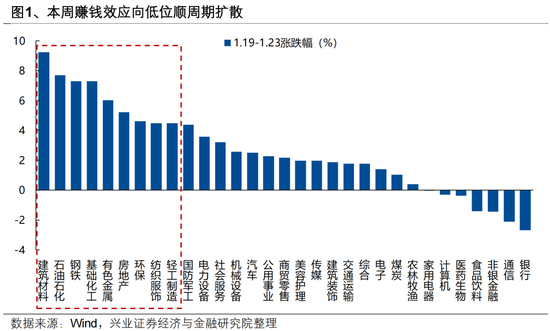
Market Review - Global stock indices experienced more declines than gains this week, with Hong Kong, US, and European markets all showing downturns. In contrast, the A-share market saw slight increases, with the Shanghai Composite Index and Shenzhen Component Index rising by 0.8% and 1.1% respectively. Small-cap stocks outperformed large-cap stocks, with indices such as the Micro-cap Index, CSI 500, and CSI 2000 leading gains, while the SSE 50 and CSI 300 lagged behind. In terms of sectors, cyclical and technology growth sectors performed well, with construction materials, oil and petrochemicals, steel, and chemicals leading the gains, while large financials, telecommunications, and food and beverage sectors faced declines. In the commodities market, precious metals continued to strengthen, with COMEX silver and gold prices reaching new historical highs, while domestic black commodities remained weak. The US dollar index fell below 98, and the RMB appreciated against the US dollar [1][2][3]. Market Outlook - The report maintains a "slow bull" market trend and focuses on three main investment lines. In the past two weeks, under "counter-cyclical adjustment" measures, net outflows from major A-share ETFs and a slight decline in financing balances have effectively controlled trading momentum. Market turnover remains relatively high, with strong support for small-cap growth stocks, indicating a shift into a phase of accelerated sector rotation. Looking ahead, the current period coincides with a dense disclosure of annual report forecasts, with high-growth sectors becoming the focal point of market attention. The report suggests focusing on the expansion of technology trends, price increase themes, and sectors with high growth in annual report forecasts [2][3]. Sector Allocation - The report recommends focusing on the following sectors: 1) Technology industry expansion, including AI computing, AI applications, robotics, space photovoltaics, storage, and Hong Kong internet sectors 2) Sectors benefiting from "anti-involution" and price increases, such as chemicals and non-ferrous metals 3) Industries with high growth in annual report forecasts, including electronics, machinery, and pharmaceuticals [2][3]. Structural Analysis - Currently, the market is in a window of dense annual report forecast disclosures, with high growth or improving sectors becoming the focus. As of January 24, over 900 listed companies have disclosed their 2025 performance forecasts, with an overall positive forecast rate of 38%. In specific sectors, those with high growth in annual reports (with a median year-on-year growth rate of over 100% in net profit after deducting non-recurring gains) include PCB, storage, optical modules, lithium batteries, non-ferrous metals, and pharmaceuticals. Since the beginning of the year, the Wind pre-increase index has risen by 18%, indicating that outstanding performance sectors have become one of the market's focal points [3][4]. Long-term Perspective - From a medium to long-term perspective, comparing the current A-share market to previous bull markets, this round of market activity is still in the middle stage, with a "slow bull" trend expected to continue. Compared to the peaks of the bull markets in 2007, 2015, and 2021, the CSI 300 index has only reached the mid-stage, with current index levels significantly lower than previous highs. The current risk premium of the CSI 300 is 5.27%, which is higher than the 2.5% level seen in previous bull markets. Additionally, the ratios of total A-share market capitalization to M2 and free float market capitalization to household deposits are both near historical averages, indicating that there is still ample space and opportunity for the market [3][4].
兴证策略张启尧团队:后续还有哪些催化值得期待?
Xin Lang Cai Jing· 2026-01-25 08:52
Group 1 - The core logic supporting the upward trend of the spring market remains unchanged despite a slowdown in market rhythm, indicating that the current spring market is still in progress [1][34] - The abundant liquidity environment is driven by insurance funds' strong performance, concentrated maturity of residents' deposits, and the appreciation of the RMB attracting foreign capital back to the market [3][36] - The insurance sector has seen a significant increase in individual insurance premium growth, with many companies reporting over 30% growth, contributing to substantial new capital entering the market [3][36] Group 2 - The peak of residents' deposit maturities is expected in the first half of the year, providing an important window for residents to increase their allocation to equity assets [3][36] - The continuous appreciation of the RMB has led to a record high in foreign capital inflow, with a bank surplus of $99.9 billion in December 2025, including a securities investment surplus of $11.5 billion [5][39] - The favorable macroeconomic environment, supported by improved domestic macro data and coordinated policy efforts in real estate, consumption, and monetary policy, is expected to enhance market risk appetite [6][40] Group 3 - Upcoming weeks will feature a series of significant industry catalysts, particularly the earnings reports from major North American tech companies, which may influence the domestic market [9][41] - The earnings preview period is approaching its peak, with a disclosure rate expected to reach around 55%, which will significantly impact market structure [10][44] - High growth and exceeding profit expectations are concentrated in sectors such as computing power, chemicals, new energy, pharmaceuticals, and non-ferrous metals, with 304 companies forecasting over 50% profit growth [12][45] Group 4 - The sectors with notable profit surprises include storage, battery storage, grid equipment, chemicals, and innovative pharmaceuticals, indicating strong performance potential [15][47] - The upcoming month of February is anticipated to be a core window for market activity, driven by abundant liquidity and a focus on high-growth sectors [26][29] - Historical data suggests that February is one of the months with the highest success rates for major indices, with a focus on small-cap and growth sectors expected to perform well [26][28]




AI应用龙头,又被空头整了
Sou Hu Cai Jing· 2026-01-25 08:40
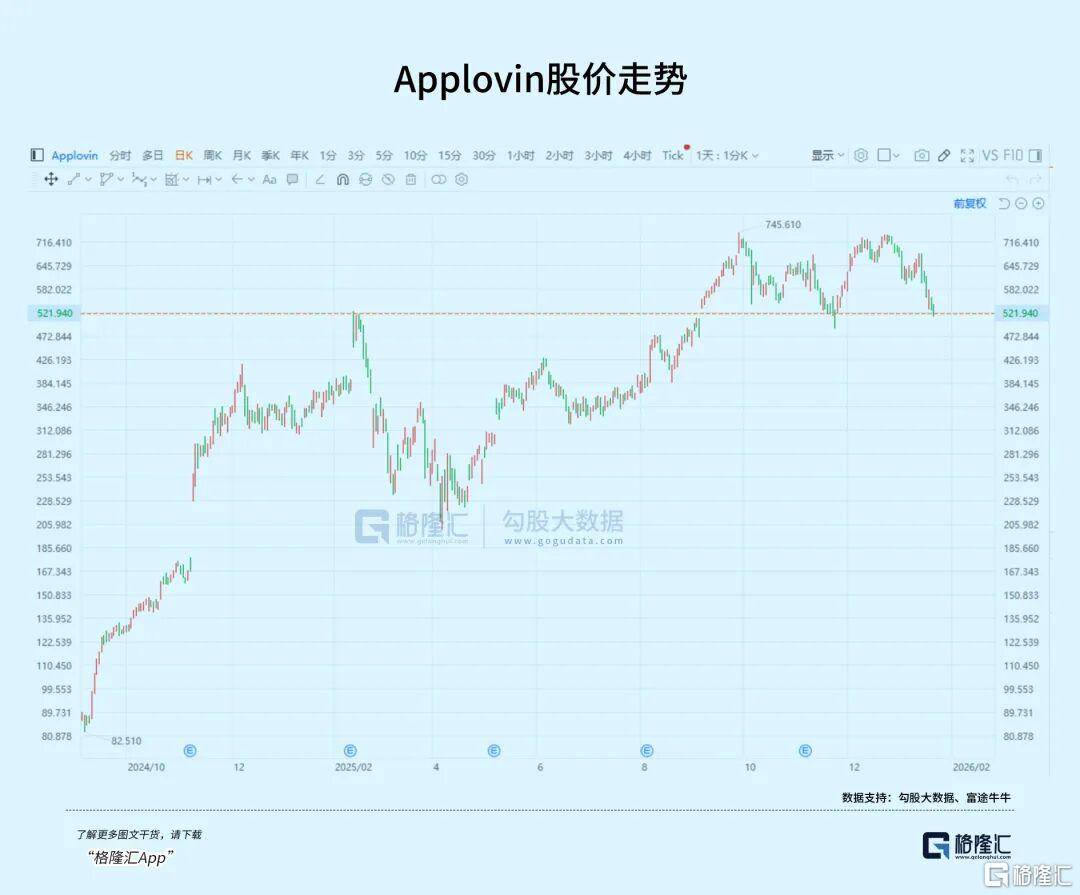
Core Viewpoint - Applovin, a leading player in the AI application sector, has faced significant scrutiny following allegations of being involved in a large-scale money laundering operation, which has led to a sharp decline in its stock price from a peak of $745 to around $520 [1][3][21] Group 1: Company Performance and Growth - Applovin's stock price surged over 700% within a year, reaching a market capitalization of over $200 billion, establishing itself as a leader in the AI application space [1] - The company reported a remarkable 68% year-over-year revenue growth in Q3 2025, with an adjusted EBITDA margin of 82%, significantly higher than industry peers [1][13] - The transition from a game publisher to a pure advertising technology platform has proven successful, with software platform revenue reaching $3.22 billion in 2024, a 75% increase year-over-year [11] Group 2: Allegations and Investigations - A report by CapitalWatch accused Applovin of being a key player in a multinational money laundering network, implicating major shareholder Hao Tang in illegal financial activities linked to the Chinese P2P platform Tuandai.com [3][5] - The report detailed a sophisticated money laundering scheme involving fictitious high-end service trades and underground banking networks, suggesting that funds were transferred under the guise of legitimate business expenses [7][8] - The investigation also highlighted connections to the Prince Group in Cambodia, which allegedly provided ongoing cash flow through fraudulent activities, further complicating Applovin's financial legitimacy [8][9] Group 3: Market Dynamics and Future Challenges - Despite the impressive financial metrics, the company faces existential threats from the rise of AI agents that could disrupt traditional advertising models, potentially diminishing the need for intermediaries like Applovin [18][20] - Gartner predicts that by 2028, 60% of brands will utilize AI agents for direct interactions, signaling a potential end to conventional marketing channels [19] - The dual nature of Applovin as both a market darling and a target for short-sellers raises questions about its long-term sustainability amidst ongoing legal and ethical challenges [20][21]
AI应用龙头,又被空头整了
格隆汇APP· 2026-01-25 08:29
Core Viewpoint - Applovin has emerged as a leading player in the AI application sector, experiencing a stock price surge of over 700% within a year, reaching a market capitalization of over $200 billion, but recent allegations of being involved in a money laundering network have raised significant concerns about its business practices [2][4][20]. Financial Performance - In Q3 2025, Applovin reported a revenue growth of 68% year-over-year, with an adjusted EBITDA margin of 82%, showcasing exceptional profitability compared to industry peers [3][23]. - The company's transition to a pure advertising technology platform has resulted in a software platform revenue of $3.22 billion in 2024, a 75% increase year-over-year [21][22]. Allegations and Controversies - A report by CapitalWatch accused Applovin of being a key player in a large-scale international money laundering network, implicating major shareholders in illegal financial activities [7][10]. - The report detailed a sophisticated money laundering strategy involving fictitious high-end service trades and the use of underground banking networks to transfer funds [12][13]. - Applovin has faced scrutiny from short-sellers, with previous allegations of commercial fraud regarding its AXON2.0 algorithm, which is claimed to infringe on user privacy [16][17][20]. Market Position and Future Challenges - Despite its impressive growth and profitability, Applovin's reliance on advertising as a middleman may be threatened by the rise of AI agents that could disrupt traditional advertising models [30][32]. - The company is positioned at a crossroads, balancing its status as a market darling with serious allegations of financial misconduct and the looming threat of technological disruption in the advertising space [34].

出行链热度攀升,政策+需求延续出游高景气
GOLDEN SUN SECURITIES· 2026-01-25 08:11
证券研究报告 | 行业周报 gszqdatemark 2026 01 25 年 月 日 投资建议:短期重视春节旺季子板块,2026 年看好新服务&新零售 考虑到临近春节旺季,我们建议重视旺季有业绩弹性的子板块,主要包括 免税、部分景区、商超、黄金珠宝等,以及作为春晚四大分会场之一的义 乌(小商品城);免税和出行链近期基本面环比改善,建议后续持续观察和 验证。此外,当前市场关注 AI 应用落地情况,AI 赋能电商营销潜力大。 展望 2026 年,我们建议:1)对内,在政策持续加码的背景下,看好服 务消费和商品消费两大方向,重视顺周期属性较强的免税和出行链(景区 酒店餐饮文旅等)、估值性价比较高的黄金珠宝板块和名创优品,以及市 场预期偏低但基本面有改善机会的调改主线。2)对外,建议继续优选出 海龙头,平台与品牌均有机会,既有出口高景气β保障成长和 AI 应用提 效空间,也有品牌强势高增和部分清库尾声的反转机会。 综上推荐小商品城、中国中免、华住集团、首旅酒店、锦江酒店、潮宏基、 九华旅游、若羽臣、青木科技、名创优品、永辉超市,关注三峡旅游、陕 西旅游、菜百股份、老铺黄金、君亭酒店、古茗、小菜园、百胜中国、海 底捞 ...
计算机行业研究:动态漫Agent,景气的极致
SINOLINK SECURITIES· 2026-01-25 07:50
Investment Rating - The report indicates a positive investment outlook for the industry, highlighting a "golden window period" for the short drama sector, with expectations for significant growth in the coming years [2][11]. Core Insights - The short drama industry has reached a scale of nearly 1 trillion yuan, surpassing both the film and long video sectors, with a projected compound annual growth rate (CAGR) of over 50% from 2023 to 2026 [11]. - The market for animated dramas is expected to exceed 22 billion yuan by 2026, contributing 50% of the incremental growth in the short drama industry [11]. - ByteDance is positioned as the absolute leader in the animated drama sector, leveraging its "traffic + IP + AI" integrated strategy to dominate the market [2][17]. - The application of AI technology is transforming the production paradigm of animated dramas, reducing production cycles from over 50 days to under 30 days and significantly lowering costs [3][21]. Summary by Sections Section 1: The Golden Window for Short Dramas - The short drama market has surpassed 1 trillion yuan, with user engagement increasing, and the average daily viewing time expected to exceed 100 minutes by 2025 [11]. - The market has entered a phase of rapid growth and commercialization, with significant increases in both supply and demand for animated dramas [11][12]. Section 2: AI Reshaping Production Paradigms - AI technologies are enabling a shift from manual production to industrialized generation, with production costs dropping to the thousand-yuan level [3][21]. - The integration of AI in production processes is expected to streamline workflows, reducing the number of steps from 11 to 5 and cutting costs by 60% [3][24]. Section 3: Trends in AI Applications - The report anticipates a significant uptick in AI applications by 2026, driven by the need for software to leverage substantial computational investments [4][31]. - Companies are increasingly integrating AI into their business models, with some reporting that AI-related revenues account for over 10% of total income [4][31]. Section 4: Related Investment Targets - Key investment targets include companies such as DeCai Co., Zhaochi Co., and Wanxing Technology, among others, which are positioned to benefit from the growth in the animated drama and AI sectors [5][40].



申万宏源:春季行情仍沿着既定路径前进
Ge Long Hui· 2026-01-25 07:47
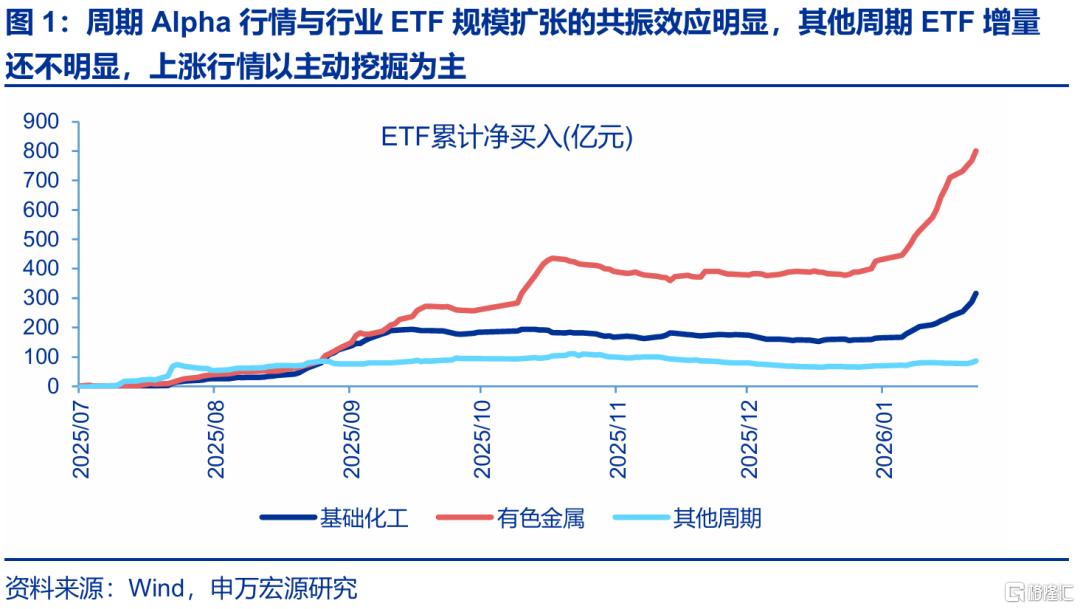
Group 1 - The core viewpoint emphasizes that the "steady and far-reaching" strategy is facilitating the transition of the spring market into subsequent phases without disrupting the established path of the spring market [1][2] - The spring market is characterized by incremental games and favorable conditions for long positions, supported by factors such as increased equity allocation by residents and active trading funds [2][3] - Short-term, the focus is on discovering bottom assets, with cyclical Alpha investments expanding towards more cyclical turning points, while the overall profit effect is nearing a high [1][4] Group 2 - The spring market is positioned as an extension and expansion phase of the high valuation area of the 2025 technology structural market, with expectations of a consolidation phase following the spring market [3] - Short-term, cyclical Alpha is becoming a key focus for market participants looking to exploit low positions, with notable sectors including commercial aerospace and AI applications showing rebound opportunities [4][7] - The long-term outlook remains positive for sectors such as technology and cyclical Alpha, with a focus on areas like overseas computing chains and AI applications [7][12]

大资金连砸几千亿 A股本周为何不跌反涨?一文看懂
天天基金网· 2026-01-25 07:00
Group 1 - The A-share market experienced a significant recovery after a period of panic among investors, with major indices showing improvement from January 19 to 23, 2026 [2] - The market saw a notable increase in small and mid-cap stocks, with indices like the CSI 500, CSI 1000, and CSI 2000 reaching new highs [3][4] - Despite the overall market recovery, the Shanghai Composite 50 and CSI 300 indices continued to decline, indicating a mixed sentiment among investors [4][5] Group 2 - Large funds have been selling off major ETFs, leading to a net outflow of 329.6 billion yuan from the top ten ETFs during the week, with the Huatai-PB CSI 300 ETF alone seeing a net outflow of 72.4 billion yuan [5][6] - Cumulatively, these ETFs have experienced over 470 billion yuan in outflows, reflecting a significant shift in market dynamics [6][5] - The sell-off in ETFs has raised questions among investors about the reasons behind the pressure on these indices and the potential for alternative investment strategies [7][8] Group 3 - The limited decline in the overall market despite massive ETF sell-offs is attributed to the presence of arbitrage funds that help stabilize prices by buying undervalued ETFs [16][19] - Arbitrage trading involves a series of steps where large funds sell ETFs, creating price discrepancies that are quickly exploited by algorithmic traders [18][21] - Institutional investors dominate the arbitrage space, capitalizing on the liquidity and volatility of ETFs to manage their positions effectively [24][22] Group 4 - Insurance funds have been increasing their investments in the equity market, with significant commitments to technology and innovation sectors, indicating a long-term bullish outlook [27] - The market has seen a shift in focus from macro liquidity to micro performance, with upcoming earnings reports expected to drive investor sentiment [30] - Key sectors to watch include dividends, technology, and power equipment, as companies with strong earnings potential are likely to attract investor interest [30]