
再通胀

Search documents
陈果:留意外部扰动,耐心伺机布局
Xin Lang Cai Jing· 2025-12-14 12:00
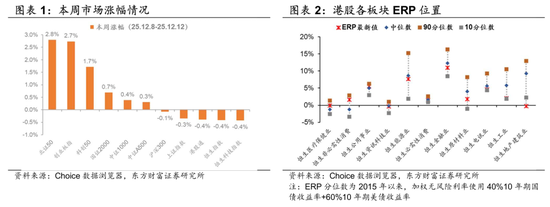
Group 1 - The core viewpoint of the article highlights the divergence in performance between A-shares and Hong Kong stocks, driven by the recent central economic work conference in China and the mixed signals from the Federal Reserve regarding interest rates [1][3][22] - A-shares are seeing a preemptive allocation towards high-growth technology sectors, while Hong Kong stocks are under pressure due to weak earnings expectations and hawkish signals from the Federal Reserve [1][3][22] - The Federal Reserve's recent actions, including a rate cut, have not led to a favorable liquidity environment as U.S. Treasury yields are rising, indicating potential market volatility [1][5][25] Group 2 - The upcoming Bank of Japan interest rate hike is expected to impact global liquidity, but the market has likely priced in the anticipated 0.75% rate level, suggesting limited immediate disruption [23][31] - The focus should be on external factors and the dual themes of technology and cyclical recovery, with a recommendation to maintain a base in financial and dividend-paying sectors while gradually increasing exposure to growth areas [23][31] - Key sectors to watch include the AI supply chain, renewable energy, and international pharmaceuticals, as these areas are expected to benefit from improving liquidity and risk appetite [23][34] Group 3 - The market is preparing for a "super data week," with critical reports on CPI and employment data that will validate the effectiveness of previous monetary policies and assess inflation risks [10][29] - The potential appointment of a new Federal Reserve chair, with a more hawkish stance, could further influence market expectations regarding future monetary policy [10][11][29] - The anticipated spring market rally is supported by historical data indicating that liquidity improvements typically lead to positive market movements, particularly in technology and cyclical sectors [16][34]

帮主郑重:2026五大确定性风口!中长线布局就盯这几条赛道
Xin Lang Cai Jing· 2025-12-13 14:53
Core Insights - The article emphasizes the identification of key investment opportunities for the next five to ten years, driven by recent economic meetings and forecasts from top institutions for 2026 [1] Group 1: Key Investment Areas - The first major opportunity is in "Artificial Intelligence and Computing Power," with 2026 expected to be a year of application validation and commercial closure, focusing on profitability rather than investment amounts [3] - The second opportunity lies in the "New Energy and Power System" upgrade, addressing the potential for power shortages due to the explosive growth of AI data centers, which will necessitate a stronger and smarter power system [4] - The third area of focus is "High-end Manufacturing and Cyclical Leaders," where domestic industries are advancing in semiconductor and industrial machinery, creating significant opportunities for domestic replacements [4] Group 2: Emerging Technologies and Demographics - The fourth opportunity involves "Humanoid Robots" and "Commercial Space and Low-altitude Economy," with 2026 marking a critical point for the commercialization of humanoid robots, particularly in logistics and precision manufacturing [5] - The fifth area, often overlooked, is the "Silver Economy," targeting the growing demographic of seniors over 60 years old, with a shift in demand towards quality of life services rather than basic needs [5] Group 3: Strategic Investment Approach - The recommended investment strategy includes focusing on "AI+" and "High-end Manufacturing" as core long-term holdings, while also being aware of cyclical opportunities in energy and metals due to global power tensions [6] - Investors are advised to remain calm amidst market noise, as 2026 will prioritize tangible profits over speculative narratives, necessitating caution with high-valuation themes [6]

A股三大指数放量上涨,开源证券:科技+周期主线或仍将延续 | 华宝3A日报(2025.12.12)
Xin Lang Cai Jing· 2025-12-12 11:54
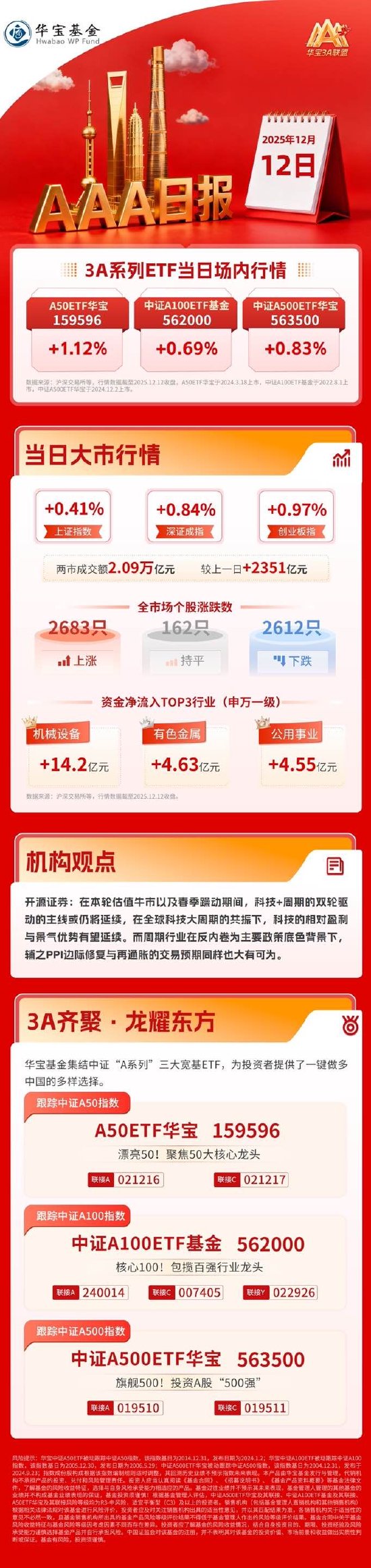
Group 1 - The core viewpoint highlights the ongoing valuation bull market and spring rally, driven by a dual focus on technology and cyclical sectors, with expectations for continued relative profitability and economic advantages in technology [2][5] - The total trading volume in the two markets reached 2.09 trillion yuan, an increase of 235.1 billion yuan compared to the previous day, with 2,612 stocks rising and 2,683 falling [5] - The top three sectors for net capital inflow were machinery equipment, non-ferrous metals, and public utilities, indicating strong investor interest in these areas [5] Group 2 - Huabao Fund has launched three major broad-based ETFs tracking the CSI A-series indices, providing investors with diverse options to invest in China [2][5] - The A50 ETF focuses on the top 50 core leading companies, while the A100 ETF encompasses the top 100 industry leaders, and the A500 ETF targets the top 500 companies in the A-share market [2][5]
年内涨超112%!白银成年内最牛期货 法巴银行看涨至100美元
Hua Xia Shi Bao· 2025-12-11 23:42
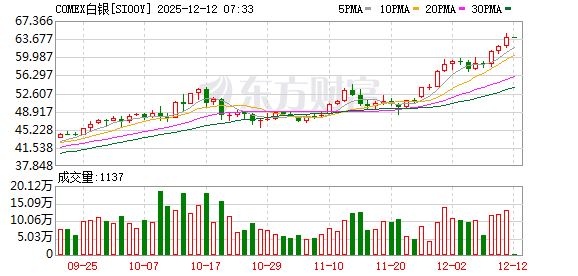
Group 1: Silver Market Performance - New York silver futures reached a high of $63.25 per ounce, closing at $62.355, marking a 2.17% increase on the previous trading day, with a year-to-date gain exceeding 112% [2] - Domestic silver futures in China also saw a significant increase of 92.43% since the beginning of the year, driven by inflation expectations and demand from the global optoelectronic industry [3] - The gold-silver ratio reached a new low of 68.22, indicating that silver is rising faster than gold, supported by industrial demand and low inventory levels [4] Group 2: Federal Reserve's Monetary Policy - The Federal Reserve cut interest rates by 25 basis points, bringing the federal funds rate to a range of 3.50%-3.75%, and announced a liquidity injection plan of $40-$60 billion over the next 30 days [7] - There is significant internal disagreement within the Federal Reserve regarding future interest rate policies, with some members advocating for substantial rate cuts while others support maintaining current rates [8][9] - The Fed's economic forecasts indicate a more positive outlook compared to previous predictions, suggesting less necessity for aggressive rate cuts in the near future [8] Group 3: Supply and Demand Dynamics - The World Silver Association projects a global silver demand of at least 35,000 tons by 2025, with 80% attributed to industrial use, while the total supply is estimated at 29,000 tons, resulting in a supply gap of over 6,000 tons [10] - The ongoing demand from the photovoltaic, electric vehicle, and data center sectors is expected to drive steady growth in silver demand, while supply constraints will likely persist [10] - The iShares Silver Trust ETF has seen significant inflows, with approximately $1 billion entering the fund recently, indicating strong investor interest in silver [10] Group 4: Future Price Predictions - Analysts predict that silver prices could reach $100 by the end of next year, driven by strong industrial demand and ongoing supply constraints [12] - The long-term outlook for silver remains bullish due to the dual expansion of U.S. fiscal and monetary policies, which are expected to weaken the dollar and support higher silver prices [11]
资管一线 | 2026 年资产配置如何布局?中欧基金王培、代云锋、杜厚良等基金经理给出答案
Xin Hua Cai Jing· 2025-12-11 08:03
Group 1 - The A-share market has experienced a surge in the technology sector and a reversal in cyclical industries this year, with a focus on investment strategies for 2026 [1][2] - The investment focus for 2026 is expected to revolve around technology, value, and leading companies, with a shift from valuation expansion to corporate profitability as the main driver of stock prices [1][2] - The "strong stocks, stable bonds" characteristic is becoming more evident, with stock assets expected to have increased volatility but supported by performance-driven logic [1][6] Group 2 - The market is anticipated to enter a value recovery phase in 2026, with a focus on traditional cyclical industries such as oil, coal, and basic metals, as well as quality enterprises in non-bank finance and new energy [3][4] - AI applications and computing power are expected to be central to technology investments, with significant demand for AI infrastructure and smart hardware [4][5] - The global electricity shortage may become a market focal point, with rising electricity demand driven by AI data centers and re-industrialization, potentially leading to investment opportunities in cyclical sectors [8]
新能源及有色金属日报:几内亚GIC矿预期复产在即-20251211
Hua Tai Qi Huo· 2025-12-11 02:52
Group 1: Investment Ratings - Unilateral: Aluminum: Cautiously bullish; Alumina: Neutral; Aluminum alloy: Cautiously bullish. Arbitrage: Neutral [8] Group 2: Core Views - The decline in electrolytic aluminum prices is limited, with weak spot market trading and slight repair of spot discounts. Social inventory is basically stable with a slight decline. Consumption has rigidity in the off - season, and the low inventory level is not a negative factor for prices. There is optimism about future consumption, with unchanged expectations of interest rate cuts and unreflected re - inflation. Attention should be paid to the evolution of the economic conference and the expected inventory reduction before the Spring Festival. Overseas liquidity risks need to be vigilant. [6] - GIC is allowed to resume operations. Once a $125 million payment is transferred to the treasury, it can start operating the former Axis mine, indicating the government's support for local bauxite mining and reducing policy uncertainty. The alumina fundamentals lack positive factors, with no significant reduction in domestic supply, continuous increase in social inventory, and weak procurement willingness of electrolytic aluminum plants. The near - month contract is at a large discount to the far - month contract. The cost support needs to be tested without large - scale production cuts. [6][7] Group 3: Key Data Aluminum Spot - On December 10, 2025, the price of East China A00 aluminum was 21,770 yuan/ton, a change of - 110 yuan/ton from the previous trading day, and the spot premium/discount was - 90 yuan/ton, unchanged from the previous trading day. The price of Central China A00 aluminum was 21,660 yuan/ton, and the spot premium/discount changed by 30 yuan/ton to - 200 yuan/ton. The price of Foshan A00 aluminum was 21,670 yuan/ton, a change of - 100 yuan/ton from the previous trading day, and the spot premium/discount changed by 10 yuan/ton to - 190 yuan/ton. [1] Aluminum Futures - On December 10, 2025, the main contract of Shanghai aluminum opened at 21,805 yuan/ton, closed at 21,935 yuan/ton, a change of - 55 yuan/ton from the previous trading day, with a maximum price of 22,025 yuan/ton and a minimum price of 21,735 yuan/ton. The trading volume for the day was 159,863 lots, and the position was 185,806 lots. [2] Inventory - As of December 10, 2025, the domestic social inventory of electrolytic aluminum ingots was 595,000 tons, a change of - 1000 tons from the previous period. The warrant inventory was 68,587 tons, a change of 724 tons from the previous trading day. The LME aluminum inventory was 520,800 tons, a change of - 2500 tons from the previous trading day. [2] Alumina Spot Price - On December 10, 2025, the SMM alumina price in Shanxi was 2790 yuan/ton, in Shandong was 2740 yuan/ton, in Henan was 2820 yuan/ton, in Guangxi was 2885 yuan/ton, in Guizhou was 2890 yuan/ton, and the FOB price of Australian alumina was 310 US dollars/ton. [2] Alumina Futures - On December 10, 2025, the main contract of alumina opened at 2540 yuan/ton, closed at 2477 yuan/ton, a change of - 81 yuan/ton or - 3.17% from the previous trading day's closing price, with a maximum price of 2546 yuan/ton and a minimum price of 2474 yuan/ton. The trading volume for the day was 283,517 lots, and the position was 278,854 lots. [2] Aluminum Alloy Price - On December 10, 2025, the purchase price of Baotai civil - use primary aluminum was 16,700 yuan/ton, and the purchase price of mechanical primary aluminum was 17,000 yuan/ton, with a daily price change of 100 yuan/ton. The Baotai quotation for ADC12 was 21,000 yuan/ton, with a daily price change of 100 yuan/ton. [3] Aluminum Alloy Inventory and Cost - Profit - The social inventory of aluminum alloy was 73,800 tons, and the in - plant inventory was 58,100 tons. The theoretical total cost was 21,387 yuan/ton, and the theoretical profit was - 387 yuan/ton. [4][5]
12月美联储议息会议传递的信号:联储:扩表更重要
ZHESHANG SECURITIES· 2025-12-11 01:59
Group 1: Federal Reserve Actions - The Federal Reserve lowered interest rates by 25 basis points, adjusting the federal funds target rate to a range of 3.50%-3.75%[1] - The Fed initiated a Reserve Management Purchase tool, starting with a purchase of $40 billion in short-term bonds with maturities of one year or less[2] - The Fed's balance sheet expansion aims to maintain adequate reserve levels, as bank reserves are currently at a critical state, with reserves constituting 9% of GDP[3] Group 2: Economic Projections - GDP growth forecast for 2025 was slightly revised up from 1.6% to 1.7%, while the 2026 forecast was significantly raised from 1.8% to 2.3%[4] - The unemployment rate is projected to remain stable at 4.5% for 2025 and 4.4% for 2026[4] - The PCE inflation forecast for 2025 is set at 2.9%, with a slight decrease to 2.4% for 2026[4] Group 3: Future Rate Expectations - The dot plot indicates one potential rate cut in 2026, totaling 25 basis points, which is more hawkish than previous expectations[4] - The Fed is expected to continue with one more rate cut in Q1 2026, likely in March, before the new chair takes over[7] - The potential for unexpected rate cuts in 2026 is limited due to ongoing inflationary pressures[7] Group 4: Market Implications - The adjustment in monetary policy is expected to alleviate liquidity pressures, leading to a rise in U.S. stock markets and a decline in bond yields and the dollar[4] - The dollar index is anticipated to remain stable around 100, while the Chinese yuan may appreciate against the dollar[11] - The overall outlook for U.S. equities remains positive, driven by economic momentum and technological advancements[11]
四点半观市 | 机构:春季行情有望提前展开
Shang Hai Zheng Quan Bao· 2025-12-10 14:01
来源:上海证券报·中国证券网 12月10日日间盘,国内商品期货主力合约涨跌互现,其中沪银主力合约大涨,再创新高。截至15:00收 盘,沪银涨超5%,集运指数(欧线)涨超3%,碳酸锂、沪锡涨超2%,铁矿石、多晶硅、橡胶等涨超 1%,烧碱、乙二醇、纤维板等微涨 12月10日,国债期货各主力合约收涨。截至收盘,30年期国债期货(TL2603)报收112.790元,上涨 0.340元,涨幅0.30%;10年期国债期货(T2603)报收108.030元,上涨0.060元,涨幅0.06%;5年期国 债期货(TF2603)报收105.825元,上涨0.060元,涨幅0.06%;2年期国债期货(TS2603)报收102.456 元,上涨0.036元,涨幅0.04%。 近日,在"看见・中欧基金2026年度投资策略会"上,中欧权益研究部副总监、基金经理任飞表示,2026 年全球可能面临"再通胀"风险,成因并非传统需求拉动,而是供给约束,特别是全球范围内可能出现的 电力短缺。周期板块或在明年迎来重要机遇,再通胀可能从"潜在风险"转变为投资机遇。 【资金风向标】 Choice数据显示,12月10日,资金净流入额排名前十的个股依次是N ...
财经观察丨涨幅远超黄金!白银首次涨破60美元创历史新高,后市怎么走?
Sou Hu Cai Jing· 2025-12-10 12:21
Core Viewpoint - Silver futures prices on the New York Mercantile Exchange surpassed $60 per ounce for the first time on the 9th, with a year-to-date increase of 102%, significantly outpacing gold's nearly 60% rise [1][3] Group 1: Price Movements - On the 9th, spot silver rose over 3%, reaching a peak of $60.895 per ounce, marking a historical high [3] - As of the morning of the 10th, spot silver was trading at $61.302 per ounce, continuing to set new historical highs [3] - COMEX silver futures also hit a record high of $61.295 per ounce, marking the first time it crossed the $61 threshold [5] Group 2: Supply and Demand Factors - The surge in silver prices is attributed to multiple factors, including a weaker dollar, changes in U.S. tariff policies, and a shortage in silver supply [1] - The World Silver Association forecasts a continued annual deficit in the silver market through 2025 due to limited production and rising industrial and investment demand [7] - Structural supply constraints are highlighted, with approximately 70-80% of silver production being a byproduct of mining for other metals, limiting the ability to increase supply rapidly [7] Group 3: Market Sentiment and Economic Indicators - Expectations of a rate cut by the U.S. Federal Reserve have increased, which may further depress the dollar and support higher silver prices [1][11] - Analysts note a "dual-driven" pattern in the recent price increase, linked to the instability of the global credit monetary system and the dynamic changes in the gold-silver price ratio [9][10] - The demand for precious metals has surged due to rising debt levels in major Western economies and the associated risks of currency devaluation [7] Group 4: Future Outlook - UBS has raised its silver price target for 2026 to between $58 and $60 per ounce, with a possibility of reaching $65 [6] - Market analysts suggest that while silver may experience high volatility, the underlying long-term trend remains upward due to structural supply-demand imbalances [12]
中欧基金任飞:全球电力短缺催化再通胀,潜在风险或转为市场主线
Zheng Quan Shi Bao Wang· 2025-12-10 06:41
人民财讯12月10日电,近日,在中欧基金2026年度投资策略会上,中欧权益研究部副总监、基金经理任 飞表示,与以往经济周期不同,当前有两股趋势性力量正在形成额外的电力需求:一是AI数据中心的 快速扩张,二是再工业化带来的高耗能产业转移与供应链重建。这两者均独立于传统经济波动,且增速 显著。从中远期来看,全球在未来几年需要额外消耗的用电需求或将面临巨大提升。 在此逻辑下,任飞认为有三大方向值得关注:一是供给约束,电解铝等高耗能行业或受直接限制;二是 需求提振,全球性电力紧张推升光伏、储能需求,2027-2028年海外储能市场或迎增长;三是中国优 势,中国电力供应相对充裕,高耗能制造业成本与供应链优势将进一步凸显。 ...