
科技革命

Search documents
“破浪前行,扬帆起航”——2026中信期货年度策略会即将启幕
Qi Huo Ri Bao· 2025-11-11 05:15
展望2026年,我们正站在新旧周期交替的关键节点。全球政治经济格局的深层重构仍在持续,"风高浪 急"的外部环境仍然存在。与此同时,国内进入"十五五"开局之年,这一关键开局不仅是时间上的序 章,更是发展战略上的全面破局。 在国内外环境依然复杂的背景下,中信期货汇聚顶尖专家与产业翘楚,共同探讨新形势下的机遇和挑 战。本次会议立足全球视野、聚焦前瞻主题,共设一个主论坛和八大分论坛:包括宏观总量、金融、有 色、能源转型、黑色、能化、农业与海外市场等主题,深度探讨宏观环境、资产配置、产业逻辑的全景 演变,洞察全球市场脉动,为投资者呈现一场思想交锋与智慧共鸣的盛会。 中信期货将继续秉承"合规、诚信、专业、稳健、担当"的精神,以研究驱动服务升级,以专业赋能行业 发展。面对新周期的浩荡风潮,中信期货愿与市场同行者携手共进,以专业为舵,以远见为帆,破浪前 行,扬帆起航! 潮起东方,扬帆破浪。2025年11月26日-27日,中信期货以"破浪前行,扬帆起航"为主题的2026年度策 略会将在上海浦东嘉里大酒店隆重举行。 回望2025年,百年未有之变局进一步演化。世界在"破"与"立"的激荡中前行:一方面,旧有的全球治理 秩序与贸易规则 ...
“每年这个时候的波动是正常现象,而非异常”:高盛交易员认为股市存在“上涨尾部”_ZeroHedge
Goldman Sachs· 2025-11-11 01:01
Investment Rating - The report upgrades India's stock market rating to "Overweight" (OW) due to supportive economic growth policies, earnings recovery, and reasonable valuations [24]. Core Insights - The artificial intelligence cycle is still in its early stages, with institutional positions not fully allocated, and capital flows are expected to become favorable before year-end [5][6]. - The report suggests that the stock market has a potential upside of 5-10% before the end of the year, driven by broad market participation [6]. - Concerns about credit markets are impacting alternative asset management stocks, particularly those with significant private credit exposure, but the overall impact on the credit market remains limited [21]. - The report highlights the significant investment opportunities in the electricity and water sectors due to increasing demand and aging infrastructure [18]. Summary by Sections Market Trends - The report notes that the current market volatility is typical for this time of year, rather than abnormal [1][19]. - There is a comparison of the current NDX with past technology bubbles, indicating that while some characteristics are similar, the current valuations are still below historical peaks [10][11]. Economic Indicators - The report estimates that AI investments will create $20 trillion in GDP economic value, with $8 trillion flowing into U.S. companies as capital income [13]. - The labor market is showing signs of weakness, with expectations of potential salary cuts in December [31]. Emerging Markets - India's stock market has underperformed compared to other emerging markets, but recent trends suggest a potential recovery driven by earnings and foreign investment [23][24]. - The report indicates that emerging markets have seen strong performance overall, with a 30% increase this year, while India's market has only seen a 3% increase [23]. Consumer Behavior - There are signs of cracks in the U.S. consumer market, with hedge funds reducing their holdings in consumer service stocks to a five-year low [26]. - The report discusses the impact of inflation and economic conditions on different income groups, suggesting a mixed outlook for consumer spending [28][29].

进博Walk|创新赋能“黑科技”,智慧生活向未来
Xin Hua She· 2025-11-09 08:27
Group 1 - The core viewpoint emphasizes that China is providing a "best testing ground" for global enterprises through reform, innovation, and openness, accelerating the transition of scientific research achievements from laboratories to the market [2] - The new round of technological revolution and industrial transformation is creating new development opportunities and reshaping the global open innovation landscape, with numerous innovative products showcased at the expo [3] - The expo serves as a window for the world to observe the future, highlighting that advanced technologies, once considered distant, are becoming part of everyday life [5] Group 2 - The exhibition features innovative products such as the Orbera365 gastric balloon, which aids in weight loss by occupying stomach volume to reduce food intake and enhance satiety [5] - A fully 3D-printed shoe was also showcased, demonstrating advancements in manufacturing technology [7]


又上4000点了,这次千万别听老股民“追涨杀跌”
阿尔法工场研究院· 2025-10-30 00:07
Core Viewpoint - The article emphasizes that investors should move away from short-term speculative trading and focus on the structural changes and opportunities presented by the current market environment, particularly in light of the "15th Five-Year Plan" and technological advancements [4][9][12]. Market Performance - On October 29, the A-share market saw all three major indices rise, with the Shanghai Composite Index closing at 4016.33 points, marking a significant milestone not seen since 2015 [5]. - The market's strong performance was supported by a trading volume of 2.29 trillion yuan, an increase of 125.4 billion yuan from the previous day, with over 2600 stocks gaining [5]. Key Drivers of Market Strength - **"15th Five-Year Plan" Implementation**: The release of detailed guidelines for the "15th Five-Year Plan" has provided a new impetus for the market, enhancing investor confidence and establishing a clearer investment framework [6]. - **Easing of Major Power Tensions**: Recent developments in U.S.-China relations, including constructive trade discussions, have alleviated market pressures and contributed to the A-share rally [7]. - **Expectations of U.S. Federal Reserve Rate Cuts**: Recent U.S. inflation data has strengthened market expectations for further rate cuts by the Federal Reserve, which could positively impact the Chinese market by easing currency pressures and allowing for more domestic monetary policy flexibility [8]. Historical Context - The article draws parallels between the current market situation and previous instances when the Shanghai Composite Index crossed 4000 points in 2007 and 2015, both of which were characterized by rapid market growth driven by traditional sectors [9]. - Unlike past instances, the current market dynamics are underpinned by deeper policy, funding, and industrial synergies, suggesting a more sustainable growth trajectory [9]. Long-term Investment Perspective - The ongoing technological revolution, particularly in AI and semiconductor sectors, is expected to provide lasting momentum for the A-share market, as these areas are prioritized in national strategy [9][10]. - The current policy environment emphasizes long-term stability and systematic upgrades, moving away from short-term adjustments to a focus on innovation and resource optimization [10][11]. - The regulatory framework has been strengthened to enhance market stability and protect long-term investments, indicating a shift towards a more mature market structure [11]. Investment Strategy - Investors are encouraged to focus on high-growth sectors identified in the "15th Five-Year Plan," such as semiconductors and artificial intelligence, rather than getting caught up in short-term market fluctuations [12].

大数据视角透视A股新周期
Shang Hai Zheng Quan Bao· 2025-10-29 18:01
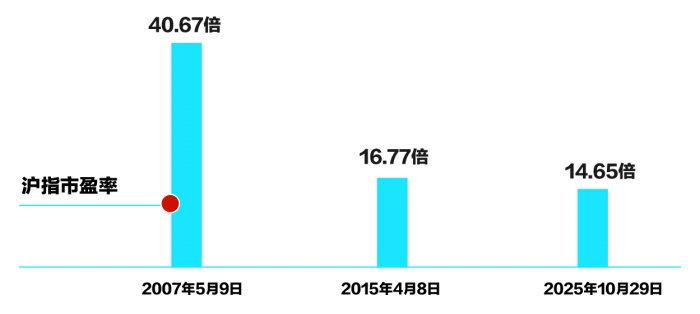
Core Viewpoint - The Shanghai Composite Index (SHCI) has surpassed the 4000-point mark, indicating a potential new upward cycle in the market, driven by the rise of leading technology companies and the integration of China's capital market with cutting-edge technology sectors [2][3]. Market Performance - As of October 29, the total market capitalization of A-shares reached 123.09 trillion yuan, doubling over the past decade, with the current price-to-earnings (P/E) ratio of the SHCI at 14.65, which is at the historical median level [3][4]. - The SHCI's P/E ratio was significantly lower than during previous peaks in 2007 and 2015, where it was 40.67 and 16.77, respectively [3]. Sector Analysis - The technology sector has seen a substantial increase in weight within the SHCI, rising from 4.3% in April 2015 to 16.8% recently, reflecting a shift in market dynamics towards technology-driven growth [7][8]. - The communication and electronics sectors led the market rally, with respective increases of 125.30% and 121.14% from 3000 to 4000 points, showcasing the dominance of technology stocks in the current market cycle [7]. Investment Trends - Institutional investors have significantly increased their presence in the A-share market, with their holdings rising to 46% of the free float market capitalization by the end of 2024, compared to 31% in 2014 [8]. - The market has experienced a structural shift, with a notable divergence between sectors, as institutional funds are more sensitive to sector fundamentals and industry conditions compared to individual investors [7][8].
2025金融街论坛|当银发潮遇上科技革命 养老金如何解题“长钱长投”
Bei Jing Shang Bao· 2025-10-28 18:13
Core Viewpoint - The intersection of the aging population and technological revolution is leading to a historic redefinition of the role of pensions, emphasizing the need for long-term investment strategies to support innovation and economic development [1][2]. Group 1: Pension Role and Investment Strategy - Pensions are designed for long-term stability and should not engage in short-term speculation; they must act as long-term investors to support the real economy [2][4]. - The aging population in China is increasing the pressure on pensions to maintain value, with the proportion of people aged 65 and above reaching 15.6% and expected to rise to 26% by 2050 [1][2]. - The current technological revolution and industrial transformation require substantial long-term capital to support sectors like artificial intelligence, renewable energy, and biomedicine [2][3]. Group 2: Investment Opportunities and Challenges - The rapid development of new technologies offers significant returns for pension investments, necessitating a focus on innovative investment products [3][4]. - Pensions must transition from being merely financial capital to strategic capital that supports technological advancement while also sharing in the returns from innovation [4][6]. - Establishing a long-term assessment mechanism is crucial for pensions to adapt to the high upfront costs and delayed returns typical of technology companies [4][5]. Group 3: Risk Management and Market Support - Risk management for pensions should shift from focusing on short-term volatility to a comprehensive dynamic risk control system that emphasizes long-term value realization [5][6]. - The development of financial instruments that align with long-term capital needs, such as long-term bonds and infrastructure REITs, is essential for matching pension durations [6]. - Enhancing transparency and information disclosure for technology companies will improve asset pricing and market conditions for pension investments [6][7].

当银发潮遇上科技革命,养老金如何解题“长钱长投”
Bei Jing Shang Bao· 2025-10-28 13:29
Core Viewpoint - The intersection of the aging population and technological revolution is leading to a historic redefinition of the role of pensions, emphasizing the need for long-term investment strategies to support innovation and economic development [1][3]. Group 1: Aging Population and Pension Pressure - The proportion of the population aged 65 and above in China has reached 15.6% and is expected to rise to 26% by 2050, increasing the pressure on pensions to maintain value and growth [1]. - The acceleration of the aging process in China necessitates a focus on the preservation and appreciation of pension funds [3]. Group 2: Long-term Investment Opportunities - Pensions are designed for long-term stability and should not engage in short-term speculative investments; instead, they should act as long-term investors that support the real economy [3]. - The new technological revolution and industrial transformation present significant opportunities for pension funds to invest in strategic emerging industries such as artificial intelligence, new energy, and biomedicine [3][4]. Group 3: Financial Innovation and Technology - Rapid technological advancements are revitalizing capital markets and providing substantial returns for pension investments, necessitating the creation of suitable investment products for technology innovation [4]. - The historical relationship between technological revolutions and financial innovations suggests that pension funds can play a crucial role in supporting technological advancements [4]. Group 4: Long-term Assessment Mechanisms - There is a need for pension funds to establish long-term assessment mechanisms to align financial supply with technological demand, ensuring that they can act as capital engines for technological progress while also benefiting from excess returns [5][6]. - The transition from financial capital to strategic operational value is essential for pensions to effectively engage with intangible assets like data and algorithms [6]. Group 5: Market Ecosystem Support - The development of financial instruments that cater to long-term capital needs, such as long-term bonds and infrastructure REITs, is crucial for aligning with pension fund durations [7]. - Enhancing transparency and information disclosure standards for technology companies will improve market conditions for pension investments [7]. - Pension funds should be guided to invest in key areas such as technological innovation, advanced manufacturing, and green development to create a positive cycle of economic growth and pension value preservation [7].


2025金融街论坛|当银发潮遇上科技革命,养老金如何解题“长钱长投”
Bei Jing Shang Bao· 2025-10-28 13:24
Core Viewpoint - The intersection of the aging population and technological revolution is leading to a historic redefinition of the role of pensions, emphasizing the need for long-term investment strategies to support innovation and economic development [1][3]. Group 1: Aging Population and Pension Pressure - The proportion of the population aged 65 and above in China has reached 15.6% and is expected to rise to 26% by 2050, increasing the pressure on pensions to maintain and grow value [1]. - The acceleration of the aging process in China necessitates a focus on the preservation and appreciation of pension funds [3]. Group 2: Investment Opportunities in Technology - Pensions are designed for long-term stability and should not engage in short-term speculative investments; instead, they should act as long-term investors that support the real economy [3]. - The current technological revolution, including advancements in artificial intelligence, renewable energy, and biomedicine, requires substantial long-term capital investment, creating a significant opportunity for pension funds [3][4]. Group 3: Financial Innovation and Technology - The rapid development of new technologies has revitalized capital markets and provided substantial returns for pension investments, highlighting the need for pension funds to embrace new opportunities [4]. - Financial innovation is essential to match the pace of technological advancements, with pensions needing to create suitable investment products that enhance their portfolios and returns [4][5]. Group 4: Long-term Assessment Mechanisms - A key challenge for pension management is to align financial supply with technological demand while ensuring risk and return characteristics are met [5]. - There is a need to transition from traditional financial valuation methods to a focus on operational value, particularly as intangible assets become more central to production [6]. Group 5: Cultivating Patient Capital - To transform pensions into patient capital, there must be a shift in investment philosophy and systemic support from the market [7]. - Developing long-term financial instruments and improving transparency in technology companies are crucial for enhancing the investment environment for pensions [7]. - Pension funds should be directed towards key sectors such as technological innovation, advanced manufacturing, and green development to create a virtuous cycle of economic growth and pension value preservation [7].


聚焦十五五——总量创辩第114期:资产配置快评
Huachuang Securities· 2025-10-28 04:33
Macro Insights - The "14th Five-Year Plan" emphasized structural adjustments over absolute growth, while the "15th Five-Year Plan" is expected to focus more on clear and positive growth expectations[16] - The emphasis on economic construction, technological self-reliance, and enhancing national security capabilities is highlighted in the recent policy discussions[11] Investment Strategy - The stability of the "15th Five-Year Plan" suggests a shift in equity asset investment from short-term to long-term perspectives, aligning with a 5-10 year investment horizon[16] - The expected EPS growth for equity assets is anticipated to stabilize, driven by a stronger demand for economic growth during the "15th Five-Year Plan" period[16] Sector Focus - The focus on technology is shifting from hardware to software, aiming to seize strategic advantages in the new technological revolution[16] - Consumer demand is expected to lead supply, marking a shift from "supply creates demand" to "demand leads supply" in economic dynamics[16] Market Performance - The total position of equity funds increased to 98.46%, up by 100 bps from the previous week, indicating a bullish sentiment among institutional investors[24] - The average return for equity mixed funds was 3.8%, while stock ETFs averaged a return of 3.73% this week[31] Real Estate Insights - High rental yields may slow the decline in housing prices, but they do not necessarily indicate a price bottom, as seen in lower-tier cities where rental yields are high but prices continue to fall[39] - The relationship between rental income and housing prices is crucial, with rental income being a more significant indicator than rental yield in determining price trends[39]
AI的宏观悖论与社会主义全球化
Huafu Securities· 2025-10-27 03:16
Core Insights - The report argues that regardless of whether AI represents a true technological revolution, it will inevitably exacerbate the inherent contradictions of the current U.S. capitalist framework, potentially leading to either a short-term financial crisis or a long-term deflationary environment with intensified social conflicts [3] - The technological revolution is characterized as a deflationary process, where capital seeks profit through innovation, but the macroeconomic outcome of innovation diffusion results in declining profit margins, creating a paradox between micro rationality and macro outcomes [3][4] - The impact of technological advancements on demand is uncertain, with the net effect of technological progress on employment being a complex interplay of substitution, restoration, and enhancement effects [3][13] - The current AI revolution is showing a suppressive effect on demand, contrasting with the previous internet revolution that boosted labor shares; the AI revolution is characterized by stronger substitution effects and delayed restoration effects [3][11] - The systemic challenges faced by the U.S. in developing AI stem from a fragile "impossible trinity" that requires lower interest rates, larger fiscal stimuli, and a stable dollar credit system to work in tandem [3][12] Theoretical Framework: Capitalist Perspective on Technological Revolution - The essence of technological revolution is driven by capital's pursuit of profit, where firms innovate to lower costs and achieve excess profits, but competition leads to overall industry productivity increases, resulting in declining profit margins [9][10] - The relationship between the organic composition of capital and profit margins is negatively correlated, confirming Marx's view that an increase in the organic composition of capital generally leads to a decline in profit margins [9][10] Historical Validation: Unique Path of U.S. Technological Revolution - The period from 1947 to 1987 was characterized by a balance between substitution and restoration effects, maintaining stable labor shares and wage growth in line with productivity [23][24] - In contrast, from 1987 to 2017, the acceleration of automation and a slowdown in the creation of new tasks led to a decline in labor shares and a decoupling of wage growth from productivity [30][31] Current Application: Is AI a True Technological Revolution? - The report questions whether the current AI investments can replicate the labor demand dynamics seen during the internet revolution, highlighting that the AI sector's growth may not translate into broad-based labor demand increases [76][80] - The potential for AI to create new tasks is limited by the current pace of technological maturity and market demand, leading to a scenario where the substitution effect may dominate, resulting in sustained pressure on labor demand [90][91] Future Projections: Two Scenarios Under AI - If AI is not a true revolution, it may lead to a narrative collapse and a potential market bubble burst, with significant risks of recession as market confidence wanes [88] - Conversely, if AI is a genuine revolution, it could exacerbate existing contradictions and lead to long-term deflation, as the disparity between capital gains and labor income widens, resulting in insufficient demand to match production capacity [90][91]