
财政赤字

Search documents
关税裁决交易指南:如果最高法院说“不”,特朗普还有什么牌?
Hua Er Jie Jian Wen· 2026-01-09 11:35
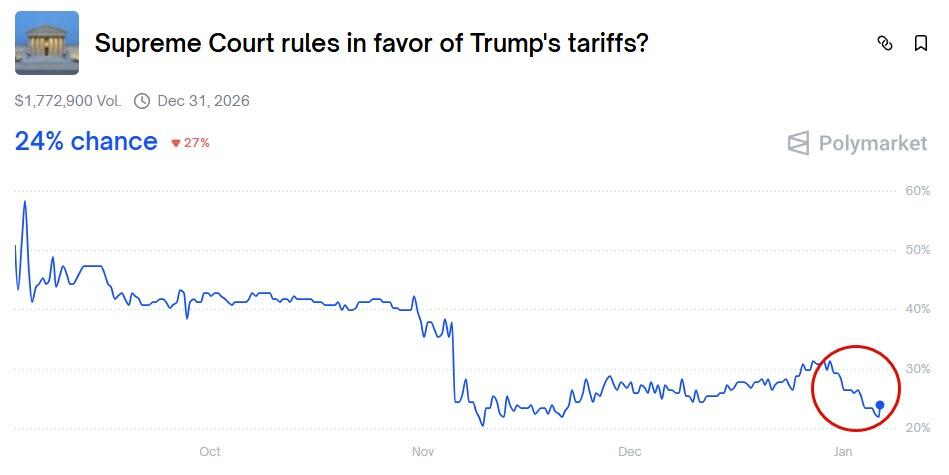
Core Viewpoint - The U.S. Supreme Court is set to make a ruling on tariffs, which is expected to significantly impact market direction, with a focus on potential responses from the White House following the decision [1][3]. Market Reactions - If tariffs are overturned but replaced, the S&P 500 index may initially rise but then decline, while a complete removal of tariffs would benefit consumer and financial stocks but could raise concerns about fiscal deficits, complicating the Federal Reserve's interest rate path [1][3]. - Current market predictions indicate a 24% chance that Trump's tariff policy will be maintained, with analysts expecting a 7:2 or 6:3 majority against the tariffs [1][3]. Sector Analysis - Consumer and retail sectors, particularly companies reliant on imports like Nike and Mattel, are expected to benefit the most if tariffs are lifted [4]. - Financial institutions such as JPMorgan and Goldman Sachs may gain from increased consumer confidence, while transportation stocks could also see positive impacts if tariffs are removed alongside tax cuts [9]. Legal Alternatives - The government has alternative legal avenues to maintain its trade agenda, including the use of various trade laws, although these options may face significant legal challenges [3][7]. - Specific trade laws mentioned include the Trade Expansion Act of 1962 and the Trade Act of 1974, which provide the president with broad powers to impose tariffs but come with limitations and potential legal hurdles [10].

地缘政治+财政赤字攀升,黄金将在2026上半年冲到5000美元?
Hua Er Jie Jian Wen· 2026-01-09 10:41
Core Viewpoint - HSBC predicts that gold prices may surpass $5,000 per ounce in the first half of 2026, driven by a combination of geopolitical risks and deteriorating fiscal conditions [1][2] Group 1: Factors Influencing Gold Prices - HSBC's report highlights that the rising fiscal deficits in the Western world, particularly the projected $2.05 trillion federal deficit in the U.S. for the 2026 fiscal year, are becoming a hidden driver for gold price increases [2] - The increasing fiscal deficits are eroding the credibility of fiat currencies, thereby amplifying the appeal of gold as a non-debt asset [2] - Deutsche Bank notes a fundamental shift in market structure, where the pricing power of gold is moving from price-sensitive consumers to less price-sensitive official buyers, such as central banks [3] Group 2: Market Dynamics and Investor Behavior - Institutional investors are currently experiencing "FOMO" (Fear of Missing Out), which is driving short-term volatility in the gold market [4] - The report warns that if anticipated interest rate cuts do not materialize, the rebound in gold prices may face suppression and potential corrections [4] - The gold market in 2026 is expected to exhibit characteristics of "high volatility and high prices," reflecting a broader distrust in the existing credit system [4]


过山车一夜?全球市场今晚“好戏连场”
Hua Er Jie Jian Wen· 2026-01-09 06:48
Core Viewpoint - Global investors are preparing for a highly volatile "Super Friday," with significant events that could reshape short-term pricing logic in the bond, stock, and commodity markets [1]. Economic Data - The U.S. non-farm payroll report for December will be released at 21:30 Beijing time, serving as a crucial reference for assessing economic health and influencing the Federal Reserve's interest rate decisions [1][3]. - Economists predict a job increase of 70,000 in December, with the unemployment rate expected to drop from 4.6% to 4.5% [6]. Federal Reserve Policy - The non-farm payroll data is viewed as a "deciding hammer" for the Fed's policy, with a weak report potentially increasing the likelihood of a rate cut in January to 50% [6]. - Current market pricing indicates only a 10% chance of a rate cut this month, with the next expected in June [6]. Supreme Court Ruling - The market is closely watching the Supreme Court's decision on the legality of Trump’s tariffs, which could have a binary effect on the stock and bond markets [7]. - If tariffs are overturned, the S&P 500 could rise by 0.75%-1%, while maintaining tariffs could lead to a decline of 30-50 basis points [7][8]. Commodity Market Dynamics - The commodity market is facing a "double storm" with the upcoming results of the "232 clause" tariff investigation and significant index rebalancing trades [2][10]. - The annual rebalancing of the Bloomberg Commodity Index has begun, with an expected influx of approximately $7.7 billion in silver sell orders, equating to 13% of total COMEX silver open interest [12]. Market Reactions - Analysts warn that the combination of tariff rulings and commodity market adjustments could lead to extreme volatility, particularly in precious metals like palladium and silver [10][12]. - The potential for a liquidity vacuum could trigger severe repricing in the market, with differing views on whether prices will continue to rise or face significant downward risks once liquidity improves [12][13].


最高法院周五或裁定特朗普关税合法性,美国经济面临关键抉择
Jin Rong Jie· 2026-01-09 05:48
Core Viewpoint - The U.S. Supreme Court is expected to make a ruling on the legality of tariffs implemented during Trump's administration, which could have significant implications for trade policy and the U.S. fiscal situation [1] Group 1: Legal and Policy Implications - The ruling will address whether the government has the authority to impose tariffs under the International Emergency Economic Powers Act (IEEPA) and whether the government must refund tariffs paid by importers if the tariffs are deemed illegal [1] - The court may issue a mixed ruling, granting limited authority under IEEPA while requiring limited refunds, or it may explore various other options [1] - Even if the White House loses the case, it retains other policy tools to implement tariffs without invoking emergency powers [1] Group 2: Economic Impact - Losing the tariff tool could have multiple repercussions, including negative effects on the ambition for industrial relocation to the U.S. and potential increases in interest rates, although it may benefit corporate profits by lowering input costs and facilitating trade [2] - The government has identified several alternative strategies to maintain most tariffs if the court ruling is unfavorable, with a 28% probability that the court will support the current tariff implementation [2] - Tariffs are projected to generate approximately $195 billion in revenue for the fiscal year 2025, with an additional $62 billion expected in 2026 [2] Group 3: Analyst Perspectives - Analysts from Morgan Stanley believe there is significant leeway in the Supreme Court's ruling, which could result in a narrowing of existing tariffs without a complete repeal or limitations on future tariff applications [3] - The focus on affordability issues may allow the government to adopt a more moderate approach to the overall tariff system [3] Group 4: Trade Deficit and Inflation - The impact of tariffs has exceeded analysts' expectations, showing limited effects on inflation while significantly reducing the trade deficit, countering views that tariffs could isolate the U.S. in global trade [4] - The U.S. trade deficit reached its lowest level since the end of the 2009 financial crisis in October last year, indicating a substantial decrease in imports [4]
就在今天!特朗普关税案迎关键裁决,如何影响美国经济及股债?
Feng Huang Wang· 2026-01-09 04:03
Group 1 - The U.S. Supreme Court is expected to rule on the legality of tariffs imposed by President Trump, which could significantly impact trade policy and the U.S. fiscal situation [1] - The ruling will focus on whether the Trump administration had the authority to impose tariffs under the International Emergency Economic Powers Act (IEEPA) and if the government must refund tariffs if deemed illegal [1] - Treasury Secretary Yellen anticipates a compromise ruling, suggesting that the government could still collect tariffs at similar levels even if it loses the case [1] Group 2 - If the tariffs are invalidated, it could negatively affect U.S. industrial repatriation plans and fiscal health, potentially raising interest rates, while benefiting corporate profits by lowering input costs [2] - The probability of the Supreme Court supporting the current tariff policy is only 28%, indicating a strong expectation of a ruling against the tariffs [2] - The Treasury Department projects tariff revenues of approximately $195 billion for FY2025 and $62 billion for FY2026 to date [2] Group 3 - The upcoming ruling is seen as a significant test for U.S. equity and bond markets, with potential long-term uncertainty if tariffs are overturned [3] - Analysts predict that if tariffs are lifted, corporate profit margins may increase, boosting the stock market, while complicating the Federal Reserve's interest rate decisions [3] - A potential economic stimulus from halting tariffs could exacerbate the government's budget deficit, putting pressure on U.S. debt [3] Group 4 - Wells Fargo's chief equity strategist forecasts a 2.4% increase in EBITDA for S&P 500 companies in 2026 if the Supreme Court overturns the tariff policy, likely leading to higher stock prices [4] - Companies heavily reliant on imported goods, such as apparel and toy manufacturers, are expected to benefit the most from tariff removal [5] - Financial institutions may also gain from increased consumer spending, along with industrial manufacturing and transportation sectors benefiting from potential economic boosts [5] Group 5 - Conversely, sectors benefiting from trade protectionism, such as materials and commodities, may underperform if tariffs are lifted [6] - Bond traders are preparing for market volatility, with U.S. Treasury bonds having risen over 6% last year, marking the best performance since 2020 [6] - The removal of tariffs could reignite fiscal concerns, leading to a rise in long-term yields, although the impact is expected to be limited as the Trump administration may seek alternative legal avenues to restore most tariffs [6]
【环球财经】纽约金价6日涨超1% 银价大涨近6%重上80美元关口
Xin Hua Cai Jing· 2026-01-07 00:58
Group 1 - The core viewpoint of the articles highlights the significant rise in gold and silver prices driven by geopolitical tensions and strong market demand, with gold reaching $4505.70 per ounce and silver surpassing $80 per ounce [1][2] - The geopolitical unrest following the U.S. control of Venezuelan leaders has led to increased demand for safe-haven assets like gold and silver, indicating a shift in market sentiment towards these precious metals [1] - The World Gold Council reported that central banks purchased a net total of 45 tons of gold in November 2025, with total purchases from January to November 2025 nearing 297 tons, reflecting ongoing strong demand from emerging market central banks [1] Group 2 - Analysts from Saxo Bank noted that gold and silver are evolving from mere inflation hedges to foundational assets in the global economy, with gold being viewed as a key monetary asset and alternative to the U.S. dollar [2] - The report emphasizes that the strong performance of gold and silver at the beginning of 2026 indicates that the underlying drivers for price increases remain robust, with concerns over currency devaluation and fiscal sustainability continuing to support demand for hard assets [2] - UBS Wealth Management analysts predict that factors such as central bank gold purchases, increasing fiscal deficits, declining U.S. interest rates, and persistent geopolitical risks will drive gold prices to reach $5000 per ounce by the end of Q1 2026 [2]
VIX指数跌破14!黄金却飙破4500,市场正在酝酿一场无声风暴?
Sou Hu Cai Jing· 2026-01-06 08:38
Core Viewpoint - The current financial market is characterized by a paradox where low VIX levels suggest calmness, while rising gold prices indicate underlying systemic risks [1][3][12]. Group 1: VIX Index and Market Dynamics - The VIX index has dropped to 13.6, a five-year low, indicating a seemingly stable market and high investor confidence [3][5]. - However, this low VIX does not reflect a lack of risk; rather, it suggests that risks are being artificially suppressed by institutions engaging in strategies like shorting volatility and high-frequency trading [7][9]. - The market's apparent calmness is fragile, as historical precedents show that low VIX levels can quickly lead to significant volatility spikes [9][11]. Group 2: Gold Prices and Systemic Risks - Gold prices have surged to over $4,500, reflecting skepticism towards the VIX and signaling growing systemic risks in the financial system [12][14]. - Key indicators, such as the rising interest payments on U.S. debt and the expansion of the Federal Reserve's balance sheet, suggest that systemic risks are accumulating [14][16]. - The demand for gold, including ETFs and physical gold, has increased among central banks and investors, indicating a shift towards tangible assets as a hedge against financial instability [18][20]. Group 3: Future Outlook and Market Sentiment - The outlook for 2026 suggests a facade of geopolitical stability, but real risks lie within the financial system, including potential AI bubble bursts and unsustainable debt levels [22][24]. - The divergence between the narratives of a tech-driven market and the reality of unsustainable debt is becoming more pronounced, with investors increasingly favoring the latter perspective [20][24]. - The current market conditions may not lead to an immediate crisis, but they are likely to prompt a reevaluation of risks and investment strategies as the underlying vulnerabilities become more apparent [26].

2026年财政政策力度前瞻:赤字规模或接近6万亿元
Xin Hua Cai Jing· 2026-01-06 06:10
Core Viewpoint - The Central Economic Work Conference proposed to continue implementing a more proactive fiscal policy in 2026, maintaining necessary expenditure intensity and potentially increasing the deficit scale to nearly 6 trillion yuan, with new special bond issuance expected to reach 5 trillion yuan [1][2]. Fiscal Policy Direction - The fiscal policy for 2026 will focus on expanding fiscal expenditure, optimizing government bond tools, enhancing transfer payment efficiency, and improving expenditure structure to support key areas [2][4]. - The expected deficit scale for 2026 is close to 6 trillion yuan, with a deficit rate projected to be no less than 4% [2][3]. Debt Management - The total new debt scale for 2026 is anticipated to rise to 15 trillion yuan, with new special bonds expected to reach 5 trillion yuan [4][5]. - The issuance of special bonds is deemed necessary to support infrastructure investment and stimulate economic growth [5][6]. Local Government Support - The central government plans to increase transfer payments to local governments, likely exceeding 10 trillion yuan, to alleviate local fiscal difficulties and encourage economic development [2][3]. - There is a focus on addressing local fiscal challenges and improving the local tax system, with potential reforms in consumption tax and local tax structures expected in 2026 [7]. Structural Adjustments - The fiscal expenditure in 2026 is expected to increase slightly compared to 2025, with a focus on structural adjustments to enhance the effectiveness of fiscal policies [3][4]. - The reform of the local tax system aims to incentivize local governments to cultivate tax sources and shift from production-oriented competition to consumption-oriented competition [7].
巴西失业率继续走低
Shang Wu Bu Wang Zhan· 2026-01-01 16:46
Group 1 - The unemployment rate in Brazil decreased to 5.2% for the period of September to November, marking a month-on-month decline of 0.4% and a year-on-year decline of 0.9%, reaching the lowest level since 2012 [1] - The Brazilian federal state-owned enterprises reported an expanded loss, with a cumulative fiscal deficit of 6.3 billion reais from January to November, representing the worst performance since records began in 2002 [1]
外资行美债&汇率2026展望汇总
2025-12-31 16:02
Summary of Key Points from the Conference Call Records Industry Overview - The conference call records focus on the U.S. Treasury market and interest rate outlook for 2026, with insights from various financial institutions including Barclays, HSBC, Morgan Stanley, Deutsche Bank, and Bank of America Merrill Lynch. Core Insights and Arguments U.S. Treasury Market Outlook 1. **Yield Curve Dynamics**: - Barclays predicts a steepening of the yield curve, with 2-year yields expected to drop to 3.1% and 30-year yields remaining around 4.7%, resulting in a 2s30s spread of 160 basis points [6][10]. - HSBC anticipates a bear steepening of the yield curve, projecting a 10-year yield of 4.30% by the end of 2026 [15][19]. - Morgan Stanley suggests that the Fed's rate cuts may be less than market expectations, with a forecast of only 50 basis points of cuts [25][26]. 2. **Federal Reserve Policy**: - The new leadership at the Federal Reserve is expected to adopt a more dovish stance, potentially lowering rates below neutral levels [6][7]. - The Fed is projected to end quantitative tightening (QT) and begin purchasing T-bills to maintain adequate reserves, with an estimated purchase of $330 billion in T-bills in 2026 [10][31]. 3. **Fiscal Deficit and Inflation**: - The fiscal deficit is expected to remain around 6% of GDP, approximately $1.9 trillion, with inflation projected to stabilize around 2% [6][10][25]. - Concerns about inflation resurgence due to fiscal expansion and tariff impacts are highlighted, with core PCE inflation expected to remain above 2% [41][48]. Supply and Demand Dynamics 1. **Net Supply Projections**: - A significant reduction in net supply of U.S. Treasuries is anticipated, with a decrease of approximately $470 billion to $1.2 trillion in 2026 [6][58]. - Investment-grade corporate bonds are expected to see an increase in net supply, driven by mergers and acquisitions [58]. 2. **Market Demand**: - Bank demand for mid-term Treasuries is expected to rebound due to regulatory changes [9]. - Continuous inflows into bond funds are supporting demand, particularly for MBS, which are favored due to their attractive spreads [58][62]. Investment Recommendations 1. **Asset Recommendations**: - Barclays recommends going long on 2-year Treasuries to capitalize on anticipated rate cuts [10]. - HSBC suggests positioning in the belly of the curve (5-year Treasuries) for lower structural risk and positive carry [21]. - Deutsche Bank advises a cautious approach to long-dated Treasuries, predicting underperformance relative to swaps [39]. 2. **Strategic Themes**: - "Carry is king" is emphasized as a core investment strategy, focusing on high-yield bonds and leveraged loans due to their attractive coupon rates in a stable interest rate environment [41][47]. - The potential for a bear steepening of the yield curve is noted, with strategies to exploit this dynamic [21][47]. Other Important Insights - The reports highlight a complex economic landscape characterized by resilient growth, sticky inflation, and the dual risks of fiscal deterioration and inflation rebound [7][17]. - The impact of AI-driven capital expenditures and fiscal stimulus from legislation like the One Big Beautiful Bill Act (OBBBA) is noted as a potential growth driver [41][48]. - The need for caution regarding economic recession risks and policy uncertainties is emphasized, particularly in relation to tariffs and Fed independence [26][37]. This summary encapsulates the key points from the conference call records, providing a comprehensive overview of the U.S. Treasury market outlook and associated investment strategies for 2026.