
滞胀

Search documents
ETF市场日报 | 纳指相关跨境ETF领涨,红利资产韧性凸显
Jie Mian Xin Wen· 2025-03-24 07:55
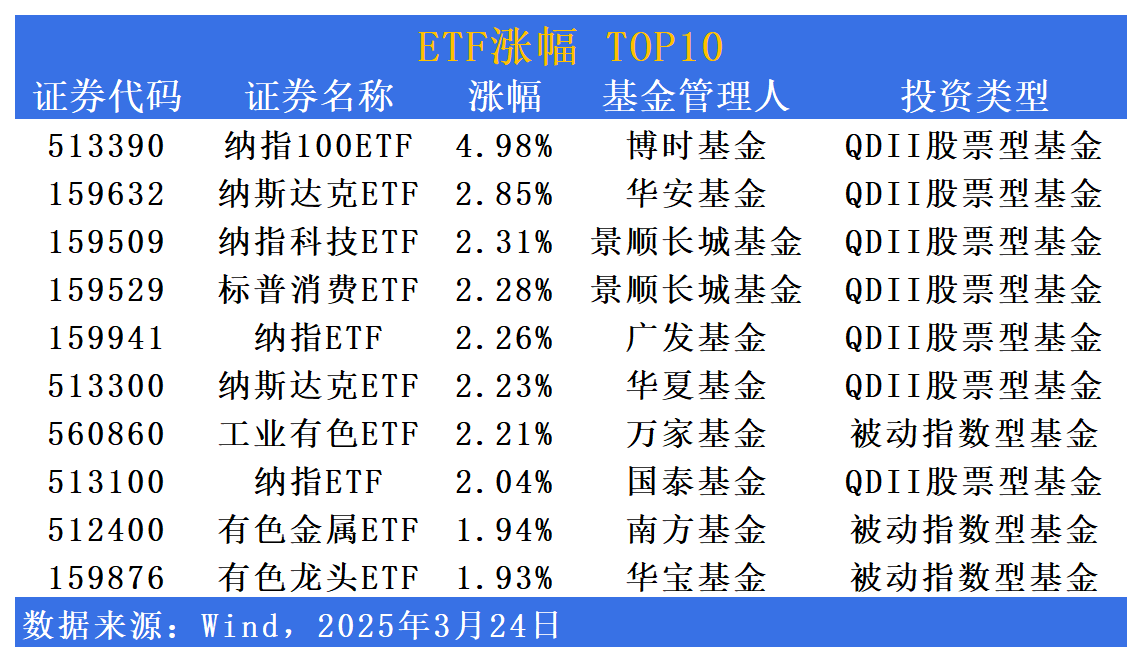
ETF市场日报 | 纳指相关跨境ETF领涨,红利资产韧性凸显 2025年3月24日,Wind数据显示,A股三大指数红盘报收,沪指涨0.15%;深证成指涨0.07%;创业板指涨0.01%。沪深两市成交额达到14507亿,较上周 五缩量1001亿。 涨幅方面,纳指100ETF(513390)上涨近5% | 证券代码 | 证券名称 | ETF涨幅 TOP10 | | | | --- | --- | --- | --- | --- | | | | 涨幅 | 基金管理人 | 投资类型 | | 513390 | 纳指100ETF | 4.98% | 博时基金 | QDII股票型基金 | | 159632 | 纳斯达克ETF | 2.85% | 华安基金 | QDII股票型基金 | | 159509 | 纳指科技ETF | 2.31% | 景顺长城基金 | QDII股票型基金 | | 159529 | 标普消费ETF | 2.28% | 景顺长城基金 | QDII股票型基金 | | 159941 | 纳指ETF | 2. 26% | 广发基金 | QDII股票型基金 | | 513300 | 纳斯达克ETF | 2.23% ...

FOMC议息会议:通胀“暂时”论回归?
Tai Ping Yang· 2025-03-21 15:23
Economic Outlook - The Federal Reserve has revised its economic growth forecast for 2025 from 2.1% to 1.7%[1] - The unemployment rate for 2025 is projected to increase from 4.3% to 4.4%[1] - PCE inflation for 2025 has been adjusted upward from 2.5% to 2.7%, while core PCE inflation is raised from 2.5% to 2.8%[1] Monetary Policy Adjustments - The Fed will slow down the balance sheet reduction starting April 1, reducing the cap on Treasury securities from $25 billion to $5 billion, while maintaining the pace for agency debt and mortgage-backed securities at $35 billion[3] - The overnight reverse repurchase agreement (ONRRP) usage has significantly decreased to below $20 billion, indicating a need to slow down the balance sheet reduction[3] Market Reactions - The market responded positively to the Fed's meeting, with a significant drop in the 1-year SOFR OIS indicating a dovish expectation[8] - Powell's dismissal of recession risks and inflation concerns has boosted risk appetite across various asset classes, reminiscent of the "transitory" inflation narrative from 2021[8] Risks - Potential risks include unexpected increases in U.S. inflation, surging oil prices, and possible interventions by the Trump administration in Fed policies[9]
美国经济衰退或滞胀概率几何?|国际
清华金融评论· 2025-03-21 10:30
Core Viewpoint - The likelihood of the U.S. economy entering a recession in the foreseeable future is low, but growth is expected to slow down, with a possibility of a brief stagnation or decline, although this is considered unlikely. Current high inflation, exacerbated by rising tariffs, raises the potential for stagflation, but any occurrence would not be considered true stagflation [1][14]. Current Economic Status - The U.S. economy has shown resilience despite predictions of recession, with mixed economic indicators suggesting both recessionary signals and robust growth metrics. The Federal Reserve's recent meetings indicate a stable economic outlook, although uncertainty has increased [1][4][8]. - Various indicators point towards recession risks, including a significant drop in consumer confidence and weak retail sales data. However, the relationship between soft indicators and actual economic performance is often tenuous [5][7]. - The Atlanta Fed's prediction of a 2.8% decline in GDP for Q1 is primarily attributed to temporary factors, and economists still expect continued growth, albeit at a reduced rate [6][8]. Recession Indicators - Soft indicators, such as consumer confidence and small business optimism, have declined, but actual employment data remains strong, with job growth and low unemployment rates indicating a stable labor market [7][8]. - The mixed signals from economic data necessitate careful analysis to distinguish between temporary fluctuations and underlying trends [4][5]. Future Outlook - If current economic policies remain unchanged, the probability of recession may increase, potentially leading to a transition from soft to hard indicators of economic decline. However, historical patterns suggest that political pressures may lead to policy adjustments to mitigate economic damage [10][11]. - The impact of tariffs on inflation is projected to be temporary, with estimates suggesting an increase of 0.5-0.8 percentage points in inflation rates. The Federal Reserve is inclined to overlook these temporary effects, focusing instead on broader economic stability [14][15]. - The resilience of the U.S. economy, particularly through technological innovation and infrastructure investment, is expected to support growth while controlling inflation, although significant unforeseen challenges could still arise [15].

英国央行,重磅信号!
21世纪经济报道· 2025-03-21 02:37
Core Viewpoint - The Bank of England decided to maintain the benchmark interest rate at 4.5%, reflecting the current economic uncertainties and the need for careful monitoring of both global and domestic economic developments [2][5]. Economic Conditions - The UK economy is facing stagnation, with January GDP unexpectedly contracting by 0.1% and manufacturing PMI dropping to a 14-month low of 46.9, indicating a continued contraction in the manufacturing sector [3][11][12]. - Inflation unexpectedly rebounded, with January CPI rising to 3%, surpassing the previous month's 2.5% and exceeding market expectations, which raises concerns about the sustainability of continuous rate cuts [6][11]. Inflation and Monetary Policy - The Bank of England's decision to hold rates steady is influenced by rising inflation concerns, particularly due to a £100 billion fiscal expansion plan and potential cost pass-through from increased minimum wages and social security contributions [6][13]. - The central bank slightly raised its inflation forecast to 3.75%, indicating persistent inflationary pressures that complicate the monetary policy landscape [6][15]. External Factors - The uncertainty stemming from Trump's tariff policies poses a significant threat to the UK economy, with potential tariffs on steel, aluminum, and other sectors that could impact a quarter of UK exports to the US [7][8][9]. - Analysts suggest that the Bank of England is waiting for more clarity on the impact of these tariffs before making further monetary policy decisions [9]. Future Outlook - The risk of stagflation is increasing, with expectations of "weak growth + high inflation" in 2025, necessitating a careful balance between curbing inflation and supporting economic growth [12][16]. - Market expectations indicate a likelihood of two additional rate cuts within the year, with a 77% probability of a cut in May and a 55.6% chance in August [15][16].
美联储3月FOMC会议点评:滞胀预期下的降息挑战
BOCOM International· 2025-03-20 12:46
Global Macro - The Federal Reserve maintained interest rates at the March FOMC meeting, aligning with market expectations, indicating a challenging environment for rate cuts amid stagflation concerns [2][3] - The economic forecast has been downgraded, with 2025 GDP growth revised from 2.1% to 1.7%, and the unemployment rate adjusted from 4.3% to 4.4%, reflecting a stagflation narrative [6][8] - The Fed's decision to slow down balance sheet reduction from $25 billion to $5 billion per month is seen as a proactive measure to mitigate risks amid economic uncertainties [17][20] Interest Rate Outlook - The median interest rate forecast suggests two rate cuts, but the number of committee members supporting this has decreased from 15 to 11, indicating a higher threshold for future cuts [6][8] - The current unemployment rate of 4.1% is expected to rise to 4.4% by the end of 2025, which historically correlates with recessionary conditions [8][10] - The Fed faces pressure from the White House regarding high interest rates, which conflict with fiscal goals such as reducing the deficit and encouraging manufacturing return [22][27] Economic Projections - The economic projections indicate a shift towards a potential shallow recession, with the likelihood of rate cuts increasing as economic conditions evolve [22][27] - The Fed's economic outlook reflects a balance of risks, with inflation expectations rising among committee members, complicating the path for rate cuts [5][6] - The report highlights the uncertainty surrounding Trump's policies, which may impact economic stability and the Fed's decision-making process [3][22]
研客专栏 | 3月美联储:犹豫的代价?
对冲研投· 2025-03-20 11:51
以下文章来源于川阅全球宏观 ,作者民生宏观团队 川阅全球宏观 . 卖方宏观研究,舞动漫天彩绸固然是一种本事,剪取庭前小枝也需要视角与功底。 欢迎加入交易理想国知识星球 文 | 林彦 邵翔 裴明楠 来源 | 川阅全球宏观 编辑 | 杨兰 审核 | 浦电路交易员 对于美国经济,联储和我们前期报告判断的一致——滞涨。在如何处理"滞胀"这个问题上,美联储还是犹豫了。今天凌晨的议息会议美联 储对当前经济的定性是"滞胀"属性和不确定性上升,应对上观望和平衡更加明显,支持年内至少2次降息的人变少了,而意外的放缓缩表也 被官方视为"以时间换空间"的中性措施。面对白宫,美联储依旧不想先动,而落后于曲线(Behind the Curve)的代价可能是在未来不得 不宽松得更多。 信号偏鹰的点阵图: 点阵图显示今年降息预测中值仍是2次(和去年12月一致),但是支持年内降息2次以上的人变少了:从15人减少至11 人。 微妙的放缓缩表: 本次会议比较意外的是宣布从4月起放缓缩表节奏,将美国国债的每月赎回上限从250亿美元降至50亿美元。鲍威尔强调 不是货币政策态度的变化,而是应对债务上限的技术性调整,而且可能意味着缩表结束的时点延后。不 ...

事件点评:锚点通胀向就业,政策强“鹰”向弱“鹰”
Guotai Junan Securities· 2025-03-20 11:18
Investment Rating - The report indicates a cautious approach towards investment, suggesting a neutral stance on the industry performance relative to the benchmark index [15]. Core Insights - The Federal Reserve's March FOMC meeting maintained interest rates, signaling a shift in policy focus from inflation to employment, which is interpreted as a dovish signal by the market [1][4]. - The Fed plans to slow down its balance sheet reduction starting in April, decreasing monthly Treasury redemptions from $250 billion to $50 billion, while keeping MBS redemptions unchanged [4][5]. - The Fed's economic growth forecast for Q4 2025 has been downgraded from 2.1% to 1.7%, while the unemployment rate is expected to rise from 4.3% to 4.4% [4][6]. - Inflation expectations have been revised upward, with the PCE inflation forecast for Q4 2025 increased from 2.5% to 2.7% and core PCE from 2.5% to 2.8% [4][6]. - The market anticipates a higher likelihood of rate cuts, with futures indicating expectations for three rate cuts this year, despite the Fed's guidance suggesting only two [4][9]. Summary by Sections Federal Reserve Policy Changes - The Fed's recent policy shift emphasizes employment over inflation, reflecting a more cautious approach to monetary policy [1][4]. - The removal of language indicating a balance of risks between employment and inflation suggests a heightened focus on employment risks [4]. Economic Forecast Adjustments - The Fed has lowered its GDP growth forecast for 2025 while raising inflation expectations, indicating concerns about potential stagflation [4][6]. - The adjustments in forecasts highlight the Fed's ongoing challenges in balancing economic growth and inflation control [4]. Market Reactions - Following the Fed's announcements, there was a notable increase in both short-term stock and bond markets, reflecting investor optimism about the dovish signals [4][5]. - The market's reaction underscores the sensitivity of investors to changes in Fed policy and economic outlook [4].
【招银研究|海外宏观】“通胀暂时论2.0”——美联储议息会议点评(2025年3月)
招商银行研究· 2025-03-20 11:04
作者:招商银行研究院 纽约分行 美东时间3月19日,美联储保持政策利率不变但降低缩表速度。政策利率保持在4.25-4.50%区间,准备金利率 (IORB)保持在4.40%,美国国债减持速率从250亿美元/月下调至50亿美元/月,住房抵押证券(MBS)减持 速率维持在350亿美元/月不变。 鲍威尔强调,近期衰退预期被夸大了,更多来自调查类"软数据",以失业率为代表的"硬数据"仍然稳固。关税 引发的通胀更可能是"暂时的",重要的是长期通胀预期仍然稳定。事实上,"通胀暂时论"三年前已经破产过一 次。当前美国零售数据等"硬数据"正在走弱,美联储试图通过"通胀暂时论2.0"稳定市场预期,阻止"滞胀"预期 自我实现。 我们保持逢低做多中长期美债的投资策略,在5年期收益率接近4.3%,10年期收益率接近4.5%时做多美债;继 续执行相对中性的外汇交易策略,密切关注关税政策边际变化的影响。 美联储在关税问题上秉持"通胀暂时论"。 点阵图将2025年PCE通胀预测值上调至2.7%,但2027年及长期预测 仍维持在2.0%。鲍威尔指出,关税确实会让"抗通胀"进程有所延迟,但最终仍将实现目标。鲍威尔强调,保持 稳定的长期通胀预期是 ...

美联储转向“滞胀剧本”,鲍威尔宣布大幅放慢缩表
美股研究社· 2025-03-20 10:55
Core Viewpoint - The Federal Reserve has extended its wait-and-see approach on interest rates while raising inflation forecasts and lowering economic growth and employment outlooks for the year [2][4]. Group 1: Federal Reserve's Decisions - The Federal Reserve has kept the federal funds rate stable at around 4.3% as it assesses the impact of various policies from the Trump administration on the economic outlook [2][4]. - Recent economic predictions show that 11 out of 19 decision-makers expect at least two rate cuts this year, a decrease from 15 officials' expectations in December [4]. - The inflation rate is projected to rise from 2.5% in January to 2.7% due to tariffs, with officials indicating that progress in reducing inflation may be temporarily delayed [4][5]. Group 2: Economic Indicators - Recent economic data presents mixed signals, with consumer sentiment declining and stable hiring, as evidenced by a 4.1% unemployment rate in February [6]. - The GDP growth rate for 2025 is now forecasted at 1.7%, down from 2.1% predicted in December [4][5]. - Despite a slowdown in consumer spending, the labor market remains robust, but uncertainty in policies is affecting loan demand and business operations [6]. Group 3: Inflation and Consumer Expectations - The Federal Reserve's response will largely depend on whether businesses and consumers expect sustained price increases, as these expectations can become self-fulfilling [7]. - There is growing concern that tariffs may lead to inflationary psychology among consumers and businesses, prompting them to raise prices preemptively [7]. - The Federal Reserve has approved a plan to slow the reduction of its $6.8 trillion asset portfolio, allowing $5 billion in Treasury securities to mature each month without reinvestment, down from the current pace of $25 billion [7].

3月FOMC会议:以静制动的美联储态度并不鹰派
中国银河· 2025-03-20 08:00
Group 1: Federal Reserve Policy - The Federal Reserve maintained the federal funds rate at 4.25%-4.50% and further slowed the pace of quantitative tightening (QT) from $25 billion per month to $5 billion per month, nearing a halt[3] - Despite rising concerns about stagflation, the Fed officials still guide for two rate cuts within the year, indicating a dovish stance[1] - The Fed's economic projections lowered GDP growth from 2.1% to 1.7% and raised PCE inflation expectations from 2.5% to 2.7%[1] Group 2: Economic Indicators - The unemployment rate forecast was adjusted from 4.3% to 4.4%, reflecting concerns about economic slowdown due to tariff impacts[1] - The Fed anticipates that Trump's tariffs and other economic reforms could reduce economic growth by 0.4 percentage points and increase nominal inflation by 0.3 percentage points[1] - Current economic data shows signs of marginal weakening, but the distance to a recession remains significant[4] Group 3: Market Reactions - The 10-year Treasury yield fell by 4.8 basis points to 4.237%, while the 2-year yield dropped by 7.17 basis points to 3.966%[4] - The market's key focus remains on Trump's policies, with expectations of inflation and economic downturn continuing to influence market sentiment[4] - CME data indicates that traders expect two rate cuts in 2025, aligning with the Fed's projections[4]