AI泡沫

Search documents
下周市场有望探底回升
Haitong Securities International· 2025-11-16 13:35
Group 1 - The report indicates that the stock market may rebound after further corrections, with expectations of a choppy upward pattern in the short term as new catalysts are awaited [1][8] - The Hang Seng Index showed resilience, supported by the dividend and consumption sectors, while technology indices continued to face corrections [1][8] - The Federal Reserve's hawkish stance has led to a decline in the probability of a rate cut in December, impacting market liquidity and causing declines in Bitcoin and gold [2][9] Group 2 - China's economy showed signs of accelerated weakening in October, with consumption and fixed-asset investment declining, while credit growth also slowed [2][10] - Recent policy signals from the Chinese government remain supportive, focusing on boosting consumption and effective investment [2][10] - Capital inflows into Chinese equities continued, with A-share equity ETFs recording a net inflow of RMB 8 billion, indicating ongoing investor interest [3][11] Group 3 - The technology sector has faced pressures due to external factors, including disappointing earnings from major companies and concerns over an "AI bubble" [4][12] - Despite short-term overvaluation in the tech sector, the report suggests that a significant downturn is unlikely without disruptive new technologies [4][12] - The report anticipates that if the tech sector stabilizes, it could lead to a broader market rebound, particularly benefiting underperforming sectors like brokerage firms [5][13]
投资策略周报:“中小市值+主题投资”仍是11月的核心主线-20251116
HUAXI Securities· 2025-11-16 11:43
Market Review - Global stock indices showed divergence this week, with European, Brazilian, and Indian indices rising, while Chinese and American tech stocks declined. The Shanghai Composite Index continued its narrow fluctuation, with major broad indices generally adjusting. The average daily trading volume in the A-share market remained around 2 trillion yuan, indicating a focus on existing stock games. Growth leaders fell while small-cap stocks rose, with the micro-cap index increasing by 4.11% [1][2] - In terms of sector performance, the TMT, machinery, and military sectors saw the largest declines, while precious metals and copper prices rose, and domestic double焦 prices weakened [1][2] Market Outlook - The core theme for November remains "small-cap stocks + thematic investment." The recent pullback in Chinese and American tech stocks is attributed to tight overseas liquidity and concerns over AI bubbles. Future attention will be on U.S. economic data and changes in December rate cut expectations. The current A-share market is primarily focused on existing stock games, with financing and southbound trading showing a "high-low cut" trend. The performance benchmark for public funds is expected to curb issues like style drift and short-term ranking chasing, potentially weakening extreme institutional clustering [2][3] Fundamental Analysis - The domestic economy is expected to achieve a growth rate of around 5% for the year, despite a weakening trend in both supply and demand in October. Industrial added value growth was 6.1%, continuing to decline. Investment in narrow infrastructure turned negative, and real estate development investment and sales areas also saw significant declines. Retail sales growth was only 2.9%, marking five consecutive months of decline, particularly in major consumer goods. However, corporate earnings are stabilizing, and with PPI growth expected to turn positive next year, the potential for profit improvement in certain sectors is anticipated [3][4] Macro Policy - Future policy observations will focus on the December Political Bureau meeting and the Central Economic Work Conference. The central bank has reiterated "cross-cycle adjustment," signaling a balance between long-term goals and supportive monetary policy. The third-quarter monetary policy report indicates that the national economy is progressing steadily, with a solid foundation for achieving annual targets. The central bank's focus is shifting towards supporting policies that consider long-term objectives [4] Funding Dynamics - Since November, market style has shifted, with tech leaders retreating and small-cap stocks outperforming. This is due to concerns over the AI bubble affecting tech sentiment in A-shares. Financing transactions in sectors like semiconductors and communication equipment have seen net selling since November. Southbound funds have favored banks and oil sectors, leading to a phase where value stocks outperform tech stocks. Recent guidelines from the fund industry association aim to curb style drift and extreme clustering among funds, prompting some capital to migrate towards underweight sectors [5][6] Industry Configuration - Focus on "14th Five-Year Plan" related thematic investments, such as energy storage, batteries, domestic substitution, and new materials. Attention should also be given to sectors benefiting from "anti-involution" trends, such as chemicals, and the guidance signals from Hong Kong's innovative pharmaceuticals to A-shares [5]
孙正义重夺日本首富后清仓英伟达,释放了AI泡沫破裂信号?
创业邦· 2025-11-16 10:53
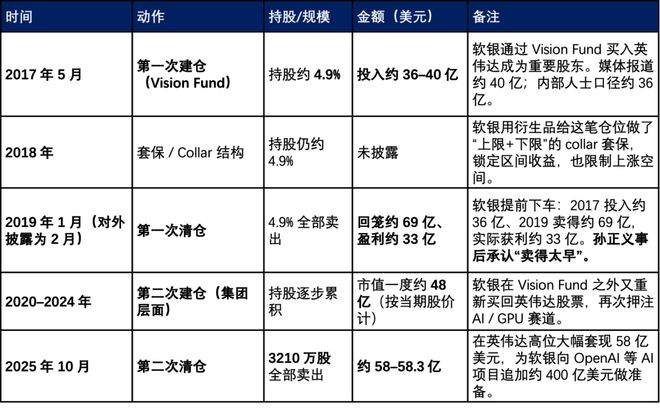
Core Viewpoint - The article discusses Masayoshi Son's strategic decision to liquidate SoftBank's entire stake in NVIDIA, raising approximately $5.8 billion, and the implications of this move on the AI investment landscape, particularly regarding OpenAI [5][10][12]. Group 1: NVIDIA Investment - SoftBank's liquidation of NVIDIA shares resulted in a significant drop in NVIDIA's market value, losing $100 billion overnight [5]. - Son's previous experience with NVIDIA, including a complete exit in 2019, serves as a cautionary tale about missed opportunities in tech investments [10]. - The decision to sell NVIDIA shares is seen as a shift in focus towards OpenAI, which Son believes is undervalued compared to its potential [11][12]. Group 2: OpenAI Focus - SoftBank plans to invest over $30 billion in OpenAI, necessitating the liquidation of existing assets to fund this commitment [13]. - Son's investment strategy emphasizes high-stakes bets on leading companies rather than diversified portfolios, which has led to both successes and failures in the past [7][11]. - OpenAI is currently viewed as being in its early stages, with expectations of significant future growth, but also faces challenges such as high operational costs and potential market corrections [12][18]. Group 3: Market Dynamics and Risks - The article highlights concerns about a potential AI bubble, with significant investments flowing into companies like OpenAI, raising questions about sustainability [15][18]. - There are indications that the market may be underestimating the risks associated with over-commitment to AI investments, as evidenced by SoftBank's financial maneuvers [16][20]. - The reliance on circular financing among tech giants, where funds are recycled between companies, raises concerns about the underlying economic viability of these investments [19][20]. Group 4: Future Outlook - The article suggests that while OpenAI may succeed in going public, it faces substantial challenges related to resource availability, particularly in power supply for data centers [20]. - Historical patterns indicate that technological bubbles can burst without undermining the overall progress of the technology sector, as seen in past tech revolutions [22].


做空英伟达的华尔街大空头,基金清盘了
Tai Mei Ti A P P· 2025-11-16 09:41
Core Insights - The article discusses Masayoshi Son's regret over selling SoftBank's stake in NVIDIA, which could have been worth over $150 billion today if held [1][2] - The conversation highlights NVIDIA's transformation into a key player in the AI era, emphasizing the importance of timing in high-growth industries [2] - SoftBank's recent strategic moves, including selling NVIDIA shares to invest in OpenAI, reflect a shift in focus towards AI startups [3][4] Group 1: NVIDIA Investment History - SoftBank invested approximately $3.6 billion in NVIDIA in May 2017, acquiring a 4.9% stake, but sold all shares by January 2019 for about $6.9 billion, realizing a profit of around $3.3 billion [1][3] - In October 2025, SoftBank sold 32.1 million shares of NVIDIA for approximately $9.17 billion as part of its asset monetization strategy [3] - The company has a history of buying and selling NVIDIA shares, indicating a pattern of missing out on significant gains during NVIDIA's growth phases [5] Group 2: Strategic Shift Towards AI - SoftBank's decision to divest from NVIDIA was influenced by its investment in OpenAI, where it plans to invest $22.5 billion, increasing its stake from 4% to 11% [3][4] - The Vision Fund's $19 billion profit in the second quarter was bolstered by investments in the AI ecosystem, including chips and large language models [4] - Despite selling NVIDIA shares, SoftBank remains involved in AI projects that rely on NVIDIA technology, such as the $500 billion Stargate data center project [4] Group 3: Market Dynamics and Short Selling - NVIDIA's stock has become a focal point for both bullish and bearish investors, with significant short positions being taken by notable figures like Michael Burry [6][12] - The article outlines the volatility surrounding NVIDIA's stock, driven by large short positions and the potential for significant price swings [14][20] - Concerns about NVIDIA's valuation and the sustainability of its growth are highlighted, with analysts questioning the timing of cash flow realization in relation to capital expenditures [10][17]

美国“K形”经济下消费多靠富人,股市会成经济“阿喀琉斯之踵”吗?
Di Yi Cai Jing· 2025-11-16 09:31
Economic Disparity - The wage growth for the lowest 25% of income earners in the U.S. has fallen to its lowest level in nearly a decade, indicating a significant economic disparity known as the "K-shaped economy" [1] - The top 10% of income earners contribute nearly half of total U.S. consumption, up from 44.6% in 2019, highlighting the increasing income inequality and consumption structure divergence [4] - Consumer confidence among low-income Americans is significantly lower than that of high-income groups, contrasting with 2022 when market downturns affected both groups similarly [4] Corporate Performance - Companies like Coca-Cola and McDonald's have reported noticeable differences in consumer behavior across income levels, with low-income consumers facing pressure and reducing spending, while high-income consumers continue to show strong spending growth [5] - Ford has indicated that its profits are primarily derived from high-end models, reflecting the purchasing power of wealthier consumers [5] Stock Market Impact - The stock market has created a significant wealth effect for the affluent, with the S&P 500 index rising 89% and the Nasdaq index rising 93% over the past five years, benefiting the wealthiest 20% of households who hold nearly 93% of stocks [6] - The potential for a downturn in the stock market, particularly if the "AI bubble" bursts, could lead to a negative wealth effect, impacting consumer spending and possibly dragging the economy into recession [6][7]

策略深度报告 20251116:2026年,美股AI泡沫会破裂吗?
Soochow Securities· 2025-11-16 07:08
证券研究报告·策略报告·策略深度报告 策略深度报告 20251116 2026 年,美股 AI 泡沫会破裂吗? 2025 年 11 月 16 日 [Table_Tag] [观Table_Summary] 点 ◼ 我们认为 2026 年刺破美股 AI 泡沫的可能不是产业周期和股票估值,更可能是宏观和政治周 期。 ◼ 一、泡沫只看估值吗? 市场以估值、Capex、自由现金流等基本面视角判断、解读美股 AI 泡沫。华尔街对 AI 是否 有泡沫这个问题本身就有分歧。参照 2019 年 Goldfarb 和 Kirsch 出版的 《泡沫与崩溃 : 技术创 新的繁荣与萧条》 ,58 个历史泡沫涵盖 4 个特征:不确定性,对应当前 AI 商业化落地方向和节 奏存在不确定性;纯粹的游戏,对标 Mag7 估值快速上涨,部分科技股股价显著脱离内在价 值;新手投资者,当前全球散户和机构都集中参与科技股投资,甚至出现"只买一只股票就买 英伟达"的盛况;通过叙事协调或者统一信仰,好比现在 AI 叙事已脱离科技本身,指向终极 信仰—"国家信仰"。从这四个特征看,美股 AI 确实存在泡沫。 ◼ 二、美股 AI 泡沫有多大? 众说纷纭。相比 ...
美股AI泡沫度量与互联网周期定位
Guohai Securities· 2025-11-16 06:02
Investment Rating - The report maintains a positive outlook on the AI industry, indicating that the AI bubble is still in its early stages, closer to the year 1997 of the internet era rather than 1999 [3]. Core Insights - The report addresses key questions regarding the potential risks of a bubble in the US AI industry, methods to measure the extent of the AI bubble, and how these indicators compare to the internet era [3]. - Five dimensions are used to monitor the AI bubble's degree, including Capex/GDP, Capex/revenue, revenue growth rate, valuation, and funding quality [3]. - The AI industry is experiencing a shift from a "cash flow battle" to a "financing battle," with increased competition and a focus on efficiency [5]. Summary by Sections Five Dimensions to Monitor AI Bubble Degree - **Capex/GDP**: Approaching or exceeding levels seen during the internet bubble, with AI technology's adoption and its impact on GDP growth occurring at a faster pace than in the past [3]. - **Capex/Revenue**: High Capex relative to AI-related revenue, but still manageable compared to free cash flow [3]. - **Revenue Growth Rate**: AI-related revenue growth is on par with Capex growth, with large AI tech companies showing stronger financial health than their internet bubble counterparts [3]. - **Valuation**: Valuations are nearing internet bubble levels, but strong profit support and high market concentration among tech giants enhance their market influence [3]. - **Funding Quality**: Remains healthy, although there are concerns that funding quality may decline due to rising interest rates and the influence of new players in cloud computing [3]. Credit Cycle Positioning - A new round of the US corporate credit cycle has begun, primarily driven by the AI industry, while the US consumer credit cycle is still in a downward trend [5][9]. AI Industry Changes - The AI industry is facing intensified competition, with a shift in focus from cash flow to financing, leading to a decline in revenue quality due to cyclical trading [5]. AI Industry Core Issues - The primary challenge in the AI industry is enhancing efficiency, with limited new productivity and a reliance on existing ToB clients for orders [5].





孙正义重夺日本首富后清仓英伟达,释放了AI泡沫破裂信号?
首席商业评论· 2025-11-16 04:12
Core Viewpoint - The article discusses the recent actions of SoftBank's Masayoshi Son regarding NVIDIA, highlighting concerns about potential market bubbles and the implications of heavy investments in AI, particularly in OpenAI [3][10][12]. Group 1: SoftBank's Actions - SoftBank has completely liquidated its NVIDIA holdings, cashing out approximately $5.83 billion (around 41.5 billion RMB), which led to a significant drop in NVIDIA's market value by $100 billion overnight [3][10]. - This marks the second time Son has sold off NVIDIA shares, with a previous liquidation in 2019 that has since been viewed as a cautionary tale in the investment community [10][11]. - The decision to sell NVIDIA is seen as a strategic move to free up capital for investments in OpenAI, with SoftBank's CFO stating the need for liquidity to fulfill commitments to OpenAI [12][14]. Group 2: Investment Strategy and Risks - Son's investment strategy appears to focus on concentrated bets on leading companies rather than diversified hedging, which has led to significant losses in past investments, such as WeWork and Coupang [7][11]. - The article raises concerns about the sustainability of OpenAI's business model, noting that it may face substantial losses and cash burn in the coming years, with estimates suggesting losses exceeding $5 billion by 2025 [18][21]. - There are indications that the current market environment may be experiencing a bubble, with warnings from prominent figures about the risks associated with inflated asset prices in the tech sector [18][19]. Group 3: Market Dynamics and Future Outlook - The article suggests that the heavy reliance on circular financing among tech companies, including OpenAI, creates an illusion of unlimited demand while facing real supply constraints, particularly in energy and resources [21][24]. - Historical patterns indicate that SoftBank's stock splits have often coincided with significant market downturns, raising questions about the potential implications of its upcoming stock split [15][18]. - The future of OpenAI is uncertain, with challenges related to energy supply and operational sustainability posing significant risks to its growth and profitability [22][24].

外资,开始躺平收租了
首席商业评论· 2025-11-16 04:12
Core Insights - The article discusses the trend of foreign companies in China shifting from direct operations to a model of leasing their brands and operations to local partners, indicating a strategic retreat from aggressive market engagement [5][15]. Group 1: Strategic Moves by Foreign Companies - Starbucks has entered into a joint venture with Boyu Capital to operate its retail business in China, valuing the deal at approximately $4 billion [5]. - Decathlon is also rumored to be evaluating the opening of part of its equity in the Chinese market, reflecting a broader trend among foreign firms [7]. - Historical examples include McDonald's selling its controlling stake in China for $2.08 billion in 2016 and Philips selling its home appliance business for €4.4 billion (approximately 34 billion RMB) in 2021 [7][9]. Group 2: Market Challenges - The Chinese market has become increasingly competitive, with Starbucks reporting an 11% drop in same-store sales in Q2 of fiscal year 2024, leading to a decline in both customer spending and transaction volume [9]. - Decathlon, while still growing, is experiencing a slowdown in growth rates due to competition from local brands and online retailers [9]. Group 3: Complexity of Local Operations - The article highlights that managing operations in China has become more complex, requiring local insights and rapid decision-making that foreign companies may struggle to provide [11]. - Yum China, after its spin-off, has successfully localized its product offerings, achieving record revenues and profits [11][12]. Group 4: Shift to Brand Leasing - Foreign companies are realizing that their most valuable asset in China is their brand, leading them to adopt a model where they lease their brand and provide technical services, which generates high margins with low operational risk [13]. - For instance, McDonald's has a brand licensing agreement that allows it to earn 2-5% of sales from its franchisee in China, translating to an estimated annual income of 2-3 billion RMB based on 2023 sales figures [13]. Group 5: Implications of the New Model - This shift to a leasing model benefits foreign companies by allowing them to maintain brand presence while securing cash flow without the operational burdens [14]. - Local teams face both opportunities and challenges as they take on the operational responsibilities of these international brands, which may lead to a shift in corporate culture and operational priorities [14][15].



做空英伟达的华尔街大空头,基金刚刚被迫清盘了!
Sou Hu Cai Jing· 2025-11-16 02:28
Core Insights - The article discusses the missed investment opportunity by SoftBank's founder Masayoshi Son in NVIDIA, highlighting the regret over selling shares before the company's significant growth driven by AI demand [1][2][4]. Group 1: Investment History - SoftBank invested approximately $3.6 billion in NVIDIA in May 2017, acquiring a 4.9% stake, but sold all shares in January 2019 for about $6.9 billion, realizing a profit of approximately $3.3 billion [1][7]. - If SoftBank had retained its shares, their current value would exceed $150 billion [1][7]. - In October 2025, SoftBank sold 32.1 million shares of NVIDIA for approximately $5.83 billion as part of its asset monetization strategy [5][7]. Group 2: Strategic Shifts - SoftBank's recent stock sales are part of a broader strategy to invest heavily in AI projects, including a $22.5 billion investment in OpenAI, which will increase its stake from 4% to 11% [5][8]. - The company aims to maintain financial stability while providing investment opportunities, as stated by CFO Yoshiaki Goto [5]. Group 3: Market Reactions and Analyst Perspectives - Despite SoftBank's stock sales causing a 2% drop in NVIDIA's share price, the company remains involved in several AI projects reliant on NVIDIA technology, such as the $500 billion Stargate data center project [6]. - Analysts suggest that SoftBank's actions should not be interpreted as a negative stance towards NVIDIA but rather as a necessity for funding its AI investments [6]. Group 4: Short Selling Dynamics - NVIDIA has become a significant target for short sellers, with a nominal short position exceeding $48 billion as of October 2025, making it the largest single short position in the U.S. capital markets [16][21]. - The volatility of NVIDIA's stock is largely influenced by the substantial options positions, leading to exaggerated price movements [23]. - Short sellers express concerns over NVIDIA's pricing power, the AI investment return timeline, and potential accounting adjustments affecting depreciation [17][18][19].