高端化

Search documents
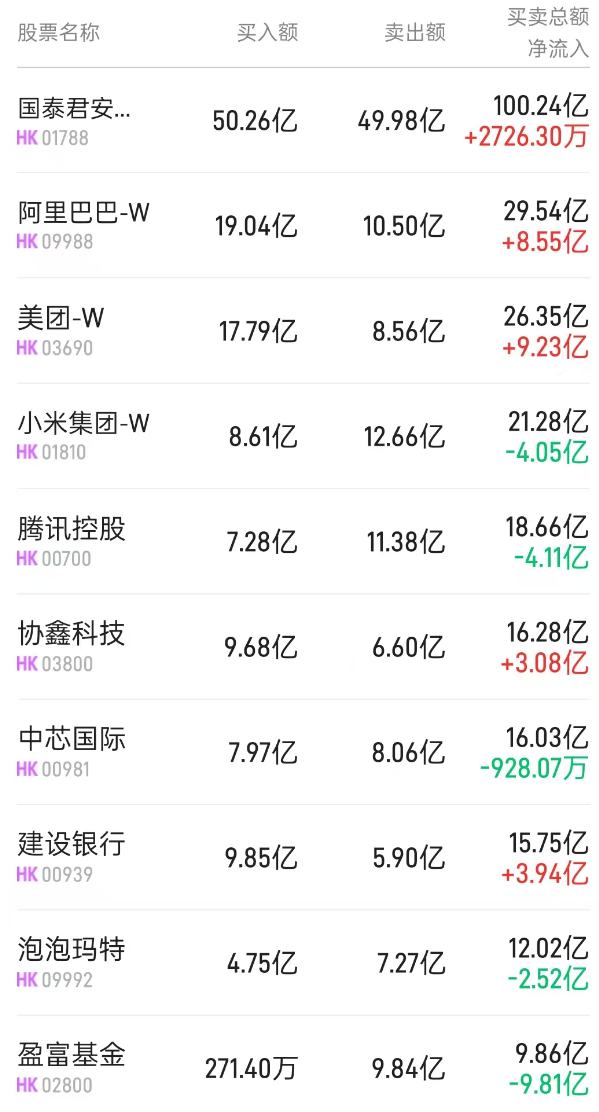
北水动向|北水成交净买入3.87亿 外卖大战进入白热化 北水同时抢筹美团(03690)及阿里(09988)
智通财经网· 2025-07-08 10:05
Group 1: Market Overview - On July 8, the Hong Kong stock market saw a net inflow of 387 million HKD from Northbound trading, with a net sell of 238 million HKD from Shanghai Stock Connect and a net buy of 625 million HKD from Shenzhen Stock Connect [1] - The most bought stocks included the Tracker Fund of Hong Kong (02800), Meituan-W (03690), and China Construction Bank (00939) [1] - The most sold stocks included the Tracker Fund of Hong Kong (02800), Tencent (00700), and Hang Seng China Enterprises (02828) [1] Group 2: Stock Performance - The net inflow for Guotai Junan International (01788) was 1.94 billion HKD, attributed to the upcoming implementation of the stablecoin regulations in Hong Kong [7] - Alibaba-W (09988) and Meituan-W (03690) received net buys of 14.1 billion HKD and 11.31 billion HKD respectively, driven by intense competition in the food delivery sector [6] - China Construction Bank (00939) saw a net buy of 3.94 billion HKD, supported by positive performance in the banking sector [6] - Kuaishou-W (01024) had a net buy of 1.61 billion HKD, with positive developments in its AI strategy [7] Group 3: Notable Sell-offs - Xiaomi Group-W (01810) faced a net sell of 4.29 billion HKD due to concerns over order authenticity and delivery issues [8] - The Tracker Fund of Hong Kong (02800) and Hang Seng China Enterprises (02828) experienced net sells of 9.8 billion HKD and 5.44 billion HKD respectively, influenced by liquidity tightening in the market [8] - Tencent (00700) had a net sell of 6.21 billion HKD, reflecting broader market concerns [9]



成为江苏“唯一”入选城市,无锡有什么“密钥”
Xin Hua Ri Bao· 2025-07-07 23:12
Core Viewpoint - Wuxi has been selected as the only city in Jiangsu Province for the 2025 pilot program for new manufacturing technology transformation, highlighting its commitment to advancing intelligent, high-end, and green manufacturing practices [1][10]. Group 1: Focus on Intelligence - Wuxi is leading in intelligent manufacturing, exemplified by the "lighthouse factory" of Xincheng Special Steel, which integrates over 200 smart applications and significantly enhances production efficiency [2][3]. - The factory's implementation of AI and IoT technologies has resulted in an 11.79% increase in total output and a 46.7% reduction in product quality loss, achieving a profit of 4.376 billion yuan in a challenging market [3][4]. - Wuxi's strategy includes promoting "intelligent industrialization" and "industrial intelligence," focusing on key industries and establishing a multi-tiered intelligent factory system [4][10]. Group 2: Focus on High-End Manufacturing - Wuxi is enhancing its high-end manufacturing capabilities, as demonstrated by the new headquarters of Rihuan Technology, which aims to double production capacity and revenue through advanced X-ray detection equipment [5][6]. - The city is fostering a comprehensive innovation ecosystem, supporting key industries like integrated circuits and high-end equipment through policy initiatives and technology development [7][10]. - Wuxi's R&D investment intensity reached 3.44%, ranking second among Chinese prefecture-level cities, reflecting its commitment to high-end manufacturing [7][10]. Group 3: Focus on Green Development - Wuxi Baotong Technology has achieved recognition as a national "green factory," showcasing its commitment to sustainable practices and innovative green products [8][9]. - The city has successfully reduced its energy consumption per unit of GDP by 18% over the past three years, exceeding its energy-saving targets [10]. - Wuxi is leading in green initiatives, with over 6,000 green factory evaluations completed, and aims to implement numerous green transformation projects by 2027 [10][11].

啤酒和乳制品行业研究:向上修复阶段的啤酒和乳制品
Donghai Securities· 2025-07-07 09:43
Group 1: Beer Industry - The beer sector is experiencing marginal demand improvement, with cost reductions enhancing profit elasticity. In 2024, terminal consumption remains weak, but leading beer companies are working on channel inventory destocking, with inventory levels at historical lows. The sector's valuation has dropped to a five-year low, but there is a high certainty of sales data recovery in 2025 due to low base effects and consumption policy stimuli, which may catalyze valuation increases. Additionally, costs are in a downward cycle, and product structure optimization is ongoing, indicating potential profit elasticity. Companies to watch include Qingdao Beer and Yanjing Beer, which have strong growth momentum and stable profit improvement [2][41]. - The beer production volume has stabilized over the past four years, with expectations for steady production in the next five years. The main consumer demographic for beer is aged 18-49, and after peaking in 2013, beer production has gradually declined. The production volume is expected to remain stable, with a slight decrease projected for 2024 [9][11]. - The beer industry has a high concentration, with the top five companies holding over 90% market share. Price increases remain a key growth driver for leading companies, particularly in the 6-10 yuan price range, as low-end products upgrade and high-end demand recedes [13][17]. Group 2: Snack Industry - The snack industry is entering a stable growth phase, with accelerated penetration into lower-tier markets and continued channel benefits. The retail market for leisure food and beverages is projected to reach 3.7 trillion yuan in 2024, with a year-on-year growth of 4.1%. The lower-tier market is expected to grow faster than higher-tier markets, with a projected market size of 1.18 trillion yuan by 2025 [44][45]. - Health-conscious and quality-oriented demands are increasingly shaping the snack market. Products like konjac and quail eggs are gaining popularity due to their health benefits and taste experiences. The konjac market is expected to continue its rapid growth, with significant sales increases noted in recent quarters [68][79]. - The rise of membership supermarkets is creating new opportunities for snack growth. Companies are actively expanding their presence in membership channels like Sam's Club and Hema, which are becoming key points for product launches and rapid sales growth [61][79]. Group 3: Dairy Industry - The dairy industry is experiencing a gradual improvement in supply-demand dynamics, with expectations for a turning point in the raw milk cycle. The price of fresh milk has been declining, leading to increased losses in dairy farming, but a reduction in raw milk inventory is anticipated as summer demand for cold dairy products rises. This could enhance the profitability of dairy companies once prices stabilize [2][82]. - The dairy sector has faced three rounds of price declines since 2008, with the current cycle extending due to weak demand and excess supply. The total milk production in China is projected to decrease for the first time since 2018, indicating a significant adjustment phase for the industry [88].




国内高端客车破局之作 宇通天域S12上市
Zhong Guo Qi Che Bao Wang· 2025-07-07 08:03
Core Insights - The launch of Yutong's high-end S series model, Tianyu S12, represents a significant response to the booming high-end tourism market in China, showcasing the company's integration of global resources in research and development [2][11] - The global tourism market is projected to reach 14.2 billion trips and $6.1 trillion in revenue in 2024, indicating a strong recovery and a shift towards high-end travel experiences [3] - High-end tourism is experiencing a structural transformation, with consumers willing to pay a premium for quality experiences, leading to a demand for upgraded travel products and services [3][12] Industry Trends - The high-end tourism market has surpassed $1.7 trillion, growing at a rate of 23.4%, reflecting a shift from price-sensitive to experience-oriented consumption [3] - There is a growing need for high-quality travel tools, as high-end travelers believe that the quality of transportation directly impacts their overall satisfaction [4] - The current bus market lacks sufficient high-end models and service standards, highlighting the need for a new product standard system in the industry [4][11] Yutong's Strategic Positioning - Yutong aims to address market demands by establishing a new product standard system, focusing on four key elements: excellent experience, beautiful design, superior operation, and high quality [4][11] - The Tianyu S12 is designed to meet the needs of high-end tourism and business reception, offering customized solutions for various scenarios [7][12] - Yutong's competitive edge is reinforced by 102 patented technologies, setting new industry benchmarks in terms of vehicle specifications and user experience [7][8] Product Features and Innovations - The Tianyu S12 features advanced technologies such as an active remote pre-purification system, zero-gravity seats, and a dedicated navigation system tailored for buses, enhancing passenger comfort and safety [8][9] - The vehicle's design includes a spacious interior, high visibility, and a long service life, which collectively redefine high-end bus standards [7][8] - Yutong's cloud platform, "Anruitong," provides intelligent operational support, optimizing maintenance and monitoring for improved efficiency [9][12] Market Impact and Future Outlook - The introduction of the Tianyu S12 signifies a pivotal moment in the evolution of China's bus manufacturing industry, aligning with global standards and enhancing competitiveness [11][12] - Yutong is transitioning from a hardware supplier to a comprehensive solution provider, fostering collaboration with tourism and transportation sectors to enhance the overall travel experience [12] - The company's commitment to innovation and quality is expected to drive further growth in the high-end travel market, establishing new benchmarks for the industry [12]


宇通又给中国客车开了个好头
Zhong Guo Qi Che Bao Wang· 2025-07-07 07:49
Core Viewpoint - Yutong Bus has launched its first high-end highway passenger bus, the Tianyu S12, in response to the evolving trends in tourism consumption and diversified travel demands, indicating a strategic shift towards high-end models despite a shrinking market for traditional buses [2][3]. Industry Trends - The market for highway passenger buses has been compressed due to changes in travel methods, leading to a decline in their status as the preferred choice for intercity and provincial travel [2]. - The demand and positioning of large buses have transformed, now serving as important facilitators for consumption upgrades and tourism expansion rather than merely transporting passengers from point A to point B [2]. Product Features - The Tianyu S12 exceeds national standards for large high-level buses and features industry-leading performance in air purification and structural longevity [3]. - 86% of the 114 key performance indicators of the Tianyu S12 align with those of top international high-end buses, showcasing its competitive edge in energy consumption, interior space, and aesthetics [3]. Design Philosophy - The design of the Tianyu S12 integrates Eastern aesthetics with global technology, drawing inspiration from traditional Chinese elements such as Ming-style furniture and ancient architecture [4]. - The vehicle's design team meticulously selected colors from over 1,000 options, simulating various lighting conditions to ensure optimal visual appeal, reflecting a commitment to high-end design [4]. Market Positioning - The launch of the Tianyu S12 aligns with the current phase of China's tourism industry, which is transitioning from rapid recovery to prosperous development, highlighting consumer aspirations for enhanced travel experiences [2]. - The emphasis on aesthetic design and high-end features in the Tianyu S12 sets a precedent for the future of China's bus industry, suggesting a potential for greater recognition on the international stage [5].

黄酒行业深度:供需共振,高端化与年轻化突围
Soochow Securities· 2025-07-07 06:21
Investment Rating - The report maintains an "Accumulate" rating for the yellow wine industry [1] Core Viewpoints - The yellow wine industry has undergone deep adjustments and is currently experiencing positive changes, with profit margins reaching a turning point and leading companies showing simultaneous growth in volume and price [5][11] - The CR2 market share of the yellow wine industry has continuously increased, with leading companies guiding industry transformation through product innovation and channel expansion [5][18] - The report draws parallels between the yellow wine industry and the beer industry, suggesting that supply-demand resonance can drive continuous upgrades in the yellow wine sector [26][31] - The success of Japan's sake industry in high-end transformation serves as a reference for the yellow wine industry, emphasizing the importance of brand culture, process innovation, and market expansion [55][60] Summary by Sections 1. Positive Changes in the Yellow Wine Industry - The yellow wine industry has seen a marginal turning point in profit margins, with leading companies like Kuaijishan and Guyuelongshan showing significant growth in both volume and price [14][18] - In 2023, the revenue of large-scale enterprises in the yellow wine industry was 8.547 billion yuan, down 15.90% year-on-year, while total profit reached 1.558 billion yuan, up 23.06% year-on-year, resulting in a profit margin increase of 5.77 percentage points to 18.23% [14][18] 2. Market Share and Industry Transformation - The CR2 market share in the yellow wine industry has risen from 14.9% in 2017 to 37.4% in 2023, with Kuaijishan and Guyuelongshan holding market shares of 20.9% and 16.5%, respectively [18][36] - The increase in market share is attributed to product innovation and channel expansion, leading to a high-end, youthful, and national effect [18][21] 3. Supply-Demand Resonance and Industry Upgrades - The report highlights the similarities between the current yellow wine industry and the beer industry, where supply-demand changes have driven industry upgrades since 2018 [26][31] - Leading companies in the yellow wine sector are adopting strategies focused on high-end, youthful, and national markets, similar to the beer industry's approach [26][27] 4. Lessons from Japan's Sake Industry - The Japanese sake industry has undergone several phases, including post-war recovery, rapid growth, economic downturns, and a focus on globalization and high-end products [55][60] - The success of the Dassai brand in Japan, which has seen its total sales increase from 4.6 billion yen in 2014 to 19.5 billion yen in 2024, serves as a model for the yellow wine industry [60][64]
宇通客车(600066):6月销量增幅明显,海外市场势头强劲
CMS· 2025-07-05 14:56
Investment Rating - The report maintains a "Strong Buy" investment rating for Yutong Bus [3][5]. Core Views - Yutong Bus has shown significant growth in June sales, with a total of 5,919 vehicles sold, representing a 24.8% increase year-on-year. Cumulative sales for the first half of 2025 reached 21,321 vehicles, up 3.7% [1]. - The domestic market is benefiting from the "old-for-new" policy in the public transport sector, which has increased subsidies for replacing old electric buses to 80,000 yuan per vehicle, further driving demand [1]. - The company has made substantial inroads into overseas markets, with total sales exceeding 10,000 vehicles in Central Asia and nearly 6,000 units in Europe, supported by strong technological capabilities and after-sales service [2]. - Yutong Bus is optimizing its product layout in line with industry trends, focusing on electrification, intelligent connectivity, and high-end products, which positions the company well for future growth [2]. Financial Summary - The projected net profits for Yutong Bus from 2025 to 2027 are estimated at 4.691 billion yuan, 5.274 billion yuan, and 6.069 billion yuan respectively, indicating a robust growth trajectory [3][4]. - The total revenue for 2025 is expected to reach 42.614 billion yuan, with a year-on-year growth of 15% [4]. - The company's return on equity (ROE) is projected to be 32.0% in 2025, reflecting strong profitability [14].
比亚迪 | 6月:海外销量再创新高 全球化稳步推进【民生汽车 崔琰团队】
汽车琰究· 2025-07-05 07:37
Core Viewpoint - The company reported a strong performance in June with significant growth in wholesale sales of new energy vehicles, indicating a positive trend in both domestic and international markets [1][2][3]. Sales Performance - In June, the wholesale sales of new energy vehicles reached 383,000 units, a year-on-year increase of 12.0% and a month-on-month increase of 0.03% [1]. - The wholesale sales of new energy passenger vehicles were 378,000 units, showing a year-on-year growth of 11.0% and a month-on-month growth of 0.2% [2]. - The breakdown of sales by brand includes 343,000 units for Dynasty and Ocean series, 15,783 units for Tengshi, 18,903 units for Fangchengbao, and 205 units for Yangwang [1]. Export Performance - The company achieved a record high of 90,000 units in overseas sales in June, benefiting from increasing demand in markets such as Turkey, Brazil, and Europe [3]. - The sales of plug-in hybrid passenger vehicles were 173,000 units, reflecting a year-on-year decline of 11.5%, while pure electric passenger vehicles saw sales of 207,000 units, a year-on-year increase of 42.5% [2]. Product Development and High-End Strategy - The year 2025 is projected to be a significant year for high-end products, with flagship models like Han L and Tang L launched in April, featuring advanced driving systems and fast-charging technology [4]. - The Fangchengbao Titanium 7 is expected to launch in Q4 2025, targeting family users with its spacious design and advanced technology [4]. Financial Projections - Revenue projections for 2025-2027 are estimated at 990.8 billion, 1,188.97 billion, and 1,397.04 billion yuan, respectively, with net profit estimates of 55.2 billion, 65.8 billion, and 75.3 billion yuan [5][7]. - The earnings per share (EPS) are projected to be 10.05, 11.98, and 13.71 yuan for the years 2025, 2026, and 2027, respectively, with corresponding price-to-earnings (PE) ratios of 33, 28, and 24 [5][7].

白酒量跌,RTDs猛增!未来十年中国酒市怎么走?IWSR最新报告给出三大答案
Sou Hu Cai Jing· 2025-07-04 08:47
Core Insights - The IWSR report indicates a significant restructuring in the Asia-Pacific alcoholic beverage market, with an overall slowdown in growth, particularly in China where baijiu sales have declined by 5% while gin sales surged by 20% [1][6] Group 1: Market Overview - The total beverage alcohol (TBA) volume in the Asia-Pacific region is projected to decrease by 2% in 2024, with a 3% decline in total value [2] - Major categories such as beer (-3%), spirits (-2%), and wine (-4%) have all experienced value declines, while ready-to-drink (RTD) beverages saw a slight increase in sales (+1%) [2] - India stands out with a TBA growth of 6%, driven by a 19% increase in ultra-premium product consumption, contrasting sharply with China's 5% decline [2][5] Group 2: Regional Performance - The Philippines, Thailand, and Vietnam recorded a TBA growth of 2%, while Japan (-1%), South Korea (-1%), and Australia (-3%) faced declines [2] - The Indian market is benefiting from a recent UK-India free trade agreement, which will significantly reduce import tariffs on Scotch whisky and British gin, fostering growth in these categories [5] Group 3: Category-Specific Trends - In India, there is a notable increase in the consumption of Irish whiskey (+58%) and vodka (+17%), indicating a shift in consumer preferences beyond traditional whiskey [5] - In China, the decline in key categories such as baijiu (-5%), cognac (-14%), and Scotch whisky (-8%) is attributed to reduced formal consumption occasions [6][8] - Gin and vodka are benefiting from the rising cocktail culture, with gin sales increasing by 20% and vodka by 4% in China [6] Group 4: Future Projections - IWSR forecasts that from 2024 to 2034, beer sales in China will remain stable, while RTDs are expected to grow at a CAGR of 2%, and sparkling wine at +5% [9] - The report predicts a compound annual growth rate (CAGR) of 7% for Scotch whisky and 3% for gin in India from 2024 to 2029 [5] - The overall spirits category in the Asia-Pacific is expected to decline by 1% CAGR, but excluding baijiu, the growth rate is projected at +2% [9] Group 5: Wine and Beer Trends - The wine category in the Asia-Pacific region faced a 4% decline in 2024, an improvement from the 8% drop in 2023, with still wine and other wine categories contributing to the decrease [13] - Beer sales are expected to continue declining until 2026, with a projected recovery starting in 2027, particularly in India, Vietnam, Thailand, and the Philippines [14][16] Group 6: RTD Growth - RTDs are positioned for strong growth in the coming years, primarily driven by Japan and Korea, with a projected CAGR of +3% from 2024 to 2029 [17] - Japan is expected to be a key driver for RTD growth, while China, Korea, and India are also anticipated to see increases in this category [17]

迈瑞医疗(300760)2024年年报及2025年一季报业绩点评:短期承压韧性犹存 业绩拐点值得期待
Xin Lang Cai Jing· 2025-07-04 08:38
Core Insights - The company reported a revenue of 36.726 billion yuan in 2024, reflecting a growth of 5.14%, with a net profit attributable to shareholders of 11.668 billion yuan, up by 0.74% [1] - In Q4 2024, the company experienced a revenue decline of 5.08% to 7.241 billion yuan, while net profit surged by 40.99% to 1.031 billion yuan [1] - The first quarter of 2025 saw a revenue drop of 12.12% to 8.237 billion yuan, with net profit decreasing by 16.81% to 2.629 billion yuan [1] Financial Performance - The overall gross margin for 2024 was 63.14%, a decrease of 1.08%, primarily due to changes in business structure and product pricing adjustments [2] - The company’s operating cash flow for 2024 was 12.432 billion yuan, an increase of 12.38% [1] - The gross margin for Q1 2025 improved by 6.57 percentage points to 62.53%, indicating that short-term adjustments may have been largely absorbed [2] Business Segments - The Life Information and Support segment generated 13.557 billion yuan in 2024, a decline of 11.11%, but the minimally invasive surgery business grew by over 30% [3] - The In Vitro Diagnostics segment achieved a revenue of 13.765 billion yuan, up by 10.82%, despite domestic challenges due to policy changes [3] - The Medical Imaging segment reported a revenue of 7.498 billion yuan, reflecting a growth of 6.60%, with high-end ultrasound models contributing significantly [3] International Expansion - The company’s international business grew by 21.28% in 2024, accounting for approximately 45% of total revenue, driven by high-end customer acquisition and local platform development [2] - The In Vitro Diagnostics international business saw over 30% growth, with local production projects initiated in 13 countries [3] Research and Development - The company maintained high R&D investment levels, with 4.008 billion yuan in 2024, representing 10.91% of revenue [4] - As of March 31, 2025, the company had applied for approximately 12,000 patents, with 5,973 patents granted [4] Shareholder Returns - The company distributed a total cash dividend of 7.602 billion yuan in 2024, with a cash dividend ratio of 65.15% [4] - A mid-term profit distribution plan for 2025 proposes a cash dividend of 1.710 billion yuan, reflecting strong profitability and commitment to shareholder returns [4]