中央经济工作会议

Search documents
邢自强:四中全会,三个时点
Sou Hu Cai Jing· 2025-10-15 13:39
Group 1 - The Fourth Plenary Session reaffirmed the dominant role of technology while signaling a slow economic rebalancing, with low likelihood of unexpected policy announcements [2][4] - The 14th Five-Year Plan suggestions will provide more guidance but will still lack specific numerical targets, focusing on supply-side policies and gradual improvements to the social security system [2][5] - The Central Economic Work Conference in mid-December is expected to maintain a GDP growth target of around 5% for 2026, with similar fiscal efforts as this year, while real estate measures will progress slowly [2][9] Group 2 - The Fourth Plenary Session will release two important documents regarding the 14th Five-Year Plan, with the first being a general communiqué outlining key tasks for the period from 2026 to 2030 [4] - The subsequent detailed suggestions will explore specific policy areas, including technology and industry policies, domestic demand, environmental protection, and social welfare [5][6] - The gradual rebalancing of the economy is anticipated, with public feedback on living standards acting as a catalyst for this process [8] Group 3 - The performance of the "Golden Week" holiday showed a modest increase in tourism and retail sales, with daily spending per capita declining, indicating potential overestimation of actual demand growth [13] - Retail sales growth for major retail and catering enterprises was 2.7%, lower than the previous month's 3.4% [13] - Despite weak demand, revenue per available room in the hotel industry showed low single-digit growth, suggesting reduced price elasticity of demand [13]

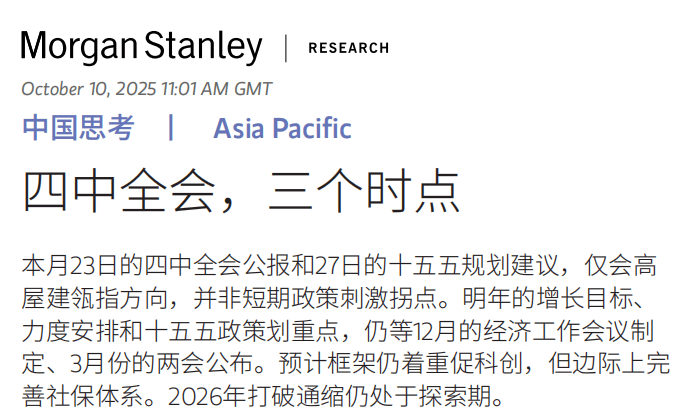
中国思考-四中全会,三个时点
2025-10-13 01:00
October 10, 2025 11:01 AM GMT 中国思考 | Asia Pacific 四中全会,三个时点 本月23日的四中全会公报和27日的十五五规划建议,仅会高 屋建瓴指方向,并非短期政策刺激拐点。明年的增长目标、 力度安排和十五五政策划重点,仍等12月的经济工作会议制 定、3月份的两会公布。预计框架仍着重促科创,但边际上完 善社保体系。2026年打破通缩仍处于探索期。 要点 #1. 四中全会前瞻 四中全会将发布两份关于十五五规划的重要文件: 中国将于10月20-23日召开四中 全会。10月23日将发布一份《 公报》 (约5,000-6,000字),高屋建瓴地为未来五 年指引方向。随后或将在10月26-27日发布更详细的《中共中央关于制定国民经济 和社会发展第十五个五年规划的建议》(约2万字),提供更具体的产业政策和结 构性改革指引。 10月23日 – 四中全会《公报》– 出现政策意外的可能性较低: 《公报》 将阐述十 五五时期(2026–30年)的"重点任务",通常包括经济增长、结构性改革、社 会治理、生态环保以及民生改善。我们预计,科技自主、创新和国家安全仍将是 政策核心,同时在边际上缓慢 ...
博时宏观观点:流动性和风险偏好支撑有色与成长
Xin Lang Ji Jin· 2025-10-09 11:09
Market Overview - The profit cycle remains weak, but liquidity and risk appetite factors have improved, making the market relatively attractive in the medium term [1] - The Federal Reserve's interest rate cuts are favorable for gold, copper, and growth styles [1] - Global stock indices have risen, with gold surpassing $4000 per ounce, while oil prices remain weak [1] Economic Indicators - In September, the manufacturing PMI marginally increased to 49.8% from 49.4% in August, while the non-manufacturing business activity index slightly decreased to 50% from 50.3% [1] - The production side shows stronger improvement compared to the demand side, indicating a high market risk appetite [1] Market Strategy - In the bond market, interest rates are expected to fluctuate at high levels before the holiday, with intense long-short battles [1] - The central bank is expected to maintain a supportive monetary policy stance, but cautious liquidity measures indicate a focus on preventing capital turnover [1] - The bond market may remain in a volatile pattern due to upcoming events such as the Fourth Plenary Session and US-China negotiations [1] A-Share Market - Despite the National Day consumption not exceeding expectations, the market is still in a window period for the Federal Reserve's interest rate cuts [1] - Anticipation of new domestic demand policies from the Fourth Plenary Session and the Central Economic Work Conference suggests limited downside risk for indices [1] - The technology growth sector is expected to continue outperforming, driven by domestic and international AI industry catalysts [1] Hong Kong Stock Market - Following the Federal Reserve's preemptive interest rate cuts, the Hong Kong stock market typically shows strong resilience [2] Oil Market - Oil demand is expected to remain weak over the next 25 years, with continuous supply release putting downward pressure on oil prices [3] Gold Market - A positive long-term outlook for gold prices is anticipated, with short-term upward pressure from events such as the US government shutdown [4]
2025年中国厨房空调产品消费指引白皮书-GfK&现代家电传媒
Sou Hu Cai Jing· 2025-04-05 17:35
Core Insights - The report indicates that the Chinese home appliance market has entered a quality upgrade phase, with kitchen air conditioners expected to accelerate in popularity by 2025 due to various factors including government policies aimed at boosting consumption and consumer confidence [1][11][12]. Market Trends - The kitchen air conditioner market is projected to grow in volume from 2024 to 2025, with split-type models gaining market share and embedded and wall-mounted types becoming mainstream. The primary power ratings are expected to be 0.75 HP, 1 HP, and 1.5 HP [1][38]. - The overall retail market for home appliances is expected to stabilize and grow, with kitchen air conditioners being a significant contributor to this growth [21]. Government Policies - The Central Economic Work Conference emphasized the importance of expanding domestic demand and promoting consumption as key tasks for 2025, with a focus on early implementation of supportive policies [11][12]. - The government has introduced a special action plan to boost consumption, which includes measures to stabilize the stock and real estate markets, thereby enhancing consumer confidence [12][19]. Consumer Behavior - Consumers are increasingly focused on the quality of their living environment, leading to a rise in demand for kitchen air conditioners. However, consumer awareness of these products is still in the early stages, indicating significant market potential [1][11][31]. - Most consumers have a budget of under 5,000 yuan for kitchen air conditioners and prioritize brand reputation and product performance [1][11]. Challenges and Opportunities - The kitchen air conditioner industry faces challenges such as low consumer awareness and insufficient installation services. Manufacturers are encouraged to enhance product performance in energy efficiency and oil resistance to meet consumer needs [1][11]. - Marketing strategies should leverage platforms like Douyin and Xiaohongshu, as well as offline stores, to improve consumer awareness and address installation issues [1][11][12]. Brand Insights - The report highlights several brands in the kitchen air conditioner market, including Midea, Haier, and others, showcasing their product features to help consumers understand market offerings [1].

中国银行研究院:预计上半年我国GDP增速将保持在5%以上
Zhong Guo Jin Rong Xin Xi Wang· 2025-03-27 12:49
与此同时,鉴于上年同期基数较低,报告预计,一季度我国GDP将同比增长5.2%左右,二季度我国 GDP将同比增长5.3%左右。上半年GDP增速将保持在5%以上,为全年5%左右增长目标的实现打牢基 础。 去年年底召开的中央经济工作会议和2025年政府工作报告,都将"大力提振消费、提高投资效益,全方 位扩大国内需求"作为今年重点工作之首。日前中共中央办公厅、国务院办公厅还印发了《提振消费专 项行动方案》,那么,二季度消费走势将如何? 报告预计,二季度消费有望持续回升。具体来看,一是促消费政策将提振居民消费;二是资本市场向好 将带来一定财富效应,进而推动居民消费倾向回升;三是集团消费或将低位企稳。综合来看,政策加码 与信心恢复将共同推动消费回暖。 转自:新华财经 新华财经北京3月27日电(记者余蕊 翟卓)中国银行研究院27日发布《中国经济金融展望报告(2025年 第2季度)》,预计二季度我国GDP同比增长5.3%左右。内需对经济的拉动作用将进一步增强,市场供 求结构性矛盾将有所缓解。 报告预计,二季度,美国关税和投资政策的影响或进一步显现。国内方面,宏观政策将明显加力,《提 振消费专项行动方案》有望加快实施。同时,科 ...

煤炭行业周报:预期底部夯实,静待需求复苏
Tebon Securities· 2025-03-23 10:23
Investment Rating - The report maintains an "Outperform" rating for the coal industry [1] Core Viewpoints - The coal industry is expected to see a recovery in demand, with prices anticipated to rebound due to macroeconomic improvements and policy support [4][7] - The report highlights the resilience of the coal sector amidst price fluctuations and emphasizes the potential for profit recovery in the coal-coke-steel supply chain [4][7] Summary by Sections 1. Industry Data Tracking - **Price Analysis**: As of March 21, 2025, the Qinhuangdao Q5500 thermal coal price is 671 CNY/ton, down 10 CNY/ton (-1.47%) from the previous week, while the main coking coal price at Jingtang Port remains stable at 1380 CNY/ton [4][13] - **Supply and Demand**: The report notes a slight decrease in overall supply due to some coal mines halting production, while downstream demand is expected to increase as construction activities resume [4][36] - **Inventory Analysis**: The total inventory at major ports shows a mixed trend, with southern ports decreasing by 1.04% and northern ports increasing by 0.77% [4][43] 2. Market Performance - The coal sector has outperformed the broader market, with a decline of only 0.86% compared to a 1.60% drop in the Shanghai Composite Index [4][57] 3. Recent Events - **Company Announcements**: China Shenhua reported a revenue of 338.375 billion CNY for 2024, a decrease of 1.4% year-on-year, while China Coal Energy reported a revenue of 189.399 billion CNY, down 1.9% year-on-year [4][62][63] - **Policy Developments**: The report mentions the government's initiatives to support the coal industry, including a focus on traditional industry upgrades and demand expansion [4][7]


中金:用AI解读政府工作报告
中金点睛· 2025-03-06 23:31
Core Viewpoint - The article utilizes AI to analyze the "Government Work Report" and quantify the incremental information from the "Two Sessions" compared to the Central Economic Work Conference, aiming to identify policy signals and asset trends [2][3]. Group 1: AI Methodology and Analysis - The conventional method of policy interpretation involves identifying key phrases in policy texts and comparing them with previous years to assess policy direction and intensity. AI enhances this by extracting comprehensive information from historical policy documents, overcoming human memory and subjective judgment limitations [3][4]. - AI can convert policy expressions into traceable numerical time series, making it easier to track and understand policy texts. The collaboration between AI and human analysts is essential for nuanced policy interpretation [3][4]. - The analysis of the "Government Work Report" from 2013 to 2025 using AI has yielded quantitative emotional indices for various themes, reflecting the changing focus of policies in response to economic conditions [11][12]. Group 2: Policy Themes and Emotional Indices - The "Government Work Report" can be categorized into 13 themes, including "macroeconomic policy," "structural reform," and "expanding domestic demand," with the thematic focus closely linked to economic conditions and policy guidance [9][10]. - The emotional index for key themes indicates the degree of policy positivity, with higher scores reflecting a more proactive policy stance. For instance, the emphasis on "macroeconomic policy" has increased significantly since 2019, indicating a sustained focus on "stabilizing growth" [5][11]. - The 2025 "Government Work Report" highlights the prioritization of expanding domestic demand and emphasizes specific measures for risk prevention, particularly in the real estate sector [11][12]. Group 3: Market Reactions and Asset Performance - The article finds a correlation between the incremental emotional sentiment in the "Government Work Report" and short-term A-share market performance, with a stronger sentiment on "stabilizing growth" leading to higher stock market gains [16][17]. - Historical analysis from 2010 onwards shows that the market typically experiences a pattern of initial declines followed by rebounds after the "Two Sessions," with the A-share market performing better than historical averages post-2024 [22][23]. - The report suggests a strategic overweight in Chinese stocks and gold, indicating a potential revaluation of Chinese assets driven by recent policy shifts and global economic conditions [24].

对话基金经理:2025年:新质生产力全面腾飞的战略机遇期
2025-03-06 05:19
Summary of the Conference Call Industry Overview - The focus is on the **technology sector** in China, particularly regarding the investment opportunities and dynamics expected in **2025** [3][5][21]. Key Points and Arguments 1. **Investment Logic for 2025 Technology Sector**: - Influenced by policy, liquidity, economic, and technology cycles. The policy cycle is entering an expansion phase following the December 2023 economic meeting [3][3]. - The technology sector is expected to experience strong performance due to a technological cycle explosion and low-frequency trading strategies, marking a historic investment opportunity [3][5]. 2. **Impact of U.S. Policy Changes**: - The removal of AI regulations under Trump's administration has led to unrestricted AI development in the U.S., enhancing competitive dynamics for China [3][8][9]. - The geopolitical landscape has shifted, with improved diplomatic relations for China, reducing external risks and increasing the focus on technology development [3][9][10]. 3. **Government Support for Emerging Industries**: - The Chinese government is actively encouraging the acceleration of new industries, with a significant increase in tolerance for emerging sectors and support for technology penetration across various fields [3][11][13]. - The China Securities Regulatory Commission (CSRC) is showing greater acceptance for unprofitable companies to go public, which is expected to accelerate the IPO pace in the A-share market [3][13]. 4. **Technological Advancements**: - Since the tech war began in 2018, China has made significant strides in technology research and industrial innovation, with domestic alternatives gaining traction [3][15]. - Chinese universities have improved their R&D capabilities, ranking highly in global research output, which supports the development of emerging industries [3][20]. 5. **Market Dynamics and Risks**: - The technology sector is expected to maintain growth momentum in 2025, although large-scale commercialization models are yet to be established, leading to potential market volatility [3][21]. - The balance between development and security is crucial, with pilot programs being used to assess the impact of emerging technologies before wider implementation [3][7]. 6. **Investment Strategies**: - Investors are advised to adopt a dual strategy: long-term positioning in broad-based indices and thematic investments once specific events are clear [3][22]. - The introduction of the **Science and Technology Innovation Index** is seen as timely, providing a comprehensive reflection of the sector's performance [3][23][24]. 7. **Focus Areas for 2025**: - Key investment themes include **smart driving** and **cloud computing**, with expectations of significant growth and favorable market conditions in these areas [3][28][29]. Other Important Insights - The easing of regulatory policies is expected to continue into 2026, but tightening may occur if substantial risks emerge [3][14]. - The overall R&D environment in China has improved, with increased funding and a focus on practical applications, leading to a rise in patent commercialization rates [3][16][19]. - The shift in the global R&D landscape shows a growing presence of Chinese companies in the top ranks of global R&D spending [3][17]. This summary encapsulates the critical insights from the conference call regarding the technology sector's outlook and investment strategies for 2025, highlighting the interplay of government policy, market dynamics, and technological advancements.
躁动!深圳房价,抬头了!
城市财经· 2025-03-04 03:39
Core Viewpoint - Shenzhen's real estate market has shown a significant recovery since the fourth quarter of last year, driven by government stimulus measures and a rebound in buyer confidence, leading to increased transaction volumes and prices in both new and second-hand housing markets [2][11][22]. Group 1: New Housing Market - In October 2023, Shenzhen's new housing transactions surged to 4,153 units, up from around 2,000 units previously, with November seeing 8,076 units and December maintaining a high of 6,769 units [2]. - The total new housing transaction volume for the year exceeded that of 2023, indicating a strong recovery trend [2]. - The second-hand housing market also experienced a notable rebound, with transaction volumes increasing from 3,191 units in September to 8,282 units in December [2][3]. Group 2: Price Trends - After hitting a low of 6 million yuan per unit in July 2023, Shenzhen's second-hand housing prices rebounded, reaching 6.3 million yuan in October and further increasing to 6.41 million yuan by February 2025 [3][8]. - Despite the increase in transaction volumes, the average transaction price showed slight fluctuations, with a minor decline noted in November and December 2023 [7][8]. Group 3: Economic and Policy Context - The recovery in Shenzhen's real estate market is attributed to strong purchasing power, a supply-demand imbalance, and improved market confidence driven by macroeconomic policies [11][12]. - The central government's shift towards more aggressive monetary and fiscal policies aims to stabilize the economy and support the real estate sector, with expectations of significant reductions in interest rates and increased government spending [11][15]. - Shenzhen's economic performance remains robust, with a GDP growth rate of 5.8% in 2023, outperforming other major cities, and a total GDP nearing 3.7 trillion yuan [13][14]. Group 4: Population Dynamics - Shenzhen's population increased by 199,400 in 2024, reaching a total of 17.99 million, marking the highest growth among major cities [20][21]. - This population growth is expected to further support housing demand and contribute to the overall recovery of the real estate market [20]. Group 5: Future Outlook - While the current recovery is promising, the long-term stability of Shenzhen's real estate market hinges on broader economic recovery and employment improvements across the country [22][25]. - The market is still in an adjustment phase, and the true impact of recent policy changes and economic conditions will become clearer in the second and third quarters of 2024 [25][26].

两会|全国人大代表、清华大学国家金融研究院院长田轩:激发耐心资本入市积极性 完善政府基金分类管理机制
证券时报· 2025-03-03 04:27
Core Viewpoint - The development of patient capital is crucial for adapting to the new round of technological revolution and industrial transformation, as well as for nurturing new productive forces [1] Group 1: Patient Capital and Market Development - Patient capital can provide continuous funding support for technological innovation and emerging industries, promoting a virtuous cycle in private equity and venture capital [4] - Suggestions to enhance patient capital include government-led investment funds to guide investments towards strategic emerging industries, reducing administrative interference, and optimizing incentive mechanisms [4][5] - Expanding funding sources by encouraging financial institutions to innovate products and services, and lowering entry barriers for long-term investments from insurance companies and pension funds [4][5] Group 2: Risk Management and Investment Focus - To focus capital on long-term projects, policy guidance and financial support are necessary, including tax incentives and special funds [6] - Establishing a robust risk management and evaluation system for new productive forces, ensuring scientific investment decisions [6][12] - Strengthening collaboration among government, banks, and insurance sectors to enhance market transparency and investor protection [6] Group 3: Government Investment Funds - Government investment funds face challenges such as fundraising difficulties and a lack of market-oriented operations, which affect their effectiveness [12] - Recommendations include relaxing restrictions on financial institutions participating in government funds and enhancing the market-oriented operation mechanism [12][13] - Establishing a dynamic evaluation mechanism to adjust investment strategies and ensure continuous support for new productive forces [11][13] Group 4: Monetary Policy Tools - The central bank's structural monetary policy tools have improved liquidity and market stability, but there is still room for optimization [15] - The establishment of a stabilization fund is deemed necessary to mitigate market volatility, especially in uncertain external environments [16] - The central bank should expand its macro-prudential and financial stability functions, introducing new financial tools to address systemic risks [17] Group 5: Coordination of Fiscal and Monetary Policies - The shift towards a balanced focus on investment and consumption will significantly impact macro fiscal and monetary policy [18] - Fiscal policies will aim to boost domestic demand, particularly consumption, while monetary policies will focus on reducing financing costs [18][19] - Enhanced coordination between fiscal and monetary policies is essential to maximize policy effectiveness and ensure timely execution [19]