食品烟酒

Search documents
国内高频指标跟踪(2025 年第 50 期):内需有待继续修复
Haitong Securities International· 2025-12-24 14:34
Consumption - Domestic demand is recovering, with service consumption potential being significant, as evidenced by high visitor numbers at Shanghai Disneyland and ongoing winter tourism demand in Hainan[3] - Automotive sales show a slight decline, with retail and wholesale volumes at near-average levels for recent years[6] - Food and beverage prices are rising due to pre-holiday stocking, with agricultural product wholesale prices reaching recent highs[6] Investment - Real estate sales are showing marginal improvement, with new home transaction area declines narrowing from 33.7% to 23.4% year-on-year[18] - Infrastructure investment is supported by improved fiscal spending, although November's spending remains below last year's levels[18] - Land transaction area has seasonally increased, but the land premium rate has dropped to 1.8%, indicating ongoing price competition[18] Trade and Export - Port operations are showing marginal improvement, with an increase in the number of outbound vessels compared to the previous week[24] - Domestic export freight rates have risen by 0.6%, with Ningbo and Shanghai seeing increases of 3.2% and 3.1% respectively[24] - The Baltic Dry Index (BDI) has dropped by 12.9% due to excess shipping capacity and seasonal factors affecting international trade[24] Production - Production rates are showing divergence across sectors, with high operating rates in formaldehyde and lithium iron phosphate, while polyester and lithium battery demand support production[26] - Steel and photovoltaic industries are experiencing mixed performance, with upstream and downstream sectors showing different trends[26] Prices and Inflation - Industrial product prices are declining, with the Consumer Price Index (CPI) showing structural differentiation in price movements across categories[42] - The Producer Price Index (PPI) continues to decline, with coal prices dropping and Brent oil prices also decreasing, reflecting weak winter demand[42] Liquidity - The Renminbi continues to strengthen, with the exchange rate against the US dollar improving from 7.0554 to 7.0410[46] - The 10-year government bond yield has decreased by 0.9 basis points to 1.83%[47]
国内高频指标跟踪(2025年第49期):内需仍待提振
GUOTAI HAITONG SECURITIES· 2025-12-14 07:33
Consumption - Overall commodity consumption is weak, with automotive sales declining and high-end liquor prices continuing to fall[1] - Seasonal recovery in textile and apparel demand is insufficient compared to the same period last year[1] - Service consumption shows stable population movement, with Shanghai's amusement consumption performing well in the off-season[1] Investment - Investment remains weak, with infrastructure construction slowing down and new home transactions marginally declining[1] - The area of new homes sold in 30 cities continues to decrease, with a slight narrowing of the year-on-year decline[14] - The proportion of second-hand home transactions has increased to 65.94%[14] Production - Production is expected to improve mainly due to year-end rush work, with coal inventory at ports continuing seasonal replenishment[1] - The operating rate of asphalt has slightly decreased to 27.8%, remaining at historical lows[14] - The operating rate of carbonates has increased, but remains at a relatively low level compared to the same period last year[23] Trade - The number of ships departing from ports has shown seasonal recovery, with domestic and international freight rates continuing to diverge due to demand differences[1] - Export value has increased, with a year-on-year growth rate of 17.3%[20] Prices - Industrial product prices have declined, with the PPI dropping by 0.97%[33] - CPI growth rate has decreased by 0.02 percentage points, with significant price increases in food and healthcare services[33] Liquidity - The US dollar index has fallen by 58 basis points to 98.4, influenced by the Federal Reserve's interest rate cuts[36] - The central bank's net currency injection was 4.7 billion yuan in the week of December 13[36]
宏观点评:服务与输入性因素推升物价-20251110
CAITONG SECURITIES· 2025-11-10 07:37
Group 1: CPI Analysis - October CPI shows a positive marginal change, with a year-on-year increase of 0.2%, compared to a market expectation of -0.1% and a previous value of -0.3%[5] - The month-on-month CPI increased by 0.2%, surpassing the previous month's increase of 0.1% and the five-year historical average of 0.02%[7] - The improvement in CPI is primarily driven by food, services, and non-energy industrial consumer goods, influenced by holiday-related consumption and external factors[8] Group 2: PPI Insights - October PPI increased by 0.1% month-on-month, marking the first increase of the year, while the year-on-year decline was 2.1%, narrowing by 0.2 percentage points from the previous month[29] - The recovery in PPI is attributed to easing supply-demand pressures and external input factors, particularly in the coal and non-ferrous sectors[34] - Production material prices rose by 0.1%, contributing approximately 0.08 percentage points to the PPI increase, with significant increases in coal mining and non-ferrous metal prices[32] Group 3: Price Trends and Risks - Service prices showed notable recovery in October, with a month-on-month increase of 0.2%, influenced by holiday effects, particularly in travel-related categories[17] - Despite overall improvements, certain categories like pork and tobacco prices remain weak, with pork prices down 2.5% month-on-month, impacting CPI negatively by approximately 0.03 percentage points[25] - Risks include geopolitical uncertainties, slower-than-expected recovery in domestic employment and income, and potential underperformance of policy effects[44]
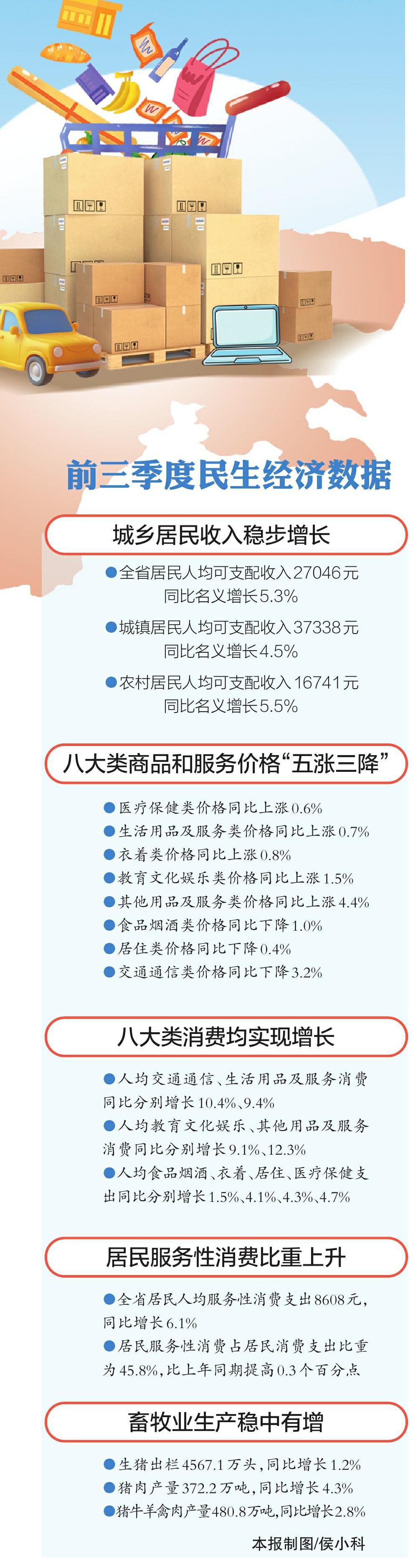
全省前三季度民生经济数据出炉 居民人均消费支出同比名义增长5.4% 消费潜力释放 服务性消费稳步增长
Si Chuan Ri Bao· 2025-10-21 00:17
Core Insights - The report highlights steady growth in urban and rural residents' disposable income in Sichuan province, with urban residents earning an average of 37,338 yuan and rural residents earning 16,741 yuan, reflecting nominal growth rates of 4.5% and 5.5% respectively [2][7] - The consumer price index (CPI) in Sichuan has shown a slight decline of 0.4% year-on-year, influenced by various factors including slow domestic consumption recovery and price competition in certain industries [3][4] - The report indicates a structural decline in prices, with service prices rising by 0.3% while consumer goods prices fell by 0.8%, highlighting a shift in consumer spending patterns [4][5] Income and Consumption - The average disposable income for residents in Sichuan reached 27,046 yuan, with a nominal increase of 5.3% year-on-year, and a real increase of 5.7% after adjusting for inflation [7] - Urban residents' average consumption expenditure was 23,690 yuan, growing by 4.7%, while rural residents' expenditure was 13,902 yuan, with a higher growth rate of 5.6% [7] - The share of service consumption in total spending has increased, with per capita service expenditure rising to 8,608 yuan, a growth of 6.1% [6][7] Price Trends - The report notes that prices for eight categories of goods and services experienced five increases and three decreases, with healthcare prices rising by 0.6% and food prices declining by 1.0% [2][4] - The core CPI in Sichuan showed a positive trend, increasing by 0.4% year-on-year, with a notable rise in September reaching a high of 0.6% [5] - Industrial producer prices (PPI) decreased by 2.8%, but there are signs of recovery in certain sectors, particularly in high-tech industries, which have seen price increases [5][6] Consumer Behavior - The report emphasizes that rural consumption growth outpaced urban consumption, indicating a significant potential in rural markets [7] - The increase in consumer spending is attributed to various government initiatives aimed at boosting consumption, including policies for replacing old consumer goods [6][7] - Notably, spending on transportation and communication services saw substantial growth, with increases of 10.4% and 9.4% respectively [6]

消费回落,生产改善
Haitong Securities International· 2025-10-20 09:00
Consumption - Post-holiday consumption has shown a slight decline, with retail and wholesale automobile sales significantly dropping compared to the previous week, indicating a temporary "vacuum" in market demand after pre-holiday promotions[6] - The wholesale price index for agricultural products increased by 0.4% month-on-month, while the price of Moutai liquor has significantly decreased, reflecting a broader trend of price adjustments in consumer goods[6] - Service consumption has returned to normal levels, with a notable decline in movie attendance and tourism prices, indicating the end of the holiday "pulse" effect[7] Investment - Infrastructure investment has seen a cumulative issuance of special bonds amounting to CNY 3.81 trillion as of October 18, with an additional CNY 133.88 billion issued in October, suggesting a supportive funding environment for infrastructure projects[17] - Real estate transactions in 30 cities have shown a seasonal rebound, with first-tier and third-tier cities experiencing a narrowing of year-on-year declines, while second-tier cities have turned positive[17] Trade and Export - Domestic export prices have decreased by 4.1% month-on-month, while import prices fell by 2.2%, indicating weak demand in non-mainline shipping routes[23] - The Shanghai and Ningbo export container price indices increased by 12.9% and 16.8% respectively, reflecting a recovery in demand for mainline shipping routes post-holiday[23] Production - Most production sectors have shown improvement post-holiday, with coal consumption in coastal provinces increasing, although steel production has seen a mixed performance with some declines in output[26] - The operating rate for asphalt has slightly increased, indicating a gradual recovery in construction activities following the holiday[17] Inventory and Prices - Coal inventories at ports have significantly decreased, while cement inventory ratios have slightly increased, reflecting varying demand across sectors[36] - Consumer prices have shown a slight overall increase, while industrial prices have generally declined, with the PPI for industrial products decreasing by 1.1% month-on-month[38] Liquidity - The central bank has conducted a net withdrawal of CNY 231.9 billion to maintain liquidity stability, with the dollar index declining by 27 basis points, indicating a stable overall liquidity environment[42]
海关总署:前三季度,我国新增了135种农食产品的准入,涉及50个国家和地区
Xin Lang Cai Jing· 2025-10-13 02:55
Core Insights - China is the world's second-largest goods import market, presenting significant opportunities for global trade [1] - In the first three quarters, the decline in prices of some major commodities affected import growth, but the quantity index of imports increased by 0.6% year-on-year [1] - Import volumes of crude oil and metal ores rose by 2.6% and 4.2% respectively, while the import value of food, tobacco, and cultural products grew by 10.2% and 9.4% [1] - The removal of foreign investment restrictions in the manufacturing sector led to a 1.1% increase in imports from foreign-invested enterprises [1] Import Growth and Market Expansion - China is actively expanding its import market, having added 135 new agricultural and food products from 50 countries and regions in the first three quarters [1] - A 100% zero-tariff policy on products from the least developed countries with which China has diplomatic relations resulted in a 9.7% increase in imports from these nations [1] - China is promoting economic partnership agreements, implementing a 100% zero-tariff policy for products from 53 African countries [1] Upcoming Events and Innovations - The 8th China International Import Expo will be held in Shanghai next month, serving as a platform for showcasing new products and facilitating entry for multinational companies into the Chinese market [1] - Innovative products, including family companion robots and advanced technology items, will debut at the expo [1] - Customs will enhance clearance measures and innovate regulatory models to help global enterprises access China's vast market [1]
国内高频指标跟踪(2025 年第 39 期):内需分化,外需偏弱
Haitong Securities International· 2025-09-29 10:12
Consumption - Automotive retail and wholesale volumes continue to rise, but year-on-year growth has marginally declined due to the low base effect from the Mid-Autumn Festival[6] - Service consumption has weakened, particularly in urban areas affected by typhoon weather, leading to a significant drop in subway ridership in first-tier cities[7] - Food and beverage prices have shown a slight recovery, with agricultural product wholesale prices increasing, but the year-on-year decline continues to widen due to high base effects from 2024[6] Investment - As of September 27, 2025, the cumulative issuance of special bonds reached CNY 3.71 trillion, with CNY 446.52 billion issued in September alone, marking the fastest issuance pace since 2020[19] - Real estate sales have seen a slight seasonal improvement, but the absolute values remain at historical lows, with new home sales in 30 cities showing a marginal year-on-year decline[19] - The asphalt construction rate has risen significantly, reaching a yearly high, while cement and steel consumption indicate slower construction progress[19] Trade and Export - Domestic export freight rates have decreased by 2.9% month-on-month, with container freight rates from Shanghai and Ningbo dropping by 7% and 8.5% respectively[27] - The manufacturing PMI readings for the US and Europe in September were 52.0 and 49.5, indicating a slight decline in overseas manufacturing activity, which may weaken demand for imports from China[27] Production and Inventory - Most industries are experiencing a decline in production, with coal consumption in coastal provinces showing a seasonal decrease[29] - Inventory levels are primarily decreasing, with significant reductions in coal inventories at ports due to increased downstream purchasing ahead of the holiday[37] Price Trends - The Consumer Price Index (CPI) has shown a slight recovery, with service prices in transportation, education, and healthcare increasing year-on-year, while clothing and housing prices have declined[42] - Industrial product prices are mixed, with the South China price index falling by 0.3% month-on-month, while cement prices increased by 2.5%[42] Liquidity - The central bank's net cash injection through reverse repos was CNY 640.6 billion last week, with an additional CNY 300 billion in medium-term lending facility (MLF) operations, totaling CNY 880.6 billion to support liquidity[44] - The US dollar index has risen significantly, reflecting a stronger US economy and impacting the USD/CNY exchange rate, which increased from 7.1125 to 7.1345[44]
生产热度回升,出口量价分化
Haitong Securities International· 2025-09-17 07:28
Consumption - Service consumption continues to decline, while durable goods consumption shows weakness[5] - Food and clothing consumption sees seasonal increases, but overall demand remains weak[5] - Movie attendance and box office revenue drop to historical lows, indicating reduced consumer interest[6] Investment - Real estate sector remains weak, with new home sales not showing sustained improvement despite policy optimizations in major cities[15] - Infrastructure investment shows marginal recovery, but overall funding remains below last year's levels[15] Trade and Export - Domestic export prices continue to decline, with a decrease of 2.1% in export freight rates, indicating a retreat from technical rush shipments[22] - Port activity increases with the upcoming Christmas stocking season, reflecting a rise in overseas demand[22] Production - Overall production heat is recovering, with significant increases in coal consumption and steel production rates[25] - The operating rate for PTA has rebounded significantly, driven by increased demand in the textile sector[27] Prices and Inflation - CPI remains stable, while PPI shows a general decline, with industrial prices mostly decreasing[37] - Cement prices have dropped by 2.0% due to weak construction demand, while copper and aluminum prices have increased by 1.4% and 1.8%, respectively[37] Liquidity - The 10-year government bond yield rises to 1.86%, the highest level in 2025, reflecting strong equity market performance and improved inflation data[39] - The overall liquidity remains stable, with a net injection of 196.1 billion yuan through reverse repos by the central bank[39] Risks - Trade uncertainties and escalating geopolitical risks pose significant threats to market stability[46]
出行火热,地产降温
Haitong Securities International· 2025-08-18 09:22
Consumption - Travel and tourism activity remains high, with significant recovery in urban and intercity population movement, reflected in increased subway ridership and flight operations[7] - Retail and wholesale volumes for automobiles have slightly declined, indicating a weakening effect of promotional activities and subsidies[7] - Movie attendance and box office revenues have significantly decreased post-summer, indicating a drop in consumer interest[7] Investment - New special bonds issued reached CNY 3.08 trillion as of August 16, with a recent acceleration in issuance[20] - Real estate transaction volumes remain subdued, with new home sales in 30 cities showing a slight recovery but still down year-on-year[20] - Construction activity is marginally improving, with asphalt operating rates increasing and cement shipment rates recovering seasonally[20] Trade and Prices - Import and export volumes are showing divergence, with a 11.1% decline in imports from China to South Korea and a 4.3% drop in global exports[26] - Domestic export freight rates have decreased for seven consecutive weeks, reflecting a retreat from previous shipping surges due to tariff concerns[26] - The Producer Price Index (PPI) remains flat overall, with industrial prices showing little change except for a notable 15% increase in lithium carbonate prices[44] Liquidity - The 10-year government bond yield rose by 5.7 basis points to 1.75%, indicating a tightening liquidity environment[47] - The US dollar index fell by 42 basis points, influenced by moderate inflation data from July, which strengthened expectations for a potential interest rate cut in September[47]
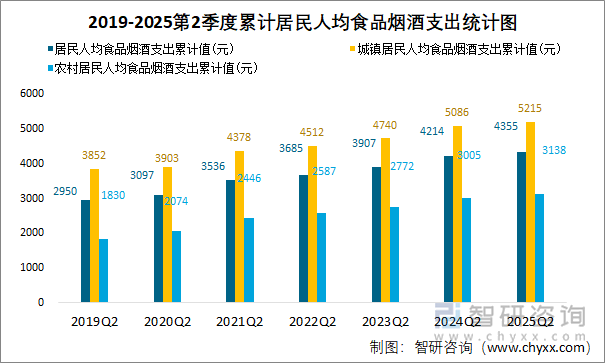
2025第2季度居民人均食品烟酒支出累计为4355元,累计增长3.3%
Chan Ye Xin Xi Wang· 2025-08-13 03:17
Group 1 - The total per capita expenditure on food, tobacco, and alcohol for residents nationwide in Q2 2025 reached 4355 yuan, reflecting a cumulative growth of 3.3% [1] - The per capita expenditure for urban residents on food, tobacco, and alcohol accumulated to 5215 yuan, with a cumulative growth of 2.5% [1] - The per capita expenditure for rural residents on food, tobacco, and alcohol amounted to 3138 yuan, showing a cumulative growth of 4.4% [1]