
光伏行业

Search documents
“反内卷”加码扩围,低通胀何时改善?
Tebon Securities· 2025-07-18 09:41
Group 1: Current Inflation Status - The CPI in June 2025 increased by only 0.1% year-on-year, significantly below the 2% inflation target[3] - The PPI in June 2025 dropped to -3.6%, marking the lowest level in the year and continuing a negative trend for 33 consecutive months[3][19] - Key factors contributing to low CPI include weak performance in food and energy prices, underestimating the impact of "de-real estate," and weak demand for durable goods and services[3][15][18] Group 2: Policy Implications and Future Outlook - The "anti-involution" policy is expected to have a weaker impact on inflation compared to "capacity reduction" policies, as it focuses on market mechanisms rather than administrative measures[3][26] - CPI recovery to above 2% is anticipated to be slow due to ample supply and underappreciated real estate factors[3][29] - PPI is projected to turn positive by Q2 2026, with a forecasted year-end PPI of -1.3% in 2025[3][29] Group 3: Risks and Market Dynamics - Risks include unexpected downturns in the real estate market and insufficient policy effectiveness[3][29] - The relationship between PPI and commodity prices is crucial, with coal, rebar, lithium carbonate, copper, pork, and crude oil being significant influencers[3][20][22] - Recent commodity price trends show a decline in coal and rebar prices, while copper has shown signs of recovery[3][22]
大摩闭门会-供给侧改革反内卷,是新瓶装旧酒吗?- 纪要
2025-07-15 01:58
Summary of Key Points from Conference Call Industry and Company Involved - The conference call primarily discusses the **Chinese economy** and the **supply-side reform** initiatives, particularly focusing on the **steel**, **cement**, and **photovoltaic glass** industries. Core Insights and Arguments 1. **Impact of Tariffs on U.S. Economy**: Despite the U.S. imposing tariffs on multiple countries, the market's reaction has been muted. However, the long-term effects on U.S. corporate profits and inflation are expected to be significant post-Q3 2023, necessitating vigilance from companies regarding potential risks [1][3][21]. 2. **Differences in Supply-Side Reform 2.0**: The current supply-side reform differs from the 2015-2018 reforms in its broader scope, complexity due to international factors, and emphasis on institutional adjustments for long-term stability [1][4][5][17]. 3. **Economic Performance in H1 2025**: China's economy showed resilience with a GDP growth exceeding 5%, driven by export activities and policy support. However, challenges are anticipated in H2 2025 due to supply-demand imbalances and deepening deflation [1][8][9]. 4. **Sector-Specific Production Cuts**: The steel industry plans to cut production by approximately 30 million tons, while the cement industry has a reduction plan set to begin in November 2024. The coal industry is unlikely to be involved in this round of reforms due to electricity safety concerns [1][10][11][12]. 5. **Challenges in the Photovoltaic Industry**: The photovoltaic glass sector is currently facing losses, with leading companies beginning to reduce production. The industry struggles with low concentration and weak demand, making comprehensive supply-side reform a lengthy process [1][13][30][31]. 6. **External Demand Pressures**: China faces external demand pressures from high tariffs, potential declines in exports to the U.S., and a global trade cycle downturn, which could impact economic growth and inflation [1][18][19]. 7. **Stock Market Outlook**: The Chinese stock market has entered a volatile phase since June, with recommendations to focus on A-shares while maintaining caution towards Hong Kong stocks. The long-term impact of supply-side reforms is expected to be positive for the overall stock market [2][20][25][27][28]. 8. **Future Economic Predictions**: The macroeconomic outlook for 2025 and 2026 suggests a potential deflationary environment, but successful supply-side reforms could lead to upward risks in economic growth [1][29]. Other Important but Possibly Overlooked Content 1. **Institutional Adjustments Needed**: The current reform emphasizes the need for institutional changes, including local government fiscal systems and social security frameworks, to achieve sustainable development [1][5][36]. 2. **Market Reaction to Policy Changes**: The market's response to new tariff policies has been characterized by investor fatigue, indicating a desire for clarity and stability in trade relations [1][22]. 3. **Long-Term Investment Strategies**: The call suggests a cautious approach to investments in the short term, with a focus on individual A-share opportunities, while the overall market is expected to improve in terms of investment returns over the next 6 to 12 months [1][24][28].
棒杰股份:预计2025年上半年净利润亏损1.2亿元-1.8亿元
news flash· 2025-07-14 10:10
棒杰股份(002634)公告,预计2025年1月1日至2025年6月30日期间,归属于上市公司股东的净利润为 亏损1.2亿元至1.8亿元,扣除非经常性损益后的净利润为亏损8800万元至1.48亿元,基本每股收益为亏 损0.26元/股至0.39元/股。公司表示,亏损主要原因是光伏板块子公司债务压力及停产影响,以及公司 对因供应商、金融机构等债务逾期的违约责任计提了预计损失。 ...

2025年6月物价数据点评:6月菜价、油价上涨推动CPI同比转正,PPI同比降幅有所扩大
Dong Fang Jin Cheng· 2025-07-09 06:50
Group 1: CPI Analysis - In June 2025, the CPI increased by 0.1% year-on-year, reversing from a decline of 0.1% in May, with a cumulative year-on-year decline of 0.1% for the first half of the year[1][2] - The main drivers for the CPI increase were a significant narrowing of the year-on-year decline in vegetable prices and a rise in domestic energy prices due to international crude oil price increases[2][3] - The core CPI, excluding volatile food and energy prices, showed a cumulative year-on-year increase of 0.4%, indicating a weak overall price level[3][6] Group 2: PPI Analysis - In June 2025, the PPI decreased by 3.6% year-on-year, widening from a decline of 3.3% in May, with a cumulative year-on-year decline of 2.8% for the first half of the year[1][2][8] - The PPI decline was primarily influenced by weak domestic demand and oversupply, leading to accelerated price declines in coal, steel, and cement[2][9] - The PPI's month-on-month decline remained at 0.4%, consistent with the previous month, marking four consecutive months of such a decline[8][10] Group 3: Future Outlook - The report anticipates that the CPI may return to negative territory in July, likely around -0.2%, due to external economic pressures and high base effects from the previous year[7][12] - The PPI is expected to continue its month-on-month decline in July, but the rate of decline may slightly narrow, with a year-on-year decline projected to remain around -3.6%[12]
交银国际每日晨报-20250709
BOCOM International· 2025-07-09 03:51
Group 1: Company Overview - The report highlights that the company, Aisuo Co., Ltd. (爱旭股份), has received approval for a private placement of funds, which is expected to alleviate its financial pressure significantly [1] - The company's asset-liability ratio reached 86.0% in Q1 2025, and the estimated fundraising of 3.5 billion RMB is projected to reduce this ratio by 9.6 percentage points [1] - Following a 40% increase in stock price since the rating upgrade on April 30, the report suggests that the current valuation is no longer attractive, leading to a downgrade to a neutral rating [1] Group 2: Market Performance - The report anticipates that over 40% of the company's ABC components will be sold in higher-priced overseas markets in Q2, which is expected to significantly reduce losses for the quarter [1] - Recent statements from central government officials emphasize the orderly exit of outdated production capacity, indicating a potential turning point for the photovoltaic supply side [1] Group 3: Stock and Valuation - The closing price of Aisuo Co., Ltd. is reported at 14.63 RMB, with a target price raised to 16.50 RMB, indicating a potential upside of 12.8% [1] - The report notes that further valuation improvement is contingent upon the implementation of substantial policies [1]

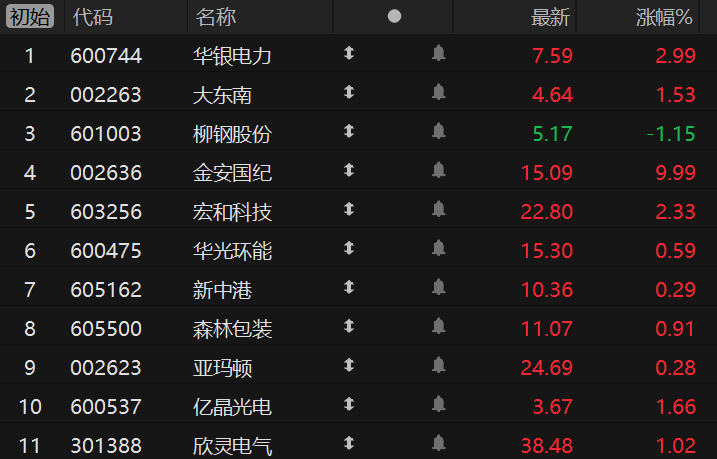
竞价看龙头:金安国纪一字涨停晋级5连板
news flash· 2025-07-09 01:28
Group 1 - The market focus is on leading stocks, with Huayin Power experiencing a 2.99% increase and achieving 5 consecutive trading days of gains [1][2] - Solid-state battery concept stock Dadongnan has seen a 1.53% rise, marking 7 gains in 11 days [1][2] - The PCB sector's Jin'an Guoji has reached a trading limit increase of 9.99%, marking its 4th consecutive gain [1][2] Group 2 - Steel stock Liugang shares opened lower with a 1.15% decrease, despite having 5 gains in 6 days [1][2] - Other notable stocks include Honghe Technology with a 2.33% increase and 4 gains in 6 days, and Huaguang Huaneng with a 0.59% rise and 4 gains in 4 days [1][2] - The packaging and printing sector's Senlin Packaging opened with a 0.91% increase, while the photovoltaic sector's Yamaton and Yijing Optoelectronics saw minor increases of 0.28% and 1.66% respectively [1][2]


“ISSB 可持续披露准则先学伙伴”成都研讨会——暨第三届零碳协同创新大会成功举办
Jing Ji Guan Cha Bao· 2025-07-08 09:42
Core Insights - The conference focused on "Zero Carbon Collaborative Innovation Empowering Global Sustainability," highlighting the importance of sustainable practices and the role of ISSB standards in integrating sustainability into financial reporting [1][2]. Group 1: ISSB Standards and Sustainable Development - Zhang Zhengwei, a senior advisor to ISSB, emphasized the shift from non-financial to integrated financial reporting, which will embed sustainability into core business value creation [2]. - Ndidi Nnoli-Edozien discussed the significance of multi-stakeholder collaboration in advancing global sustainability, with China's involvement being crucial for developing impactful global standards [5]. Group 2: Industry Contributions to Sustainability - Tinci Lithium's Vice President Zou Jun outlined the lithium industry's role in achieving net-zero goals through technological innovation and sustainable financial tools, aiming for a 2030 emission reduction target [3]. - Zhang Guohao from China Southwest Construction shared a new model for integrated low-carbon building renovation services, addressing the disconnect in financing, design, construction, and operation phases [4]. Group 3: Collaborative Initiatives and Agreements - The "Xinglong Lake Sustainable Consensus" was signed by multiple organizations, promoting zero-carbon technology innovation and ecological construction in the Xinglong Lake area [8]. - The "Supply Chain ESG Management Initiative" expanded to include four new companies, enhancing its influence and supporting the establishment of ESG assessment standards in supply chains [9]. Group 4: Discussions on ESG and Climate Action - A roundtable discussion highlighted the importance of standardization in ESG disclosures and the integration of carbon management across enterprises and cities, which is vital for global zero-carbon transitions [10][11]. - The role of ISSB standards in reshaping global value chains was discussed, emphasizing their function in enhancing corporate governance and competitive advantage through sustainable practices [12].
破内卷困局,离不开扩内需支撑
China Post Securities· 2025-07-08 02:57
Group 1: Economic Policy and Trends - The central government is reinforcing "anti-involution" policies to address low nominal economic growth and persistent negative PPI, focusing on eliminating low-price competition and overcapacity[1] - The manufacturing sector's capacity utilization rate was 74.10% at the end of Q1 2025, significantly below the historical average of 7.1% since 2018[16] - The PPI growth rate for coal mining and washing, general equipment, specialized equipment, automotive, and pharmaceuticals is at historically low levels, indicating potential "involution" issues in these sectors[17] Group 2: Industry Impact and Investment Opportunities - Key industries identified for "anti-involution" measures include coal mining, chemical raw materials, non-metallic minerals, and automotive manufacturing, which are expected to undergo significant policy scrutiny[17] - Recent price recovery in coal, rebar, and polysilicon suggests that the market has priced in expectations of "anti-involution" policies, presenting potential investment opportunities if policies align with market expectations[28] - If "anti-involution" policies fall short, there is a risk of price corrections in these industries, necessitating caution for investors[28] Group 3: Risks and Economic Challenges - The report highlights external uncertainties, including global trade tensions and geopolitical conflicts, which could exacerbate economic challenges[4] - The need for coordinated demand expansion policies alongside supply-side reforms is emphasized to mitigate potential structural pain in industrial production and employment[27] - The real estate sector is undergoing significant adjustments, impacting overall investment momentum and economic growth prospects[27]
两个“跌停”后长龄液压继续停牌 上市以来净利润连续4年下跌
Zheng Quan Shi Bao Wang· 2025-07-07 13:35
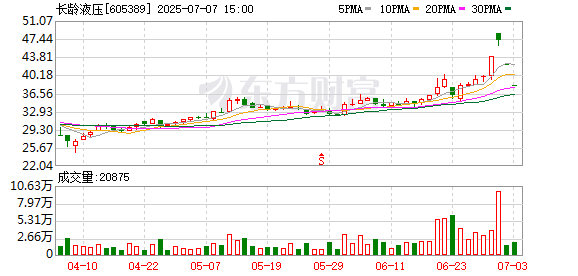
Core Viewpoint - The company, Changling Hydraulic, is undergoing a potential change in control, leading to a suspension of its stock trading for an estimated period of no more than three trading days [2]. Group 1: Stock Suspension and Control Change - Changling Hydraulic announced that its stock will continue to be suspended from trading starting July 8, due to ongoing discussions regarding a significant matter that may result in a change of control [2]. - The company's major shareholders, Xia Jifa and Xia Zemin, are currently negotiating key terms of the transaction with the involved parties, which requires internal approval processes [2]. Group 2: Historical Context and Previous Suspensions - The company was listed on the Shanghai Stock Exchange on March 22, 2021, with a three-year lock-up period for its controlling shareholders, which will expire on March 22, 2024 [3]. - In January 2023, the company also suspended trading due to a similar situation regarding a potential change in control, which was later terminated due to disagreements on core terms with the transaction party [3]. Group 3: Financial Performance - For the year 2024, Changling Hydraulic reported a revenue of 883 million yuan, representing a year-on-year increase of 9.75%, while the net profit attributable to shareholders decreased by 6.84% to approximately 94.73 million yuan [4]. - This marks the fourth consecutive year of declining net profit since the company went public, contrasting with a steady increase in net profit from 2017 to 2020 [4].

《特殊商品》日报-20250707
Guang Fa Qi Huo· 2025-07-07 06:37
1. Natural Rubber Industry 1.1 Investment Rating No investment rating is provided in the report. 1.2 Core View Short - term macro - warming and state reserve purchase news boost rubber prices, but under the expectation of increasing supply and weakening demand, rubber prices are expected to remain weak. Hold short positions above 14,000 and pay attention to raw material supply in each producing area and macro events [2]. 1.3 Summary by Directory - **Spot Price and Basis**: On July 4th, the price of Yunnan state - owned whole - miscible rubber (SCRWF) in Shanghai was 14,050 yuan/ton, up 100 yuan or 0.72% from the previous day. The basis of whole - milk rubber (switched to the 2509 contract) increased by 110, with a growth rate of 169.23%. The price of Thai standard mixed rubber decreased by 50 yuan/ton, a decline of 0.36% [2]. - **Monthly Spread**: The 9 - 1 spread remained unchanged at - 865 yuan/ton; the 1 - 5 spread decreased by 10 yuan/ton, a decline of 14.29%; the 5 - 9 spread increased by 10 yuan/ton, a growth rate of 1.07% [2]. - **Fundamental Data**: In May, Thailand's production increased by 166,500 tons to 272,200 tons, a growth rate of 157.52%; Indonesia's production increased by 6,200 tons to 200,300 tons, a growth rate of 3.19%; India's production increased by 2,300 tons to 47,700 tons, a growth rate of 5.07%; China's production increased by 38,900 tons to 97,000 tons. The weekly开工 rate of semi - steel tires decreased by 7.64 percentage points to 70.41%, and that of all - steel tires decreased by 1.89 percentage points to 63.75%. In May, domestic tire production decreased slightly, while tire exports increased by 7.72%. The total import volume of natural rubber decreased by 13.35% [2]. 2. Log Industry 2.1 Investment Rating No investment rating is provided in the report. 2.2 Core View From a fundamental perspective, the demand for logs enters the off - season during the high - temperature and rainy season from June to August. The arrival volume remains low, and the shipment volume from New Zealand is expected to decrease seasonally. The market is gradually entering a pattern of weak supply and demand. The 09 contract is expected to fluctuate weakly in the short term, but recent positive news has boosted market sentiment [5]. 2.3 Summary by Directory - **Futures and Spot Prices**: On July 4th, the 2509 log contract closed at 795 yuan/cubic meter, up 2.5 yuan/cubic meter from the previous day. The prices of major deliverable spot products remained unchanged. The price of medium - sized A - grade radiata pine in Shandong was 750 yuan/cubic meter, and that in Jiangsu was 760 yuan/cubic meter [5]. - **Supply**: In May, the port shipment volume increased by 228,000 cubic meters to 1.955 million cubic meters, a growth rate of 13.20%. The number of ships from New Zealand to China, Japan, and South Korea decreased by 5 to 58, a decline of 7.94% [5]. - **Inventory**: As of June 27th, the national total inventory of coniferous logs was 3.36 million cubic meters, a slight increase from the previous week. The daily average log shipment volume was 65,700 cubic meters, an increase of 21,000 cubic meters from the previous week [5]. 3. Glass and Soda Ash Industry 3.1 Investment Rating No investment rating is provided in the report. 3.2 Core View For soda ash, although the recent policy has boosted the market sentiment, the supply - demand pattern is still in excess. In the long - term, there will be a further profit - reduction process. For glass, the market sentiment has improved recently, but the industry still needs capacity clearance to reverse the situation. In the short term, both are affected by market sentiment, with large price fluctuations [6]. 3.3 Summary by Directory - **Glass - related Prices and Spreads**: The prices of glass in North China, East China, Central China, and South China remained unchanged. The glass 2505 contract increased by 4 yuan/ton, a growth rate of 0.34%, while the 2509 contract decreased by 13 yuan/ton, a decline of 1.25% [6]. - **Soda Ash - related Prices and Spreads**: The prices of soda ash in North China, East China, Central China, and Northwest China remained unchanged. The soda ash 2505 contract increased by 1 yuan/ton, a growth rate of 0.08%, and the 2509 contract decreased by 9 yuan/ton, a decline of 0.73% [6]. - **Supply and Demand**: The soda ash production rate decreased by 1.08 percentage points to 82.21%, and the weekly production decreased by 0.8 tons to 709,000 tons. The daily melting volume of float glass increased by 0.1 tons to 15,780 tons, and the daily melting volume of photovoltaic glass decreased by 4,020 tons to 94,390 tons [6]. - **Inventory**: The glass factory inventory increased slightly, while the soda ash factory inventory increased by 5 tons to 278,000 tons, and the soda ash delivery warehouse inventory decreased by 5 tons to 228,000 tons [6]. 4. Industrial Silicon Industry 4.1 Investment Rating No investment rating is provided in the report. 4.2 Core View In the short term, the price of industrial silicon is expected to fluctuate strongly due to production cuts. In the long term, the increase in production after resumption will intensify the pressure of oversupply. Attention should be paid to the production - cut plans of polysilicon and the impact of coking coal prices. In the context of anti - involution policies, the arbitrage strategy of buying polysilicon and short - selling industrial silicon is favorable [8]. 4.3 Summary by Directory - **Spot Price and Main Contract Basis**: On July 4th, the price of East China oxygen - passing S15530 industrial silicon was 8,750 yuan/ton, up 50 yuan or 0.57% from the previous day. The basis of oxygen - passing SI5530 increased by 80 yuan, a growth rate of 11.59% [8]. - **Monthly Spread**: The 2507 - 2508 spread increased by 15 yuan/ton, a growth rate of 18.75%; the 2508 - 2509 spread increased by 5 yuan/ton; the 2509 - 2510 spread decreased by 10 yuan/ton, a decline of 25% [8]. - **Fundamental Data**: In June, the national industrial silicon production increased by 20,000 tons to 327,700 tons, a growth rate of 6.5%. The production of polysilicon increased by 4,900 tons to 101,000 tons, a growth rate of 5.1%. The production of organic silicon DMC increased by 25,300 tons to 209,300 tons, a growth rate of 13.75% [8]. - **Inventory Change**: The factory inventory in Xinjiang decreased by 22,800 tons to 150,100 tons, a decline of 13.19%. The social inventory increased by 10,000 tons to 552,000 tons, a growth rate of 1.85% [8]. 5. Polysilicon Industry 5.1 Investment Rating No investment rating is provided in the report. 5.2 Core View In the short term, the polysilicon futures market fluctuates greatly under the background of weak reality and strong expectation. The current supply increases while the demand decreases, and the price is still under pressure. However, policy expectations have a great impact on the market, and prices are expected to rise in the long term. Attention should be paid to risk management [9]. 5.3 Summary by Directory - **Spot Price and Basis**: The average prices of N - type re -投料, P - type cauliflower - like material, and N - type granular silicon remained unchanged. The basis of N - type material decreased by 460 yuan/ton, a decline of 48.42%; the basis of cauliflower - like material decreased by 460 yuan/ton, a decline of 7.13% [9]. - **Futures Price and Monthly Spread**: The PS2506 contract increased by 460 yuan/ton, a growth rate of 1.31%. The spreads between different contracts showed different degrees of change [9]. - **Fundamental Data**: The weekly production of silicon wafers decreased by 15,400 GW to 11,900 GW, a decline of 11.46%. The weekly production of polysilicon increased by 400 tons to 24,000 tons, a growth rate of 1.69%. In June, the production of polysilicon increased by 4,900 tons to 101,000 tons, a growth rate of 5.1% [9]. - **Inventory Change**: The polysilicon inventory increased by 200 tons to 27,200 tons, a growth rate of 0.74%. The silicon wafer inventory decreased by 890 GW to 19,220 GW, a decline of 4.43% [9].