
房地产

Search documents
国家统计局:2026年1月份非制造业PMI为49.4%,比上月下降0.8个百分点
Guo Jia Tong Ji Ju· 2026-01-31 01:39
Group 1 - The non-manufacturing business activity index for January is 49.4%, a decrease of 0.8 percentage points from the previous month [1] - The construction business activity index is at 48.8%, down by 4.0 percentage points compared to last month [1] - The services business activity index stands at 49.5%, which is a decline of 0.2 percentage points from the previous month [1] Group 2 - In the services sector, industries such as monetary financial services, capital market services, and insurance have business activity indices above 65.0% [1] - Conversely, industries like wholesale, accommodation, and real estate have business activity indices below the critical point [1]
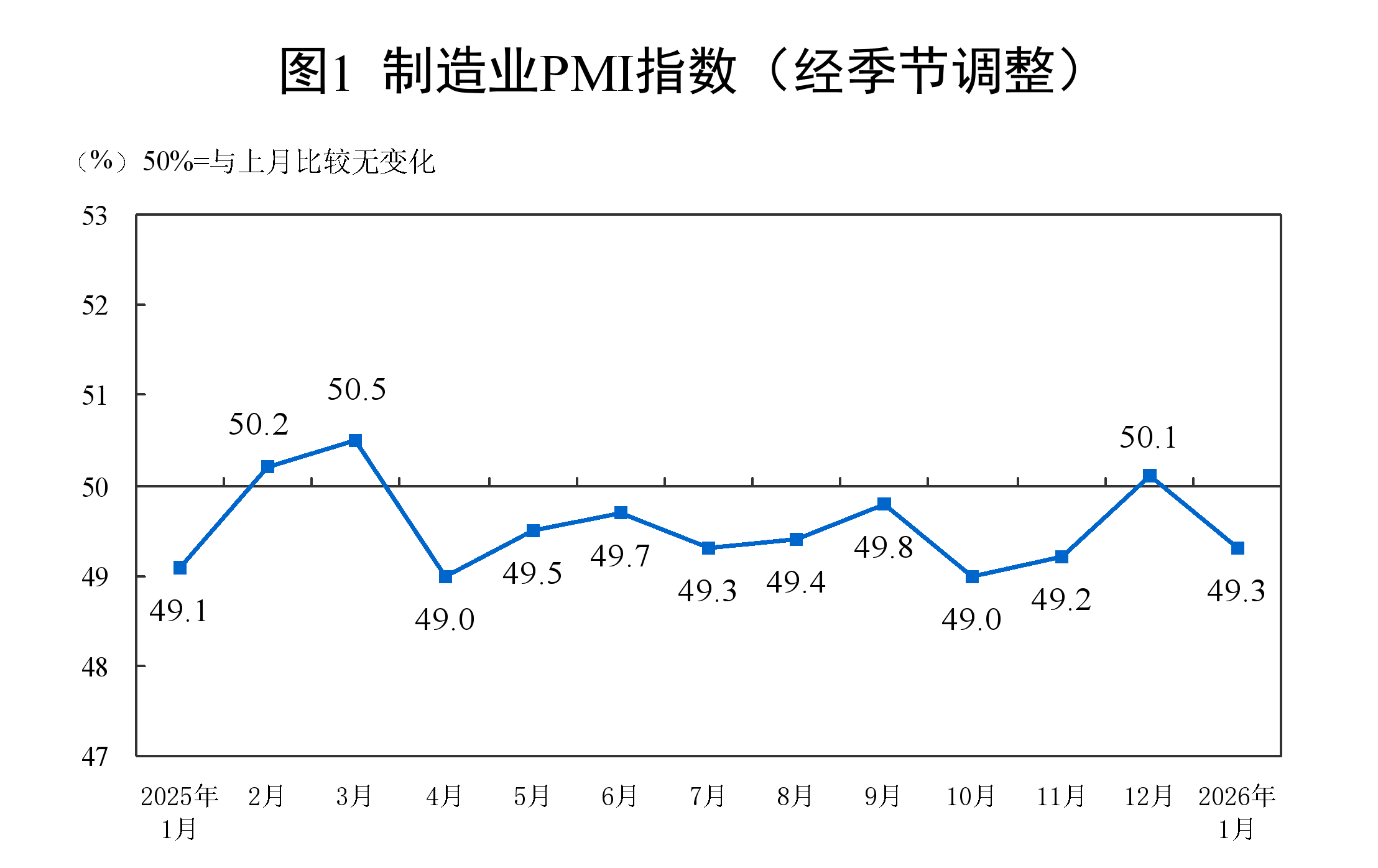
2026年1月中国采购经理指数运行情况
Guo Jia Tong Ji Ju· 2026-01-31 01:32
Group 1: Manufacturing PMI Overview - The manufacturing Purchasing Managers' Index (PMI) for January is 49.3%, a decrease of 0.8 percentage points from the previous month, indicating a decline in manufacturing activity [1] - Large enterprises have a PMI of 50.3%, down 0.5 percentage points, while medium and small enterprises have PMIs of 48.7% and 47.4%, down 1.1 and 1.2 percentage points respectively, both below the critical point [4] - The production index is at 50.6%, down 1.1 percentage points but still above the critical point, suggesting continued expansion in manufacturing production [4] Group 2: Manufacturing Demand and Supply Indicators - The new orders index is at 49.2%, a decline of 1.6 percentage points, indicating a slowdown in market demand for manufacturing [5] - The raw materials inventory index is at 47.4%, down 0.4 percentage points, showing a continued decrease in the inventory of major raw materials [6] - The employment index is at 48.1%, down 0.1 percentage points, indicating a slight decline in employment conditions within manufacturing [7] - The supplier delivery time index is at 50.1%, down 0.1 percentage points but still above the critical point, indicating that supplier delivery times are continuing to accelerate [8] Group 3: Non-Manufacturing PMI Overview - The non-manufacturing business activity index for January is 49.4%, a decrease of 0.8 percentage points from the previous month [12] - The construction business activity index is at 48.8%, down 4.0 percentage points, while the service industry index is at 49.5%, down 0.2 percentage points [14] Group 4: Non-Manufacturing Demand and Price Indicators - The new orders index for non-manufacturing is at 46.1%, a decline of 1.2 percentage points, indicating a decrease in market demand [18] - The input price index is at 50.0%, down 0.2 percentage points, indicating stable input prices for non-manufacturing activities [18] - The sales price index is at 48.8%, an increase of 0.8 percentage points, suggesting a narrowing decline in overall sales prices [18] Group 5: Employment and Expectations in Non-Manufacturing - The employment index for non-manufacturing is at 46.1%, remaining stable compared to the previous month [20] - The business activity expectation index is at 56.0%, down 0.5 percentage points but still indicating optimism among non-manufacturing enterprises [20] Group 6: Comprehensive PMI Overview - The comprehensive PMI output index for January is 49.8%, a decrease of 0.9 percentage points, indicating a slowdown in overall production and business activities compared to the previous month [23]

2026年河南住房城乡建设领域“路线图”敲定 让城乡增品质提气质
He Nan Ri Bao· 2026-01-30 23:11
Core Insights - The provincial housing and urban-rural construction work conference in Zhengzhou outlined the achievements in the housing sector for 2025 and established a roadmap for 2026, focusing on nine key areas to promote high-quality transformation and development in housing and urban-rural construction [1] Group 1: Achievements and Goals - In 2025, the province achieved significant results, including the renovation of 246,000 old residential units, the construction of 390 "pocket parks," and the installation of 29,000 public charging stations, exceeding the provincial key livelihood project targets [1] - The province aims to implement urban renewal vigorously, enhance urban governance, promote high-quality real estate development, and accelerate the upgrading of the construction industry [1] Group 2: Urban Renewal Initiatives - The province will focus on five key projects to advance urban renewal, including improving regulatory policies, enhancing coordination mechanisms, and exploring diversified financing models [2] - Plans include renovating over 2,000 old elevators, constructing or upgrading 500 kilometers of urban roads, and building 15,000 public charging stations and 100 "pocket parks" [2] Group 3: Real Estate Market Stabilization - The province aims to stabilize the real estate market by promoting "selling old to buy new" initiatives and utilizing funds for the acquisition of existing residential properties for affordable housing [2] - Efforts will include increasing the construction of affordable housing through new builds, renovations, and stock conversions, as well as improving housing quality standards [2] Group 4: Construction Industry Upgrades - The province will continue to regulate the construction market and promote new construction methods while deepening reforms in key areas such as integrated urban water supply and drainage [3] - Reforms will also include expanding the scope of housing provident fund withdrawals and loans, particularly for flexible employment and new labor forms [3]
上海豫园旅游商城(集团)股份有限公司 2025年年度业绩预告
Zheng Quan Ri Bao· 2026-01-30 22:42
Core Viewpoint - The company, Shanghai Yuyuan Tourist Mart (Group) Co., Ltd., is forecasting a significant net loss for the year 2025, with expected net profit attributable to shareholders of approximately -480 million yuan, indicating a downturn compared to the previous year's performance [2][4]. Group 1: Performance Forecast - The performance forecast period is from January 1, 2025, to December 31, 2025 [3]. - The company anticipates a net profit attributable to shareholders of approximately -480 million yuan for 2025, with a net profit excluding non-operating gains and losses expected to be around -470 million yuan [4][5]. Group 2: Previous Year Performance - In the same period last year, the total profit was 31.61 million yuan, with a net profit attributable to shareholders of 12.53 million yuan, and a net profit excluding non-recurring gains and losses of -210.89 million yuan [6]. Group 3: Reasons for Expected Loss - The expected loss is primarily due to asset impairment tests conducted on real estate projects and goodwill, leading to provisions for asset impairment [8]. - The ongoing downturn in the real estate sector has prompted the company to optimize sales strategies, resulting in a decrease in actual sales prices and gross margins [8]. - Structural changes in the consumption sector, influenced by macroeconomic pressures and significant price fluctuations, have negatively impacted revenue and gross profit [8]. Group 4: Strategic Focus - The company is committed to its "Eastern Lifestyle Aesthetics" strategy, focusing on reducing debt, optimizing financial structure, and concentrating on high-potential core industries [9]. - The company aims to enhance product capabilities through refined operations, cultural empowerment, and global business expansion, thereby promoting business growth and long-term value for shareholders [9].

第四代住房或将问世:或能实现人人买得起房,满足你对庭院生活的期望
Sou Hu Cai Jing· 2026-01-30 20:08
Core Viewpoint - The emergence of the "fourth generation housing" concept reflects a shift in housing needs and preferences, aiming to provide affordable living options with better quality of life, particularly for ordinary workers [4][5][10]. Group 1: Evolution of Housing - The first generation of housing in China consisted of shared living spaces like tube buildings, which evolved into the second generation of commodity housing in the 1990s, featuring private kitchens and bathrooms [1]. - The third generation introduced high-rise apartments and luxury homes, leading to skyrocketing prices, making homeownership unattainable for many [3][4]. - The fourth generation of housing aims to combine affordability with quality living, featuring low-density designs and private gardens, making it distinct from traditional high-end villas [4][5]. Group 2: Market Trends and Pricing - In 2024, new housing projects in cities like Beijing are priced between 10,000 to 15,000 yuan per square meter, significantly lower than the 40,000 to 60,000 yuan per square meter in central areas [6]. - A project in Jiangsu's Nantong offers homes with private yards at around 3,500 yuan per square meter, showcasing the cost advantages of this new housing model [8]. Group 3: Demographic Shifts and Demand - There is a notable demographic shift as younger populations are moving away from first-tier cities due to high living costs, seeking better living conditions in lower-tier cities or suburbs [9][10]. - Approximately 300 million people live in urban areas in China, with nearly 100 million residing in high-rise buildings, indicating a substantial potential market for fourth generation housing [9]. Group 4: Challenges and Future Outlook - The concept of fourth generation housing faces challenges such as public perception, policy support, and market acceptance, as traditional preferences lean towards high-rise living [15]. - Successful pilot projects and government encouragement for low-density, high-quality community development may pave the way for broader acceptance and implementation of this housing model in the next 5 to 10 years [16].

办好民生实事 筑牢幸福根基
Xin Lang Cai Jing· 2026-01-30 19:41
Group 1: Healthcare and Medical Services - The government emphasizes that over 70% of fiscal spending in the region is allocated to public welfare, with a focus on improving healthcare access and quality [1] - The establishment of a tightly-knit medical community aims to ensure that minor illnesses can be treated locally, while serious conditions are adequately managed, with a projected increase in outpatient visits to 80,000 by 2025, representing a 26.32% growth from 2024 [1] - Recommendations include enhancing the collaboration between military and civilian healthcare systems, optimizing the hierarchical diagnosis and treatment system, and establishing a unified quality control standard for healthcare services [2] Group 2: Employment and Economic Development - The development of new industries such as specialty planting, cultural tourism, and rural e-commerce has created numerous job opportunities for local residents [2] - Collaborative efforts between local employment services and regional human resources departments have led to successful job fairs and skill training initiatives, enhancing employment prospects for the community [2] Group 3: Safety and Regulation - The rise in electric bicycle usage has prompted calls for improved insurance processes and regulations to ensure safety for users [3] - Recommendations include creating a standardized insurance guide for electric bicycles, enhancing consumer awareness, and ensuring that insurance products are tailored to various usage scenarios [3] Group 4: Noise Pollution and Residential Standards - The need for stricter noise control measures in residential buildings has been highlighted, with suggestions for mandatory sound insulation standards and better regulatory oversight during construction [4] - Proposals include establishing a dedicated noise complaint channel and promoting community awareness to mitigate noise disturbances [4]
中国武夷(000797.SZ):预计2025年净亏损3.5亿元—4.55亿元
Ge Long Hui A P P· 2026-01-30 16:19
Core Viewpoint - China Wuyi (000797.SZ) is forecasting a significant net loss for the fiscal year 2025, indicating a challenging financial outlook compared to the previous year [1] Financial Performance - The company expects a net loss attributable to shareholders of between 350 million yuan and 455 million yuan, contrasting with a profit of 25.03 million yuan in the same period last year [1] - The net profit after deducting non-recurring gains and losses is projected to be a loss of 355 million yuan to 460 million yuan, compared to a profit of 9.41 million yuan in the previous year [1] Business Strategy - The company is dynamically adjusting its real estate business operations and sales strategies based on market conditions, aiming to accelerate the reduction of inventory products [1] - A decline in sales prices for certain projects has led to a decrease in project gross profit margins [1] - The company is making provisions for impairment based on the market conditions and actual sales performance of projects, adhering to a principle of prudence [1]

万科A:股价波动受诸多因素影响
Zheng Quan Ri Bao Wang· 2026-01-30 15:30
证券日报网讯1月30日,万科A在互动平台回答投资者提问时表示,股价波动受诸多因素影响,当前监 管对于停牌有明确的规定,可以查阅相关规则。 ...

豫园股份预告2025年业绩亏损,对房地产项目等计提资产减值准备
Xin Lang Cai Jing· 2026-01-30 14:33
Core Viewpoint - Yuyuan Group (豫园股份) is expected to report a net loss of approximately 4.8 billion yuan for the year 2025, marking its first loss since going public, primarily due to challenges in the real estate sector and structural changes in consumer spending [1][2]. Group 1: Financial Performance - The company anticipates a net loss attributable to shareholders of around 4.8 billion yuan for 2025, with a loss of approximately 4.7 billion yuan when excluding non-operating gains and losses [1]. - The expected losses are attributed to three main factors: asset impairment testing leading to provisions for real estate projects and goodwill, a decline in sales prices and gross margins due to ongoing adjustments in the real estate market, and structural changes in consumer spending caused by macroeconomic pressures [1]. Group 2: Industry Context - The challenges faced by Yuyuan Group reflect broader difficulties experienced by traditional enterprises in China during a period of economic transition [2]. - The real estate sector's deep adjustment is a significant contributor to the company's performance pressures, alongside various internal and external factors affecting consumer spending [2]. Group 3: Strategic Response - Yuyuan Group is committed to its "Eastern Aesthetic Life" strategy, focusing on reducing debt, optimizing financial structure, and concentrating on high-potential core industries [2]. - The company plans to enhance operational efficiency, strengthen its supply chain, and expand its global business footprint to drive growth and solidify long-term value for shareholders [2]. Group 4: Share Buyback Progress - As of January 30, 2026, Yuyuan Group has repurchased 10,800,000 shares, representing approximately 0.27746% of its total share capital, with a total expenditure of about 57.41 million yuan [3]. - The share buyback program aims to utilize a total fund of no less than 200 million yuan and no more than 300 million yuan [3].
股指期货将震荡整理白银、铜、铝、锡期货价格再创历史,新高,黄金、白银、铜、铝、镍、锡期货将偏弱宽幅震荡,原油、燃料油期货将偏强宽幅震荡,焦煤期货将震荡偏强
Guo Tai Jun An Qi Huo· 2026-01-30 13:57
1. Report Industry Investment Rating No relevant information provided. 2. Core Viewpoints of the Report - Through macro - fundamental and technical analyses, the report predicts the trends of various futures contracts on January 30, 2026, and the overall trends of futures main (continuous) contracts in January 2026 [2][3]. 3. Summary by Related Catalogs 3.1 Futures Market Outlook - **January 30, 2026 Futures Main Contract Outlook**: - Index futures (IF2603, IH2603, IC2603, IM2603) will fluctuate and consolidate, with specific resistance and support levels provided [2]. - Gold (AU2604), silver (AG2604), copper (CU2603), aluminum (AL2603), nickel (NI2603), tin (SN2603), and lithium carbonate (LC2605) futures will have a weak and wide - range fluctuation, and silver, copper, aluminum, and tin will reach new highs [2]. - Coking coal (JM2605) futures will fluctuate strongly [2]. - Crude oil (SC2603) and fuel oil (FU2603) futures will have a strong and wide - range fluctuation [2]. - **January 2026 Futures Main (Continuous) Contract Outlook**: - Index futures (IF, IH, IC, IM) will generally show a strong or strong - fluctuating trend, and IM will reach a new high [5]. - Gold (AU), silver (AG), copper (CU), aluminum (AL), tin (SN), and lithium carbonate (LC) futures main continuous contracts will be strongly fluctuating and reach new highs [5]. - Nickel (NI) futures main continuous contract will be strongly fluctuating [5]. - Crude oil (SC) futures main continuous contract will have a strong and wide - range fluctuation [5]. - Coking coal (JM2605) will have a wide - range fluctuation [5]. 3.2 Macro News and Trading Tips - **Domestic News**: - Sino - British leaders met, reaching a series of positive results, including promoting bilateral comprehensive strategic partnership, establishing a financial working group, and China considering visa - free policies for British citizens. China also reduced the import tariff on whisky from 10% to 5% [6]. - The State Council issued a work plan to cultivate new growth points in service consumption, targeting key service consumption areas such as transportation, housekeeping, and online audio - visual [6]. - The Spring Festival travel rush in 2026 is expected to see 9.5 billion cross - regional trips, a record high. Highways will be free for small cars during the Spring Festival, and the railway group introduced new refund policies [6]. - The 2026 National Spring Festival Cultural and Tourism Consumption Month was launched, with about 30,000 cultural and tourism consumption activities, over 360 million yuan in consumption vouchers, and various preferential measures [7]. - The Ministry of Civil Affairs and the Ministry of Finance advanced the central government's subsidy funds for assisting people in difficulty in 2026, amounting to 141 billion yuan, and implemented "small - scale and rapid relief" [7]. - **International News**: - The U.S. Congress Senate failed to advance a government funding bill, and the U.S. federal government is at risk of a partial shutdown [7]. - U.S. President Trump said that Russian President Putin agreed to suspend air strikes on Ukraine for a week due to cold weather. Trump also plans to announce the nomination for the next Fed chair next week and reopen the Venezuelan airspace [8]. - The U.S. trade deficit in November 2025 was $56.8 billion, a 95% increase from the previous month. Exports decreased by 3.6% to $292.1 billion, and imports increased by 5% to $348.9 billion [8]. - Iran will hold a military exercise in the Strait of Hormuz from February 1 to 2, including live - fire shooting [8]. - South Africa is considering imposing a maximum 50% tariff on imported vehicles from China and India [8]. 3.3 Commodity Futures - Related Information - On January 29, the CME Group raised the margin for COMEX copper futures by 20% and the initial margin for COMEX 100 gold futures from 5% to 6%, effective after the close on January 30 [8]. - In 2025, global gold demand reached 5,002 tons, a record high, with a total demand value of $555 billion. Gold investment demand reached 2,175 tons, and gold ETFs increased by 801 tons [9]. - On January 29, international precious metal futures generally rose, with COMEX gold futures up 1.32% to $5,410.80 per ounce and COMEX silver futures up 1.98% to $115.78 per ounce [9]. - On January 29, U.S. and Brent crude oil futures rose, with geopolitical risks driving up supply - disruption expectations [9]. - Venezuela's National Assembly passed a bill to reform the oil law, allowing private and foreign investment in the oil industry [9]. - On January 29, London base metals showed mixed results, with LME copper up 4.73%, LME zinc up 2.65%, and LME nickel up 1.37%, while LME tin fell 2.6% [10]. - On January 29, the on - shore RMB against the US dollar closed at 6.946, down 7 basis points, and the night - session closed at 6.9506. The central parity rate was 6.9771, down 16 basis points [10]. - The U.S. Treasury added 10 economies to the foreign - exchange monitoring list [10]. - On January 29, the U.S. dollar index fell 0.20% to 96.16, and most non - U.S. currencies rose [11]. 3.4 Futures Market Analysis and Outlook - **Index Futures**: - On January 29, IF2603, IH2603, and IM2603 showed different trends, with short - term upward or downward pressures [11][12][13]. - IC2603 had a short - term decline, with reduced upward momentum and increased downward pressure [13]. - A - shares had a narrow - range consolidation on January 29, with different performances among major indices [14]. - The Hong Kong Hang Seng Index rose on January 29, reaching a nearly 4 - year high [14]. - U.S. and European stock markets had mixed performance on January 29 [15]. - **Gold Futures**: - On January 29, AU2604 had a significant increase, reaching a new high. During the night - session on January 29 - 30, it declined, with increased short - term downward pressure [34][35]. - The precious metal market had large fluctuations on January 29 [36]. - **Silver Futures**: - On January 29, AG2604 rose significantly, reaching a new high. During the night - session on January 29 - 30, it had a wide - range decline, with increased short - term downward pressure [39][40]. - **Copper Futures**: - On January 29, CU2603 rose significantly, reaching a new high. During the night - session on January 29 - 30, it continued to rise, with increased short - term downward pressure [47]. - **Aluminum Futures**: - On January 29, AL2603 had a weak rise, reaching a new high. During the night - session on January 29 - 30, it continued to rise, with increased short - term downward pressure [51]. - **Nickel Futures**: - On January 29, NI2603 rose slightly, with short - term upward momentum [59]. - **Tin Futures**: - On January 29, SN2603 rose slightly, with short - term upward momentum [62]. - **Lithium Carbonate Futures**: - On January 29, LC2605 declined slightly, with increased short - term downward pressure [68]. - **Coking Coal Futures**: - On January 29, JM2605 rose, with short - term upward momentum [72]. - **Crude Oil Futures**: - On January 29, SC2603 rose, with short - term upward momentum [79]. - **Fuel Oil Futures**: - On January 29, FU2603 rose, with short - term upward momentum [84].