券商

Search documents
港股收评:恒指尾盘回升!内房股强势,锂电池走低
Ge Long Hui· 2025-11-20 08:58
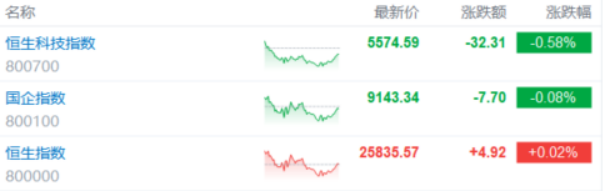
Market Overview - The Hong Kong stock market showed signs of recovery with the Hang Seng Index rising by 0.02%, while the Hang Seng China Enterprises Index fell by 0.08% and the Hang Seng Tech Index dropped by 0.58%, marking five consecutive days of decline [1] - Market sentiment remains low, but there are indications of a potential rebound [1] Sector Performance - Major technology stocks such as Baidu, Meituan, and Kuaishou saw gains, with Baidu up by 2.43% and Kuaishou up by 2.28%, while Xiaomi continued to decline, dropping nearly 3% to a new low [3][5] - Financial stocks, including banks and insurance companies, performed actively, with several Chinese brokerage stocks showing gains despite a high open and subsequent decline [3][9] - The real estate sector remained strong in the afternoon, with Sunac China and Zhongliang Holdings leading the gains [3][8] - The biopharmaceutical, home appliance, and aviation sectors also showed relative activity [3] Real Estate Market Insights - According to Centaline Property, Hong Kong's residential market recorded over 1,700 transactions in October, marking the ninth consecutive month of over 1,000 transactions, matching the longest record from March to November 2019 [7] - The month also saw at least 64 transactions exceeding HKD 50 million, totaling over HKD 6.8 billion, a new high for the year [7] - Major international banks, including Morgan Stanley and Citigroup, predict a recovery in the Hong Kong real estate market post-2025 [7] Brokerage Sector Developments - Chinese brokerage stocks saw significant increases, with Financial Street Securities rising over 4% [9][10] - The announcement of major asset restructuring plans by several brokerages is expected to enhance industry consolidation and competitiveness [9] Semiconductor Sector Activity - The semiconductor sector was active, with stocks like Contrelon rising over 8% [10][12] - Reports indicate that the U.S. may delay the imposition of long-promised semiconductor tariffs, which could impact the sector positively [11] New Energy Material Sector Decline - The new energy materials sector faced declines, with companies like China Silicon Corporation dropping over 16% [13] - The lithium battery sector also saw significant drops, with CATL falling by 5.66% [14][15] Coal Sector Insights - Coal prices have risen above RMB 830 per ton, but short-term price increases may be stabilizing [16] - The coal industry's supply-demand dynamics have fundamentally shifted since May, indicating a long-term upward trend in coal prices [16] Individual Stock Highlights - Gakos-B surged by 19.97% following the approval of its self-developed KRAS G12C inhibitor for commercialization [18] - Southbound capital saw a net inflow of HKD 15.992 billion, indicating strong investor interest [21] Future Market Outlook - CITIC Securities anticipates that the Hong Kong stock market will benefit from internal and external economic policies, predicting a second round of valuation recovery and performance resurgence by 2026 [23] - Suggested investment directions include technology sectors, healthcare, resource commodities, essential consumer goods, and sectors benefiting from RMB appreciation [23]

港股收评:恒指尾盘回升飘红,内房股盘中大幅拉升,锂电池板块跌幅明显
Ge Long Hui· 2025-11-20 08:24
另一方面,锂电池板块跌幅明显,龙头宁德时代跌5.66%,新消费概念股、军工股、煤炭股、黄金股、 汽车股纷纷下跌。(格隆汇) 临近尾盘,港股三大指数持续回升,恒生指数飘红收涨0.02%,国企指数跌0.08%,恒生科技指数跌 0.58%并且录得5连跌行情。市场情绪依旧表现低迷,但有止跌回升现象。 盘面上,连续下跌的大型科技股部分转涨,百度、美团、快手皆有涨幅,小米继续弱势下跌近3%续刷 阶段新低,阿里巴巴、腾讯小幅走低;大金融股(银行、保险、券商)多数表现活跃,中资券商股呈现高 开低走行情但总体依旧多数上涨;受传闻影响早盘拉升的内房股午后维持强势行情,融创中国、中梁控 股涨幅居前,生物医药股、家电股、航空股、重型机械股、电力股相对表现活跃。 ...
A股三大指数集体翻绿,九牧王上演天地天行情,大牛股复牌直线涨停
21世纪经济报道· 2025-11-20 07:26
记者丨 李益文 见习记者张嘉钰 编辑丨 曾静娇 11月20日,A股 市场震荡调整, 截至收盘,沪指跌0.4%,深成指跌0.76%,创业板指跌 1.12%, 此前一度涨超1.5%。沪深两市成交额1.72万亿,较上一个交易日缩量200亿。盘面 上,市场热点快速轮动,全市场超3800只个股下跌。 亚太其他股市方面,日韩股市深V反弹,港股三大指数飘绿。 具体来看, 算力硬件概念局部活跃,中富电路20cm涨停。银行板块逆势走强,中国银行、工 商银行均续创历史新高。光刻胶概念延续强势,国风新材2连板,百川股份涨停。下跌方面, 美容护理、旅游酒店、食品、零售等泛消费方向集体走弱,南侨食品、天马科技触及跌停,国 联水产、水羊股份、益客食品等多股大跌。 个股方面,九牧王股价高开后直线拉升涨停,盘中炸板,随后股价一路走低,午后盘中触及跌 停;随后该股再度直线拉升,触及涨停,上演"天地天"行情。 11月20日,停牌核查仅3个交易日的合富中国(603122.SH)复牌再度受资金热捧,盘中封死 涨停板,截至午盘,报26.18元/股,涨停板封单资金达0.85亿元。这一走势让其10月28日以来 的"妖股"行情再添一笔,15个交易日内斩获1 ...

华福证券联合举办“走进深交所”活动
Zheng Quan Ri Bao Wang· 2025-11-20 07:14
Core Insights - The "Walk into Shenzhen Stock Exchange" event was successfully held as part of the Fujian Capital and Industry Docking Conference series, aimed at helping Fujian enterprises utilize bond and REITs financing tools to promote high-quality regional economic development [1] - Over 80 representatives from key bond-issuing enterprises, listed companies, and financial institutions in Fujian participated in the event, which was guided by the Shenzhen Stock Exchange and various financial regulatory bodies [1] Group 1 - The event served as a bridge for precise connections between Fujian enterprises and the capital market, facilitating the deep integration of industry and capital [1] - The event included specialized sharing sessions on innovative bond products and asset revitalization tools, as well as free exchange discussions addressing specific issues and policies related to innovative products [1] Group 2 - Huafu Securities, a Fujian-based brokerage, has assisted local enterprises in completing 80 bond financing deals this year, with an underwriting scale of nearly 27 billion yuan [2] - The company has achieved breakthroughs in innovative bonds, completing several "firsts" in the field, including the first cultural relic protection bond and the first carbon-neutral green ABS in Fujian [2] - Huafu Securities aims to continue its commitment to serving Fujian and promoting innovative projects that contribute to the province's economic development and modernization efforts [2]
多股创历史新高!大金融崛起,高股息再发力,价值ETF(510030)盘中涨超1%!机构高呼配置价值凸显
Xin Lang Ji Jin· 2025-11-20 05:35
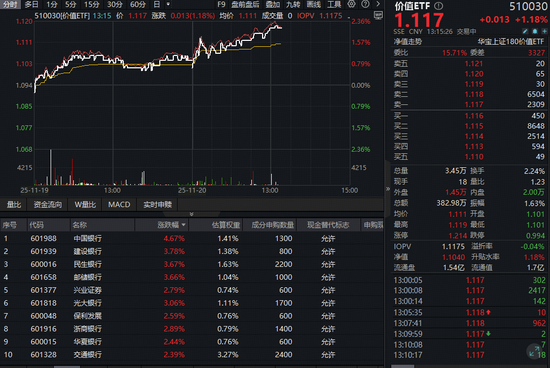
Core Viewpoint - High dividend stocks are experiencing a strong rise, particularly focusing on "high dividend + low valuation" large-cap blue-chip stocks, with the value ETF (510030) showing a 1.18% increase as of the latest report [1] Group 1: Market Performance - The banking sector is seeing significant gains, with major banks like Bank of China rising over 4%, and other banks such as China Construction Bank and Minsheng Bank increasing by over 3% [1] - Both Bank of China and Industrial and Commercial Bank of China reached historical highs during trading [1] Group 2: Institutional Investment Trends - Insurance capital is increasing its holdings in the banking sector, with a reported 27.95% holding position as of Q3 2025, which is a slight decrease in market value but an increase in share quantity by 8.36 billion shares [3] - As of the end of September, insurance capital has invested in 23 banks, with 10 banks receiving increased investments and several new entries from both large and regional banks [3] - Factors such as new premium inflows, increased equity investment ratios, and the implementation of IFRS9 are expected to provide further growth opportunities for insurance capital in the banking sector [3] Group 3: Valuation Insights - The value ETF (510030) is tracking the 180 Value Index, which has a price-to-book ratio of 0.86, indicating a relatively reasonable valuation level, positioned at the 46.38 percentile over the past decade [4] - The index is characterized by a high dividend yield, making it attractive for defensive positioning in volatile markets [5] Group 4: Future Market Outlook - The market is expected to maintain a volatile structure towards the end of the year, with a focus on themes like "anti-involution" and dividends [5] - The A-share market is in a consolidation phase, with rapid rotations between sectors, particularly as technology stocks are currently stabilizing [5] - The value ETF (510030) closely follows the 180 Value Index, which includes 60 stocks with high value factor scores, covering 20 banking stocks [5]



午评:沪指涨0.38%,银行、地产板块拉升,锂矿等概念活跃
Zheng Quan Shi Bao Wang· 2025-11-20 04:58
东莞证券认为,当前市场处于震荡蓄势阶段,沪指大概率围绕4000点附近整固蓄力,但长期震荡上行的 趋势仍有望延续。配置上建议延续"哑铃型"策略:防御端关注高分红板块,发挥其压舱石作用;进攻端 可适度布局相关科技板块,把握结构性机会。 20日早盘,沪指盘中震荡上扬,创业板指、科创50指数等走势疲弱,场内近3100股飘绿。 (文章来源:证券时报网) 截至午间收盘,沪指涨0.38%报3961.71点,深证成指微跌0.05%,创业板指跌0.52%,科创50指数跌 0.55%,沪深北三市合计成交11170亿元。 从盘面上看,食品饮料、旅游餐饮、石油、煤炭、半导体等板块走低,银行、地产板块拉升,保险、券 商等板块上扬,锂矿、海南自贸概念等活跃。 ...
彻底爆了!见证历史
Zhong Guo Ji Jin Bao· 2025-11-20 04:44
Market Overview - The A-share market opened higher but closed lower, with the Shanghai Composite Index up by 0.38%, while the Shenzhen Component and ChiNext Index fell by 0.05% and 0.52% respectively [1] - The total trading volume in the Shanghai and Shenzhen markets reached 1.11 trillion yuan, an increase of 23 billion yuan from the previous trading day [2] Banking Sector - The banking sector showed strong performance, with all bank stocks rising [4] - China Bank's stock price surged by 5.17%, reaching a historical high of 6.31 yuan per share, with a market capitalization of 186.78 billion yuan [5] - Other banks such as Construction Bank and Postal Savings Bank also saw significant increases, with gains of 4.73% and over 3% respectively [5] Lithium Mining Sector - The lithium mining sector continued its strong performance, with energy metals prices rising [7] - Notable stocks in this sector included Weiling Co. and Dazhong Mining, both hitting the daily limit up, while Tianhua New Energy and Shengxin Lithium Energy saw increases of over 9% and 8% respectively [7] - The price of lithium carbonate futures broke through 100,000 yuan per ton, reaching a new high since June 2024 [9] Securities Firms - A merger wave among securities firms has sparked market interest, with major firms like CICC planning to acquire two listed brokerages [10] - The performance of securities stocks was mixed, with some firms like Shouchao Securities rising over 5%, while others experienced declines [10] Aquaculture Sector - The aquaculture sector saw a pullback, but Zhongshui Fishery's stock price hit a daily limit up, marking its fifth consecutive increase [12] - The stock price reached 13.72 yuan per share, with a market capitalization of 5 billion yuan, amid news of China suspending imports of Japanese seafood [12]






彻底爆了!见证历史
中国基金报· 2025-11-20 04:38
Market Overview - The A-share market opened higher but experienced a decline, with the Shanghai Composite Index rising by 0.38% while the Shenzhen Component and ChiNext fell by 0.05% and 0.52% respectively [3][4]. - The total trading volume in the Shanghai and Shenzhen markets reached 1.11 trillion yuan, an increase of 23 billion yuan compared to the previous trading day [5]. Sector Performance - The banking sector showed strong performance, with all bank stocks rising. Notably, China Bank's stock price surged by 5.17%, reaching a historical high with a market capitalization of 186.78 billion yuan [11][10]. - The lithium mining sector continued its strong momentum, with significant gains in stocks such as Weiling Co. and Dazhong Mining, which recorded a limit-up increase of 10% [16][17]. - Conversely, the retail, soft drink, and tourism sectors experienced noticeable declines, with the water product and lithium battery electrolyte sectors also weakening [5][6]. Specific Stock Movements - Major banks such as Agricultural Bank, Industrial and Commercial Bank, and Construction Bank saw increases of 0.36%, 1.58%, and 4.73% respectively, contributing to a robust banking sector performance [14]. - In the lithium sector, the price of lithium carbonate futures surged past 100,000 yuan per ton, indicating strong demand from downstream manufacturers [18][19]. Brokerage Sector - A wave of mergers among brokerages has sparked market interest, with stocks like Shouchuang Securities rising over 5% following announcements of significant asset restructuring [22][23]. - The overall performance of brokerage stocks was mixed, with some stocks experiencing gains while others saw declines [22]. Fisheries Sector - The fisheries sector, particularly Zhongshui Fisheries, saw its stock price rise by 10.02% amid geopolitical tensions affecting Japanese seafood imports to China [25][26].



港股午评:恒指涨0.14%,内房股直线拉升,金融股活跃,锂电龙头大跌
Ge Long Hui· 2025-11-20 04:05
港股上午盘三大指数再度呈现高开低走行情,恒生科技指数表现最弱,午间收跌1.01%,恒生指数小幅 上涨0.14%,国企指数跌0.09%。权重科技股分化,百度涨超2%,小米继续下跌超3%再度刷新阶段新 低;受消息影响,内房股直线拉升上扬,融创中国涨超10%领衔上涨,物管股、建材水泥股等相关产业 链齐涨,大金融股(银行、保险、券商)多数表现活跃。另外,锂电池股、汽车股、煤炭股走低,锂电龙 头宁德时代大跌超8%。(格隆汇) ...
600280,盘中“天地板”,A股这一概念集体异动拉升
Zheng Quan Shi Bao· 2025-11-20 04:01
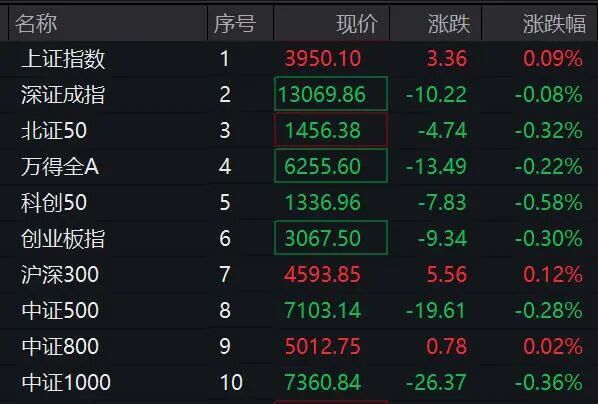
Market Overview - The A-share market opened higher on November 20, with the ChiNext index rising nearly 2% at one point, while the Shanghai Composite Index showed slight gains and the Shenzhen Component and ChiNext indices turned negative [1] - The Shanghai Composite Index was at 3950.10, up 3.36 points or 0.09%, while the Shenzhen Component was at 13069.86, down 10.22 points or 0.08% [2] Brokerage Stocks - Brokerage stocks collectively opened strong, with Shouhua Securities rising over 4%, and China Galaxy and CITIC Securities also showing significant gains [2] - China International Capital Corporation (CICC) plans to merge with Dongxing Securities and Xinda Securities, which may have contributed to the positive sentiment in the brokerage sector [2] Solid-State Battery Concept - The solid-state battery concept saw a surge, with companies like Guanghua Technology, Nord Shares, and Binhai Energy hitting the daily limit, while Shengxin Lithium Energy, Tianhua New Energy, and others also experienced gains [6] - Research reports indicate that solid-state batteries are entering the pilot production phase, benefiting equipment manufacturers, with some already shipping related equipment and validating process routes with downstream clients [8] Lithium Mining Stocks - Lithium mining stocks collectively surged, with Dazhong Mining and Jinyuan Shares both hitting the daily limit, while Shengxin Lithium Energy, Guocheng Mining, and others also saw gains [8] Organic Silicon Concept - The organic silicon sector continued to show strength, with companies like Chenguang New Materials achieving three consecutive daily limits, and others like Yuanxiang New Materials and Hongbai New Materials also rising [8] - A recent seminar indicated that the overall operating rate of the organic silicon industry will be reduced by 30%, with plans to implement this in early December, and a price target for organic silicon DMC set at 13,500 yuan per ton or higher [8] CPO Concept - The CPO concept was active, with Zhongfu Circuit rising over 13%, and other companies like Juguang Technology and Zhongji Xuchuang also experiencing gains [9] - China Aviation Optical-Electrical Technology Co. confirmed its capability in providing CPO-related products and solutions, indicating a strategic focus on meeting customer needs [9] Central Plaza Stock Movement - Central Plaza (600280) experienced significant volatility, with a "Tian Di Ban" pattern observed during trading, following two consecutive daily limits [10][11] - The company announced that its stock price had deviated significantly over three trading days, prompting a review, but confirmed no undisclosed major issues [13]