
钢铁

Search documents
钢铁板块集体走强 凌钢股份、安阳钢铁双双涨停
Xin Lang Cai Jing· 2026-02-25 02:06
Core Viewpoint - The steel sector has shown significant strength, with companies like Lingang Co. and Anyang Steel hitting the daily limit up, indicating positive market sentiment and performance in the industry [1] Industry Summary - The steel sector collectively strengthened, with multiple stocks such as Lingang Co., Anyang Steel, Jiu Steel Hongxing, Shandong Steel, Ansteel, and Sangang Min Guang rising over 5% [1] - As of February 10, a total of 27 listed companies in the steel sector released earnings forecasts, with 15 companies reporting positive net profits attributable to shareholders, representing 55.5% of the companies that issued forecasts [1] - The profit range for these companies is reported to be between 0.07 billion to 3 billion [1]



首钢股份涨2.18%,成交额3609.05万元,主力资金净流出129.58万元
Xin Lang Cai Jing· 2026-02-25 02:06
Core Viewpoint - Shougang Co., Ltd. has shown a significant increase in stock price and profitability, despite a slight decline in revenue, indicating potential investment opportunities in the steel industry [1][2]. Group 1: Stock Performance - As of February 25, Shougang's stock price increased by 2.18% to 5.62 CNY per share, with a total market capitalization of 43.583 billion CNY [1]. - Year-to-date, the stock price has risen by 14.69%, with a 32.86% increase over the past 60 days [1]. - The trading volume on February 25 was 36.09 million CNY, with a turnover rate of 0.09% [1]. Group 2: Financial Performance - For the period from January to September 2025, Shougang reported operating revenue of 77.234 billion CNY, a year-on-year decrease of 5.78% [2]. - The net profit attributable to shareholders reached 0.953 billion CNY, reflecting a substantial year-on-year increase of 368.13% [2]. Group 3: Shareholder Information - As of September 30, 2025, the number of shareholders increased to 91,800, up by 9.59% from the previous period [2]. - The average number of circulating shares per shareholder decreased by 8.75% to 70,890 shares [2]. - The top ten circulating shareholders include significant entities such as Hong Kong Central Clearing Limited and Southern CSI 500 ETF, with notable changes in their holdings [3].

“反内卷”与成本让利共振,钢铁板块迎来估值修复窗口
Mei Ri Jing Ji Xin Wen· 2026-02-25 02:02
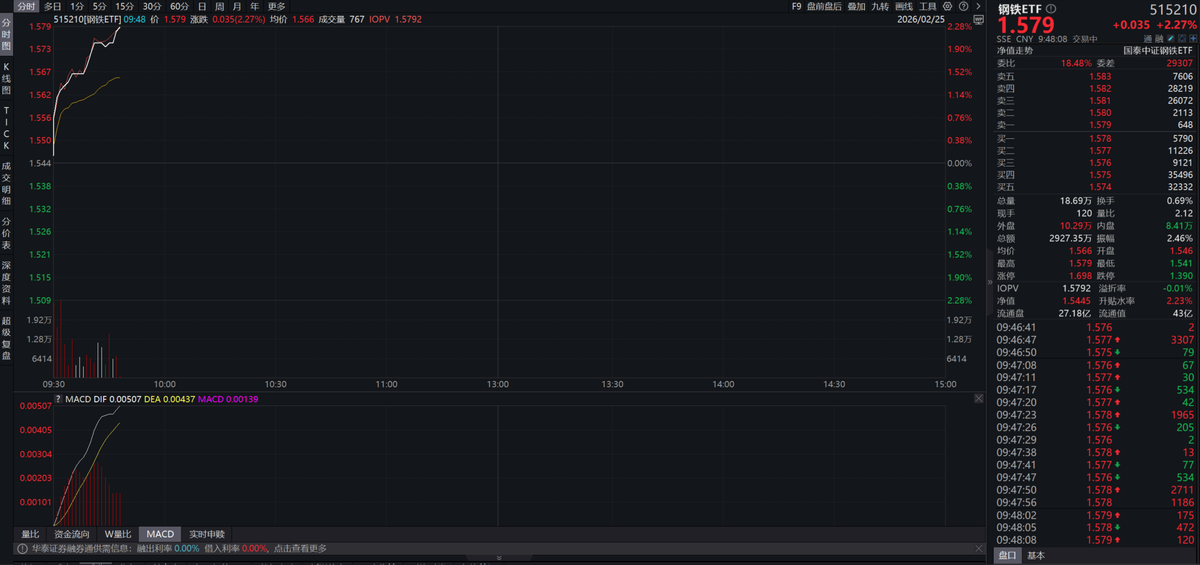
Core Viewpoint - The steel sector is at a turning point characterized by low expectations, a bottoming out of fundamentals, and upcoming catalysts, with the only steel ETF (515210) rising over 2% [1] Supply Side: "Anti-Competition" Policy Implementation and Capacity Management Acceleration - The "anti-competition" policy in the steel industry is becoming actionable, with clearer requirements for supply control in the new growth stabilization plan [2] - Environmental inspections are ongoing, leading to accelerated exit of non-compliant capacities, which is expected to enhance industry concentration [2] - The market share of the eight major construction state-owned enterprises has increased from 41% at the end of 2022 to 51% by the end of 2025, indicating a trend towards resource concentration among leading firms [2] Cost Side: Iron Ore Supply Easing and Profit Transfer to Downstream - The long-standing issue of the steel industry being constrained by upstream iron ore is changing, with new large mines coming online [3] - Current port iron ore inventory has reached 169 million tons, nearing historical highs, indicating a loosening supply [3] - The profit distribution within the steel industry is shifting, with iron ore profits expected to decrease, allowing for improved profitability in the finished steel segment [3] Inventory and Price: Low Inventory and Price Stabilization Establishing an Upward Foundation - This year's winter storage efforts are weaker than in previous years, resulting in total inventory at near historical lows, which reduces post-holiday destocking pressure [4] - Steel prices have stabilized at around 3200 yuan/ton, indicating a bottoming out, and any demand or supply-side catalysts could lead to significant price increases [4] - The upcoming demand peak in March, following the late Lunar New Year, is expected to boost trade sentiment and increase the likelihood of a strong market opening [4] Demand Side: Internal and External Demand Expected to Create Synergy - External demand remains resilient due to manufacturing expansions in Southeast Asia and continued loose policies in Europe and the U.S. [5][6] - Domestic demand is anticipated to stabilize as the real estate sector shows signs of recovery after a prolonged downturn [6] - New emerging sectors, such as oil and gas and nuclear power, are expected to contribute to incremental demand for steel products [6] Investment Opportunity: Steel ETF (515210) as a Strategic Tool - The steel ETF (515210) provides a diversified investment approach to capture the sector's recovery potential amid "anti-competition" and cost reduction dynamics [7] - The current absolute valuation of the steel sector has improved from undervaluation to a moderately low position, indicating potential for absolute returns [7] - The ETF tracks leading companies with stable profit characteristics, making it a core investment choice for capturing both short-term trading opportunities and long-term value in the steel sector [7]

建信期货铁矿石日评-20260225
Jian Xin Qi Huo· 2026-02-25 01:53
1. Report Industry Investment Rating - Not provided in the content 2. Core View of the Report - The current supply in the first quarter is relatively tight, while the demand side is expected to see an acceleration in steel mill复产 after the Spring Festival. It is predicted that the iron ore price will show a trend of being weak first and then strong. The high port inventory and the expected increase in annual supply will continue to suppress the upside space of the iron ore price. One can consider deploying buy - hedging or investment strategies at the lower edge of the oscillation range [11]. 3. Summary by Relevant Catalogs 3.1行情回顾与后市展望 - **Market Review**: On February 24, the main 2605 contract of iron ore futures oscillated downward, opened lower, oscillated and declined, then rebounded and rose, and weakened again in the afternoon, closing at 740.5 yuan/ton, down 1.79% [7]. - **Spot Market and Technical Analysis**: On February 24, the main iron ore outer - disk quotes decreased by 1.3 US dollars/ton compared with the previous trading day, and the prices of main - grade iron ore at Qingdao Port decreased by 6 yuan/ton compared with the previous trading day. Technically, the daily KDJ indicator of the iron ore 2605 contract showed a divergent trend, with the K and J values turning up and the D value continuing to decline, showing a trend of a golden cross; the green column of the daily MACD indicator of the iron ore 2605 contract has been expanding for 2 consecutive trading days [9]. - **Outlook for the Future**: In terms of supply, the shipments from Australia and Brazil significantly declined before the Spring Festival holiday, mainly affected by the holiday. Considering the influence of weather and holiday factors in the first quarter, it is expected that the subsequent shipment volume will remain at a relatively low level. The recent arrival volume has been continuously declining, also affected by the holiday, and it is estimated that the subsequent arrival volume will show a trend of being low first and then high. In terms of demand, the daily average pig iron output before the Spring Festival slightly recovered to over 2.3 million tons, and the demand resilience remained in a good state. Although February is still in the off - season of demand, the current profit performance is not bad, and the profit per ton of steel in the blast furnaces of rebar and hot - rolled coils is in the positive range. Driven by profit, the resumption of production of steel mills after the festival is expected to accelerate, and the iron ore demand is expected to be weak first and then strong. In terms of inventory, steel mills replenished their stocks relatively fully before the festival, with the available inventory days reaching a maximum of 31 days, and it is expected to gradually decline. The port inventory has been continuously accumulating. Due to the stock replenishment of steel mills and the decline in arrivals in the week before the festival, the port inventory decreased, and it is expected to remain at a high level and may further break through [10][11]. 3.2 Industry News - The Trump administration is considering imposing new "national security tariffs" on six industries, including large - scale batteries, pig iron and iron accessories, plastic pipes, industrial chemicals, and power grid and telecommunications equipment. These tariffs will be levied according to Article 232 of the Trade Expansion Act of 1962, and will be implemented separately from the new global 15% tariff. It is not clear when the tariff investigations by the Department of Commerce will be announced and when the tariffs will be finally imposed [12]. 3.3 Data Overview - The report provides multiple data charts, including the prices of main iron ore varieties at Qingdao Port, the price differences between high - grade ore, low - grade ore and PB powder at Qingdao Port, the basis between the iron ore spot at Qingdao Port and the May contract, the shipment volumes of iron ore from Brazil and Australia, the arrival volumes of iron ore at 45 ports, the capacity utilization rate of domestic mines, the trading volumes of iron ore at main ports, the available inventory days of iron ore in steel mills, the inventory of imported sintered powder ore, the port iron ore inventory and the port clearance volume, the tax - free pig iron cost of sample steel mills, the blast furnace operating rate and the iron - making capacity utilization rate, the electric furnace operating rate and the capacity utilization rate, the national daily average pig iron output, the apparent consumption volume of five major steel products, the weekly output of five major steel products, and the steel mill inventory of five major steel products. All data sources are from Mysteel and the Research and Development Department of CCB Futures [14][15][21]
观点与策略:国泰君安期货商品研究晨报:黑色系列-20260225
Guo Tai Jun An Qi Huo· 2026-02-25 01:50
1. Report Industry Investment Ratings - No industry - wide investment ratings are provided in the report. 2. Core Views - The report analyzes the trends of various commodities in the black series. It believes that iron ore will oscillate downward due to poor demand expectations; rebar and hot - rolled coils will have wide - range oscillations with weak apparent demand; ferrosilicon and silicomanganese will experience low - level oscillations with raw material and spot price catch - up declines; coke and coking coal will have wide - range oscillations; logs will oscillate strongly due to low arrivals and low inventories [2][4][7][11][17][21]. 3. Summary by Commodity Iron Ore - **Price and Position**: The closing price of the I2605 contract was 740.5 yuan/ton, down 5.5 yuan/ton (- 0.74%), and the position increased by 24,654 hands to 519,204 hands. Among spot prices, the price of imported ore PB (61.5%) decreased by 9 yuan/ton, and the price of domestic ore邯邢 (66%) decreased by 20 yuan/ton [4]. - **News**: The Trump government is committed to raising the temporary global tariff rate from 10% to 15%. The trend strength is - 1, indicating a bearish view [4]. Rebar and Hot - Rolled Coils - **Price and Position**: The closing price of the RB2605 contract was 3,027 yuan/ton, down 27 yuan/ton (- 0.88%), and the position increased by 92,067 hands to 2,034,509 hands. The closing price of the HC2605 contract was 3,195 yuan/ton, down 28 yuan/ton (- 0.87%), and the position increased by 18,657 hands to 1,500,880 hands. Spot prices generally declined [7]. - **Industry Data**: In the steel - union weekly data on February 19, rebar production increased by 1.22 tons, hot - rolled coil production increased by 2.05 tons, but rebar apparent demand decreased by 60.75 tons, and hot - rolled coil apparent demand decreased by 49.46 tons. The trend strength of both is 0, indicating a neutral view [8]. Ferrosilicon and Silicomanganese - **Price and Position**: The closing price of the ferrosilicon 2605 contract was 5470 yuan/ton, down 22 yuan/ton. The closing price of the silicomanganese 2605 contract was 5,738 yuan/ton, down 32 yuan/ton. Spot prices of ferrosilicon and silicomanganese decreased [11]. - **Industry News**: A new silicon - manganese production capacity in Inner Mongolia is expected to start production at the end of February. Some manganese ore suppliers will not provide supply and quotes to China in March, and the price of semi - coke decreased. The trend strength of both is 0, indicating a neutral view [11][13]. Coke and Coking Coal - **Price and Position**: The closing price of the JM2605 coking coal contract was 1,101.5 yuan/ton, down 19.5 yuan/ton (- 1.7%), and the position increased by 56,059 hands to 468,538 hands. The closing price of the J2605 coke contract was 1,634.5 yuan/ton, down 47.5 yuan/ton (- 2.8%), and the position increased by 3,937 hands to 39,187 hands. Some spot prices of coking coal decreased [17]. - **Industry News**: On February 24, the coking coal online auction had a 25% non - bid rate, and the market sentiment was pessimistic. The trend strength of both is 0, indicating a neutral view [17]. Logs - **Price and Position**: The closing price of the 2605 log contract increased by 0.3% to 789 yuan/ton. The position of the 2605 contract increased by 5.1% to 5,631 hands. Some spot prices of logs increased slightly [21]. - **Industry News**: The US is discussing Trump's visit to China, and the Trump government plans to raise the temporary global tariff rate. The trend strength is 1, indicating a relatively bullish view [23].
山金期货黑色板块日报-20260225
Shan Jin Qi Huo· 2026-02-25 01:50
Group 1: Report Summary - The report is a daily report on the black sector by Shan Jin Futures, covering steel products (rebar, hot-rolled coil) and iron ore [1] Group 2: Rebar and Hot-rolled Coil Core View - The market is in a holiday mode with weak supply and demand, expected to resume after the Lantern Festival. The market has a relatively weak demand expectation for 2026. The futures price is in a downward trend but the downside space may be limited due to low valuation [2] Operation Suggestion - Maintain a wait-and-see attitude and do not recommend chasing short positions [2] Data Summary - **Price**: Rebar and hot-rolled coil futures prices decreased, with rebar down -0.13% and -1.64% compared to the previous day and last week respectively, and hot-rolled coil down -0.31% and -1.38% [2] - **Production**: The production of rebar and hot-rolled coil decreased, with rebar production down 11.75% and hot-rolled coil down 0.45% week-on-week [2] - **Inventory**: The inventory of five major steel products and rebar increased, with the five major products' social inventory up 5.58% and rebar social inventory up 12.11% [2] - **Demand**: Apparent demand was at a low level, with the apparent demand of five major products down 5.12% week-on-week[2] Group 3: Iron Ore Core View - The market is in a holiday mode, expected to enter the consumption peak season after the Lantern Festival. Supply is affected by seasonal factors, with short-term shipments expected to be low and then recover. The futures price is in a downward trend [4] Operation Suggestion - Hold short positions with a light position [4] Data Summary - **Price**: Iron ore spot and futures prices decreased, with the DCE iron ore main contract settlement price down -0.07% and -0.85% compared to the previous day and last week respectively [4] - **Supply**: Overseas shipments decreased, with Australian shipments down 31.16% and Brazilian shipments down 3.84% week-on-week [4] - **Inventory**: Port inventory increased to a record high, up 0.70% week-on-week [4] Group 4: Industry News - In January 2026, Mongolia's coal production was 10.1689 million tons, a 2.26% month-on-month decrease and a 55.74% year-on-year increase [6] - The EU Commission Vice-President mentioned that the US is researching steel derivative tariffs [7] - From February 16th to 22nd, the average daily outbound volume of coniferous logs at 13 ports in 7 Chinese provinces decreased by 81.55% week-on-week [7]
观点与策略:国泰君安期货商品研究晨报-20260225
Guo Tai Jun An Qi Huo· 2026-02-25 01:33
Report Summary 1. Industry Investment Ratings The report does not provide an overall investment rating for the industry. Instead, it offers individual trend intensities for various commodities: - **Positive Trends**: Gold, silver, tin, aluminum, platinum, palladium, nickel, stainless steel, lithium carbonate, logs, p-xylene, PTA, MEG, rubber, short fibers, bottle chips, palm oil, soybean oil, cotton [2][18][26][30][36][60][63][71][143][156][173] - **Neutral Trends**: Copper, zinc, lead, alumina, synthetic rubber, LLDPE, PP, caustic soda, pulp, glass, methanol, urea, styrene, soda ash, LPG, PVC, fuel oil, low - sulfur fuel oil, container shipping index (European line), double - offset paper, pure benzene, soybean meal, soybeans, corn, sugar, peanuts [8][11][15][22][74][77][80][83][89][94][97][103][107][110][114][123][126][128][147][152][161][164][168][186] - **Negative Trends**: Iron ore, eggs, live pigs [43][178][181] 2. Core Views - **Commodity - Specific Views**: Each commodity's performance is influenced by its unique supply - demand dynamics, cost factors, and macro - economic and industry news. For example, gold and silver showed positive trends during the holiday period; iron ore faced poor demand expectations; and lithium carbonate had a tight supply - demand situation [2][43][36] - **Macro - economic Impact**: Global events such as Trump's tariff policies, geopolitical tensions in the Middle East, and AI - related economic impacts have affected market sentiment and commodity prices [7] 3. Summary by Commodity Precious Metals - **Gold**: Oscillated upward during the holiday. The price of domestic and international gold contracts decreased, and trading volume and positions changed. ETF holdings decreased slightly [2][5] - **Silver**: Attention should be paid to the post - holiday gap - up opening. The price of silver contracts decreased significantly, and trading volume and positions also changed [2][5] - **Platinum and Palladium**: Both showed a generally upward - trending pattern. The prices of platinum and palladium contracts rose, and trading volume and positions changed [26] Base Metals - **Copper**: The price rebounded as the US stock market rebounded. Supply - demand data showed changes in inventory and price differentials. Macro - economic and industry news included tariff policies and production data [8] - **Zinc**: Underwent wide - range adjustments. Price, trading volume, and inventory data showed certain fluctuations. News related to tariff policies also affected the market [11] - **Lead**: The increase in domestic inventory restricted price rebounds. Price, trading volume, and inventory data were presented, along with relevant news [15] - **Tin**: Showed a slightly upward - trending pattern. Price, trading volume, and inventory data changed, and there were some macro - economic and industry news [18][19] - **Aluminum**: Attention should be paid to the spring rally. Alumina had increased maintenance, and cast aluminum alloy followed the trend of electrolytic aluminum. A large amount of fundamental data was provided [22] Energy and Chemicals - **Crude Oil and Related Products**: Although not the main focus, some related information was mentioned. For example, the price of Brent crude oil futures increased, and it affected the cost of downstream products [64][66] - **P - xylene and PTA**: Had strong cost support, and the market was expected to rise after the holiday. Supply - demand and cost factors were analyzed [63][64][69] - **MEG**: Traded in a range, with a strategy of going long on PTA and short on MEG. Inventory and supply - demand information was provided [63][67][70] - **Rubber**: Showed a slightly upward - trending pattern. Price, trading volume, and inventory data were presented, and there was some industry news [71] - **Synthetic Rubber**: Was expected to trade in a short - term range. The price, trading volume, and some fundamental data were provided [74] - **LLDPE**: Had strong cost support due to geopolitical disturbances during the holiday. Supply - demand and market conditions were analyzed [77] - **PP**: The C3 raw material was strong, and PDH maintenance remained high. Price, trading volume, and supply - demand information were provided [80] - **Caustic Soda**: Was mainly trading in a range with cost support. Supply - demand and inventory information were presented [83] - **Pulp**: Showed a slightly upward - trending pattern. Price, trading volume, and inventory data were provided, along with industry news [89] - **Glass**: The price of the original sheet was stable. Price, trading volume, and supply - demand information were presented [94] - **Methanol**: Traded in a range. Price, trading volume, and inventory data were provided, and there was some market news [97] - **Urea**: The price center shifted upward. Price, trading volume, and supply - demand information were presented, and there was some industry news [103] - **Styrene**: Traded in a slightly upward - trending pattern. Price, trading volume, and inventory data were presented, and there was some market news [107] - **Soda Ash**: The spot market changed little. Price, trading volume, and supply - demand information were presented [110] - **LPG**: Had strong short - term geopolitical disturbances. Price, trading volume, and supply - demand information were presented [114] - **Propylene**: The fundamentals remained tight, and attention should be paid to post - holiday restocking dynamics. Price, trading volume, and supply - demand information were presented [114] - **PVC**: Traded in a range. Price, trading volume, and supply - demand information were presented [123] - **Fuel Oil and Low - Sulfur Fuel Oil**: Fuel oil decreased slightly at night, and low - sulfur fuel oil rebounded significantly. Price, trading volume, and supply - demand information were presented [126] Agricultural Products - **Palm Oil and Soybean Oil**: Palm oil was difficult to decline in the short term due to production cuts, and soybean oil had limited driving force from US soybeans and rebounded within a range. Price, trading volume, and supply - demand information were presented [156] - **Soybean Meal and Soybeans**: Soybean meal might rebound and oscillate, and soybeans' spot price increased to catch up, with the futures market oscillating. Price, trading volume, and supply - demand information were presented [161] - **Corn**: Showed a slightly upward - trending pattern. Price, trading volume, and supply - demand information were presented, and there was some market news [164] - **Sugar**: Traded in a narrow range. Price, trading volume, and supply - demand information were presented, and there was some industry news [168] - **Cotton**: Reached a new high for the year. Price, trading volume, and supply - demand information were presented, and there was some industry news [173] - **Eggs**: Traded in a weak - oscillating pattern. Price, trading volume, and supply - demand information were presented [178] - **Live Pigs**: The spot price was lower than expected, and it was difficult to reduce inventory during the off - season. Price, trading volume, and supply - demand information were presented [181] - **Peanuts**: Traded in an oscillating pattern. Price, trading volume, and supply - demand information were presented, and there was some market news [186] Shipping - **Container Shipping Index (European Line)**: Should be treated with an oscillating mindset. Price, trading volume, and supply - demand information were presented, and there was some market news [128] Fibers - **Short Fibers and Bottle Chips**: Had cost support and were expected to be strong in the short term. Price, trading volume, and supply - demand information were presented [143] Paper - **Offset Printing Paper**: Should be observed. Price, trading volume, and supply - demand information were presented, and there was some industry news [147]
辽宁本钢板材:非常规钢生产不断突破设计产能
Ren Min Ri Bao· 2026-02-25 01:26
Core Viewpoint - The company is focused on maintaining stable production in the hot-rolled steel sector, emphasizing the importance of both remote control and on-site monitoring to ensure quality and efficiency in manufacturing processes [1][2]. Group 1: Production and Operations - The hot-rolled production area has successfully achieved breakthroughs in producing 28mm ultra-thick and 2190mm ultra-wide steel specifications, demonstrating the company's capability in precision manufacturing [1]. - In 2025, the production area is expected to exceed an annual output of 6 million tons, showcasing significant growth and operational efficiency [2]. Group 2: Technological Innovation - The company is investing in smart factory construction, aiming for centralized control of the entire production line, which is anticipated to further enhance both product quantity and quality [2]. Group 3: Product Applications - Over 90% of the products produced in this production line are unconventional steel types, which are utilized in major engineering projects and the new energy vehicle industry, indicating a strong market demand for specialized steel products [1].

2026年中国钢渣处理行业发展历程、产业链、利用规模、重点企业及趋势研判:环保要求提升处理需求,钢渣利用规模将进一步扩张[图]
Chan Ye Xin Xi Wang· 2026-02-25 01:20
Core Viewpoint - The comprehensive utilization of steel slag in China is gaining momentum due to increased emphasis on environmental protection and resource recycling, with significant implications for the steel industry's sustainable development and cost reduction [1][11]. Group 1: Industry Overview - The steel slag treatment industry is essential for managing by-products from steel production, which contain valuable metals and harmful substances [3][4]. - Steel slag treatment methods include magnetic separation, gravity separation, particle size classification, and acid washing, all aimed at reducing environmental pollution and recovering valuable resources [3][4]. Group 2: Industry Development History - The development of China's steel slag treatment industry can be divided into three phases: the initial phase (1950-1980) with negligible resource utilization, the preliminary development phase (1980-2005) with basic recovery methods, and the rapid development phase starting in 2015 [4][5]. Group 3: Industry Chain - The steel slag treatment industry chain consists of upstream steel production generating slag, midstream treatment companies converting slag into reusable resources, and downstream applications in construction materials, agriculture, and environmental remediation [7][8]. Group 4: Current Industry Status - China produces over 100 million tons of steel slag annually, with a projected production of approximately 151 million tons by 2025, despite a low resource utilization rate leading to significant environmental concerns [10][11]. - The steel slag stockpile is expected to reach about 1.656 billion tons by 2025, highlighting the urgent need for effective treatment and utilization [10][11]. Group 5: Key Companies in the Industry - Notable companies in the steel slag treatment sector include Zhengzhou Water Energy Saving Technology Co., Jiangsu Ronda New Materials Co., and Shanghai Zhongcai Environmental Engineering Technology Co., among others, focusing on innovative and efficient treatment solutions [2][12]. Group 6: Industry Development Trends - The steel slag treatment industry is expected to evolve towards high-value and refined resource utilization, emphasizing the extraction of valuable metals and the production of high-performance materials [14]. - There is a growing focus on low-carbon and environmentally friendly processes, integrating treatment with steel production to minimize carbon footprints [15]. - The adoption of smart technologies, including IoT and AI, is anticipated to enhance treatment efficiency and resource recovery rates [16].

2026年02月25日:期货市场交易指引-20260225
Chang Jiang Qi Huo· 2026-02-25 01:18
1. Report Industry Investment Ratings - Macro-finance: Bullish on stock indices in the medium to long term, suggesting buying on dips; Treasury bonds are expected to trade sideways [1][5] - Black building materials: Short-term trading for coking coal; range trading for rebar; glass is expected to trade weakly [1][7][8] - Non-ferrous metals: Suggest buying copper on dips; strengthen observation for aluminum; moderately hold nickel on dips; range trading for tin, gold, and silver; lithium carbonate is expected to trade in a range [1][10][13][15] - Energy and chemicals: Range trading for PVC, rubber, urea, and methanol; caustic soda is expected to trade at a low level; short-selling soda ash on rallies; styrene is expected to trade strongly; polyolefins are expected to trade weakly [1][17][19][23] - Cotton textile industry chain: Cotton and cotton yarn are expected to trade strongly; apples and jujubes are expected to trade sideways [1][25][27] - Agricultural and livestock: Be cautious about shorting live pigs in the May contract, and consider shorting on rebounds; if the culling of laying hens does not accelerate, consider shorting near-term egg contracts on rebounds; corn is expected to trade in a range; short-selling soybean meal on rallies; buying edible oils on dips [1][28][29][37] 2. Core Views of the Report - The report provides investment suggestions for various futures products based on market analysis and trends, including trading strategies and market outlooks for different industries [1] 3. Summary by Relevant Catalogs Macro-finance - Stock indices are expected to trade sideways in the short term and strongly before the Two Sessions. Pay attention to market sentiment towards the Two Sessions. Treasury bonds are expected to trade sideways, and focus on supply pressure [5] Black building materials - Coking coal market is weak and stable after the Spring Festival. Rebar is expected to trade weakly due to low valuation and weak driving factors. Glass is expected to trade weakly due to supply and demand factors [7][8][9] Non-ferrous metals - Copper supply is tight and demand is resilient. Aluminum supply is expected to improve, but market sentiment remains positive. Nickel is expected to trade strongly due to reduced nickel ore quotas in Indonesia. Tin is expected to trade in a range due to supply and demand factors. Silver and gold are expected to trade in a range due to macroeconomic factors. Lithium carbonate is expected to trade in a range due to supply and demand factors [10][11][13][15][17] Energy and chemicals - PVC is expected to trade at a low level due to weak domestic demand and high inventory. Caustic soda is expected to trade at a low level due to weak demand and high inventory. Styrene is expected to trade strongly in the short term due to low inventory and export support. Rubber is expected to trade in a range due to supply and demand factors. Urea is expected to trade in a range due to supply and demand factors. Methanol is expected to trade in a range due to supply and demand factors. Polyolefins are expected to trade weakly due to weak demand and high inventory. Soda ash is expected to be shorted on rallies due to oversupply [17][19][20][21][22][23][25] Cotton textile industry chain - Cotton and cotton yarn are expected to trade strongly due to improved consumption expectations after the Spring Festival and strong foreign cotton prices. Apples and jujubes are expected to trade sideways [25][27] Agricultural and livestock - Live pigs are expected to bottom out. Be cautious about shorting in the May contract and consider shorting on rebounds. Eggs are expected to rebound at a low level. If the culling of laying hens does not accelerate, consider shorting near-term contracts on rebounds. Corn is expected to trade in a range due to supply and demand factors. Soybean meal is expected to trade at a low level. Short-selling on rallies. Edible oils are expected to open higher after the Spring Festival, and consider buying on dips [28][29][30][32][37]