
农林牧渔

Search documents
大盘或进入高波动状态
HTSC· 2026-01-18 11:32
Quantitative Models and Construction Methods 1. Model Name: A-Share Technical Scoring Model - **Model Construction Idea**: The model aims to fully explore technical information to depict market conditions, breaking down the vague concept of "market state" into five dimensions: price, volume, volatility, trend, and crowding. It generates a comprehensive score ranging from -1 to +1 based on equal-weighted voting of timing signals from 10 selected indicators[9][14][15] - **Model Construction Process**: 1. Select 10 effective market observation indicators across the five dimensions (e.g., 20-day Bollinger Bands, 20-day price deviation rate, 60-day turnover rate volatility, etc.)[14] 2. Generate long/short timing signals for each indicator individually 3. Aggregate the signals through equal-weighted voting to form a comprehensive score[9][14] - **Model Evaluation**: The model provides a straightforward and timely way for investors to observe and understand the market[9] 2. Model Name: Dividend Style Timing Model - **Model Construction Idea**: The model times the dividend style by analyzing the relative performance of the CSI Dividend Index against the CSI All Share Index, using three indicators: relative momentum, 10Y-1Y term spread, and interbank pledged repo trading volume[16][19] - **Model Construction Process**: 1. Generate daily signals (0, +1, -1) for each indicator, representing neutral, bullish, and bearish views, respectively 2. Aggregate the scores to determine the overall long/short view on the dividend style 3. When bullish, fully allocate to the CSI Dividend Index; when bearish, fully allocate to the CSI All Share Index[16][19] - **Model Evaluation**: The model has consistently maintained a bearish view on the dividend style this year, favoring growth style instead[16] 3. Model Name: Large-Cap vs. Small-Cap Style Timing Model - **Model Construction Idea**: The model evaluates the crowding level of large-cap and small-cap styles based on momentum and trading volume differences, adjusting the strategy based on whether the market is in a high or low crowding state[20][22][24] - **Model Construction Process**: 1. Calculate momentum differences and trading volume ratios between the Wind Micro-Cap Index and the CSI 300 Index over multiple time windows 2. Derive crowding scores for both large-cap and small-cap styles based on percentile rankings of the calculated metrics 3. Use a dual moving average model with smaller parameters in high crowding states and larger parameters in low crowding states to determine trends[20][22][24] - **Model Evaluation**: The model effectively captures the medium- to long-term trends in low crowding states and reacts to potential reversals in high crowding states[22] 4. Model Name: Industry Rotation Model (Genetic Programming) - **Model Construction Idea**: The model employs genetic programming to directly extract factors from industry index data (e.g., price, volume, valuation) without relying on predefined scoring rules. It uses a dual-objective approach to optimize factor monotonicity and top-group performance[27][30][31] - **Model Construction Process**: 1. Use NSGA-II algorithm to optimize two objectives: |IC| and NDCG@5 2. Combine multiple factors with weak collinearity into industry scores using greedy strategies and variance inflation factors 3. Select the top five industries with the highest composite scores for equal-weighted allocation[30][33][37] - **Model Evaluation**: The dual-objective genetic programming approach enhances factor diversity and reduces overfitting risks[30][33] 5. Model Name: China Domestic All-Weather Enhanced Portfolio - **Model Construction Idea**: The model adopts a macro factor risk parity framework, emphasizing diversification across underlying macro risk sources (growth and inflation surprises) rather than asset classes[38][41] - **Model Construction Process**: 1. Divide macroeconomic scenarios into four quadrants based on growth and inflation surprises 2. Construct sub-portfolios within each quadrant using equal-weighted assets, focusing on downside risk 3. Adjust quadrant risk budgets monthly based on macro momentum indicators, actively overweighting favorable quadrants[41][42] - **Model Evaluation**: The strategy achieves enhanced performance by actively allocating based on macroeconomic expectations[38][41] --- Model Backtesting Results 1. A-Share Technical Scoring Model - Annualized Return: 20.67% - Annualized Volatility: 17.33% - Maximum Drawdown: -23.74% - Sharpe Ratio: 1.19 - Calmar Ratio: 0.87[15] 2. Dividend Style Timing Model - Annualized Return: 16.65% - Maximum Drawdown: -25.52% - Sharpe Ratio: 0.91 - Calmar Ratio: 0.65 - YTD Return: 5.78%[17] 3. Large-Cap vs. Small-Cap Style Timing Model - Annualized Return: 27.79% - Maximum Drawdown: -32.05% - Sharpe Ratio: 1.16 - Calmar Ratio: 0.87 - YTD Return: 6.27%[25] 4. Industry Rotation Model (Genetic Programming) - Annualized Return: 31.95% - Annualized Volatility: 17.44% - Maximum Drawdown: -19.62% - Sharpe Ratio: 1.83 - Calmar Ratio: 1.63 - YTD Return: 3.31%[30] 5. China Domestic All-Weather Enhanced Portfolio - Annualized Return: 11.82% - Annualized Volatility: 6.20% - Maximum Drawdown: -6.30% - Sharpe Ratio: 1.91 - Calmar Ratio: 1.88 - YTD Return: 2.02%[42]
量化择时周报:短期调整不改牛市格局-20260118
ZHONGTAI SECURITIES· 2026-01-18 07:26
- The report introduces a **market timing system** that uses the distance between the 20-day moving average and the 120-day moving average of the WIND All A Index to determine market trends. The system identifies an uptrend when the short-term moving average is above the long-term moving average, with a significant distance threshold of 3%[2][6][11] - The **industry trend allocation model** is highlighted, which signals opportunities in specific sectors. For the medium term, the "distressed reversal expectation model" suggests focusing on innovative healthcare. The "TWO BETA model" continues to recommend the technology sector, particularly AI applications and commercial aerospace after adjustments. In the short term, the "earnings trend model" points to opportunities in computing power (e.g., Sci-Tech Chip ETF, code 588200) and energy storage batteries (e.g., Energy Storage Battery ETF, code 159566)[2][5][7] - The **position management model** is used to determine stock allocation levels. Based on the WIND All A Index's valuation and trend, the model recommends an 80% stock allocation for absolute return products[5][7] - The **valuation indicators** for the WIND All A Index are also discussed. The PE ratio is at the 90th percentile, indicating a relatively high valuation, while the PB ratio is at the 50th percentile, representing a medium level[5][7][11]
周末五分钟全知道(1月第2期):A股“历史最大成交”后如何演绎?有何规律?
GF SECURITIES· 2026-01-18 06:06
Core Insights - The report analyzes the historical patterns of A-share market performance following significant trading volume increases, indicating that market sentiment often shifts after peak trading volumes, with only a few sectors maintaining strong momentum [3][4][5] - It highlights that sectors with robust fundamental expectations tend to sustain their strength post-volume spikes, such as construction during the Belt and Road Initiative in 2014 and AI-related sectors in 2025 [3][4][5] Historical Volume Analysis - A total of six significant volume spikes in A-shares have been identified, characterized by a trading volume increase of 1.5 times or more, with the most recent occurring on January 12, 2026, when the trading volume reached 3.6 trillion yuan [6][7] - Historical data shows that after these volume spikes, the market generally experiences a one-month period of limited risk, with an average return of 1.8% and a median return of 2.7% [26][27] - Over the subsequent three months, the market tends to enter a consolidation phase, with an average decline of 5.05% [26][27] Sector Performance Post-Volume - The report indicates that sectors leading in performance before a volume spike often do not maintain their positions in the following months, suggesting a shift in market focus [37][41] - For instance, sectors like construction and technology have shown varying degrees of performance continuity after volume spikes, with some sectors like food and beverage maintaining strength due to external factors such as foreign investment [41][42] Small vs. Large Cap Stocks - Historically, small-cap stocks tend to outperform large-cap stocks in the month following a volume spike, although this trend does not hold consistently over a three-month period [47][48] - The report emphasizes the importance of monitoring market sentiment and sector fundamentals to gauge future performance [55] Future Market Outlook - The report projects that the A-share market will likely experience a strong upward trend from late January to mid-March 2026, driven by seasonal effects and positive earnings forecasts [4][52] - Key sectors to watch include copper, energy storage, and semiconductor industries, which are expected to perform well in the upcoming months [4][55]
因子周报20260116:本周Beta和低杠杆风格显著定期报告-20260117
CMS· 2026-01-17 14:42
Group 1: Market Index and Style Performance Review - Major broad market indices mostly increased this week, with the CSI 500 rising by 2.18%, the Northbound 50 by 1.58%, and the CSI 1000 by 1.27%. However, the Shanghai Composite Index fell by 0.45% and the CSI 300 by 0.57% [2][10]. - Over the past month, all major broad market indices have risen, with the CSI 500 up by 17.59% and the CSI 1000 by 14.64% [10][11]. - In terms of industry performance, sectors such as computer, electronics, media, non-ferrous metals, and machinery performed well, while defense, agriculture, coal, real estate, and non-bank financials lagged behind [14][16]. Group 2: Factor Performance Tracking - In the CSI 300 stock pool, factors such as the 20-day volume variation coefficient, standardized unexpected earnings, and overnight momentum before earnings announcements performed well this week [3][24]. - In the CSI 500 stock pool, the 60-day specificity, 20-day specificity, and 60-day momentum factors showed strong performance [3][26]. - The overall market stock pool saw strong performance from quarterly ROA, quarterly ROE, and quarterly net profit margin factors [3][22]. Group 3: Quantitative Fund Performance - The average excess return for CSI 300 index-enhanced products was 0.58%, while the CSI 500 index-enhanced products had an average excess return of -0.26% [4][12]. - The best-performing active quantitative fund this week was Huian Quantitative Preferred A [4][12]. Group 4: Quantitative Index Enhancement Portfolio Tracking - The CSI 300 index enhancement portfolio achieved an excess return of 0.24% over the past week, while the CSI 500 index enhancement portfolio had an excess return of 0.27% [5][12]. - The CSI 800 index enhancement portfolio recorded an excess return of 0.59% [5].
太卷了!上市公司“花式”回馈股东,10家公司同时明确分红规划
Zheng Quan Shi Bao· 2026-01-17 01:22
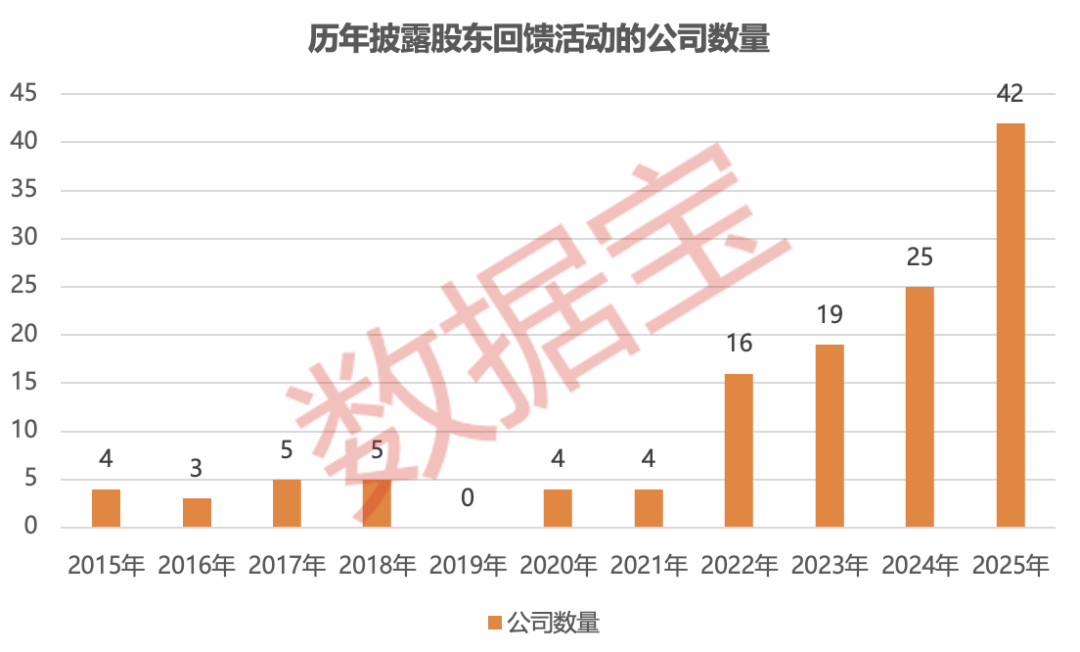
Group 1 - A-share listed companies are actively engaging in shareholder reward activities, with "Hao Xiang Ni" announcing a voluntary information disclosure regarding exclusive purchasing rights for shareholders at discounted prices [1] - Since January 8, "Hao Xiang Ni" has seen its stock price increase by over 20% [1] - The number of companies engaging in shareholder reward activities has reached a historical high, with over 40 companies reported in 2025 alone [2] Group 2 - From 2015 to 2025, nearly 130 companies have disclosed over 140 reward activity announcements, with a noticeable increase since 2022 [2] - The majority of these companies are in the food and beverage, basic chemicals, pharmaceutical and biological, and home appliance industries [2] - In 2025, companies like "Dongbei Pharmaceutical" and "He Shi Eye Hospital" offered exclusive benefits related to their products and services to shareholders [4] Group 3 - The market response to these reward activities has been mixed, but overall, companies involved have outperformed the CSI 300 index [5] - Average stock price increases for companies engaging in reward activities from 2015 to 2025 were 0.8% on the announcement day, with subsequent increases of 0.23%, 0.44%, and 0.47% over the following days [6] - In 2025, companies like "Rongtai Health" and "Emei Mountain A" experienced significant stock price increases following their announcements [7] Group 4 - Companies that have conducted shareholder reward activities since 2025 have seen an average stock price increase of nearly 25%, with some companies like "Haoen Automotive" and "Tian Chuang Fashion" exceeding 100% [8] - Financial forecasts indicate that many companies are expected to achieve profit growth in 2025 and 2026, with some companies like "Xiangyuan Culture" and "Shuiyang Co." projected to have net profit increases exceeding 45% [8] - Ten companies have established future dividend plans, with "Haoen Automotive" committing to distribute at least 10% of their annual distributable profits in cash from 2025 to 2027 [9][10]

中原证券晨会聚焦-20260116
Zhongyuan Securities· 2026-01-16 00:15
Core Insights - The report highlights a downward adjustment in the central bank's re-lending and rediscount rates by 0.25 percentage points, effective January 19, 2026, with the one-year re-lending rate decreasing from 1.5% to 1.25% [4][8] - The report indicates a significant increase in the re-lending quota for technological innovation and transformation, raising it from 800 billion to 1.2 trillion yuan, with a focus on supporting small and medium-sized private enterprises [5][8] - The semiconductor industry is experiencing robust growth, with a 29.8% year-on-year increase in global semiconductor sales in November 2025, marking the 25th consecutive month of growth [19][20] - The gaming industry is steadily growing, with animation films leading box office growth, indicating a strong market demand [26][29] Domestic Market Performance - The Shanghai Composite Index closed at 4,112.60, down 0.33%, while the Shenzhen Component Index closed at 14,306.73, up 0.41% [3] - The average price-to-earnings (P/E) ratios for the Shanghai Composite and ChiNext indices are 16.88 and 53.38, respectively, indicating a favorable long-term investment environment [9][10] International Market Performance - The Dow Jones Industrial Average closed at 30,772.79, down 0.67%, while the S&P 500 and Nasdaq also saw declines of 0.45% and 0.15%, respectively [4] Industry Analysis - The chemical industry is experiencing a slowdown in price declines, with a focus on sectors such as pesticides and polyester filament [15][16] - The semiconductor sector is highlighted for its strong performance, with a 5.11% increase in December 2025, outperforming the broader market indices [18] - The food and beverage sector is under pressure, with a 4.05% decline in December 2025, particularly affecting traditional categories like liquor and meat products [22][23] Investment Recommendations - The report suggests focusing on sectors with strong growth potential, such as technology innovation and traditional industry recovery, while also highlighting opportunities in the semiconductor and gaming industries [9][10][20] - Specific investment opportunities are recommended in the beverage and snack sectors, particularly in companies like Baoli Food and Dongpeng Beverage [24][26]
永赢基金王乾:逆向价值投资,注重安全边际
ZHESHANG SECURITIES· 2026-01-15 07:06
- The investment philosophy of Wang Qian focuses on "selecting the best among the best" through in-depth fundamental research to select companies with clear business models, outstanding competitive advantages, and leading profitability[1][11] - Wang Qian's strategy emphasizes long-term risk-reward ratio and strictly controls the margin of safety, adopting a value contrarian strategy to buy high-quality assets at reasonable prices, especially good at deploying high-quality targets in the bottom areas of the industry[1][11] - The core strategy of "bottom assets + diversified portfolio" is used to control drawdowns, which involves contrarian deployment of undervalued high-quality assets to obtain natural safety margins and achieving effective smoothing of volatility through industry diversification and moderate concentration of individual stocks[1][11]
1月14日生物经济(970038)指数涨0.43%,成份股英科医疗(300677)领涨
Sou Hu Cai Jing· 2026-01-14 10:23
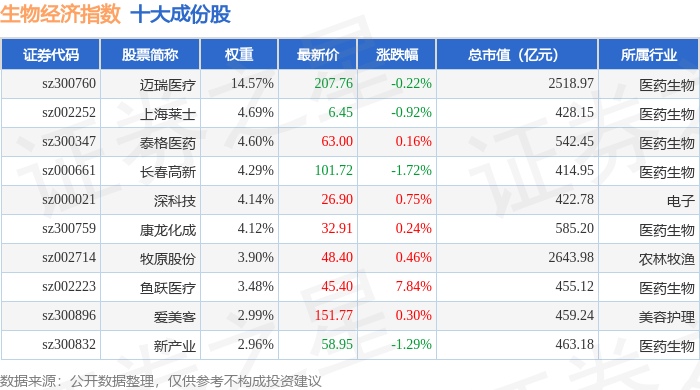
Group 1 - The Biotech Index (970038) closed at 2322.86 points, up 0.43%, with a total transaction volume of 50.71 billion yuan and a turnover rate of 3.77% [1] - Among the index constituents, 23 stocks rose, with Yingke Medical leading at an 8.37% increase, while 27 stocks fell, with Dabo Medical leading the decline at 3.28% [1] - The top ten constituents of the Biotech Index include major companies such as Mindray Medical, which has a weight of 14.57% and a market capitalization of 251.90 billion yuan, and Yuyue Medical, which has a weight of 3.48% and a market capitalization of 45.51 billion yuan [1] Group 2 - The net outflow of main funds from the Biotech Index constituents totaled 643 million yuan, while retail investors saw a net inflow of 771 million yuan [1] - Detailed fund flow data indicates that Yuyue Medical had a net inflow of 35.6 million yuan from main funds, while it experienced a net outflow of 66.06 million yuan from retail investors [2] - Mindray Medical saw a net inflow of 13.7 million yuan from main funds, with retail investors experiencing a net outflow of 36.97 million yuan [2]




当政策红利遇上消费刚需 中证主要消费指数如何成为行业压舱石?
Sou Hu Cai Jing· 2026-01-14 06:27
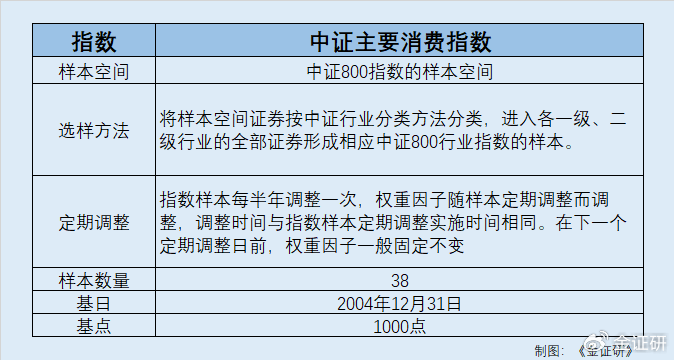
Group 1 - The core viewpoint of the article emphasizes the importance of policies aimed at boosting consumption, highlighting the collaboration between business and financial sectors to enhance consumer spending [1][2] - The China Securities Major Consumption Index, which focuses on the consumption sector, has an average free float market capitalization exceeding 600 billion yuan, reflecting the overall performance of major consumption stocks in the A-share market [2][3] - The index includes 38 sample stocks, with a free float market capitalization ranging from 36.47 billion yuan to 8,885.48 billion yuan, indicating significant growth potential in the consumption sector [2][4] Group 2 - The index is heavily concentrated in the food and beverage sector, with a weight of 67.62%, and agriculture, forestry, animal husbandry, and fishery at 28.42%, together covering over 96% of the index's weight [4][5] - The top ten stocks in the index are supported by leading companies such as Kweichow Moutai, Yili, and Wuliangye, which have strong brand recognition and stable cash flows [5][6] - The ongoing policy support for consumption is expected to enhance the long-term value and growth potential of the consumption sector, making the China Securities Major Consumption Index a quality benchmark for investing in core consumption assets [7]





中原证券晨会聚焦-20260114
Zhongyuan Securities· 2026-01-14 00:27
Key Insights - The report highlights the ongoing recovery in the A-share market, with a focus on sectors such as gaming, healthcare, and energy metals showing strong performance [5][8][9] - The semiconductor industry is experiencing significant growth, with a notable increase in global sales and rising prices for memory products, driven by AI demand [14][15][16] - The food and beverage sector is facing challenges, particularly in traditional categories like liquor, while emerging segments like snacks and health products are performing better [18][19][21] - The gaming industry is steadily growing, with animation films leading box office revenues, indicating a robust demand for content [22][24] Domestic Market Performance - The A-share market has shown slight fluctuations, with the Shanghai Composite Index closing at 4,138.76, down 0.64% [3] - The average P/E ratios for the Shanghai Composite and ChiNext are 17.02 and 53.91, respectively, indicating a favorable long-term investment environment [5][9] - Trading volumes have increased, with a total turnover of 36,991 billion yuan, suggesting heightened market activity [5][9] Industry Analysis - The semiconductor sector saw a 5.11% increase in December 2025, outperforming the broader market, with significant growth in integrated circuits and semiconductor equipment [14] - The food and beverage industry experienced a 4.05% decline in December, with traditional categories underperforming while new categories showed resilience [18][19] - The gaming sector is projected to continue its growth trajectory, supported by strong demand for animated films and innovative gaming experiences [22][24] Investment Recommendations - Focus on sectors with strong fundamentals such as technology and traditional industries, particularly in healthcare, gaming, and energy metals [5][9] - In the semiconductor space, consider investing in companies involved in memory production and AI-related technologies, as demand is expected to rise [14][15][16] - For the food and beverage sector, look towards emerging categories like health products and snacks, which are expected to perform better in the current market environment [21]