
机械

Search documents
九号公司(689009):短交通为基、机器人为翼,成长为智慧生态级玩家
Great Wall Securities· 2025-07-11 11:35
Investment Rating - The report initiates coverage with a "Buy" rating for the company [5][6]. Core Viewpoints - The company is positioned as a comprehensive player in the smart short transportation and robotics sectors, focusing on simplifying the movement of people and goods through a platform-based business ecosystem [2][13]. - The electric two-wheeler segment has become the main revenue driver, accounting for 51% of total revenue, with significant growth expected from the lawn mowing and all-terrain vehicle segments [2][5]. Financial Summary - Revenue projections show a strong growth trajectory, with expected revenues of 10,222 million in 2023, increasing to 32,366 million by 2027, reflecting a CAGR of 23.9% [1]. - Net profit is projected to grow from 598 million in 2023 to 3,245 million by 2027, with a CAGR of 34.3% [1]. - The company’s return on equity (ROE) is expected to improve from 10.8% in 2023 to 23.7% in 2027 [1]. Business Segments Electric Two-Wheelers - The company leads the high-end smart electric two-wheeler market, with over 600,000 units sold in 2024, capturing the top tier of the market priced above 4,000 yuan [3][5]. - The implementation of new national standards is expected to benefit leading manufacturers with strong R&D capabilities, allowing the company to consolidate its market position [3][43]. Robotics - The company is expanding into the robotics sector, with products like lawn mowing and delivery robots, leveraging its existing technological expertise [4][5]. - The global market for lawn mowing robots is projected to exceed 300 billion, with the company’s Navimow brand expected to reach 100,000 households by 2024 [4][5]. Market Trends - The demand for electric two-wheelers is shifting towards high-end and smart features, with 83.7% of consumers prioritizing smart functionalities in their purchasing decisions [49][50]. - The overall market for electric two-wheelers in China is expected to grow steadily, with a projected sales volume of 49.2 million units in 2024 [43][45]. Investment Recommendations - The company is expected to achieve revenues of 202.81 billion, 261.17 billion, and 323.66 billion in 2025, 2026, and 2027 respectively, with corresponding net profits of 17.96 billion, 24.17 billion, and 32.45 billion [5][6].
由创新高个股看市场投资热点
量化藏经阁· 2025-07-11 09:09
Group 1 - The report tracks stocks, industries, and sectors that are reaching new highs, indicating market trends and hotspots [1][4] - As of July 11, 2025, the distance to the 250-day new high for major indices is as follows: Shanghai Composite Index 0.00%, Shenzhen Component Index 6.95%, CSI 300 5.67%, CSI 500 4.79%, CSI 1000 2.28%, CSI 2000 0.00%, ChiNext Index 13.46%, and STAR Market 11.75% [5][24] - The sectors closest to their 250-day new highs include Power and Utilities, Steel, Comprehensive Finance, Pharmaceuticals, and Non-ferrous Metals, while Food and Beverage, Coal, Consumer Services, Automotive, and Oil and Petrochemicals are further away [8][24] Group 2 - A total of 873 stocks reached a 250-day new high in the past 20 trading days, with the most significant numbers in Basic Chemicals, Machinery, and Pharmaceuticals [2][13] - The highest proportion of new high stocks is found in Banking, Comprehensive Finance, and National Defense and Military Industry, with respective proportions of 90.48%, 40.00%, and 33.61% [13] - The manufacturing and cyclical sectors had the most new high stocks this week, with 245 and 233 stocks respectively [15] Group 3 - The report identifies 38 stocks that are considered stable new highs, including Shenghong Technology, Beijing North, and Nanhua Futures, with the most in the Manufacturing and Technology sectors [3][21] - The Manufacturing sector had the highest number of new highs, particularly in the National Defense and Military Industry, while the Technology sector saw the most in the Electronics industry [21][25]


提升首位度,“弱首府”南宁如何扛重任?
Sou Hu Cai Jing· 2025-07-11 02:25
Group 1 - The core message emphasizes the importance of Nanning as the capital of Guangxi, highlighting its role in driving regional development and the need to enhance its economic stature [2][3] - Nanning's GDP for 2024 is projected at 599.54 billion, with an economic prominence index of 20.9%, ranking 23rd among 27 provincial capitals [3] - The focus on advanced manufacturing, particularly in the new energy sector, is underscored, with plans to develop a comprehensive new energy vehicle industry cluster in Nanning [3][4] Group 2 - The "Strong Capital" strategy initiated in 2019 aims to bolster Nanning's industrial capabilities, addressing its industrial shortcomings [3] - Key enterprises such as Guangxi Fudi Battery Co., Ltd. and Nanning Sun Paper Industry Co., Ltd. are identified as core drivers of industrial growth, with a combined output value of 20.79 billion in 2024 [3] - The recent "Beautiful Nanning (Green City) Construction Planning Outline (2024-2035)" aims to enhance the development of strategic emerging industries, including new energy and advanced manufacturing [3]

向海外市场要空间、以技术革命拓成长——机械行业2025年度中期投资策略
2025-07-11 01:13
Summary of Key Points from the Conference Call Industry Overview - The conference call focuses on the machinery industry, highlighting the importance of both domestic and overseas markets for growth opportunities [1][2]. Core Insights and Arguments - **Domestic Demand Stabilization**: The general equipment sector is stabilizing, and if combined with an increase in external demand, it presents a favorable investment direction [1][5]. - **Overseas Factory Construction**: In the medium to long term, building factories overseas will become a significant driver of equipment demand, leading to marginal changes in demand structure [1][2][5]. - **Emerging Technologies**: New technology sectors such as solid-state batteries, humanoid robots, and controlled nuclear fusion are expected to have substantial capacity and ongoing marginal changes, indicating investment opportunities in the second half of the year [1][2][10]. - **Learning from Japan**: The call references Japan's experience in finding growth through exports during economic downturns, suggesting that Chinese companies can similarly benefit from diversifying supply chains and seeking overseas markets [3][4]. - **Oil Extraction Equipment Spending**: The oil extraction industry is projected to see long-term growth in equipment spending over the next three to five years, particularly in the Middle East, creating revenue opportunities for Chinese companies like Nuway and Jereh [6]. - **Manufacturing Extension**: The extension of manufacturing into upstream processes will drive demand for equipment in the steel and chemical industries, marking a long-term development direction worth monitoring [7]. Additional Important Insights - **Impact of Global Tariffs**: The global tariff situation has led to significant changes in production capacity locations, with regions that have a solid manufacturing base, abundant resources, and good infrastructure becoming potential manufacturing hubs [4]. - **Digital Printing Industry**: Changes in domestic demand structures are expected to enhance the penetration rate of the digital printing industry, although overall market elasticity remains limited [8]. - **Stock Selection Criteria**: When selecting stocks, focus should be on cyclical positioning, overseas competitive landscape, and valuation. Stocks that are stabilizing at the bottom and have overseas expansion potential are particularly promising [9]. - **Trends in Solid-State Batteries and Humanoid Robots**: The solid-state battery industry is driven by policy and industry chain dynamics, while humanoid robots present opportunities in core components and application scenarios [10]. This summary encapsulates the key points discussed in the conference call, providing a comprehensive overview of the machinery industry's current landscape and future opportunities.
杰克股份(603337):全球工业缝纫机龙头,引领产业智能化、无人化趋势
CMS· 2025-07-10 09:51
Investment Rating - The report gives a "Strong Buy" investment rating for the company [1][9]. Core Insights - The industrial sewing machine industry exhibits significant cyclicality, with Jack's performance surpassing the industry in each upcycle, establishing itself as a global leader. The company is expected to continue increasing its market share through superior product capabilities and is actively promoting automation and unmanned transformation, indicating substantial growth potential [1][6][9]. Summary by Sections Industrial Sewing Machine Industry: Cyclical Fluctuations and Demand Divergence - The industrial sewing machine industry in China has experienced two phases: a growth phase from 1999 to 2007 and a cyclical phase from 2008 to present. The current cycle began to recover in Q3 2023, with production expected to reach 6.85 million units in 2024, a year-on-year increase of 22.32% [6][14]. - Domestic demand is anticipated to face pressure in 2025, while overseas markets are expected to remain supported by inventory replenishment and supply chain restructuring [6][24]. Jack's Competitive Positioning - Jack is the global leader in the industrial sewing machine market, with a market share exceeding 30%. The company has successfully implemented a "fast response king" and "over梗 king" product strategy, focusing on high-demand products to enhance efficiency and profitability [6][32][52]. - The average selling price of Jack's industrial sewing machines is projected to rise from 2,195.6 yuan/unit in 2021 to 2,481.7 yuan/unit in 2024, contributing to an increase in gross margin from 23% to 31.28% during the same period [6][38]. Future Trends and Innovations - Jack is at the forefront of the trend towards automation and unmanned production in the sewing industry, addressing labor shortages and enhancing digital transformation. The company has launched a digital integrated solution and is exploring unmanned solutions to facilitate machine replacement for human labor [7][55][60]. - The introduction of high-end AI sewing machines and robotic systems is expected to further solidify Jack's competitive edge and open new growth avenues [7][61]. Financial Data and Valuation - Projected total revenue for Jack is expected to reach 71.64 billion yuan in 2025, with a year-on-year growth of 18%. The net profit attributable to shareholders is forecasted to be 9.73 billion yuan, reflecting a 20% increase [8][9]. - The company's PE ratio is projected to decrease from 30.9 in 2023 to 17.1 in 2025, indicating an attractive valuation as the company continues to grow [8][9].

中原证券晨会聚焦-20250710
Zhongyuan Securities· 2025-07-10 01:43
Core Insights - The report highlights the steady progress of the "14th Five-Year Plan" with 102 major projects advancing smoothly, indicating positive economic growth and productivity metrics [4][8] - China's CPI rose by 0.1% in June, marking a turnaround after four months of decline, while PPI fell by 3.6%, indicating mixed inflationary pressures [5][8] - The financial and media sectors are leading the A-share market amidst slight fluctuations, with a focus on consumer and dividend assets for stable growth [6][8] Domestic Market Performance - The Shanghai Composite Index closed at 3,493.05, down 0.13%, while the Shenzhen Component Index closed at 10,581.80, down 0.06% [3] - The average P/E ratios for the Shanghai Composite and ChiNext are at 14.37 and 38.95, respectively, suggesting a favorable environment for medium to long-term investments [8][13] International Market Performance - The Dow Jones closed at 30,772.79, down 0.67%, while the S&P 500 and Nasdaq also experienced declines of 0.45% and 0.15%, respectively [4] Industry Analysis - The communication sector outperformed the market with a 13.15% increase in June, driven by a rise in telecom business volume and 5G user adoption [15] - The solar energy sector saw a record high in new installations, with 92.92 GW added in May, reflecting a 388.03% year-on-year increase [20][21] - The semiconductor industry continues to show growth, with global sales increasing by 22.7% year-on-year in April 2025 [24] Investment Recommendations - The report maintains a "stronger than market" rating for the communication sector, suggesting investments in optical communication, telecom operators, and AI-enabled smartphones [18] - In the solar energy sector, it is recommended to focus on leading companies in polysilicon and photovoltaic glass as the market undergoes a clearing phase [22] - The machinery sector is advised for investment, particularly in traditional engineering machinery and emerging technologies like humanoid robots and AIDC [35][36]
贸易逆差还被征50%,卢拉誓言反击,巴西资产重挫
Hua Er Jie Jian Wen· 2025-07-10 00:37
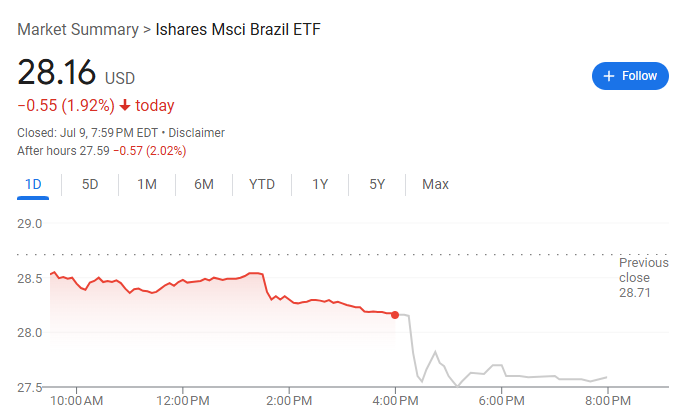
Core Viewpoint - Trump's decision to impose a 50% tariff on Brazilian goods escalates trade tensions between the U.S. and Brazil, leading to a significant drop in Brazilian assets [1][2]. Group 1: Market Reaction - Brazilian assets experienced a sharp sell-off, with the Brazilian real falling nearly 3% against the dollar and the largest U.S.-listed ETF tracking Brazilian stocks dropping nearly 2% in after-hours trading [2][3]. - The American Depositary Receipts of Embraer, a key Brazilian exporter to the U.S., plummeted by 9% in after-hours trading [6]. Group 2: Impact on Key Industries - The 50% tariff is expected to severely impact several critical export sectors in Brazil, including steel products, transportation equipment (mainly aircraft and parts), specialized machinery, and non-metallic minerals [6][8]. - Analysts express concerns that these tariffs could render exports unfeasible, indicating a deterioration in the overall institutional relationship between the two countries [6]. Group 3: Political Context - The tariff decision is politically charged, linking it to the judicial proceedings against former Brazilian President Bolsonaro, which Trump claims is a form of political persecution [7]. - The historical partnership between the U.S. and Brazil may be at risk due to this decision, despite differing ideologies of their current leaders [7]. Group 4: Trade Dynamics - The U.S. is Brazil's second-largest trading partner, and the imposition of such high tariffs could have significant repercussions on Brazil's economy, which currently has a trade deficit with the U.S. [8]. - In 2024, Brazil is projected to import approximately $44 billion worth of U.S. products while exporting around $42 billion, contrasting with other countries that have faced similar tariffs [8].
国泰海通|海外策略:Q2外围波折下外资撤离了吗——2025Q2股市外资季度动向跟踪
国泰海通证券研究· 2025-07-09 14:38
Group 1 - The core viewpoint of the article indicates that foreign capital experienced accelerated outflows from Hong Kong stocks in April and May, but began to return in June, primarily flowing into the technology sector [1] - In Q2, Hong Kong stocks saw an overall outflow of approximately 150 billion HKD, with long-term stable foreign capital accounting for a significant portion of this outflow, totaling around 120 billion HKD, while short-term flexible foreign capital contributed to an outflow of about 30 billion HKD [1] - The article highlights that in Q2, foreign capital mainly flowed into software services and technology hardware sectors in Hong Kong, while it saw outflows from banks, retail, and pharmaceutical sectors [1] Group 2 - For A-shares, the data from the Northbound trading indicates an overall inflow of 58.5 billion CNY in Q2, with a net inflow of approximately 11.4 billion CNY after excluding Chinese custodial funds [1] - Long-term stable foreign capital in A-shares saw an inflow of 51 billion CNY, while short-term flexible foreign capital experienced an outflow of 39.5 billion CNY [1] - The article notes that foreign capital in A-shares primarily increased its allocation to dividend stocks, new energy, and non-bank sectors, while reducing allocations in home appliances, food and beverage, and machinery sectors [1]

长龄液压再谋易主股价提前两跌停 净利四连降夏继发父子急切脱手
Chang Jiang Shang Bao· 2025-07-08 22:52
Core Viewpoint - The actual controllers of Changling Hydraulic, Xia Jifa and Xia Zemin, are planning to transfer the company's control for the second time within six months due to poor business performance and declining profits [1][4][6]. Group 1: Control Transfer Plans - On July 3, Changling Hydraulic announced that its actual controllers are planning a significant matter that may lead to a change in control, resulting in a stock suspension starting July 4 [2][3]. - This is the second time this year that the company has planned a control transfer, with the first attempt in January ending in failure due to disagreements on core terms with the potential buyer [4][5]. - If the current control transfer is completed, it is expected that nearly 30% of the shares will be transferred, potentially allowing the controllers to cash out approximately 1.6 billion yuan based on the last trading price of 38.21 yuan per share [5]. Group 2: Business Performance - Since its listing in 2021, Changling Hydraulic has experienced a decline in both revenue and net profit, with net profit decreasing for four consecutive years from 2021 to 2024 [6][7]. - The company's revenue figures from 2021 to 2024 show slight fluctuations, with net profits dropping significantly: 2.02 billion yuan in 2021 to 0.95 billion yuan in 2024, reflecting a decline of 14.56% to 6.84% year-on-year [7]. - In the first quarter of 2023, the company reported a revenue of 2.19 billion yuan and a net profit of 0.31 billion yuan, both showing year-on-year declines [7]. Group 3: Acquisition Attempts - In 2023, Changling Hydraulic attempted to diversify into the photovoltaic sector by acquiring a 70% stake in Jiangyin Shangchi Machinery for 336 million yuan, but the acquisition has not yielded significant results [8][9]. - The acquired company, Jiangyin Shangchi, had previously achieved notable revenue and profit figures, but Changling Hydraulic's performance post-acquisition has been disappointing, with the acquired entity failing to meet its profit commitments in 2024 [10]. Group 4: Financial Health - The company's accounts receivable have increased, reaching 409 million yuan by the end of the first quarter of this year, a year-on-year increase of 22.09%, while revenue has been declining [11].

资本市场“向新力”指标再升级 六只专精特新主题指数构建梯度培育新格局
Zheng Quan Ri Bao· 2025-07-08 16:08
Core Viewpoint - The launch of multiple specialized and innovative theme indices by the Shanghai Stock Exchange, Shenzhen Stock Exchange, and Beijing Stock Exchange marks a new phase in capital market support for technological innovation, aiming to enhance resource allocation efficiency towards "hard technology" enterprises and signal strong support for technological self-reliance [1][2][3]. Group 1: Specialized and Innovative Enterprises - Over 140,000 specialized and innovative small and medium-sized enterprises have been cultivated in China, including 14,600 "little giant" enterprises [2]. - As of July 8, 2023, there are 1,347 specialized and innovative enterprises listed in the A-share market, covering key industries such as machinery, electronics, and biomedicine [2]. - The proportion of specialized and innovative enterprises among new listings is increasing, reaching 36% in 2023, 41% in 2024, and projected at 43% from 2025 onwards [2]. Group 2: Index Characteristics and Impact - The newly launched indices include the Shanghai Stock Exchange's specialized and innovative indices, which select large companies with significant market capitalization and R&D spending, reflecting the performance of specialized and innovative enterprises [4][5]. - The indices are designed to attract long-term capital and improve the liquidity of specialized and innovative enterprises, with the potential to enhance their market valuation [8][9]. - The indices are expected to facilitate the development of passive investment products like ETFs, thereby improving market structure and guiding capital towards policy-supported sectors [8][9]. Group 3: Market Structure and Investment Tools - The introduction of specialized and innovative indices is seen as a practical measure to enhance the capital market's role in supporting the real economy and fostering high-quality development of innovative SMEs [8]. - The indices are characterized by strong innovation attributes, broad industry coverage, and a high proportion of private enterprises, aligning with national strategic needs [6]. - The indices are anticipated to improve liquidity, enhance the efficiency of enterprise value discovery, and optimize market structure by guiding capital towards "hard technology" enterprises [8][9].